Why the Y-Intercept is B: Understanding Linear Equations
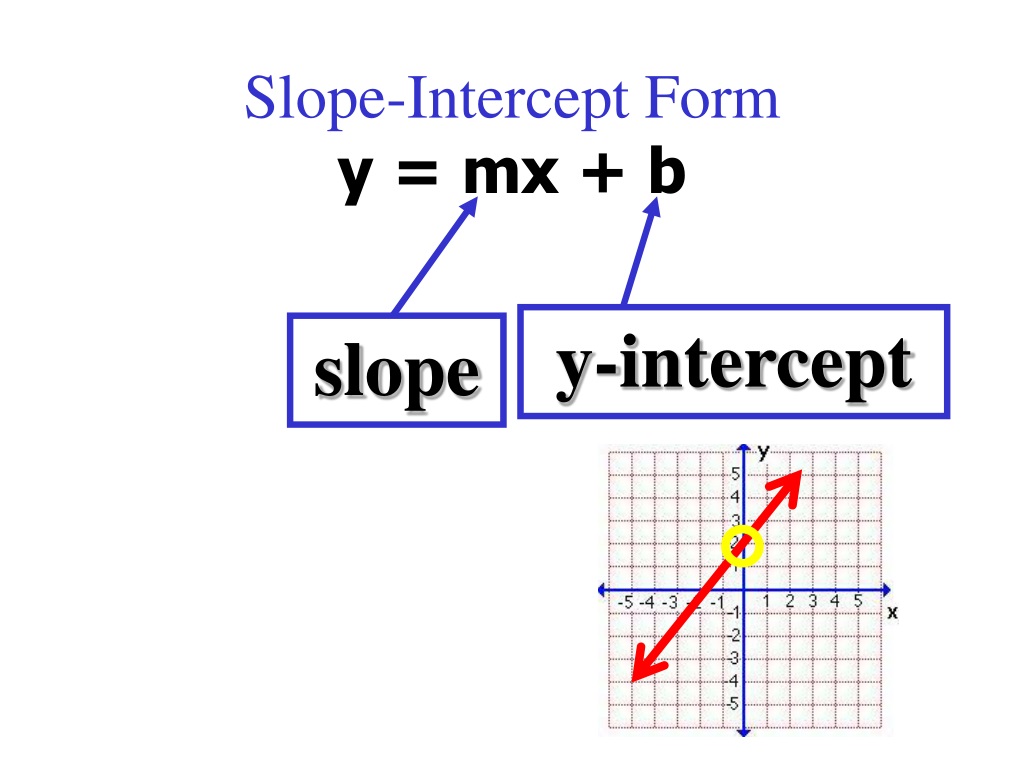
The y-intercept is represented by the variable b in the slope-intercept form of a linear equation, y = mx + b, because it identifies the precise vertical coordinate where a line crosses the y-axis. At this specific point, the horizonta...
The y-intercept is represented by the variable b in the slope-intercept form of a linear equation, y = mx + b, because it identifies the precise vertical coordinate where a line crosses the y-axis. At this specific point, the horizontal input (x) is zero, which mathematically isolates the constant term b, effectively serving as the starting value or "baseline" for the function.
Contents
The Anatomy of the Linear Equation
To understand why b holds the title of the y-intercept, we must first deconstruct the equation y = mx + b. This is the most common way to represent a linear relationship in algebra. In this formula, each letter serves a distinct purpose in describing the behavior of a straight line on a Cartesian coordinate system.
- y: This represents the dependent variable, or the output. Its value changes based on the input.
- x: This represents the independent variable, or the input.
- m: This is the slope, or the rate of change. It tells you how steep the line is and whether it tilts upward or downward.
- b: This is the y-intercept, the point where the line intersects the vertical axis.
The beauty of this equation lies in its simplicity. When you graph a line, you are mapping out an infinite series of coordinate pairs (x, y). Because a straight line is defined by its constant rate of change and its specific position in space, these two parameters—m and b—are all that is required to define any non-vertical line on a 2D plane.
The Mathematical Proof: Why X equals Zero
The reason b is called the y-intercept is rooted in the rules of the coordinate plane. On a standard Cartesian graph, the vertical axis is the y-axis, and the horizontal axis is the x-axis. Any point that lies directly on the y-axis must have an x-coordinate of zero because it has not moved left or right from the center origin.
If we take the equation y = mx + b and substitute 0 for x, the equation becomes: y = m(0) + b
Since any number multiplied by zero is zero, the term mx disappears: y = 0 + b y = b
This confirms that when the input (x) is zero, the output (y) is exactly equal to b. This makes b the "starting point" of the line. If you are looking at a graph and want to find b quickly, you simply look at where the line hits the vertical axis. If the line crosses the y-axis at 5, then your b value is 5.
Slope-Intercept Form vs. Other Representations
While y = mx + b is the most popular, it is not the only way to write a linear equation. Other forms include standard form (Ax + By = C) and point-slope form (y - y1 = m(x - x1)). Each has its utility, but slope-intercept is favored for graphing precisely because b provides an immediate, tangible anchor point.
In standard form, A and B are coefficients that do not immediately reveal the slope or the intercept. To find the intercept in standard form, you must algebraically rearrange the equation to isolate y. Once you do that, you are essentially converting it back into the y = mx + b structure, which proves that the slope-intercept form is the "source code" for understanding the visual behavior of a line.
Practical Applications of the Y-Intercept
The constant b represents more than just a coordinate on a grid; in real-world modeling, it represents the initial condition or the fixed cost of a scenario.
Consider a scenario where a technician charges a flat service fee plus an hourly rate.
- The hourly rate is your slope (m), as it changes depending on the time spent.
- The service fee is your y-intercept (b), because you pay it even if the technician works for zero hours (at the start).
In this context, if the service fee is $50, your equation becomes y = mx + 50. Even if the variable cost (mx) is zero, the baseline cost remains $50. This demonstrates why b is essential in economics, physics, and engineering—it defines the "starting value" before any variable change takes place.
Comparison Table: Understanding Variables in y = mx + b
| Component | Term | Definition | Role in Graphing |
|---|---|---|---|
| m | Slope | The rate of change | Determines steepness and direction |
| x | Independent Variable | The input value | Moves the point left or right |
| y | Dependent Variable | The output value | Moves the point up or down |
| b | Y-Intercept | The vertical crossing point | Sets the baseline where x = 0 |
Common Misconceptions
One frequent error students make is confusing the y-intercept with the x-intercept. The x-intercept is the point where the line crosses the horizontal axis. To find the x-intercept, you set y to zero and solve for x. This results in 0 = mx + b, which simplifies to x = -b/m. Unlike the y-intercept, which is clearly identified by the constant b, the x-intercept requires a two-step calculation involving both m and b.
Another confusion stems from the sign of b. If an equation is written as y = 2x - 3, the y-intercept is -3, not 3. The form is technically y = mx + b, so y = 2x + (-3). Always include the sign attached to the constant when identifying the intercept.
Frequently Asked Questions
What happens if b is zero? If b is zero, the equation becomes y = mx. This means the line passes directly through the origin (0, 0). Such equations are referred to as direct variations, where the output is directly proportional to the input.
Can the y-intercept be a negative number? Yes. A negative y-intercept simply means the line crosses the y-axis below the x-axis. It functions exactly the same way mathematically but represents a starting value that is below zero, such as a depth measurement or a debt.
How do I find b if I only have the slope and one point? You can plug the coordinates of your known point (x, y) and your slope (m) into the equation y = mx + b and solve for b. For example, if your slope is 2 and the line passes through (1, 5), then 5 = 2(1) + b, which means 5 = 2 + b, so b = 3.
Does every line have a y-intercept? Nearly every linear function has a y-intercept. The only exception is a vertical line. A vertical line has an undefined slope and follows the format x = a. Because it runs parallel to the y-axis, it will never cross it unless the line is the y-axis itself (which is x = 0).
Why is it called the "Intercept"? The word "intercept" comes from Latin, meaning to "catch" or "come between." In geometry, it refers to the point where a line cuts across or catches an axis. Since b is the value that coincides with the vertical axis, it is the y-intercept.
Final Next Steps for Mastery
To fully grasp linear equations, practice converting equations from standard form to slope-intercept form. Take equations such as 2x + 4y = 8 and solve them for y. You will find that 4y = -2x + 8, which simplifies to y = -0.5x + 2. Identifying the y-intercept (b = 2) immediately provides you with a point to plot on your graph. Once you have your intercept, use the slope to "rise and run" to the next point. This workflow is the standard professional method for visualizing linear relationships efficiently.
Image Gallery