Mastering Off-Roading Tire Pressure: The Ultimate Guide for 2026
Adjusting your tire pressure is the single most effective modification you can make for off-road performance. By lowering your PSI (pounds per square inch), you increase the tire's contact patch, which significantly improves traction o...
Adjusting your tire pressure is the single most effective modification you can make for off-road performance. By lowering your PSI (pounds per square inch), you increase the tire's contact patch, which significantly improves traction on soft surfaces like sand and mud, provides better "wrap" over obstacles like rocks, and enhances ride comfort by allowing the tires to absorb trail vibrations.
Contents
The Science Behind Airing Down
To understand why adjusting off-roading tire pressure is essential, one must look at the physics of the tire’s footprint. When a tire is inflated to its recommended street pressure—typically between 30 and 38 PSI for most modern SUVs and light trucks—the contact patch is relatively small and optimized for fuel efficiency and heat dissipation at high speeds. This high pressure keeps the tire's carcass rigid.
When you "air down," you allow the tire's sidewalls to flex and the tread area to elongate. This creates a larger surface area in contact with the ground. In technical terms, this reduces the ground pressure (the weight of the vehicle divided by the area of the contact patch). On soft terrain like silt or deep sand, lower ground pressure prevents the vehicle from digging in and becoming high-centered. Instead, the vehicle "floats" on top of the surface.
Furthermore, lower pressure allows the tire to act as a secondary suspension system. On washboard roads or rocky trails, a stiff tire transmits every vibration through the suspension to the passengers. A softer tire deforms around small rocks and corrugations, absorbing the energy before it reaches the chassis. This not only improves comfort but also reduces mechanical wear on suspension components like bushings and ball joints.
Recommended Tire Pressures by Terrain
There is no "one size fits all" number for off-roading. The ideal pressure depends on your vehicle's weight, the tire's load rating (e.g., Load Range C vs. E), and the specific terrain you are traversing. In 2026, many off-roaders use specialized software or integrated vehicle sensors to calculate these variables, but the fundamental principles remain the same.
Sand and Deep Silt
Sand requires the lowest possible pressure to maximize flotation. For most vehicles, this means dropping to 10–15 PSI. At these levels, the tire creates a long, "tank-tread" style footprint. If you find yourself struggling to maintain momentum in dunes, dropping another 2-3 PSI can make a massive difference. However, caution is required; turning sharply at very low pressures can cause the tire bead to pop off the rim.
Rock Crawling
Navigating jagged rocks or technical trails requires a balance between traction and ground clearance. A pressure range of 12–18 PSI is generally ideal. This allows the tire to "key" or wrap itself around the edges of rocks, providing mechanical grip that a high-pressure tire cannot achieve. Lowering the pressure too much in rocks can be risky, as it reduces your overall ground clearance and leaves your wheel rims vulnerable to "rock rash" or structural damage.
Mud and Clay
Mud performance is a bit more nuanced. While you want a larger footprint, you also need the tire's lugs to "clean" themselves as they spin. Pressures between 15–20 PSI are usually effective. This provides enough flotation to keep you from sinking while maintaining enough internal tension in the tire carcass to help fling mud out of the tread blocks.
Gravel and Washboard Roads
For high-speed dirt roads or "overlanding" style travel, you don't need rock-crawling pressures. Dropping to 22–28 PSI is often sufficient. This "semi-aired-down" state softens the ride significantly and reduces the risk of sharp gravel puncturing the tread, as the more flexible surface can deflect around the stone rather than being pierced by it.
The Risks of Low Tire Pressure
While the benefits are significant, operating at low PSI introduces specific mechanical risks that every driver must manage.
- Bead Failure: The "bead" is the edge of the tire that sits in the groove of the wheel rim, held in place by internal air pressure. When that pressure is too low, lateral forces (like a sharp turn) can pull the bead away from the rim, causing an instant loss of all remaining air.
- Sidewall Vulnerability: As the tire compresses, the sidewalls bulge outward. Sidewalls are the thinnest and most vulnerable part of a tire. Airing down exposes more of the sidewall to sharp rocks and sticks, increasing the risk of a non-repairable puncture.
- Heat Buildup: Tires are designed to dissipate heat through their structure. At low pressures, the constant flexing of the sidewall generates significant internal heat. If you drive too fast on pavement or hard-packed dirt with low PSI, the heat can cause the tire's internal layers to delaminate, leading to a catastrophic blowout.
- Reduced Ground Clearance: Physics dictates that as the tire flattens, the axle moves closer to the ground. In high-clearance technical sections, a few PSI can be the difference between clearing a differential-breaker rock and getting stuck.
Essential Equipment for Pressure Management
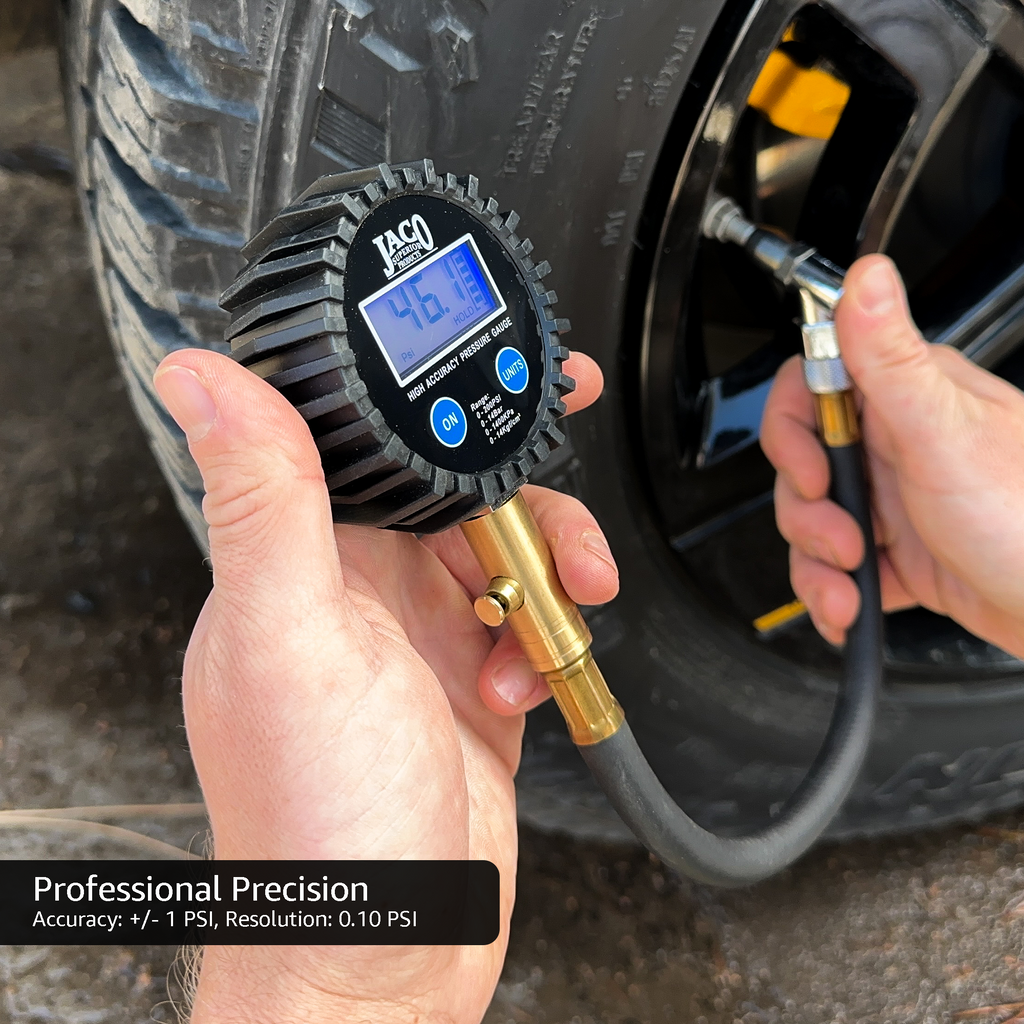
To manage your pressure effectively in the field, you need more than just a standard gas station gauge. By 2026, the market has standardized around several high-efficiency tools.
Deflators
While you can use a stick or a key to depress the Valve Stem, dedicated deflators are faster and more accurate. Rapid deflators remove the valve core entirely while holding it captive, allowing air to escape at maximum velocity. Many modern versions allow you to preset a desired PSI, so the airflow stops automatically when the target is reached.
Portable Air Compressors
Airing down is easy; airing back up is the challenge. High-output 12V compressors that connect directly to your vehicle's battery are the industry standard. For 2026, many enthusiasts have moved toward brushless motor compressors which offer higher "duty cycles" (the amount of time they can run before needing to cool down).
Beadlock Wheels
For those who consistently run pressures below 10 PSI, beadlock wheels are a critical upgrade. These wheels use a mechanical ring to bolt the tire's bead to the rim, preventing it from slipping or popping off regardless of how low the pressure goes. Note that some beadlock designs are strictly for off-road use and may not be DOT-approved for highway travel in all jurisdictions.
| Terrain Type | Recommended PSI (Standard) | Recommended PSI (Beadlocks) | Max Recommended Speed |
|---|---|---|---|
| Pavement/Highway | 30–35 PSI | 30–35 PSI | Speed Limit |
| Gravel/Dirt Roads | 22–28 PSI | 22–28 PSI | 45 MPH / 72 KMH |
| Mud/Slick Trails | 15–20 PSI | 12–16 PSI | 25 MPH / 40 KMH |
| Technical Rocks | 12–18 PSI | 5–10 PSI | 10 MPH / 16 KMH |
| Deep Sand/Silt | 10–15 PSI | 4–8 PSI | 15 MPH / 24 KMH |
Step-by-Step Guide to Managing Pressure
- Assess the Terrain: Don't air down the moment you leave the pavement if you have 50 miles of easy graded dirt ahead. Wait until you reach the section where traction or comfort becomes an issue.
- Find a Level Surface: If possible, air down on flat ground. This ensures the weight is distributed evenly across all four tires for accurate gauge readings.
- Check Your Spare: Never air down unless you have verified that your spare tire is at full street pressure and in good condition.
- Air Down in Stages: If you are unsure of the ideal pressure, start at 20 PSI. Test the vehicle's performance. If you are still spinning wheels or the ride is too harsh, drop in 2-3 PSI increments.
- Monitor Your TPMS: Many 2026 model-year vehicles have "Off-Road Modes" that recalibrate the Tire Pressure Monitoring System (TPMS) so the dashboard warning lights don't stay illuminated at low pressures.
- Re-inflate Before the Highway: This is the most critical safety step. Driving at highway speeds on low-pressure tires is extremely dangerous and will ruin your tires within miles. Always use your compressor to return to the manufacturer's recommended street pressure before hitting the asphalt.
Frequently Asked Questions
Can I air down with standard factory tires?
Yes, you can air down factory-equipped tires, but you must be more conservative than you would be with dedicated All-Terrain (AT) or Mud-Terrain (MT) tires. Factory tires often have thinner sidewalls (2-ply) compared to off-road tires (3-ply or higher). For factory tires, it is generally recommended not to go below 18–20 PSI to avoid sidewall damage or bead failure.
Does airing down affect fuel economy?
Significantly. Lowering tire pressure increases rolling resistance. While this is necessary for traction off-road, it will cause your engine to work harder and consume more fuel. This is another reason why you should only air down when necessary and re-inflate as soon as you return to stable ground.
How do I know if I've gone too low?
Common signs of excessively low pressure include the steering feeling "heavy" or "mushy," the vehicle wandering unpredictably, or hearing a "burping" sound (small amounts of air escaping) during turns. Visually, if the wheel rim looks like it is about to touch the ground or if the sidewall is folding over itself, you should add air immediately.
Should I air down in the snow?
It depends on the snow type. For deep, fresh powder, airing down to 10–12 PSI helps with flotation. However, for thin layers of snow or slush on top of a hard road, you actually want higher pressure (closer to street levels) to help the tire "cut" through the snow and reach the pavement below for grip.
Do I need to air down if I have 4WD?
Yes. 4WD gives you torque at all four wheels, but that torque is useless if the tires cannot grip the surface. Airing down improves the "coefficient of friction" between the tire and the ground. Even the most advanced 4WD system with locking differentials will perform better with properly adjusted tire pressures.
Final Recommendation
For most weekend off-roaders, the "sweet spot" for general trail riding is 18 PSI. It provides a significant increase in traction and comfort while maintaining enough pressure to keep the bead seated on standard rims during moderate turns. Always invest in a high-quality, fast-acting portable compressor—it is the most important safety tool in your off-road kit. For further technical guidance on tire safety standards, refer to the National Highway Traffic Safety Administration (NHTSA) or consult your tire manufacturer's specific off-road load inflation charts, such as those provided by BFGoodrich Tires.
Image Gallery