What the Average Cost Per Click in Digital Marketing in 2024 Reveals
The average cost per click (CPC) in 2024 revealed a maturing digital advertising landscape where increased competition and AI-driven bidding pushed costs higher across most sectors. This period marked a transition toward "value-based"...
The average cost per click (CPC) in 2024 revealed a maturing digital advertising landscape where increased competition and AI-driven bidding pushed costs higher across most sectors. This period marked a transition toward "value-based" bidding, forcing advertisers to prioritize lead quality and first-party data over sheer traffic volume to maintain profitability.
Contents
The Economic and Technical Architecture of 2024 CPCs
Analyzing the 2024 digital marketing landscape from our current 2026 perspective provides a clear view of how cost-per-click metrics served as a leading indicator for broader market shifts. In 2024, the average CPC across all industries for Google Search Ads sat at approximately $4.22, representing a notable increase from previous years. This escalation was not merely a result of inflation but a reflection of systemic changes in how platforms like Google and Meta managed their auction environments.
The primary driver behind the 2024 CPC surge was the widespread adoption of AI-automated campaign types, specifically Google’s Performance Max and Meta’s Advantage+ shopping campaigns. These systems prioritized conversions over cost efficiency. By removing manual bidding caps in favor of "maximizing conversion value," these algorithms often bid aggressively for high-intent users, naturally driving up the average cost for a single click.
Furthermore, 2024 was a pivotal year for privacy-centric marketing. As the industry grappled with the deprecation of third-party cookies and the introduction of the Privacy Sandbox, "signal loss" became a reality. Advertisers had to pay a premium to reach verified, high-intent audiences because the broad, cheap targeting of the previous decade was no longer viable.
Industry-Specific Benchmarks: The Highs and Lows
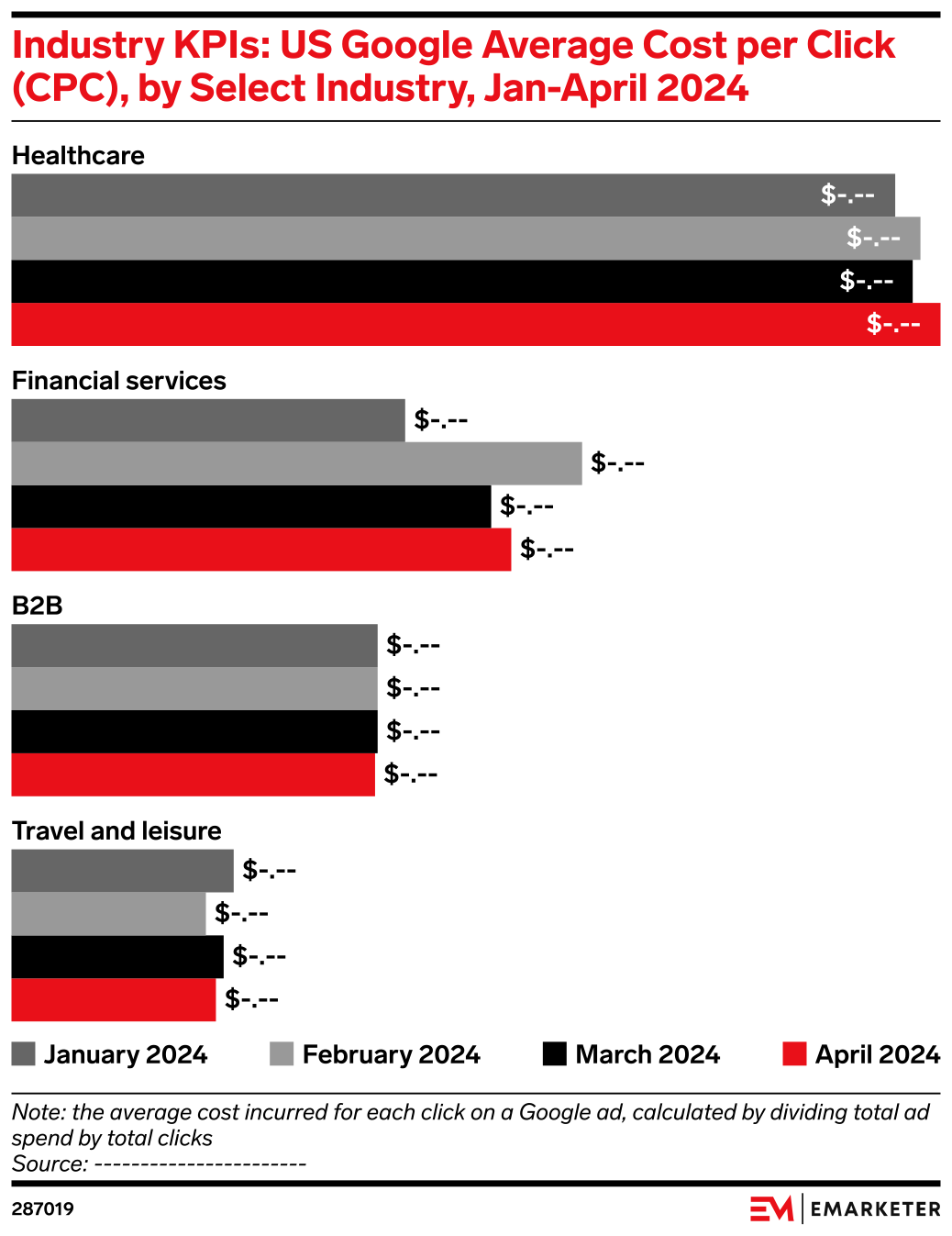
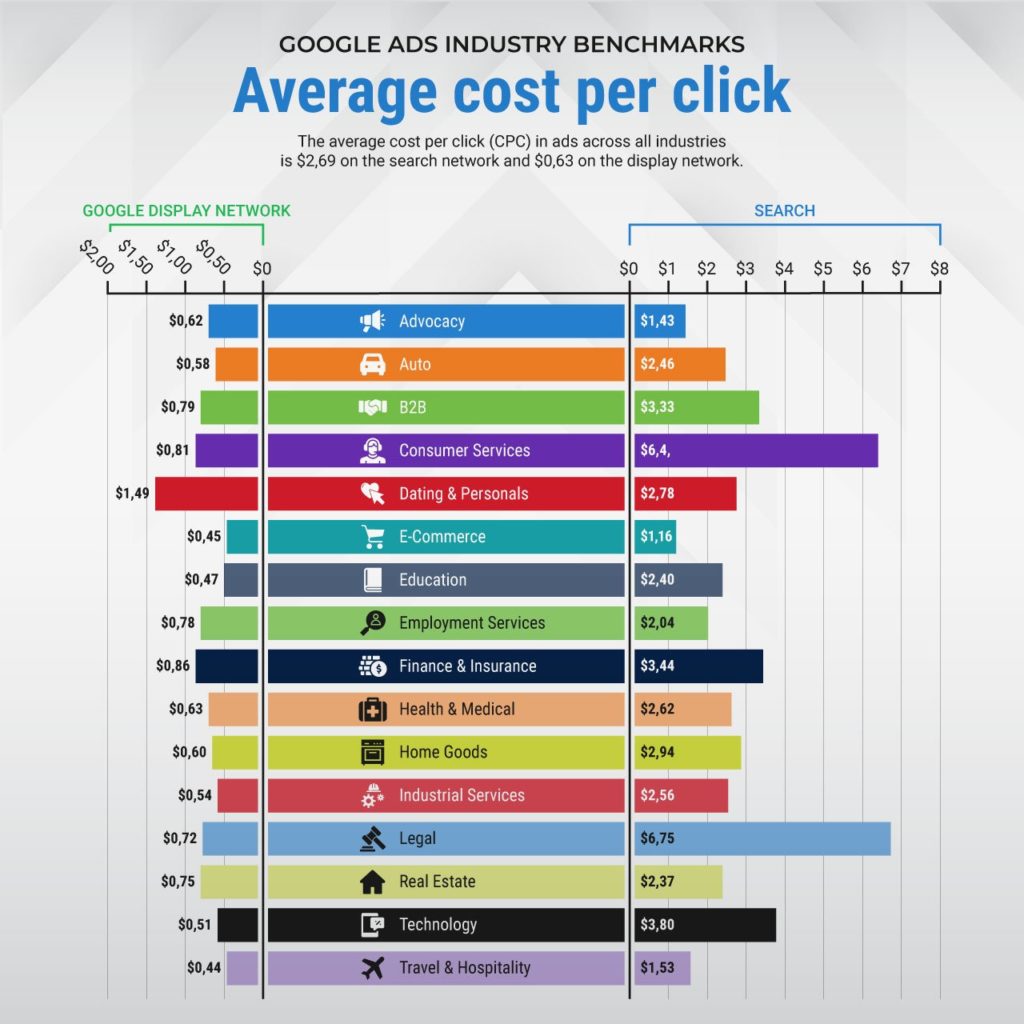
The 2024 data reveals that CPC is never a "one size fits all" metric. The variance between industries was staggering, reflecting the lifetime value (LTV) of customers in different niches. For instance, industries with high-ticket services or long-term contracts naturally saw the highest CPCs.
The Legal and Financial Peaks
In 2024, the Legal industry remained the most expensive vertical, with CPCs frequently exceeding $9.00 for general terms and reaching well over $50.00 for specific high-intent keywords like "personal injury attorney." This was driven by the massive potential settlement values associated with a single successful lead. Similarly, the Financial Services and Insurance sectors saw high averages ($5.00 - $7.00), as the recurring revenue from a single policy or bank account justifies a higher initial acquisition cost.
The E-commerce and Retail Mid-Range
Conversely, Real Estate and Home Services occupied a middle ground. In 2024, Real Estate CPCs averaged around $2.50 to $3.00. While the transaction value is high, the frequency of clicks from "window shoppers" who are not yet ready to buy keeps the average lower than the specialized legal sector. E-commerce saw some of the lowest CPCs, often under $1.50, because the sheer volume of products and the lower barrier to entry for shoppers allowed for a broader, more cost-effective reach.
| Industry Vertical | Average Search CPC (2024) | Primary Growth Driver |
|---|---|---|
| Legal Services | $9.21 | High Lead Value/Litigation Competition |
| Dental & Medical | $3.69 | Local Search Dominance |
| Home Services | $4.55 | Demand for Emergency/Immediate Solutions |
| Real Estate | $2.44 | High Intent for Local Listings |
| E-commerce/Retail | $1.16 | Volume-based Bidding/Shopping Ads |
| Finance & Insurance | $5.44 | High Lifetime Value (LTV) |
| Travel & Hospitality | $1.53 | Seasonal Competition & Meta-Search |
What 2024 Revealed About Platform Dominance
The 2024 CPC data highlighted a growing divergence between search and social platforms. Google Ads continued to command a premium because it targets "pull" intent—users actively looking for a solution. Meanwhile, Meta (Facebook and Instagram) CPCs hovered around an average of $0.94 to $1.20.
While Meta offered a lower cost per click, the 2024 data revealed that this did not necessarily equate to better value. The "Social Media CPC Gap" showed that while clicks were cheaper, the conversion rates were often lower because social media is a "push" medium where ads interrupt user discovery. This forced 2024 marketers to develop sophisticated attribution models to understand how a $1.00 click on Instagram contributed to a later $5.00 search click on Google.
LinkedIn Ads remained the outlier in 2024, with CPCs often starting at $5.00 and frequently climbing past $12.00 for senior executive targeting. What this revealed was the extreme value of professional context. B2B marketers were willing to pay 10 times the price of a Facebook click to ensure the person clicking held a specific job title at a Fortune 500 company.
The Influence of Ad Quality Score on Costs
A critical revelation from the 2024 data was the increasing penalty for poor ad quality. Google’s Quality Score (composed of expected click-through rate, ad relevance, and landing page experience) became the most significant lever for controlling CPC.
Advertisers with a Quality Score of 8, 9, or 10 often paid 50% less per click than competitors with a score of 4 or 5 for the exact same keyword. This revealed that the 2024 auction was not just a "pay to play" environment but a "relevance to play" environment. Those who invested in high-speed, mobile-optimized landing pages and highly specific ad copy were able to weather the rising average costs much better than those using generic, broad-match strategies.
Strategic Shifts Forced by 2024 Pricing
The rising average CPC in 2024 necessitated several strategic pivots that have since become standard practice in 2026.
- Shift to ROAS and POAS: Instead of focusing on the cost of the click, sophisticated marketers shifted their focus to Return on Ad Spend (ROAS) and Profit on Ad Spend (POAS). If a CPC rose by 20%, but the conversion value rose by 30% due to better AI targeting, the higher CPC was actually a sign of improved efficiency.
- The Rise of Long-Tail Strategy: To avoid the hyper-competitive (and expensive) head terms, marketers in 2024 leaned heavily into long-tail keywords. These are longer, more specific phrases that may have lower search volume but also carry lower CPCs and higher conversion intent.
- Investment in Creative as a Targeting Tool: As manual targeting options decreased due to privacy regulations, 2024 revealed that the "creative" (the image or video) became the new targeting mechanism. Platforms used user engagement with specific visuals to determine who should see the ad next, making creative testing the primary way to lower effective CPCs.
The Hidden Costs: Beyond the Click
One of the most important takeaways from 2024 was the recognition that the "click" was only the beginning of the cost. The Cost Per Acquisition (CPA) was influenced heavily by post-click friction. In a year where CPCs were rising, businesses that failed to optimize their checkout processes or lead forms saw their total marketing efficiency collapse.
Data from 2024 showed that a 1-second delay in mobile load time could increase the effective cost of a lead by over 20%. This revealed that digital marketing in the mid-2020s was no longer just about the ad platform; it was about the entire digital ecosystem of the brand.
Frequently Asked Questions
Why did CPCs increase so significantly in 2024?
The increase was primarily driven by the transition to AI-automated bidding (like Performance Max), which prioritizes high-value users regardless of the click cost. Additionally, increased competition in the post-pandemic digital economy and the loss of granular tracking data forced platforms to rely on more expensive, high-intent signals.
Which industry had the highest CPC in 2024?
The Legal industry consistently held the highest CPC, with averages around $9.21. However, specific keywords related to litigation or specialized medical malpractice could see costs exceeding $50.00 to $100.00 per click due to the extremely high value of a single won case.
Did lower CPCs on social media mean better ROI?
Not necessarily. While Meta’s average CPC was often under $1.20 (compared to Google’s $4.00+), the conversion intent is typically lower on social media. 2024 data showed that while social clicks were cheaper, the "cost per lead" often balanced out between search and social because search users are actively looking to buy.
How did Quality Score affect the average CPC?
Quality Score acted as a discount or a tax. In 2024, advertisers with high Quality Scores (8-10) could see their CPCs reduced by up to 50% compared to the industry average, while those with low scores (1-3) could pay a "penalty" of 400% or more over the base bid.
Is CPC still a relevant metric in 2026?
Yes, but it is now viewed as a diagnostic metric rather than a primary goal. While we still track CPC to understand market competition, modern strategies focus more on the "Cost Per Incremental Conversion" and the overall "Customer Lifetime Value" relative to the initial click spend.
Conclusion and Next Actions
The average cost per click in 2024 served as a clear signal that the era of "cheap traffic" had officially ended. It revealed a market where data privacy, AI automation, and industry-specific competition converged to create a higher barrier to entry for digital advertisers.
To succeed in the current 2026 landscape based on these 2024 lessons, advertisers should:
- Audit Landing Page Performance: Ensure that the traffic you are paying a premium for is not being wasted on slow or confusing websites.
- Leverage First-Party Data: Use your own customer lists to help AI algorithms find "lookalike" audiences more efficiently, reducing the need for expensive broad-match bidding.
- Focus on Conversion Rate Optimization (CRO): Since you cannot always control the cost of the click, you must control what happens after the click. Even a small increase in conversion rate can offset a significant rise in CPC.
Image Gallery