Understanding the Difference Between CSRS and FERS Retirement Systems
The primary difference between the Civil Service Retirement System (CSRS) and the Federal Employees Retirement System (FERS) lies in their structure and funding. CSRS is a defined-benefit plan covering employees hired before 1984, wher...
The primary difference between the Civil Service Retirement System (CSRS) and the Federal Employees Retirement System (FERS) lies in their structure and funding. CSRS is a defined-benefit plan covering employees hired before 1984, whereas FERS is a three-tiered system introduced in 1984, combining a defined-benefit pension, Social Security, and a defined-contribution Thrift Savings Plan.
Contents
Historical Context and Eligibility
To understand why federal employees operate under two distinct retirement frameworks, one must look at the transition period of the early 1980s. The Civil Service Retirement System was established in 1920 to provide a stable, pension-based retirement for federal workers. By the early 1980s, the Social Security Amendments of 1983 mandated that all federal employees hired on or after January 1, 1984, be covered by Social Security. This necessitated the creation of a new, integrated retirement system.
FERS was subsequently enacted, becoming effective on January 1, 1987, though employees hired between 1984 and 1986 were retroactively covered. Today, the vast majority of federal employees are under FERS. CSRS remains a "closed" system, meaning no new employees can enter it. Those currently covered by CSRS or the hybrid "CSRS Offset" system are long-tenured employees who have remained in continuous federal service or met specific re-employment criteria.
The Civil Service Retirement System (CSRS)
CSRS functions as a standalone pension plan. Because it predates the universal integration of Social Security for federal workers, it does not rely on Social Security credits to provide a retiree's primary income.
- Funding Structure: CSRS is a defined-benefit plan. Your retirement annuity is calculated based on a formula using your "high-three" average salary (the highest average basic pay earned during any three consecutive years of service) and your years of creditable service.
- Social Security Integration: Under the original CSRS, employees do not pay Social Security taxes on their federal salary, nor do they earn Social Security credits for that work. Consequently, most CSRS retirees do not receive a Social Security benefit unless they earned sufficient credits through private-sector employment.
- The Thrift Savings Plan (TSP): While CSRS employees can contribute to the TSP—the federal equivalent of a 401(k)—they receive no government matching contributions. Participation is entirely voluntary and self-funded.
The Federal Employees Retirement System (FERS)
FERS was designed as a modern, diversified retirement package. It assumes that federal employees will have portable retirement savings in addition to government-provided benefits.
- Three-Tiered Approach: FERS is composed of three distinct sources of income:
- Basic Benefit Plan: A defined-benefit annuity, similar to CSRS but generally with a lower accrual rate.
- Social Security: FERS employees pay into Social Security through payroll taxes and are eligible for benefits based on their entire earnings history.
- Thrift Savings Plan (TSP): A defined-contribution plan where the government provides automatic 1% contributions and matches employee contributions up to an additional 4%.
- Portability: Because FERS includes Social Security and the TSP, it is considered more portable than CSRS. If an employee leaves federal service before retirement eligibility, their TSP account and Social Security credits remain with them, whereas a CSRS pension is often deferred until the employee reaches a specific retirement age.
Comparing Key Retirement Mechanics
| Feature | CSRS | FERS |
|---|---|---|
| Primary Pension | Defined-benefit (Higher accrual) | Defined-benefit (Lower accrual) |
| Social Security | Generally not covered | Mandatory coverage |
| TSP Matching | None | Up to 5% total matching |
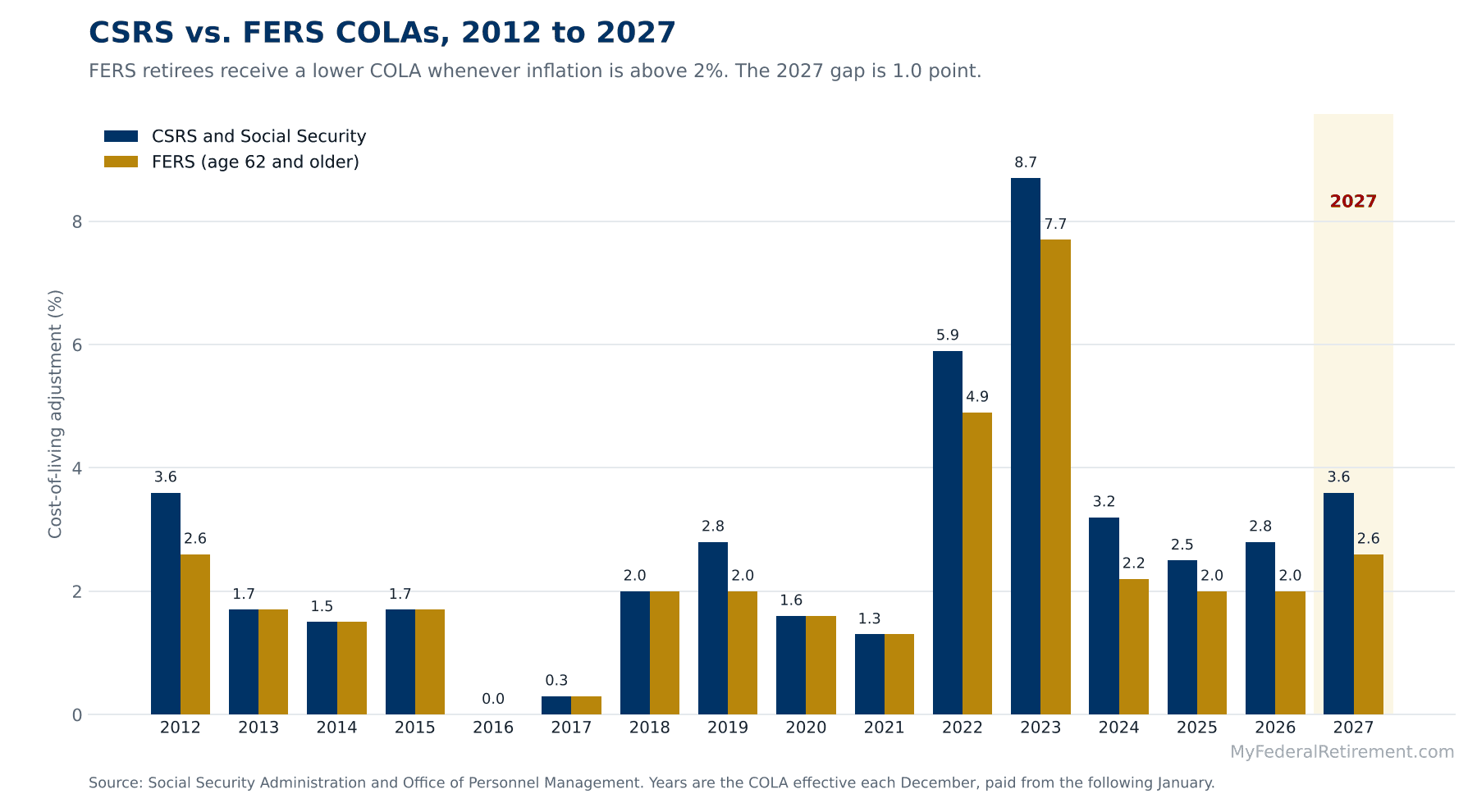
| Cost of Living Adjustments | Full COLA (any age) | COLA (usually starting at age 62) |
| Funding Source | Employee/Agency contributions | Employee/Agency/Social Security |
Financial Implications and Retirement Planning
The fundamental difference in how these systems are structured changes the way an employee must plan for their "golden years." CSRS employees have historically relied on a robust pension that covers a higher percentage of their final salary compared to FERS. Because the CSRS pension is so substantial, some participants have historically viewed the TSP as an optional "bonus" rather than a primary retirement vehicle.
Conversely, FERS employees must view the TSP as a core pillar of their financial health. Because the FERS "Basic Benefit" is designed to be smaller than the CSRS annuity—with the expectation that Social Security and TSP will bridge the gap—a FERS employee who does not contribute to the TSP risks having a significantly lower total retirement income than a CSRS retiree with similar years of service.
Handling Specific Challenges
One common point of confusion is the "CSRS Offset" provision. Employees who transitioned from CSRS to FERS or those who had a break in service may fall into this category. CSRS Offset employees are covered under CSRS but also pay Social Security taxes. Upon reaching age 62, their CSRS benefit is reduced by the amount of the Social Security benefit they earned during their time as a federal employee. This is a crucial distinction, as it prevents "double-dipping" while ensuring that the employee's total government-supported income remains roughly equivalent to what they would have received under a standard CSRS calculation.
Frequently Asked Questions
1. Can I switch from CSRS to FERS? Generally, once you are under CSRS, you stay under CSRS. There were specific open seasons in the past (such as in 1987 and 1998) that allowed employees to transfer to FERS. Today, such transitions are rare and usually occur only if an employee leaves federal service for a period and is rehired into a position that mandates FERS coverage.
2. Does my TSP balance change based on whether I am CSRS or FERS? The TSP itself is the same, but the incentives differ. FERS employees receive automatic 1% agency contributions and matching funds for their own contributions, whereas CSRS employees do not. Your account performance depends on your personal investment choices within the available fund options.
3. Is the pension calculation the same for both systems? No. CSRS uses a more generous accrual formula (e.g., 1.5% for the first five years, 1.75% for the next five, and 2% for years after ten). FERS generally uses a 1% accrual rate, or 1.1% if you retire at age 62 or later with at least 20 years of service.
4. When can I start receiving Social Security under FERS? As a FERS employee, your Social Security eligibility follows standard Social Security Administration rules. You can generally claim benefits as early as age 62, though delaying benefits increases your monthly payout.
5. Are COLA increases different for these plans? Yes. CSRS retirees receive full cost-of-living adjustments (COLA) regardless of their age. FERS retirees generally do not receive COLAs until age 62, unless they are retired under disability or survivor benefits.
Final Recommendations for Federal Employees
If you are a FERS employee, your most important actionable step is to ensure you are contributing at least 5% of your salary to your TSP. Failing to do so effectively means you are leaving free government-matched money on the table, which significantly impacts your long-term compound growth.
For those nearing retirement, review your "Individual Retirement Record" available through your agency’s HR portal. Ensure your service computation date and deposit records (for any military or temporary service) are accurate. Because these systems are governed by complex federal statutes, if you are planning to retire in 2026 or beyond, consult the official OPM (Office of Personnel Management) Retirement Services website to access your specific service history and projected benefit estimates.
Image Gallery