How Boating USA Insurance Works: A Complete Guide to Coverage and Requirements
Boating insurance in the United States operates as a specialized contract between a vessel owner and an insurance provider to mitigate financial risks associated with maritime activities. It functions by transferring the risk of physic...
Boating insurance in the United States operates as a specialized contract between a vessel owner and an insurance provider to mitigate financial risks associated with maritime activities. It functions by transferring the risk of physical damage, liability, and environmental accidents to the insurer in exchange for regular premium payments, ensuring that boaters are protected against significant out-of-pocket losses.
Contents
While the vast blue horizons of the American coastline and the thousands of inland lakes offer a sense of freedom, the financial realities of boat ownership are grounded in risk management. Whether you are navigating a personal watercraft (PWC) on a local reservoir or a 60-foot yacht along the Atlantic seaboard, understanding the mechanics of marine insurance is essential. As we move through 2026, the complexity of these policies has increased, reflecting new technologies in hull construction and evolving environmental regulations. This guide provides a comprehensive breakdown of how boating insurance works in the USA, from legal requirements to the nuances of specific coverage types.
Is Boat Insurance Legally Required in the United States?
One of the most common misconceptions among new boaters is that marine insurance is mandated by federal law in the same way auto insurance is required for drivers. In reality, the legal requirements for boat insurance in the USA are a patchwork of state-level regulations and private contractual obligations.
State Mandates
As of 2026, only a handful of states—such as Arkansas, Hawaii, and Utah—have specific laws requiring boat insurance for certain types of vessels or engines of a specific horsepower. Most states do not have a universal insurance mandate. However, this does not mean boaters operate without coverage. State parks and local municipalities may require proof of liability insurance to permit access to certain waterways or public boat ramps.
Marina and Lender Requirements
While the government may not always require insurance, private entities almost certainly will. If you finance the purchase of your boat, the lender will require you to carry "physical damage" coverage (often called hull insurance) to protect their collateral. Furthermore, nearly every reputable marina in the US requires boaters to provide a certificate of liability insurance before they are granted a slip or a mooring. These marinas typically require a minimum of $300,000 to $500,000 in liability coverage to protect the facility against damage caused by your vessel, such as a fire originating in your engine room or a collision with the dock.
The Two Primary Methods of Valuation: Agreed Value vs. ACV
When setting up a policy, the most critical decision an owner makes is how the vessel will be valued in the event of a total loss. This determines how much the insurance company will pay if the boat sinks, burns, or is stolen.
Agreed Value Policies
An Agreed Value policy is generally considered the gold standard for boat insurance. In this arrangement, the insurer and the boat owner agree on the value of the vessel at the time the policy is written. If a total loss occurs, the insurer pays that exact amount, regardless of the boat's current market value. There is no depreciation applied to the hull in the event of a total loss. This is particularly valuable for owners of well-maintained or classic boats whose market value might fluctuate but whose replacement cost remains high.
Actual Cash Value (ACV) Policies
Actual Cash Value policies are typically less expensive in terms of monthly or annual premiums. However, they factor in depreciation. If your boat is ten years old and is destroyed, the insurer will only pay what the boat was worth on the open market at the moment of the accident. For many boaters, especially those with older vessels or those on a tight budget, ACV is a functional way to meet liability requirements while providing some level of protection for the asset. However, the payout in a total loss scenario is often significantly lower than what is required to purchase a comparable replacement.
Essential Coverage Components
A comprehensive US marine insurance policy is not a single "shield" but a collection of specific coverages designed to address different types of maritime risk.
Hull and Physical Damage
This covers the boat itself, including the hull, machinery, and permanently attached equipment. In 2026, many policies also extend this to include sophisticated onboard electronics and navigation systems, which have become increasingly expensive to repair or replace.
Protection and Indemnity (Liability)
In the marine world, liability insurance is often referred to as Protection and Indemnity (P&I). This covers your legal obligations if you cause bodily injury to another person or damage someone else’s property with your boat. P&I is crucial because maritime accidents can result in massive legal settlements, particularly if multiple parties are injured in a collision.
Medical Payments
This component covers the cost of medical care for the boat owner and their passengers if they are injured while on the boat, regardless of who was at fault. It is often used to cover immediate costs like ambulance rides or emergency room visits.
Uninsured/Underinsured Boater Coverage
Similar to the automotive equivalent, this protects you if you are hit by another boater who either has no insurance or lacks sufficient coverage to pay for the damages they caused. Given that insurance is not mandatory in many states, this is a vital safety net for American mariners.
Fuel Spill Liability and Wreck Removal
Many boaters overlook these two "hidden" risks. Under federal law, specifically the Oil Pollution Act, boat owners are strictly liable for the cost of cleaning up any oil or fuel spilled from their vessel. Cleanup costs can easily reach tens of thousands of dollars. Additionally, if your boat sinks in a navigable channel, authorities may require you to have it removed. Wreck removal coverage ensures the insurer pays for the specialized salvage teams required to raise and transport the vessel.
Factors That Influence Insurance Premiums in 2026
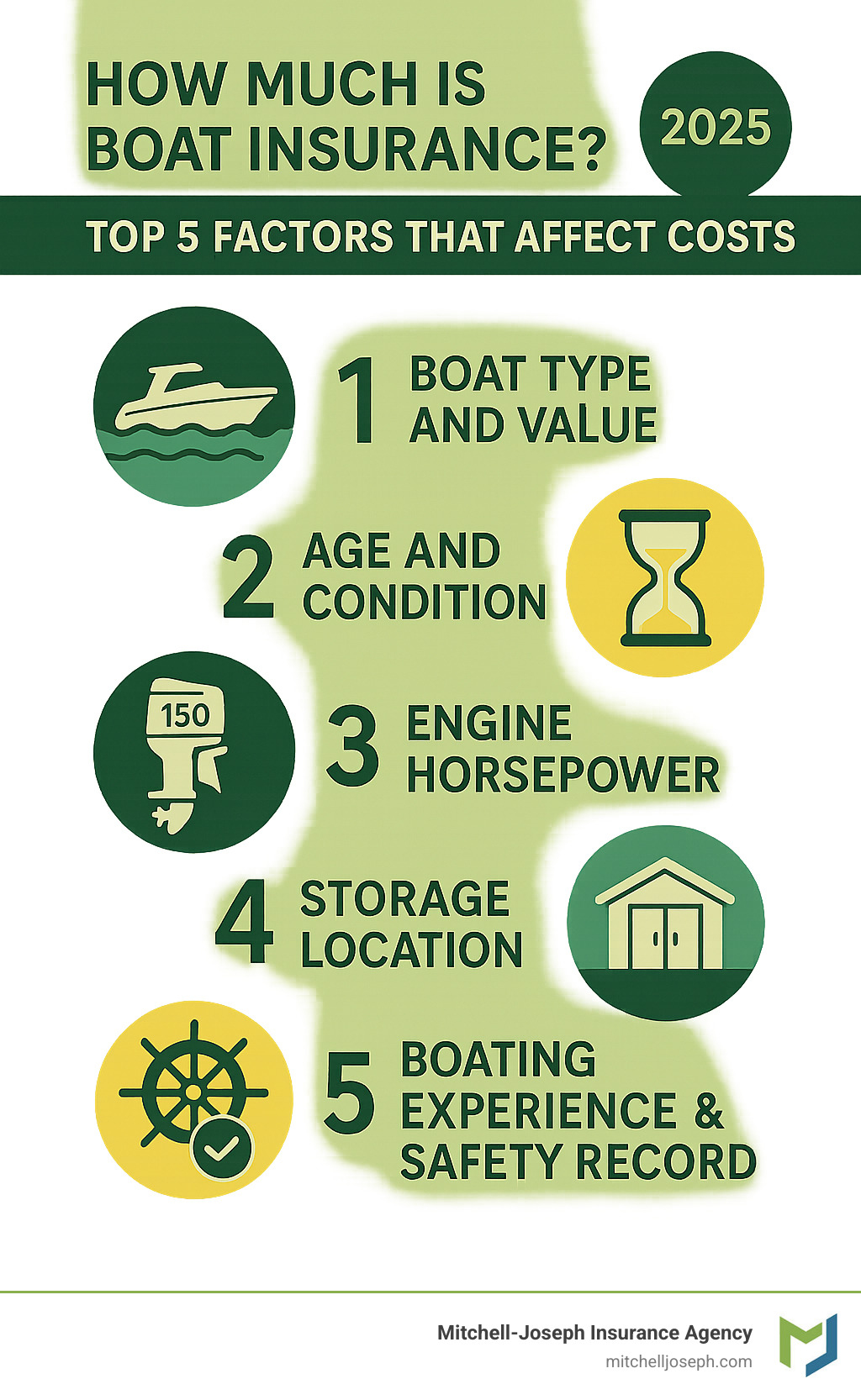
Insurance companies use a complex set of variables to determine the premium for a boating policy. Understanding these can help owners find ways to reduce their costs.
| Factor | Impact on Premium | Why It Matters |
|---|---|---|
| Vessel Type & Speed | High | High-speed PWCs and "go-fast" boats carry higher risks of accidents and severe injuries. |
| Boating Experience | Moderate | Owners with years of experience or USCG-approved certifications often receive lower rates. |
| Navigational Area | High | Boats in hurricane-prone regions (FL, Gulf Coast) pay more than those on inland lakes in the Midwest. |
| Cruising Limits | Moderate | Restricting your boating to a specific geographic "box" reduces the insurer's exposure. |
| Deductible Level | Inverse | Higher deductibles (what you pay out of pocket) lead to lower monthly premiums. |
| Safety Equipment | Low/Positive | Onboard fire suppression systems and GPS tracking can trigger small discounts. |
Navigational Limits and Lay-up Periods
Boating insurance is highly geographic. A policy for a boat in the Great Lakes will look very different from one in the Florida Keys.
Navigational Limits
Most US policies specify a "navigational territory." For example, a policy might state that coverage is only valid while the boat is in the coastal waters of the US and Canada between certain latitudes. If you decide to cruise to the Bahamas but your policy only covers US coastal waters, your insurance is effectively void the moment you cross into international waters. Boaters planning long-distance trips must notify their insurers to obtain a "navigation endorsement."
Lay-up Periods
For boaters in northern climates, "lay-up" periods are a standard feature. This is a specified timeframe (e.g., November 1st to April 1st) when the boat is out of the water and in storage. During this time, the premium is reduced because the risk of collision or sinking is virtually non-existent. However, if you decide to take the boat out for an unseasonably warm day in February during your lay-up period, you will not be covered.
The Claims Process: What Happens After an Accident?
When an incident occurs—whether it’s a grounding, a mechanical failure leading to a fire, or a collision—the claims process follows a structured path.
- Mitigate Further Damage: Under US maritime law and most insurance contracts, the owner has a "duty" to prevent further damage. This might mean hiring a commercial towing service to get a leaking boat to a haul-out facility immediately.
- Documentation: Owners must document the scene with photos and obtain contact information for any witnesses or other involved parties. In the event of a theft or a significant accident involving injuries, a report must be filed with the local marine patrol or the U.S. Coast Guard.
- Surveying: For significant damage, the insurer will send a Marine Surveyor. Unlike an auto adjuster, a marine surveyor is a specialist who understands boat construction and can identify hidden structural issues, such as moisture in a fiberglass core or stress cracks in a transom.
- Settlement: Once the surveyor’s report is complete and the cause of loss is determined to be "covered" (e.g., it wasn't caused by lack of maintenance, which is usually excluded), the insurer will issue payment to the repair facility or the owner, minus the deductible.
Common Exclusions: What Is Not Covered?
No boating policy covers everything. Standard exclusions in the US market generally include:
- Wear and Tear: Insurance is for "sudden and accidental" losses. It will not pay to replace a rusted manifold or a rotting deck.
- Animal Damage: Damage from zebras mussels, barnacles, or even raccoons nesting in the cabin is typically excluded.
- Design Defects: If a manufacturer built a hull that was prone to cracking, the insurance company will generally not pay for repairs related to that inherent flaw.
- Gradual Deterioration: This includes mold, mildew, and corrosion.
FAQs
Does boat insurance cover towing and assistance?
Many comprehensive policies include "emergency towing and assistance" as an add-on or built-in feature. This covers the cost of on-water jump-starts, fuel delivery, or towing to the nearest repair facility. Because commercial towing can cost upwards of $250 per hour, this is a highly recommended feature for all US boaters.
Is my boat trailer covered under the boat insurance policy?
In most cases, the trailer can be added to the boat insurance policy for physical damage (theft or collision). However, when the trailer is attached to your vehicle and you are driving on the road, the liability portion of your auto insurance policy usually covers any damage the trailer causes to others. It is essential to verify this "split" coverage with both your auto and marine insurers.
What is a "consequential damage" clause?
This is a sophisticated part of some marine policies. While insurance usually doesn't cover wear and tear (like a rotted hose), a consequential damage clause might cover the result of that failure. For example, if a rotted hose causes the boat to sink, the policy might cover the sinking even though it wouldn't have paid for the $20 hose itself.
Can I just use my Homeowners Insurance to cover my boat?
Homeowners policies often provide very limited coverage for small boats (typically under 16 feet with low-horsepower engines) while they are on your property. However, this coverage is usually insufficient for liability on the water and rarely covers specialized risks like fuel spills or wreck removal. A dedicated marine policy is almost always necessary for anything larger than a canoe or a small trolling boat.
Practical Recommendation
For any boat owner in 2026, the first step should be to request an Agreed Value quote and compare it against an Actual Cash Value option. While the premium for Agreed Value is higher, the peace of mind knowing exactly what you will receive in a total loss is invaluable. Furthermore, always ensure your policy includes at least $500,000 in fuel spill liability to comply with federal environmental standards. Before heading out for the season, check your "navigational limits" in the policy fine print to ensure your planned destinations are within your coverage zone.
Image Gallery