The Story Behind Caspian House of Kabob: A Legacy of Persian Flavor
Caspian House of Kabob represents a multi-generational commitment to authentic Persian cuisine, bridging the gap between the lush shores of the Caspian Sea and the American Southwest. Founded on the principles of traditional charcoal g...
Caspian House of Kabob represents a multi-generational commitment to authentic Persian cuisine, bridging the gap between the lush shores of the Caspian Sea and the American Southwest. Founded on the principles of traditional charcoal grilling and Iranian hospitality, it remains a cultural cornerstone for those seeking genuine Middle Eastern heritage through food.
Contents
To understand the story behind Caspian House of Kabob, one must look beyond the storefront and into the history of Persian migration, the technical art of fire-based cooking, and the specific regional influences of Northern Iran. As of 2026, the restaurant stands not just as an eatery, but as a living museum of culinary techniques that have been passed down through centuries of Persian history.
The Geographical Inspiration: The Caspian Influence
The name "Caspian" is not merely a branding choice; it is a reference to the Gilan and Mazandaran provinces of Iran, which border the Caspian Sea. This region is distinct from the arid plateaus of central Iran. It is characterized by lush forests, high rainfall, and a unique culinary palette that emphasizes fresh herbs, garlic, and pomegranate.
The founders of Caspian House of Kabob sought to transplant this specific atmospheric and culinary identity to their locations. In the early days of the restaurant’s inception, the goal was to provide a "home away from home" for the Iranian diaspora while introducing the uninitiated public to the nuances of Persian spice profiles. Unlike the generic "Middle Eastern" labels often found in Western dining, Caspian House of Kabob focused specifically on the Iranian method of marination and the specific geometry of the kabob skewer.
The story began with a vision to replicate the bazaars of Rasht and Tehran, where the scent of burning fat over charcoal—known as donbeh—defines the air. By focusing on the Caspian identity, the restaurant distinguishes itself through a commitment to certain "Northern" standards of hospitality, known as Mehman-navazi, which dictates that a guest should never leave the table feeling anything less than honored.
The Technical Art of the Persian Kabob
The narrative of Caspian House of Kabob is inseparable from the technical requirements of its kitchen. To the casual observer, a kabob is simply grilled meat. However, in the Persian tradition upheld by Caspian House, the process is a rigorous chemical and physical discipline.
The Marination Science
The "story" in every bite begins 24 to 48 hours before the meat touches the flame. The kitchen utilizes a specific ratio of grated onion juice, saffron, and yogurt. The onion juice acts as a natural enzymatic tenderizer, breaking down the muscle fibers of the beef and lamb without making the meat mushy. Saffron, often referred to as "red gold," is sourced with high crocin content to ensure the deep yellow hue and floral aroma that are hallmarks of the Caspian brand.
The Charcoal Requirement
While many modern restaurants have transitioned to gas grills for ease of maintenance and consistency, the story of Caspian House of Kabob is rooted in the use of natural wood charcoal. This choice is vital for the Maillard reaction—the chemical reaction between amino acids and reducing sugars that gives browned food its distinctive flavor. The charcoal provides an infrared heat that sears the outside of the meat rapidly, trapping the juices inside, a feat difficult to replicate with the convective heat of a gas flame.
The Journey to Arizona: Establishing a Cultural Landmark
The most prominent chapter of the Caspian House of Kabob story takes place in Scottsdale, Arizona. Establishing a Persian restaurant in the heart of the Sonoran Desert presented unique challenges. The founders had to source specific ingredients, such as sumac (a tangy, purple spice) and dried limes, which were not readily available in the region during the restaurant’s early years.
Over the decades, the restaurant evolved from a small family-run operation into a landmark. The interior design of the Scottsdale location often features Persian architectural motifs, including intricate tile work and artwork that depicts the landscapes of the Caspian region. This environment serves as a pedagogical tool, teaching diners about Iranian culture through visual and sensory immersion.
By 2026, the restaurant has successfully navigated several economic shifts, including the digital transformation of the food industry. Yet, the core of the business remains analog: the hand-rolling of the Koobideh (ground meat kabob) and the precision slicing of the Barg (fillet mignon).
Decoding the Menu: The Signature Offerings
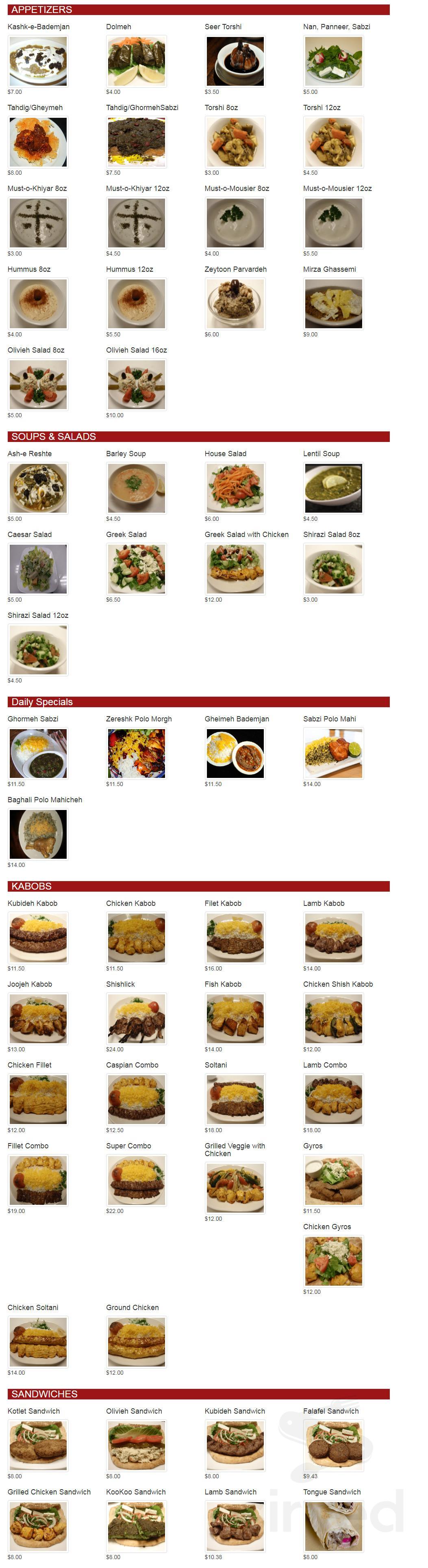
The story of the restaurant is best told through its flagship dishes. Each item on the menu represents a different aspect of Persian history and geography.
| Dish Name | Primary Ingredients | Cooking Technique | Cultural Significance |
|---|---|---|---|
| Beef Koobideh | Ground beef/lamb, grated onions, black pepper. | Grilled on wide flat skewers over high-heat charcoal. | The "people's dish" of Iran; a test of a chef's ability to balance fat and lean meat. |
| Chicken Barg | Chicken breast, saffron, lemon juice, olive oil. | Butterfly-cut and skewered to ensure even heat distribution. | Represents the lighter, citrus-forward flavors of Northern Iranian coastal regions. |
| Soltani | A combination of one skewer of Barg and one skewer of Koobideh. | Dual-heat management; the Barg requires slower cooking than the Koobideh. | Named "The Sultan’s Feast," signifying a meal fit for royalty. |
| Ghormeh Sabzi | Sauteed herbs, kidney beans, dried limes, beef. | Slow-simmered for several hours until the oils separate. | Often called the national dish of Iran; emphasizes the Persian love for greens. |
The Role of Saffron and Basmati Rice
One cannot discuss the story behind Caspian House of Kabob without addressing the "Chelo"—the steamed Basmati rice that accompanies almost every meal. In the Persian tradition, the rice is not a side dish; it is a centerpiece.
The restaurant employs the Abkesh method of cooking rice. This involves parboiling the long-grain Basmati in heavily salted water, draining it, and then steaming it with a crust of oil or butter at the bottom of the pot. This process results in "Tadig," the coveted golden crust that is often the most discussed part of the meal among regulars. The inclusion of high-quality saffron water drizzled over the top provides the final aromatic touch that distinguishes the Caspian House experience from other regional variations of rice.
Community and Longevity in 2026
In the current year of 2026, Caspian House of Kabob has solidified its place in the community by remaining resistant to "fusion" trends that often dilute authentic flavors. While many contemporary restaurants have moved toward smaller portions and complex plating, Caspian maintains the traditional Persian standard of generous portions, intended for communal sharing.
The restaurant also serves as a critical entry point for the local community to understand the distinction between various Middle Eastern cultures. By maintaining a menu that is strictly Persian, the establishment helps clarify the linguistic and culinary differences between Iranian, Arab, and Turkish traditions—a nuance that is often lost in broader Western culinary discourse.
Frequently Asked Questions
What makes the "Caspian" style of kabob different from others?
The Caspian style specifically emphasizes Northern Iranian influences, which often include a more pronounced use of citrus, saffron, and specific marination techniques that prioritize the natural flavor of the meat. Additionally, the use of wide, flat skewers for ground meat (Koobideh) is a technical hallmark that ensures the meat stays attached to the metal while cooking over high-heat charcoal.
Is the meat served at Caspian House of Kabob Halal?
Traditionally, many Persian restaurants, including Caspian House of Kabob, prioritize Halal sourcing to accommodate the dietary requirements of the Muslim community within the Iranian diaspora. However, it is always recommended to verify the current certification status with the specific location, as sourcing can vary based on supply chain availability in 2026.
What is the significance of the sumac found on the tables?
Sumac is a tart, citrusy spice made from dried and ground berries. In the story of Persian cuisine, sumac is traditionally sprinkled over meat dishes to aid in digestion and to cut through the richness of the fats in the kabob. It is an essential component of the table setting at Caspian House of Kabob.
Why is the rice yellow on top?
The yellow rice is colored with a saffron infusion. The kitchen steams the rice until it is fluffy and white, then takes a portion of the top layer and mixes it with liquid saffron before plating it. This adds both a visual contrast and a distinct floral aroma to the dish.
Can I find vegetarian options at a "House of Kabob"?
While the name focuses on meat, the story of Caspian House includes a variety of vegetarian-friendly items inherent to Persian cuisine. These include Shirazi Salad (cucumber, tomato, and onion), various herb-based stews (sometimes available in meatless versions), and the signature Basmati rice dishes like Adas Polo (lentil rice) or Baghali Polo (fava bean and dill rice).
Final Recommendation for Diners
To truly appreciate the story behind Caspian House of Kabob, first-time visitors should opt for a combination platter like the Soltani. This allows for a direct comparison between the texture of the ground Koobideh and the tenderness of the Barg fillet. Furthermore, always request a side of Tadig if available; this crispy rice crust is the ultimate signifier of authentic Persian home cooking and represents the heart of the restaurant’s culinary heritage.
Image Gallery