Durable Commercial Flooring: A Technical Guide to Long-Lifecycle Surface Solutions
Durable commercial flooring is defined by its ability to withstand heavy foot traffic, mechanical loads, and chemical exposure while maintaining structural integrity and aesthetic appeal over a long lifecycle. The most durable options...
Durable commercial flooring is defined by its ability to withstand heavy foot traffic, mechanical loads, and chemical exposure while maintaining structural integrity and aesthetic appeal over a long lifecycle. The most durable options in 2026 include polished concrete, high-performance epoxy resins, terrazzo, and high-specification resilient materials like rubber and luxury vinyl tile (LVT) with a 20+ mil wear layer.
Contents
Choosing the right flooring for a commercial environment requires a balance between initial capital expenditure and long-term maintenance costs. As we move through 2026, facility managers are increasingly prioritizing "Total Cost of Ownership" (TCO) over the sticker price. A floor that lasts 30 years with minimal upkeep is significantly more cost-effective than a cheaper surface that requires biennial stripping, waxing, or replacement every five years.
Defining Durability in the 2026 Commercial Landscape
In the context of modern architecture and facility management, durability is no longer measured solely by hardness. It is a multi-dimensional metric involving several key technical factors:
- Abrasion Resistance: The ability of the surface to resist wear from friction, usually measured by the Taber Abraser test (ASTM D4060).
- Compressive Strength: Crucial for industrial settings where heavy machinery or high-density shelving is used. This is measured in Pounds per Square Inch (PSI).
- Static Load Limit: The capacity of the flooring to resist indentation from heavy, stationary objects (ASTM F970).
- Chemical and Stain Resistance: The floor's reaction to reagents, oils, and cleaning agents, which is vital for laboratories and healthcare facilities.
- Dimensional Stability: The material’s ability to resist expansion and contraction due to temperature and humidity fluctuations.
Understanding these metrics allows stakeholders to move beyond generic marketing terms and select materials based on the specific stressors of their environment.
Polished Concrete: The Industrial Gold Standard
Polished concrete remains the premier choice for high-traffic retail, industrial warehouses, and modern office spaces. Unlike coated floors, polished concrete is a mechanical refinement process that closes the pores of the concrete slab itself.
Technical Advantages
Polished concrete typically reaches a hardness level of 7 on the Mohs scale, making it nearly impossible to scratch with standard foot traffic or pallet jacks. By 2026 standards, many specifications require the use of lithium-based densifiers. These chemicals react with the calcium hydroxide in the concrete to create calcium silicate hydrate (CSH), which fills the voids in the concrete matrix, significantly increasing the PSI of the surface.
Maintenance and Lifecycle
The primary appeal of polished concrete is its lifecycle. It does not require waxes or coatings. Maintenance generally involves daily dust mopping and weekly mechanical scrubbing with a neutral pH cleaner and diamond-impregnated pads. If maintained properly, a polished concrete floor can last the lifetime of the building, with a "refresh" polish only needed every 10 to 15 years.
Epoxy and Resinous Flooring Systems
For environments where hygiene and chemical resistance are paramount—such as hospitals, commercial kitchens, and pharmaceutical labs—epoxy and resinous systems are the most durable solutions.
Composition and Performance
In 2026, the industry has shifted toward high-solids epoxy and polyaspartic coatings. These systems are non-porous and seamless, eliminating the grout lines where bacteria and moisture can accumulate.
- Epoxy: Known for high bond strength and impact resistance.
- Polyaspartic/Urethane: Offers superior UV resistance (no yellowing) and faster cure times, allowing for overnight installations that minimize business downtime.
Durability Against Thermal Shock
In food processing areas, durable flooring must also resist thermal shock—rapid changes in temperature from hot-water washdowns. For these applications, cementitious urethane is the standard, as it has a coefficient of thermal expansion similar to the concrete subfloor beneath it, preventing delamination.
Terrazzo: The Ultimate Long-Term Investment
Often seen in airports and universities, terrazzo is widely considered the most durable flooring material ever created. It consists of a binder (epoxy or cement) mixed with aggregates like marble, quartz, granite, or recycled glass.
While the initial installation cost of terrazzo is the highest in the industry, its lifespan often exceeds 75 years. It is a permanent part of the building structure. According to the National Terrazzo and Mosaic Association, the maintenance requirements are minimal, primarily requiring damp mopping and occasional re-sealing. In 2026, epoxy-thinset terrazzo is the dominant choice because it is lighter, thinner, and more resistant to cracking than traditional sand-cushion methods.
Resilient Flooring: Rubber and High-Performance LVT
Not every commercial space requires the rigidity of concrete or stone. Resilient flooring provides "give" underfoot, which is essential for ergonomics in schools and retail.
Rubber Flooring
Natural and synthetic rubber flooring is exceptionally durable in high-impact environments like gyms or ice rinks. It is naturally slip-resistant and has excellent acoustic properties. Because it is a homogeneous material—meaning the color and pattern go all the way through the thickness—scratches and wear are virtually invisible.
Luxury Vinyl Tile (LVT) and SPC
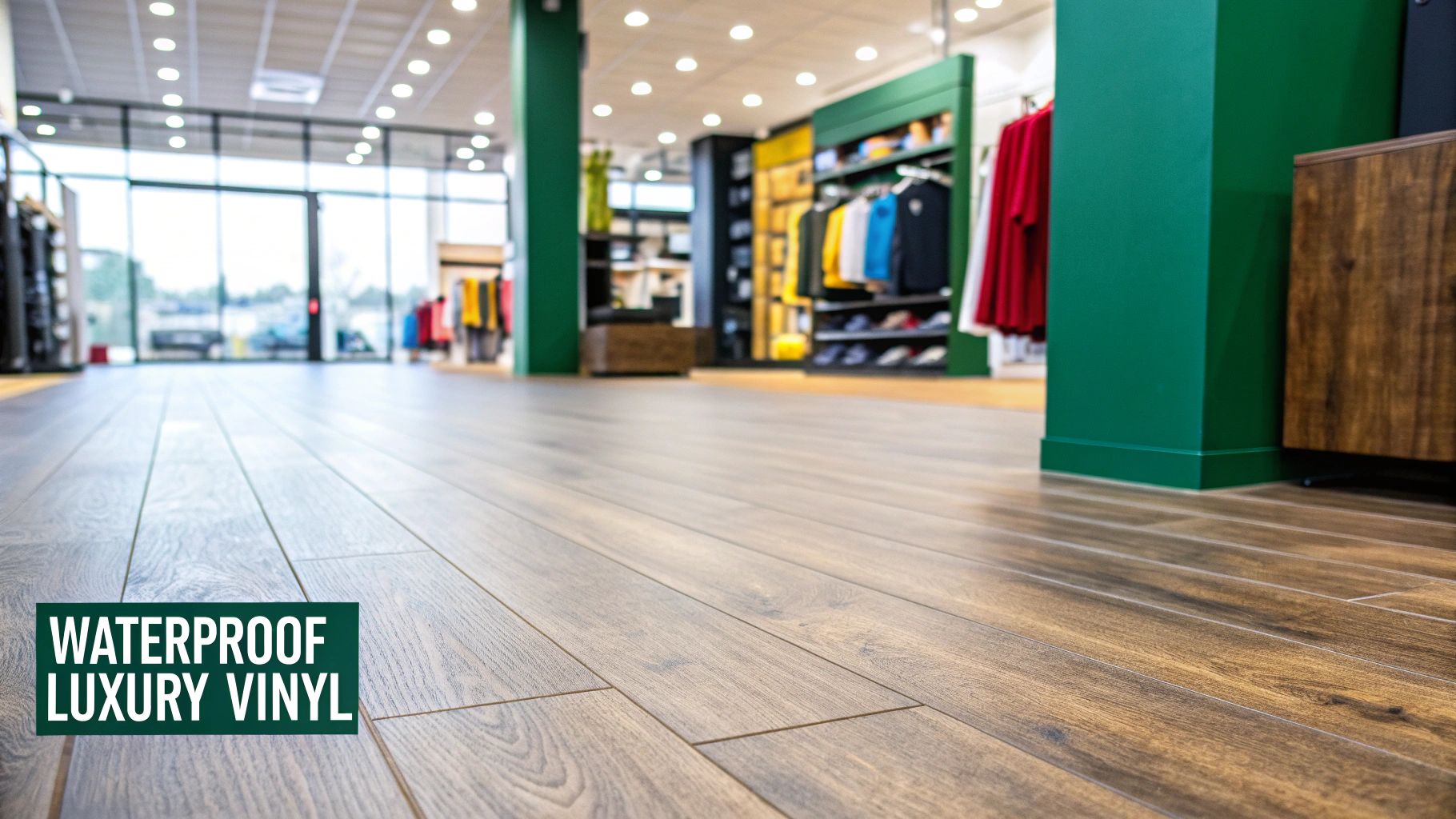
Luxury Vinyl Tile has undergone a technical revolution. For a commercial space to be considered truly "durable," the LVT must have a wear layer of at least 20 mils (0.5mm), though 30-40 mil products are now standard for 2026 high-traffic specifications.
- Stone Plastic Composite (SPC): This variant uses a limestone-core, making it incredibly dense and resistant to indentation from heavy furniture.
- Top Coats: Modern LVT often features a ceramic bead or diamond-infused urethane coating to provide an extra layer of protection against micro-scratching.
Comparison of Durable Commercial Flooring Types
| Flooring Type | Average Lifespan | Compressive Strength / PSI | Maintenance Level | Best For |
|---|---|---|---|---|
| Polished Concrete | 25+ Years | 4,000 - 6,000 | Low | Retail, Warehouses |
| Epoxy Resin | 10 - 20 Years | 10,000+ | Moderate | Labs, Food Prep |
| Terrazzo | 75+ Years | 5,000 - 9,000 | Very Low | Airports, Hospitals |
| Rubber | 15 - 30 Years | N/A (Impact Focused) | Moderate | Schools, Gyms |
| Commercial LVT | 10 - 20 Years | High (SPC Core) | Low | Offices, Hospitality |
| Porcelain Tile | 40+ Years | 20,000+ | Low | High-End Lobby |
Technical Prerequisites: Subfloor Preparation
No flooring material can be more durable than the substrate it sits upon. The most common cause of commercial flooring failure is moisture vapor emission.
Moisture Vapor Emission Rate (MVER)
Before installation, the concrete slab must be tested for moisture levels according to ASTM F1869 (Calcium Chloride test) or ASTM F2170 (Relative Humidity probes). Even the most durable LVT or epoxy will delaminate or bubble if the moisture levels are too high. In 2026, moisture mitigation primers are a standard specification for new construction to ensure the longevity of the top-floor surface.
Leveling and Planarity
For large-format porcelain tiles and LVT, subfloor flatness is critical. A floor that is not level creates "hollow spots" and "lippage." Over time, the pressure from foot traffic on a hollow spot will cause the tile to crack or the LVT locking mechanism to fail. Professional installers use the "1/8 inch in 10 feet" rule for planarity to guarantee durability.
Sustainable Durability: The 2026 Shift
As environmental regulations tighten, the definition of durability has expanded to include the environmental cost of replacement. The Tile Council of North America and other bodies emphasize that materials with long lifecycles—like porcelain and terrazzo—have a lower carbon footprint over time because they do not need to be manufactured, shipped, and installed multiple times.
Furthermore, many durable floors are now evaluated by their Indoor Air Quality (IAQ) certifications. Low-VOC (Volatile Organic Compound) finishes are essential for meeting current building codes and ensuring that the durability of the floor does not come at the expense of the health of the building's occupants.
Frequently Asked Questions
Which commercial flooring is the easiest to maintain?
Polished concrete and high-performance LVT are generally the easiest to maintain. Polished concrete requires no waxing or stripping—only routine cleaning with a walk-behind scrubber. LVT requires simple mopping and does not need the intensive buffing cycles associated with older Vinyl Composition Tile (VCT).
Can I install durable flooring over an existing floor?
It depends on the material. LVT and certain resinous systems can sometimes be installed over existing hard surfaces if they are well-bonded and level. However, for maximum durability and warranty protection, most manufacturers recommend removing the old flooring and grinding the subfloor to a clean, porous state to ensure a mechanical bond.
What is a "wear layer" and why does it matter for LVT?
The wear layer is the clear top coating that protects the photographic film of the vinyl. In commercial settings, a wear layer of 20 mils is the minimum for durability. Using a residential-grade product (6-12 mils) in a commercial lobby will result in visible wear and "traffic paths" within months.
How does slip resistance affect the durability of a floor?
While slip resistance is primarily a safety feature, it impacts durability by dictating the types of cleaning agents and equipment that can be used. A highly textured slip-resistant floor may trap more dirt, requiring more aggressive mechanical agitation, which the floor must be durable enough to withstand without losing its coefficient of friction (COF).
Is porcelain tile durable enough for heavy machinery?
Yes, porcelain is one of the hardest materials available, with high compressive strength. However, it is susceptible to cracking if the subfloor has any movement or if heavy metal objects are dropped directly onto it. For heavy industrial machinery, polished concrete or thick-build epoxy is generally preferred over tile.
What is the most cost-effective durable flooring?
When considering a 20-year window, polished concrete is typically the most cost-effective. It has a moderate installation cost and the lowest annual maintenance cost of any commercial surface.
Practical Recommendations
When selecting durable commercial flooring in 2026, start by performing a Site Stress Audit. Identify where the floor will face the most abuse: Is it the chemical spills in a lab, the heavy rolling loads in a warehouse, or the constant grit and moisture at a retail entrance?
For maximum longevity, specify Terrazzo or Polished Concrete. For environments requiring hygiene and safety, prioritize seamless Epoxy or Urethane systems. For budget-conscious durability in offices or schools, opt for high-specification LVT with an SPC core and a minimum 20 mil wear layer. Always insist on professional moisture testing and subfloor preparation to ensure the material performs to its technical specifications.
Image Gallery