Understanding Independent Life Insurance Carriers: How They Work and Why They Matter
When shopping for financial protection, choosing independent life insurance carriers gives consumers and business owners access to a diverse portfolio of policies from multiple competing insurance companies, rather than being limited t...
When shopping for financial protection, choosing independent life insurance carriers gives consumers and business owners access to a diverse portfolio of policies from multiple competing insurance companies, rather than being limited to the single brand offered by a captive agent. This multi-brand model allows independent professionals to tailor coverage options, compare rates objectively, and secure policies that align precisely with individual risk profiles and long-term financial goals.
Contents
Navigating the landscape of life insurance requires a clear understanding of the distribution channels, product offerings, and institutional structures that shape the market. While captive agents are bound to sell products from one specific corporate entity, independent insurance brokers and independent agencies operate autonomously. This foundational structural difference dictates how policies are priced, how underwriting rules are applied, and how consumers shop for term, whole, or universal life coverage.
What Are Independent Life Insurance Carriers and Agencies?
The insurance industry relies on distinct distribution channels to connect consumers with financial products. At the center of the independent model are independent insurance carriers—the actual underwriting companies that issue financial risk contracts—and independent producers, agents, or brokers who represent these carriers to the public.
Unlike captive agents who work exclusively for one insurance company and must promote that single firm's proprietary products, independent producers maintain contracts with dozens of different carriers. This multi-appointment structure transforms the purchasing process. When an applicant sits down with an independent broker, the broker can shop the open market, run underwriting comparisons, and present quotes from multiple carriers simultaneously.
Independent life insurance carriers themselves are specialized financial institutions that design, price, and underwrite policies. They rely on independent agencies and brokerage general agencies (BGAs) to distribute their products nationwide. By working through independent channels, carriers can reach a broader consumer base without maintaining expensive, exclusive brick-and-mortar storefronts in every local market.
Captive Agents Versus Independent Brokers: Structural Differences
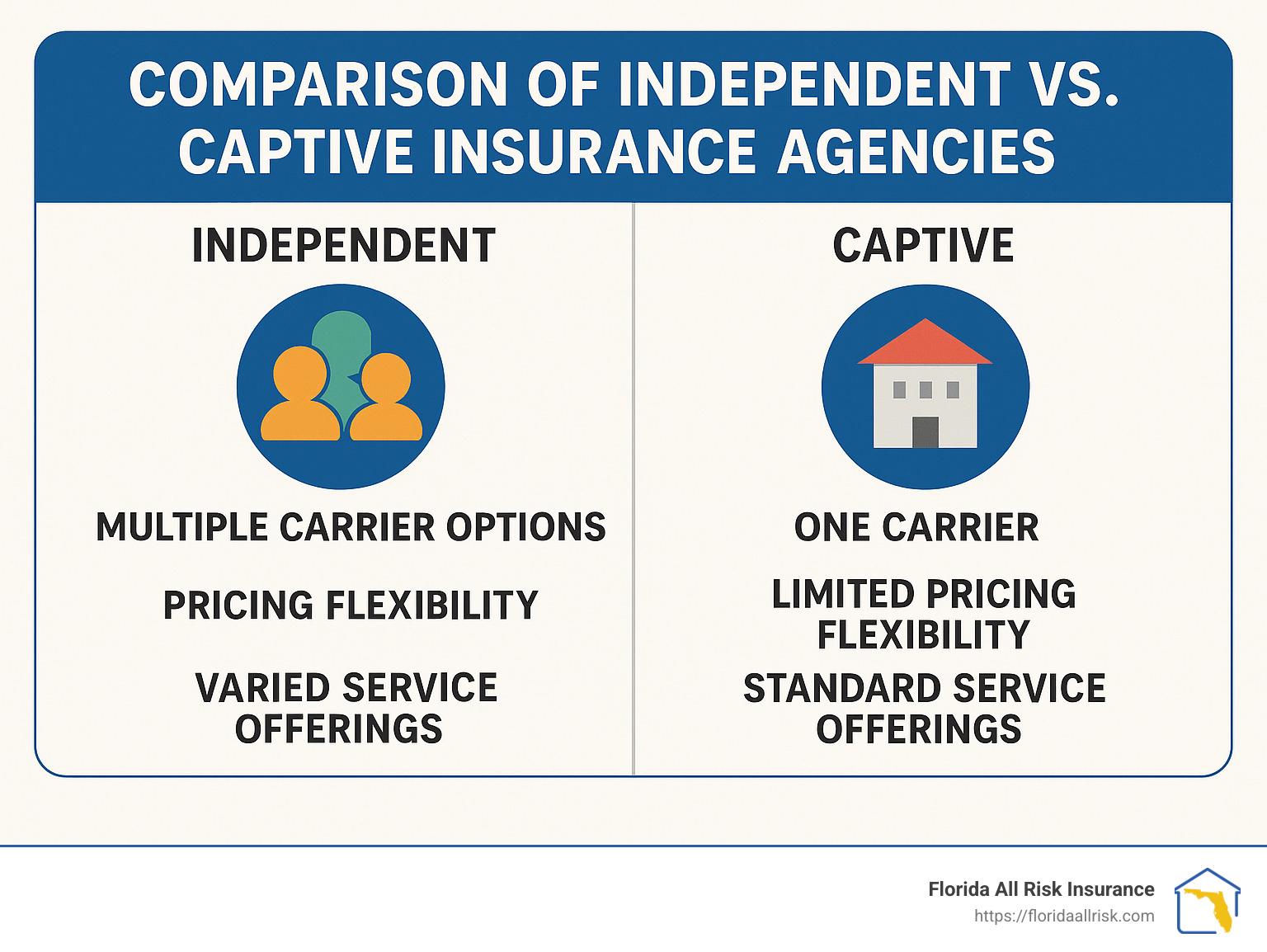
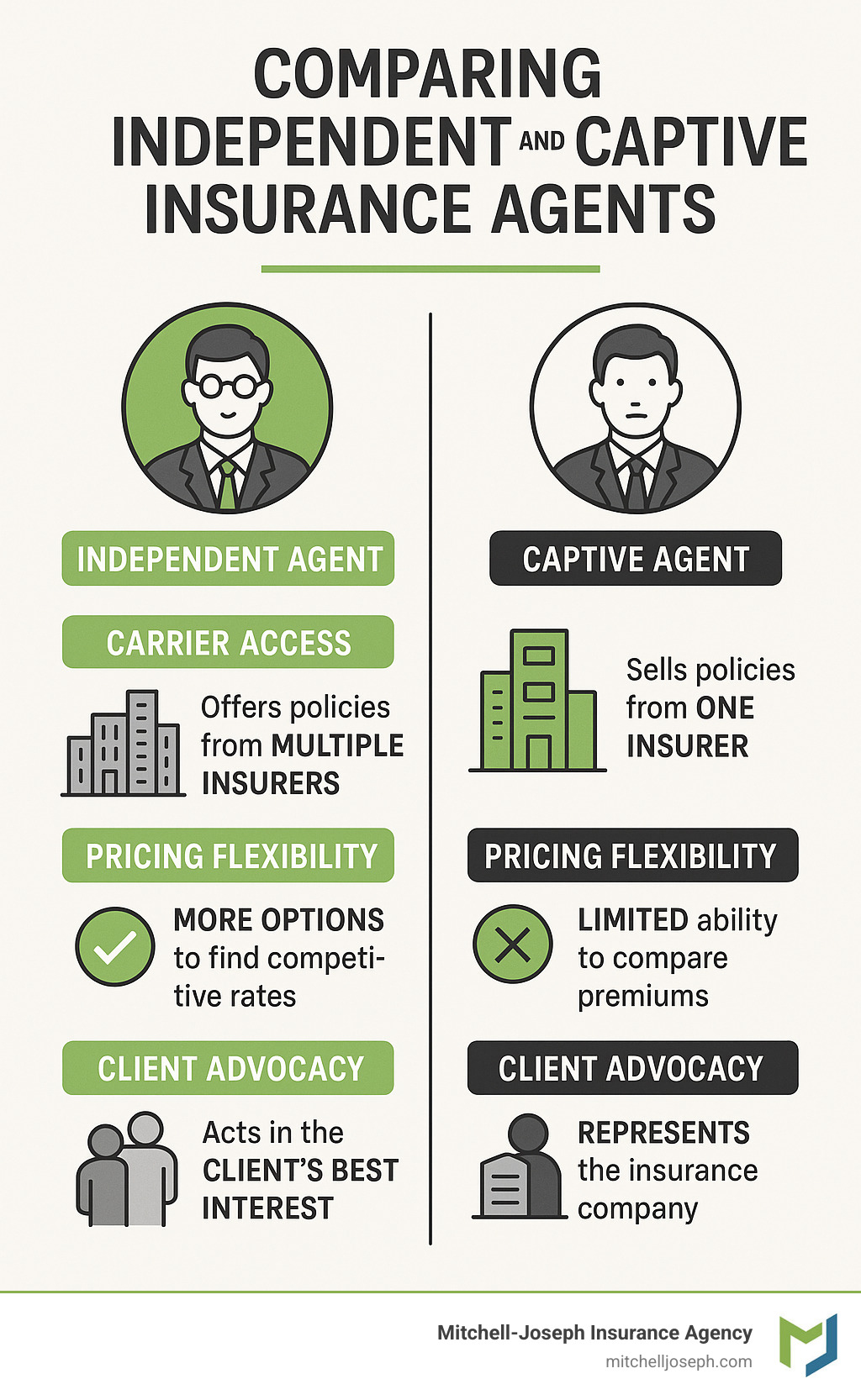
Understanding the operational differences between captive and independent distribution models helps clarify why consumers often achieve different outcomes when purchasing coverage. The table below outlines these structural variations.
| Feature | Captive Insurance Agents | Independent Life Insurance Brokers |
|---|---|---|
| Carrier Representation | Exactly one primary insurance company. | Multiple competing life insurance carriers. |
| Product Portfolio | Proprietary policies from the parent company only. | Diverse portfolios ranging from term to permanent life. |
| Underwriting Guidance | Limited to one company's manual and risk tolerance. | Broad knowledge of various carrier underwriting niches. |
| Pricing Flexibility | Fixed pricing determined by a single corporate entity. | Ability to compare quotes across numerous competing firms. |
| Business Independence | Typically employees or exclusive contractors. | Independent business owners or agency members. |
These structural distinctions directly influence the consumer experience. A captive agent may genuinely try to find the best policy available within their company's portfolio, but their hands are tied if that specific carrier’s underwriting guidelines are unfavorable for a particular medical history or lifestyle risk. Conversely, an independent broker can pivot to a different carrier whose underwriting guidelines view that specific risk more favorably.
How Underwriting and Risk Assessment Vary Among Independent Carriers
One of the most significant advantages of utilizing independent life insurance carriers is the variation in underwriting guidelines from one company to another. Underwriting is the process by which an insurance carrier evaluates an applicant's risk level to determine eligibility and premium rates.
No two independent carriers evaluate risk in an identical manner. While all carriers assess standard metrics such as age, height, weight, medical history, and tobacco use, their internal underwriting manuals weigh these factors differently. For example:
- Medical Conditions: Carrier A might view treated hypertension or controlled Type 2 diabetes as a minor risk, offering a "Standard Plus" or even "Preferred" rate class. Carrier B might penalize the same condition more heavily, resulting in a standard or sub-standard rating.
- Avocations and Hobbies: High-risk hobbies like scuba diving, private aviation, or rock climbing are viewed through wildly different lenses across the industry. Some independent carriers charge steep flat extra fees for these activities, while others accommodate them with minimal surcharges.
- Occupational Hazards: Commercial pilots, steeplechase jockeys, and structural ironworkers will find that independent carriers offer drastically different pricing structures based on their specific risk appetite.
Because independent brokers understand these nuanced underwriting guidelines, they can pre-qualify applicants and route applications directly to the carrier most likely to offer the lowest possible premium.
Product Portfolio Diversity Available Through Independent Channels
Independent life insurance carriers provide access to the full spectrum of financial protection products. Rather than forcing a one-size-fits-all approach, independent channels allow consumers to build comprehensive strategies combining temporary and permanent solutions.
Term Life Insurance
Term life insurance provides pure death benefit protection for a specified duration, such as 10, 20, or 30 years. Independent carriers offer highly competitive term rates, and brokers can easily compare conversion privileges—the option to convert a term policy into permanent coverage without undergoing a new medical exam.
Whole Life Insurance
Whole life insurance is a form of permanent coverage that includes guaranteed level premiums, a guaranteed death benefit, and a cash value component that grows at a fixed rate. Independent carriers offer varying dividend scales and policy rider options, allowing buyers to customize cash accumulation features.
Universal Life Insurance
Universal life insurance offers flexible premiums and adjustable death benefits. Within this category, independent carriers provide options such as Indexed Universal Life (IUL), where cash value growth is tied to the performance of an external market index like the S&P 500, subject to caps and floors.
Evaluating Financial Strength and Stability
When selecting an independent life insurance carrier, evaluating the financial stability of the issuing company is critical. Life insurance is a long-term promise; a policy purchased today may need to pay out a death benefit decades into the future.
Independent rating agencies evaluate and score insurance carriers based on their financial health, capitalization levels, and ability to meet ongoing insurance obligations. Key agencies include:
- AM Best: Focuses specifically on the insurance industry, issuing Financial Strength Ratings (FSR) ranging from A++ (Superior) down to D (Poor).
- Standard & Poor's (S&P) and Moody's: Provide broader credit ratings that reflect an insurer's general financial integrity and debt-paying capacity.
- Demotech: Frequently rates property and casualty insurers, but also evaluates specific life and health portfolios.
Consumers working with independent brokers can request these independent financial ratings to ensure the chosen carrier maintains robust reserves and a history of reliable claims-paying performance.
Common Mistakes When Shopping Through Independent Channels
Navigating the independent insurance market requires careful planning. Avoiding common missteps ensures a smoother application and underwriting process.
- Focusing Exclusively on Lowest Initial Quote: An initial online quote is merely an estimate based on perfect health. Underwriting determines the final rate. Choosing a carrier solely based on a low preliminary price can backfire if medical records reveal minor issues that trigger a higher rate class with that specific company.
- Failing to Disclose Complete Medical History: Omission of past medical treatments or prescription drug history on an application inevitably leads to delays or outright denials during the formal underwriting inspection via databases like the Medical Information Bureau (MIB) and prescription history reports.
- Overlooking Policy Riders: Skipping valuable riders—such as Waiver of Premium, Accelerated Death Benefits, or Guaranteed Insurability—to save a nominal amount on monthly premiums can leave policyholders vulnerable during unexpected life events.
- Neglecting Carrier Reputation: Selecting an obscure, newly formed independent carrier just to save a few dollars per month introduces unnecessary long-term counterparty risk. Stick to established carriers with strong multi-decade operating histories and favorable financial strength ratings.
Frequently Asked Questions
Do policies cost more when purchased through an independent broker?
No. Insurance pricing is strictly regulated by state insurance departments. An insurance carrier charges the exact same premium for a specific policy regardless of whether it is sold by a captive agent, an independent broker, or directly over the internet. Independent brokers are compensated via commissions paid directly by the carrier out of their operating budgets, not through added surcharges on consumer premiums.
How do independent brokers get paid?
Independent life insurance producers earn commissions from the insurance carriers when a policy is successfully underwritten, issued, and paid for. These commissions typically consist of a percentage of the first-year premium (commissionable premium), followed by smaller renewal commissions in subsequent years to encourage ongoing policy service and retention.
Can I switch independent carriers if my health improves?
Yes. If an individual purchases a life insurance policy and subsequently experiences positive lifestyle or health changes—such as significant weight loss, smoking cessation for multiple years, or the successful resolution of a medical condition—they can apply for a new policy through an independent broker with a different carrier to secure more favorable pricing, provided they still meet overall insurability standards.
What happens if an independent carrier goes out of business?
While extremely rare due to strict state reserve requirements and regulatory oversight, if an independent life insurance carrier were to become insolvent, state Guaranty Associations step in to protect policyholders. These state-mandated safety nets typically guarantee life insurance death benefits up to statutory limits (frequently $300,000 in death benefits and $100,000 in cash surrender values per individual, varying by jurisdiction). Furthermore, insolvent companies are often acquired or rehabilitated by solvent insurance firms under regulatory supervision.
Are all independent agencies tied to the same carriers?
No. Independent agencies maintain their own independent contracts and appointments with carriers. While large national brokerages may have access to dozens of major carriers, smaller local independent agencies might contract with a targeted subset of regional or specialized insurance companies. It is entirely appropriate to ask an independent producer how many carriers they actively represent.
Conclusion and Next Actions
Choosing to work with independent life insurance carriers and licensed independent brokers provides consumers with unmatched flexibility, objective market comparison, and access to customized underwriting solutions. To take the next step, compile a clear overview of your financial obligations, income replacement needs, and desired coverage duration. Next, consult with a licensed independent broker who can run quotes across multiple highly rated carriers, pre-screen your medical profile against various underwriting guidelines, and structure a resilient financial safety net tailored to your precise circumstances.
Image Gallery