How Long Does It Take to Get a Physics Degree?
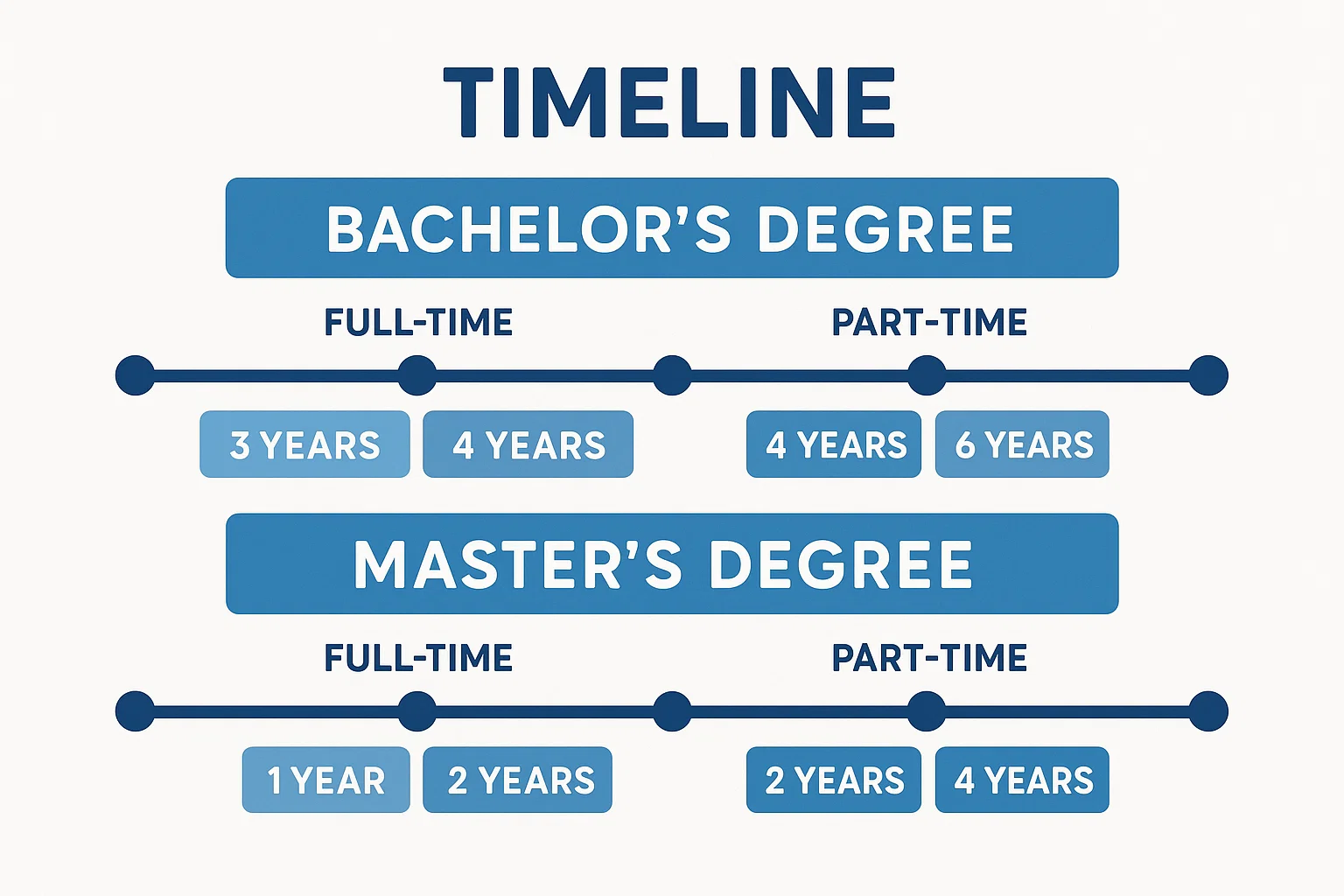
Earning a physics degree typically takes four years of full-time undergraduate study for a bachelor’s degree, while graduate programs require an additional two years for a master’s or four to six years for a doctoral (Ph.D.) degree. Th...
Earning a physics degree typically takes four years of full-time undergraduate study for a bachelor’s degree, while graduate programs require an additional two years for a master’s or four to six years for a doctoral (Ph.D.) degree. The total duration depends heavily on enrollment status, research commitments, and the specific academic track a student chooses to pursue.
Contents
Introduction to Academic Timelines in Physics
Embarking on the journey to earn a physics degree requires a significant commitment of time, intellectual effort, and financial resources. Whether you are an incoming undergraduate student mapping out your next four years or a working professional considering a career pivot into quantitative research, understanding the time investment is essential. Physics is renowned as one of the most rigorous academic disciplines. It blends advanced mathematics, theoretical principles, and intensive laboratory experimentation.
The duration required to complete a physics program is not uniform. While a standard bachelor's degree is designed for a four-year completion window, variables such as part-time enrollment, cooperative education (co-op) placements, and the choice between a Bachelor of Arts (B.A.) and a Bachelor of Science (B.S.) can alter this timeline. Furthermore, students aiming to enter academic research, aerospace engineering, or quantum computing often look beyond the undergraduate level, factoring in graduate school timelines that can extend total education past a decade.
The Undergraduate Physics Degree Timeline
For the vast majority of students, the entry point into higher education physics is the undergraduate bachelor's degree. In most educational systems, particularly in the United States and Canada, this phase is structured around a 120-to-130 credit-hour requirement distributed across eight standard semesters or four academic years.
The Standard Four-Year Bachelor's Path
A traditional, full-time undergraduate path assumes a course load of 15 to 16 credits per semester.
- Years 1 and 2 (Lower Division): The initial phase focuses on foundational coursework. Students complete introductory calculus sequences, general physics covering Newtonian mechanics and electromagnetism, general chemistry, and introductory computer programming. General education requirements in the humanities and social sciences are also heavily concentrated here.
- Years 3 and 4 (Upper Division): The focus shifts entirely to specialized physics subfields. Students tackle analytical mechanics, quantum mechanics, thermal and statistical physics, electricity and magnetism, and advanced laboratory electronics. The final year often culminates in a senior capstone project, thesis, or undergraduate research experience.
Variations: Accelerated and Part-Time Tracks
Not every student follows the traditional four-year mold.
- Accelerated Programs: Highly motivated students who enter university with significant Advanced Placement (AP) credits, International Baccalaureate (IB) credits, or dual-enrollment credits can sometimes finish a bachelor's degree in three to three-and-a-half years. This route requires taking heavy course loads, including summer sessions.
- Part-Time Enrollment: Working students or those balancing family obligations often take two classes per semester instead of four or five. On a half-time schedule, completing an undergraduate physics degree can easily stretch to six or eight years. Because physics courses are often sequenced sequentially—meaning Physics I is a strict prerequisite for Physics II, which is required for advanced mechanics—poor scheduling can compound delays.
Graduate School Pathways: Master's and Ph.D. Timelines
Students who wish to conduct independent research, teach at the university level, or secure high-level research and development (R&D) roles must look toward graduate education. The timeline for graduate studies varies significantly based on the degree objective.
| Degree Level | Typical Duration | Primary Focus |
|---|---|---|
| Bachelor of Science (B.S.) | 4 Years | Foundational coursework |
| Master of Science (M.S.) | 1 to 2 Years | Advanced theory/research |
| Doctor of Philosophy (Ph.D.) | 4 to 6 Years | Original dissertation |
Master's Degree in Physics
A Master of Science (M.S.) in physics typically takes one to two years of full-time study. Master's programs generally split into two formats:
- Coursework-Based (Terminal Master's): Focused on advanced coursework in quantum theory, electrodynamics, and mathematical physics. These can often be completed in 12 to 18 months.
- Thesis-Based: Requires coursework combined with an original research project and defense. This option frequently takes a full two years and prepares students for industrial R&D or entry into a Ph.D. program.
Ph.D. in Physics
A Doctor of Philosophy (Ph.D.) is the terminal degree in physics. In countries like the United States, students often enter a Ph.D. program directly out of their bachelor's program, bypassing a separate master's degree.
- Coursework and Qualifying Exams (Years 1–2): Students take rigorous graduate-level courses and must pass comprehensive qualifying or preliminary examinations covering core physics domains.
- Original Research and Dissertation (Years 3–6+): The remainder of the timeline is dedicated entirely to laboratory or theoretical research under a faculty advisor. The candidate must write and defend a dissertation that contributes new knowledge to the scientific community. On average, a physics Ph.D. in the United States takes 5.5 to 6 years, while international structures (such as those in Europe, where students enter with a master's degree already completed) often focus strictly on research for 3 to 4 years.
Factors That Influence Degree Completion Time
Several structural, academic, and personal factors dictate whether a student finishes on time or experiences delays.
1. Mathematics Preparedness
Physics is fundamentally tied to advanced mathematics. Students who enter university ready to take calculus immediately stay on the standard four-year track. However, students who need remedial algebra or pre-calculus before entering calculus risk falling behind by an entire year, because introductory physics courses usually require calculus as a corequisite or prerequisite.
2. Research and Internship Commitments
Engaging in undergraduate research or cooperative education placements is critical for career prospects, but it can impact graduation timelines. While summer research internships keep students on track, balancing part-time academic-year research with a heavy physics course load may force students to reduce their credit hours per semester, slightly extending their time in school.
3. Program Structure and Institution Type
Liberal arts colleges, comprehensive public universities, and specialized technical institutes structure their physics curricula differently. Larger research universities may offer more specialized electives, but scheduling conflicts between required courses can occur if a class is only offered once every academic year.
Frequently Asked Questions
Can you get a physics degree entirely online?
Fully online physics bachelor's degrees are rare due to the strict requirement for hands-on laboratory work, specialized optics equipment, and electronics instrumentation. While some universities offer hybrid programs or online general education and theoretical coursework, physical attendance for laboratory components is typically mandatory.
Is a physics degree harder than engineering?
Difficulty is subjective, but physics focuses heavily on fundamental universal laws, abstract mathematical modeling, and theoretical derivation. Engineering applies those principles to design practical systems. Physics majors generally spend more time proving abstract mathematical concepts, whereas engineering majors focus on applied design and project execution.
What is the hardest class in a physics undergraduate program?
Most students identify upper-division quantum mechanics or advanced electrodynamics (often based on David J. Griffiths' textbooks or Jackson's classical electrodynamics) as the most challenging hurdles. These classes require sophisticated multivariable calculus, differential equations, and a departure from intuitive, everyday physical intuition.
Do I need a Ph.D. to work as a physicist?
It depends on the career path. Academic positions, national laboratory research roles, and senior theoretical positions strictly require a Ph.D. However, individuals with a bachelor's or master's degree find robust employment as data scientists, software engineers, optical technicians, financial analysts, and high school educators.
How do I accelerate my physics degree timeline?
You can accelerate your timeline by maximizing transfer credits from high school AP or IB exams, taking heavy course loads during regular semesters with faculty approval, and enrolling in intensive summer physics and mathematics sessions at accredited local institutions.
Practical Recommendations for Prospective Physics Students
If you are planning to pursue a physics degree, preparation is the single best tool for staying on schedule. Begin by strengthening your mathematics foundation in high school or through self-study before your first semester. Mastering algebra, trigonometry, and basic calculus prevents bottleneck delays in your first year.
Meet with an academic advisor early to map out your entire four-year course sequence, paying close attention to prerequisite chains. If you intend to pursue graduate school, seek out undergraduate research opportunities by the end of your sophomore year to build relationships with faculty mentors and clarify your specific research interests.
Image Gallery