The Formal Names and Origins of Sin, Cos, and Tan
The collective name for sin, cos, and tan is the trigonometric functions. Individually, these abbreviations stand for sine, cosine, and tangent. They are mathematical functions that relate the angles of a right-angled triangle to the r...
The collective name for sin, cos, and tan is the trigonometric functions. Individually, these abbreviations stand for sine, cosine, and tangent. They are mathematical functions that relate the angles of a right-angled triangle to the ratios of its side lengths, and are fundamental to geometry, physics, and engineering.
Contents
Understanding the Primary Trigonometric Functions
In the study of trigonometry, we primarily focus on how the angles of a triangle relate to the physical lengths of its sides. While the abbreviations "sin," "cos," and "tan" are ubiquitous on calculators and in software code, their full names—sine, cosine, and tangent—carry significant historical and geometric meaning. These functions are often referred to as circular functions because they can also be defined based on the coordinates of a point on a unit circle (a circle with a radius of one).
As of 2026, these functions remain the cornerstone of mathematical education and professional applications ranging from architectural acoustics to quantum computing simulations. To understand the names, one must first understand the geometric relationships they describe within a right-angled triangle.
Sine (sin)
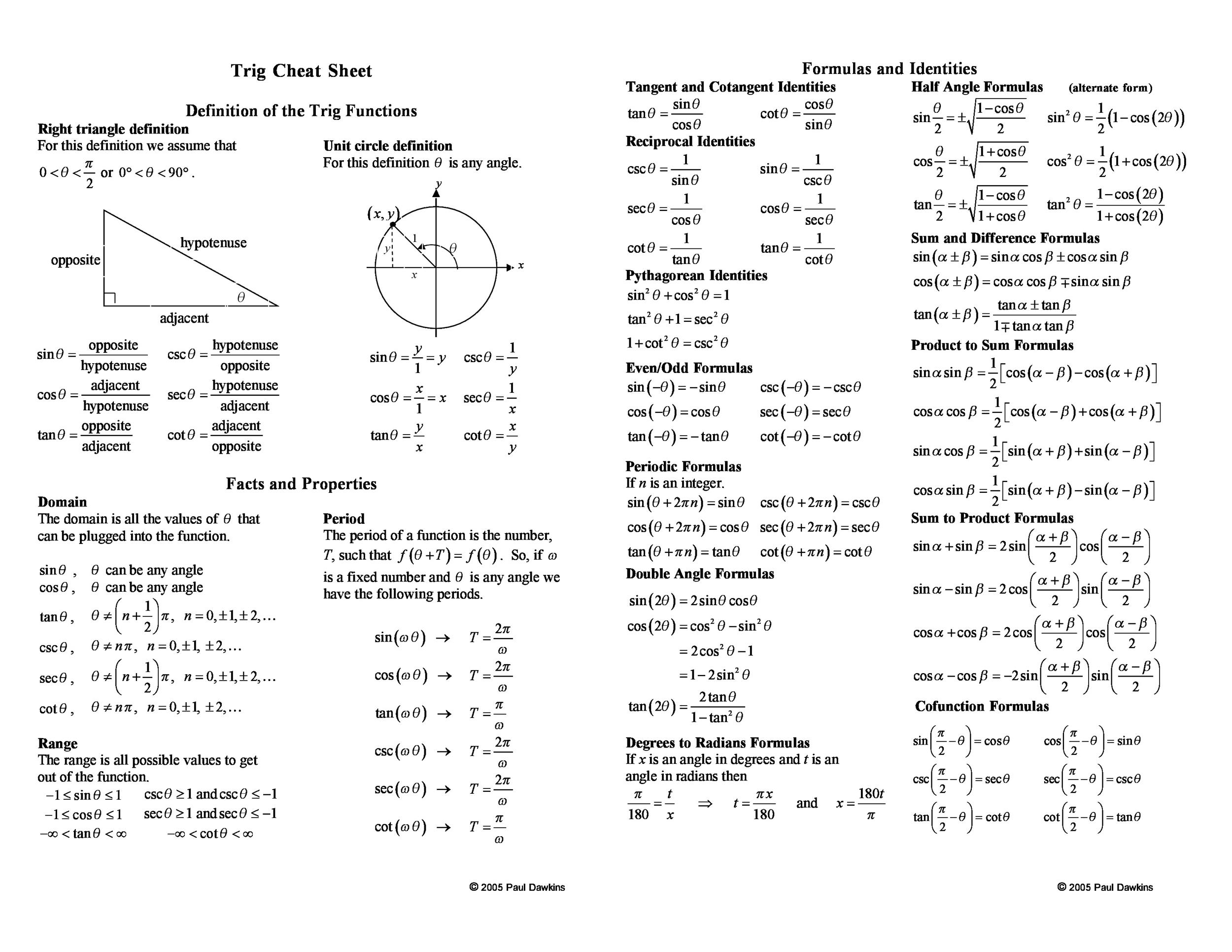
The sine of an angle is defined as the ratio of the length of the side opposite the angle to the length of the hypotenuse (the longest side of a right triangle). In a unit circle, the sine represents the vertical y-coordinate of a point. The name originates from a series of translations involving Sanskrit, Arabic, and Latin, which we will explore further in the etymology section.
Cosine (cos)
The cosine is the ratio of the length of the adjacent side (the side next to the angle that isn't the hypotenuse) to the length of the hypotenuse. The name is a contraction of "complementary sine." This is because the cosine of an angle is exactly equal to the sine of its complementary angle (the angle that, when added to the original, equals 90 degrees).
Tangent (tan)
The tangent of an angle is the ratio of the opposite side to the adjacent side. In geometric terms, if you draw a line that touches a circle at exactly one point, that line is "tangent" to the circle. The trigonometric tangent function represents the slope of the line forming the angle, which is why it is also equivalent to the sine divided by the cosine.
The Etymology and History of Trigonometric Terms
The names for these functions were not chosen arbitrarily; they are the result of over two thousand years of linguistic evolution and mathematical discovery.
The Journey of "Sine"
The word "sine" has perhaps the most colorful history. It began in India with the Sanskrit word jya-ardha, meaning "half-chord," often shortened to jya. When Indian mathematical texts were translated into Arabic during the 8th century, the word was phonetically transcribed as jiba. However, in written Arabic, vowels are often omitted.
Later, when European scholars such as Gerard of Cremona translated these Arabic texts into Latin in the 12th century, they misread the word jb (jiba) as jaib, which means "bay," "inlet," or "fold" in Arabic. Consequently, they used the Latin word for a fold or bay: sinus. Over time, this was anglicized to "sine." Despite being based on a mistranslation, the name stuck and has been the standard for nearly a millennium.
The Evolution of "Tangent" and "Secant"
The term "tangent" comes from the Latin word tangere, which means "to touch." This term was introduced by the Danish mathematician Thomas Fincke in 1583. It reflects the geometric representation of the function on a unit circle, where the value of the tangent corresponds to the length of a segment on a line that is tangent to the circle.
Similarly, the "secant" (the reciprocal of cosine) comes from the Latin secare, meaning "to cut," because a secant line cuts through the circle.
The Development of the "Co-" Prefix
The prefix "co-" in cosine, cotangent, and cosecant stands for complementary. This nomenclature was popularized by Edmund Gunter in the 17th century. He recognized that the sine of an angle's complement was a distinct and useful value, leading to the term sinus complementi, which eventually shortened to "co-sine."
The "Co-" Prefix: Understanding Complementary Relationships
One of the most important concepts in the naming of trigonometric functions is the relationship between a function and its "co-" counterpart. In a right-angled triangle, the two non-right angles are complementary, meaning they sum to 90 degrees (or $\pi/2$ radians).
The "co-" functions are defined by the identity: $f(\theta) = \text{co-}f(90^\circ - \theta)$
For example:
- $\cos(\theta) = \sin(90^\circ - \theta)$
- $\cot(\theta) = \tan(90^\circ - \theta)$
- $\csc(\theta) = \sec(90^\circ - \theta)$
This naming convention provides a built-in mnemonic for understanding how these functions behave. If you know the value of sine for angles between 0 and 45 degrees, you automatically know the values of cosine for angles between 45 and 90 degrees. This symmetry is why mathematical tables—and later, digital algorithms—could be compressed and optimized.
The Reciprocal Functions: Cosecant, Secant, and Cotangent
While sine, cosine, and tangent are the primary functions, they are part of a family of six. The other three are the reciprocal functions. Their names are just as vital for higher-level mathematics and physics.
| Abbreviation | Full Name | Ratio (Triangle) | Relationship to Primary |
|---|---|---|---|
| sin | Sine | Opposite / Hypotenuse | $1 / \csc$ |
| cos | Cosine | Adjacent / Hypotenuse | $1 / \sec$ |
| tan | Tangent | Opposite / Adjacent | $1 / \cot$ |
| csc | Cosecant | Hypotenuse / Opposite | $1 / \sin$ |
| sec | Secant | Hypotenuse / Adjacent | $1 / \cos$ |
| cot | Cotangent | Adjacent / Opposite | $1 / \tan$ |
The cosecant is the reciprocal of the sine. The secant is the reciprocal of the cosine. The cotangent is the reciprocal of the tangent. These functions are particularly useful in calculus when integrating or differentiating trigonometric expressions, and in electrical engineering when calculating impedance and phase shifts.
Practical Applications in 2026
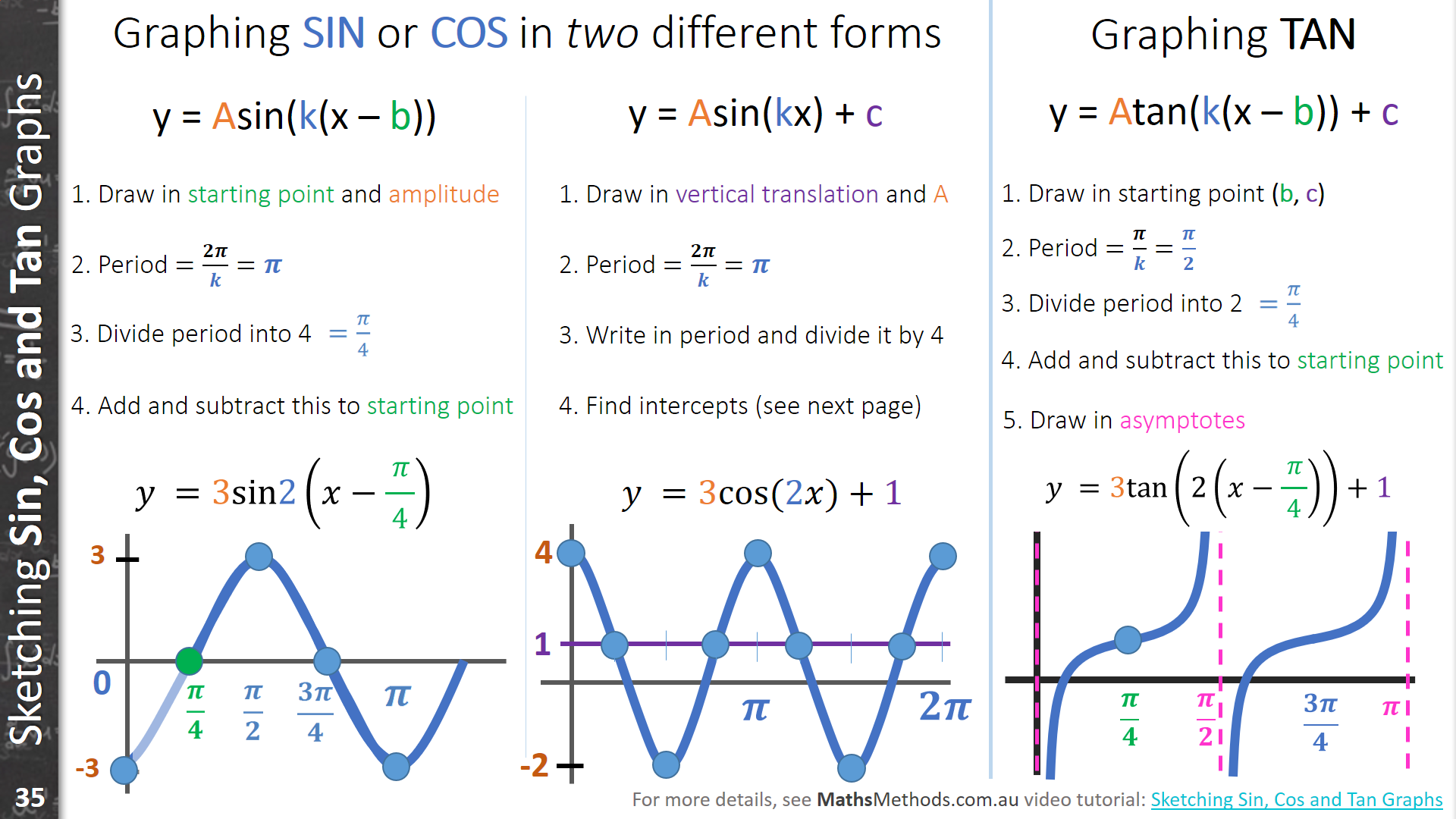
In 2026, the application of sine, cosine, and tangent extends far beyond high school geometry. These functions are the mathematical "language" used to describe waves and periodic phenomena.
- Signal Processing: Whether it is the 6G networks currently being deployed or the processing of digital audio, sine and cosine waves (sinusoids) are used to decompose complex signals into manageable parts using Fourier Analysis.
- Navigation and Aerospace: GPS technology and autonomous drone navigation rely on "spherical trigonometry," which uses these functions to calculate distances and headings over the curved surface of the Earth.
- Architecture and Engineering: Structural engineers use tangent and secant functions to calculate the stresses on beams and the angles of support cables in modern skyscrapers and bridges.
- Computer Graphics: Every 3D video game rendered in 2026 uses trigonometric functions to calculate lighting, shadows, and the rotation of objects in a virtual space. When a character turns their head, the hardware is performing millions of "cos" and "sin" calculations per second.
Common Mnemonics: SOH CAH TOA
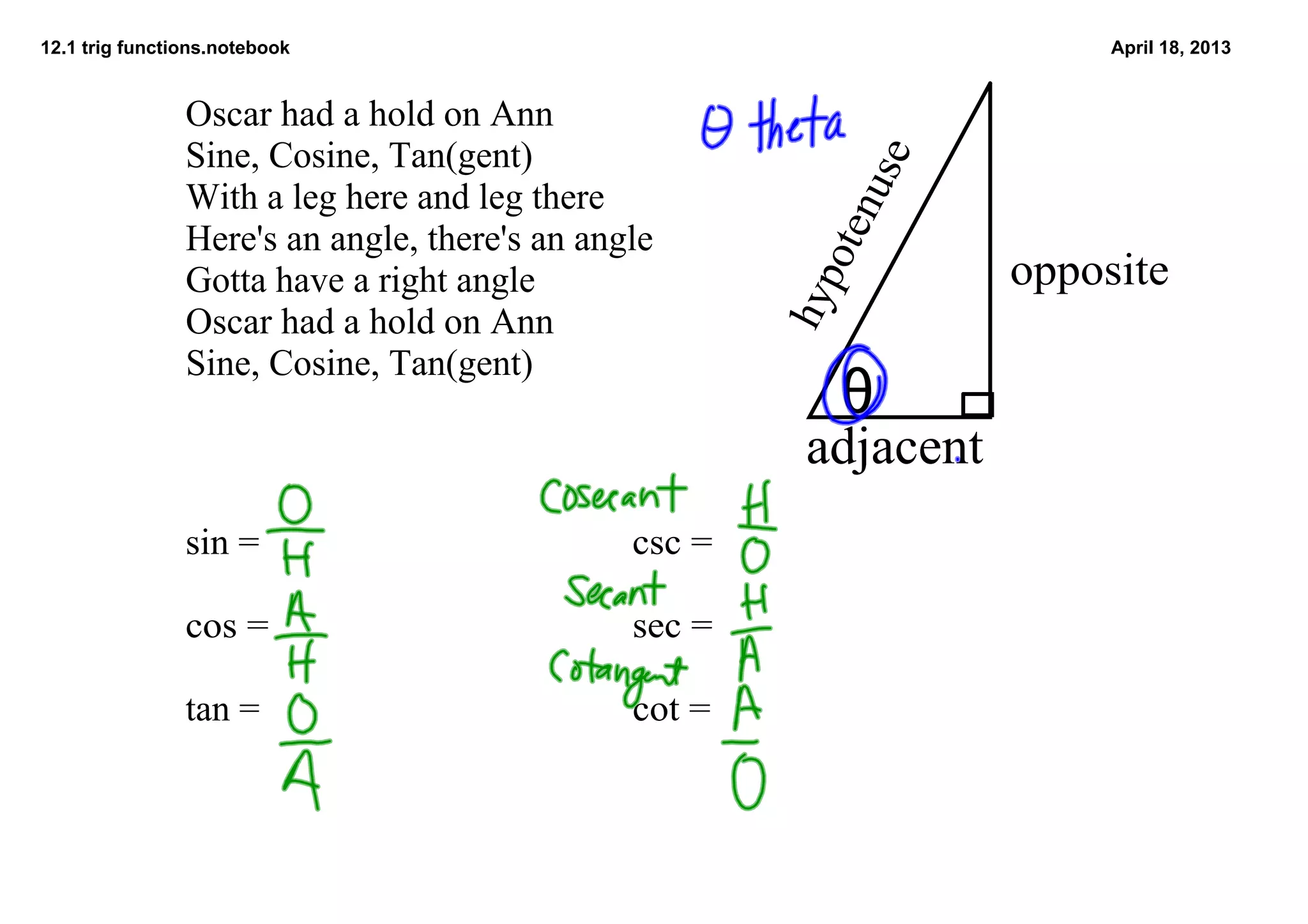
To remember the names and the ratios they represent, the most famous mnemonic remains SOH CAH TOA. This has been the standard instructional tool for decades and remains effective for students today.
- SOH: Sine = Opposite / Hypotenuse
- CAH: Cosine = Adjacent / Hypotenuse
- TOA: Tangent = Opposite / Adjacent
By memorizing this single phrase, one can quickly reconstruct the primary relationships of trigonometry without having to consult a textbook.
Frequently Asked Questions
Why do we use abbreviations like sin, cos, and tan?
Abbreviations are used primarily for brevity in mathematical notation and to fit on the limited interface of physical and digital calculators. Using "sin(x)" is significantly more efficient than writing out "the sine of x" repeatedly in complex equations or computer code.
Is there a difference between "trigonometric ratios" and "trigonometric functions"?
While the terms are often used interchangeably, "ratios" usually refers to the relationship between sides in a right triangle (limited to angles between 0 and 90 degrees). "Functions" refers to the broader application of these rules to any angle, including negative angles and those greater than 360 degrees, typically mapped on a coordinate plane or unit circle.
Who is credited with naming these functions?
No single person "invented" the names. Sine evolved through centuries of translations. Tangent and Secant were named by Thomas Fincke in 1583. Cosine was coined by Edmund Gunter in 1620. The modern notation we use today was largely standardized by Leonhard Euler in the 18th century.
Are there other trigonometric functions besides these six?
Yes, there are historical functions like the versine (1 - cos), haversine (half of a versine), and exsecant (sec - 1). While these were once crucial for maritime navigation before the advent of digital computers, they are rarely used in modern 2026 mathematics, as they can be easily expressed using the primary six functions.
What is the name for the inverse of sin, cos, and tan?
The inverse functions are called arcsine, arccosine, and arctangent. They are often abbreviated as arcsin, arccos, and arctan, or denoted with a superscript -1 ($sin^{-1}$, $cos^{-1}$, $tan^{-1}$). These functions allow you to find the angle if you already know the ratio of the sides.
Final Recommendation
When working with these terms, always ensure you are using the correct mode on your calculation tools—degrees or radians. A common mistake is calculating the "sin" of an angle in degrees while the software is set to radians, leading to incorrect results. For those looking to master the subject, focusing on the unit circle is the best way to move beyond simple triangle ratios and understand the true nature of these functions as oscillating waves.
Image Gallery