Understanding Arkansas Auto Insurance: A Comprehensive Guide to Laws, Coverage, and Costs in 2026
Navigating the complexities of Arkansas auto insurance requires a clear understanding of the state’s "fault" system, mandatory minimum liability limits, and the various optional coverages that protect against high-risk scenarios. In 20...
Navigating the complexities of Arkansas auto insurance requires a clear understanding of the state’s "fault" system, mandatory minimum liability limits, and the various optional coverages that protect against high-risk scenarios. In 2026, Arkansas law mandates that all vehicle owners maintain specific liability insurance levels to legally operate on public roads, ensuring financial responsibility in the event of an accident.
Contents
As a driver in the Natural State, you are entering a regulatory environment overseen by the Arkansas Insurance Department (AID). Whether you are commuting in Little Rock, navigating the Ozarks, or driving through the agricultural corridors of the Delta, your insurance policy serves as a critical financial shield. This guide breaks down the legal requirements, the nuances of Arkansas’s tort system, and the practical steps needed to secure the best coverage for your needs.
The Foundation of Arkansas Auto Insurance: Mandatory Liability Limits
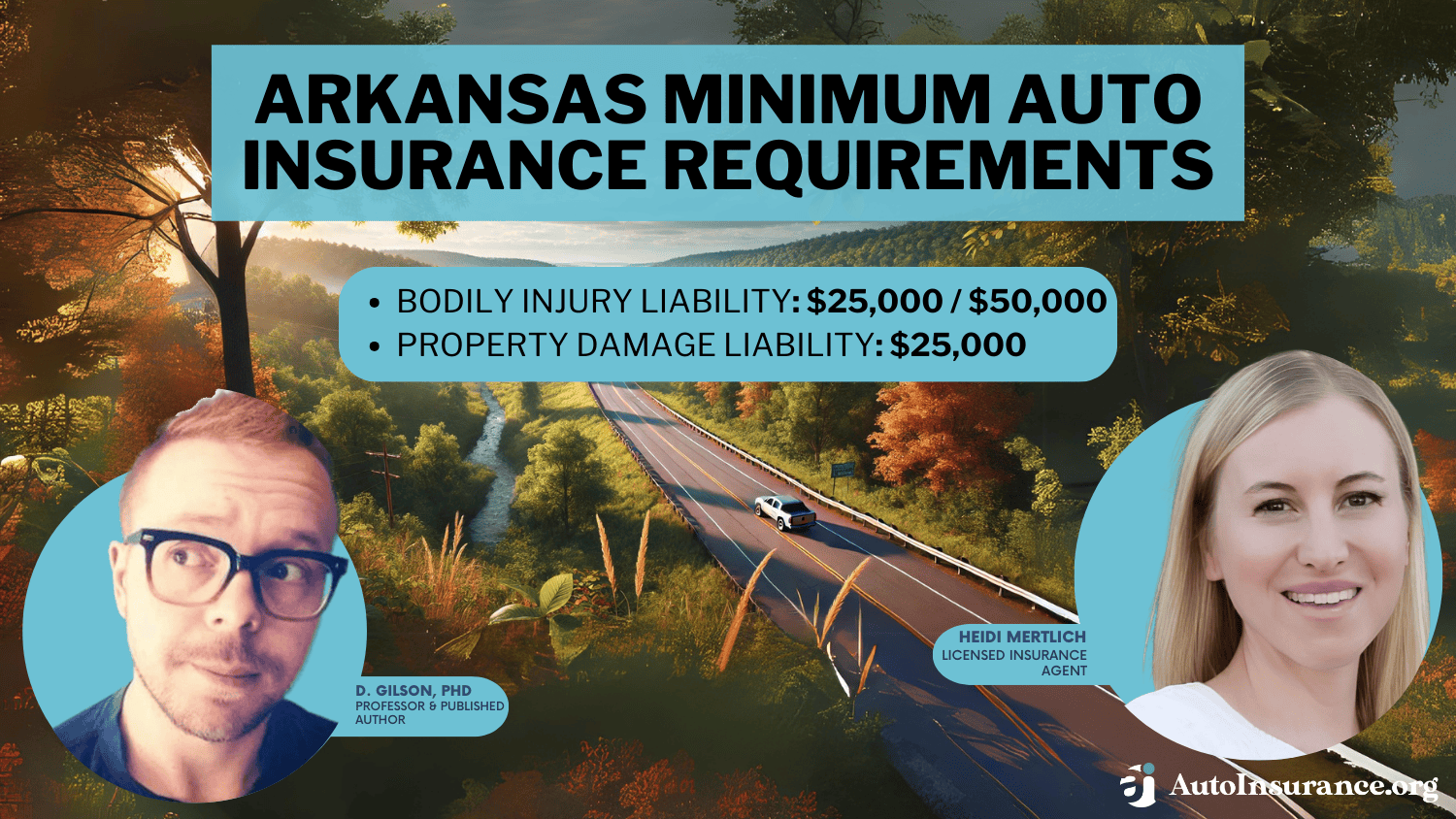
In Arkansas, the law requires a baseline level of liability insurance. This insurance does not cover your own injuries or vehicle damage; rather, it pays for the injuries and property damage you cause to others in an at-fault accident. As of 2026, the state-mandated minimums remain established under the "25/50/25" rule.
Breaking Down the 25/50/25 Requirement
- $25,000 for Bodily Injury (Per Person): This is the maximum amount your insurer will pay for the medical expenses, funeral costs, or lost wages of a single person injured in an accident where you are at fault.
- $50,000 for Bodily Injury (Per Accident): This is the total cap your insurance company will pay for all injuries sustained by multiple people in a single accident. If three people are injured and their combined medical bills reach $60,000, your policy only covers $50,000, leaving you personally liable for the remaining $10,000.
- $25,000 for Property Damage: This covers repairs to the other driver's vehicle, fences, buildings, or any other property damaged in the collision. Given that the average price of a new vehicle in 2026 often exceeds $45,000, this $25,000 limit is frequently viewed by experts as insufficient.
While these are the legal minimums to avoid fines and license suspension, they represent a "floor," not a "ceiling." Financial advisors generally recommend higher limits, such as 100/300/100, to protect personal assets from lawsuits following a major accident.
Arkansas’s Fault-Based (Tort) System
Arkansas operates under a tort system, which is a "fault-based" insurance model. This means that after an accident, an investigation is conducted to determine who was responsible. The party found at fault is legally liable for the resulting damages.
Modified Comparative Fault
Arkansas follows a modified comparative fault rule (specifically the 50% bar rule). Under this statute, an injured party can recover damages from another driver only if their own fault is less than 50%. If you are found to be 51% responsible for an accident, you cannot collect any damages from the other party. If you are 30% at fault, your total compensation will be reduced by 30%. This legal structure makes it imperative to have a robust insurance provider that can effectively investigate claims and represent your interests during a dispute.
Required Offerings: PIP and Uninsured Motorist Coverage
While liability is the only coverage you are required to carry by law, Arkansas statutes require insurance companies to offer you certain additional protections. You have the right to reject these in writing, but understanding their value is vital before signing a waiver.
Personal Injury Protection (PIP)
Arkansas is unique among tort states because it requires insurers to offer Personal Injury Protection. Often associated with "no-fault" states, PIP in Arkansas provides immediate coverage for medical bills, 70% of lost wages, and death benefits regardless of who caused the accident. Because a fault determination can take months, PIP ensures that you have access to medical care and income replacement immediately following a collision.
Uninsured/Underinsured Motorist (UM/UIM)
Arkansas consistently ranks among the states with a high percentage of uninsured drivers. Therefore, UM/UIM coverage is a critical safety net.
- Uninsured Motorist (UM): Pays for your medical bills and property damage if you are hit by a driver who has no insurance or by a hit-and-run driver.
- Underinsured Motorist (UIM): Steps in when the at-fault driver has insurance, but their limits are too low to cover your total losses. For example, if you have $100,000 in medical bills and the other driver only has the state-minimum $25,000, your UIM policy would cover the $75,000 gap.
Comprehensive and Collision: Protecting Your Asset
Liability insurance protects your bank account, but Comprehensive and Collision coverages protect your vehicle. If you are financing or leasing a car in Arkansas in 2026, your lender will almost certainly require these coverages.
- Collision Coverage: This pays for damage to your vehicle resulting from a crash with another car or an object (like a tree or pole), regardless of fault.
- Comprehensive Coverage: Often called "other than collision," this is particularly relevant in Arkansas due to the state's weather patterns. It covers damage from hail, tornadoes, floods, theft, fire, and animal strikes (such as hitting a deer).
Given the increasing frequency of severe weather events in the Mid-South, maintaining comprehensive coverage with a manageable deductible is a prudent strategy for Arkansas residents.
Factors Influencing Auto Insurance Rates in Arkansas
In 2026, insurance premiums are calculated using complex algorithms, but several Arkansas-specific factors play a major role in what you pay.
- Location (Rating Territory): Drivers in high-traffic areas like Little Rock, Fort Smith, or Fayetteville typically pay higher premiums than those in rural Madison or Newton Counties due to the higher statistical likelihood of accidents and theft.
- Credit-Based Insurance Scores: Arkansas law allows insurers to use your credit history as a factor in determining your risk level. Drivers with higher credit scores generally enjoy significantly lower premiums.
- Driving Record: Speeding tickets, DUIs, and at-fault accidents within the last three to five years will substantially increase your rates.
- Vehicle Type: The cost of parts and labor in 2026 has influenced premiums. High-tech electric vehicles (EVs) or luxury SUVs with advanced sensor arrays often cost more to insure because they are more expensive to repair.
- Annual Mileage: The more you drive on Arkansas highways, the higher your exposure to risk.
The Arkansas Online Insurance Verification System (OIVS)
To combat the issue of uninsured motorists, Arkansas utilizes the Online Insurance Verification System (OIVS). This system allows law enforcement officers and the Department of Finance and Administration (DFA) to verify your insurance status in real-time during traffic stops or registration renewals.
If the OIVS shows a lapse in coverage, the DFA will issue a notice. Failure to provide proof of insurance can lead to:
- Fines ranging from $50 to $250 for a first offense.
- The suspension of vehicle registration.
- Mandatory impoundment of the vehicle.
- Requirement of an SR-22 filing for high-risk reinstatement.
Comparison of Coverage Types in Arkansas
| Coverage Type | Is it Required? | What it Pays For | Who it Protects |
|---|---|---|---|
| Bodily Injury Liability | Yes (25/50) | Medical/legal costs of others | Other drivers/passengers |
| Property Damage Liability | Yes (25) | Damage to others' property | Other property owners |
| PIP (Personal Injury) | Optional* | Your medical bills/lost wages | You and your passengers |
| UM/UIM | Optional* | Your costs if the other driver lacks insurance | You and your passengers |
| Collision | Optional** | Repairs to your vehicle after a crash | Your vehicle investment |
| Comprehensive | Optional** | Damage from hail, theft, or animals | Your vehicle investment |
*Insurers must offer it; you must reject it in writing if you don't want it. **Required by most lienholders/leasing companies.
Frequently Asked Questions
1. Does Arkansas require "Full Coverage"?
No. "Full coverage" is a marketing term, not a legal one. Arkansas law only requires liability insurance. However, if you have an auto loan, your lender will require collision and comprehensive coverage to protect their collateral.
2. Is my insurance policy valid if I drive out of state?
Yes. Your Arkansas auto insurance policy provides coverage across all 50 U.S. states and Canada. If the state you are visiting has higher minimum requirements than Arkansas, your policy will typically "step up" to meet that state's minimums automatically while you are driving there.
3. What is the Arkansas Automobile Insurance Plan?
This is a "last resort" plan for high-risk drivers who have been denied coverage in the voluntary market. If multiple insurance companies refuse to cover you due to a poor driving record, you can apply for this plan through any licensed agent to ensure you meet the legal requirements to drive.
4. Can I use a digital insurance card in Arkansas?
Yes. As of 2026, Arkansas law permits drivers to display proof of insurance on a smartphone or other electronic device during traffic stops. However, it is always recommended to keep a paper backup in the glovebox in case of a dead battery or technical issues.
5. How does a "Total Loss" work in Arkansas?
In Arkansas, a vehicle is typically considered a total loss if the cost of repairs plus the salvage value exceeds the vehicle's Actual Cash Value (ACV). The insurer will pay you the market value of the car (minus your deductible) rather than repairing it.
Next Steps for Arkansas Drivers
To ensure you are properly protected in 2026, start by reviewing your current "Declarations Page." Check if your liability limits are still the state-minimum 25/50/25; if they are, contact your agent to quote higher limits, as the price difference is often negligible compared to the increased protection. Additionally, verify that you haven't inadvertently waived PIP or UM/UIM coverage, as these are vital in a state with significant numbers of uninsured drivers. Always shop for quotes at least once a year or after a major life event—such as a move or a change in credit score—to ensure you are receiving the most competitive rate available in the Arkansas market.
Image Gallery