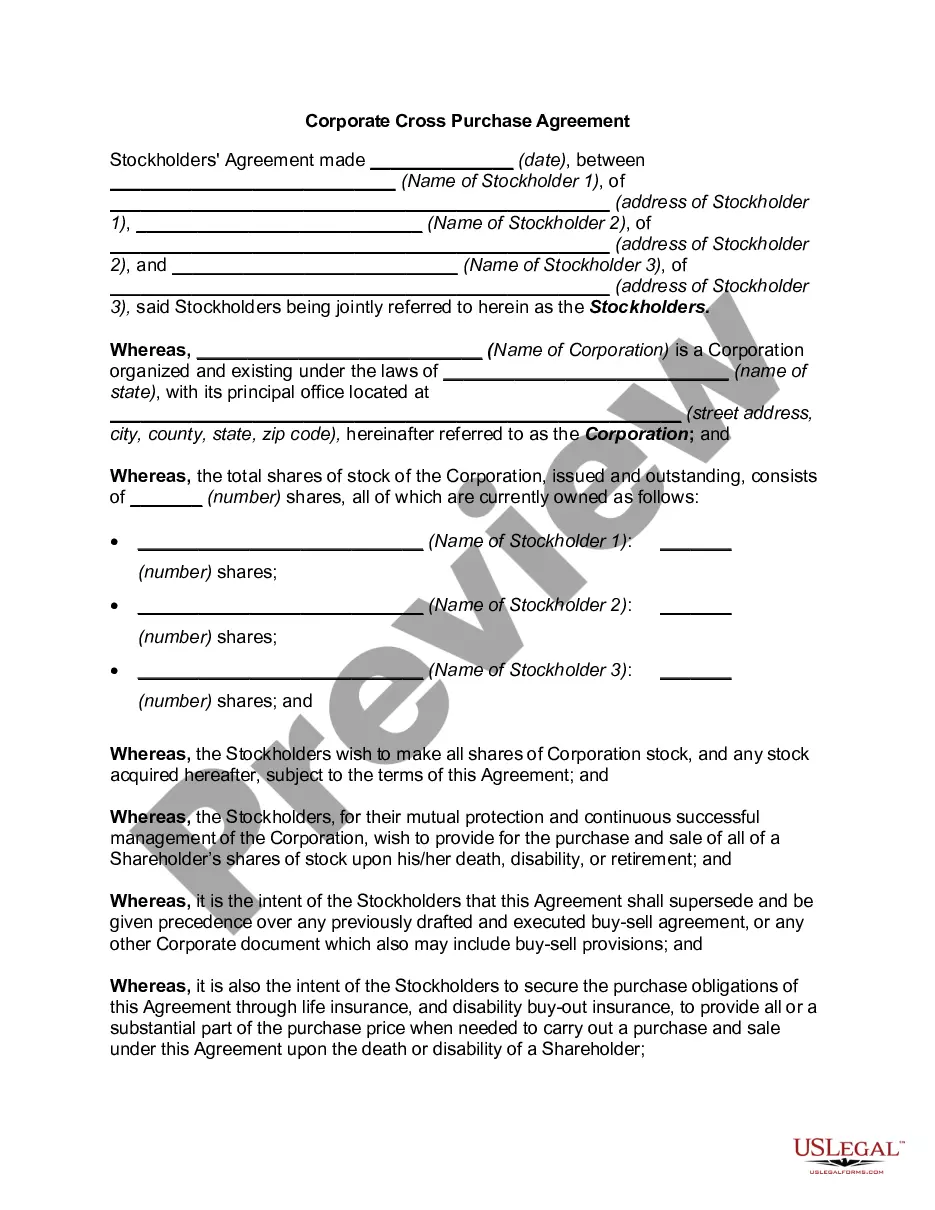
Understanding What a Cross Purchase Plan Is for Business Partners
A cross-purchase plan is a formal business agreement backed by life insurance policies where each business partner buys a policy on the lives of the other partners to ensure a smooth transition of ownership if someone dies. When one pa...
A cross-purchase plan is a formal business agreement backed by life insurance policies where each business partner buys a policy on the lives of the other partners to ensure a smooth transition of ownership if someone dies. When one partner passes away, the surviving partners use the insurance proceeds to buy out the deceased partner's share from their estate, providing financial security to the family while keeping the business under the control of the remaining owners.
Contents
Introduction to Business Continuity and Buy-Sell Agreements
When individuals enter into a business partnership, they invest time, capital, and vision into a shared enterprise. However, future uncertainties—specifically the death, disability, or retirement of a partner—pose severe risks to business continuity. Without a pre-arranged blueprint, the sudden passing of a co-owner can lead to chaotic ownership disputes, financial strain, and potential liquidation. To mitigate these catastrophic scenarios, co-owners rely on a legal contract known as a buy-sell agreement.
A buy-sell agreement dictates how a partner's shares will be redistributed or acquired under specific triggering events. While these agreements establish the valuation rules and the legal obligations of the parties involved, they require a reliable funding mechanism to ensure that the surviving partners actually have the capital required to execute a buyout. This is where specialized funding structures, most notably the cross-purchase plan, become essential. Understanding how this plan functions allows business partners to protect their investments and maintain operational stability.
Core Mechanics of a Cross-Purchase Plan
At its foundation, a cross-purchase plan relies on individual life insurance policies owned by the partners reciprocally. Unlike an entity-purchase plan (where the business entity itself buys and owns the policies on each partner), a cross-purchase plan places ownership directly in the hands of the individual co-owners.
To illustrate how this functions, consider a small enterprise with three equal partners: Alice, Bob, and Charlie. Under a cross-purchase arrangement:
- Alice purchases a life insurance policy on Bob and another on Charlie, paying the premiums herself and acting as the primary beneficiary.
- Bob purchases a policy on Alice and another on Charlie, managing the premiums and beneficiary designations independently.
- Charlie purchases a policy on Alice and another on Bob, following the same reciprocal structure.
When a triggering event occurs—such as the unexpected death of Bob—Alice and Charlie receive the tax-free death benefits from the policies they respectively own on Bob's life. They then use these cash proceeds to purchase Bob’s ownership stake directly from his surviving estate. Bob’s family receives fair market value compensation for the business shares, while Alice and Charlie absorb those shares, increasing their ownership percentages without dipping into operating capital or taking on crippling debt.
Comparison: Cross-Purchase Plans vs. Entity-Purchase Plans
Choosing the right structure depends heavily on the number of partners, age disparities, and administrative preferences. Business owners typically weigh cross-purchase plans against entity-purchase (or stock-redemption) plans.
| Feature | Cross-Purchase Plan | Entity-Purchase Plan |
|---|---|---|
| Policy Ownership | Individual partners own policies on each other. | The business entity owns policies on all partners. |
| Payer of Premiums | Individual partners pay out of personal funds. | The business entity pays out of business funds. |
| Complexity with Many Partners | High (requires $N \times (N-1)$ policies). | Low (requires only one policy per partner, $N$). |
| Basis Step-Up | Surviving partners receive a step-up in tax basis. | Surviving partners do not receive a direct basis step-up. |
| Age and Premium Disparity | Can be burdensome if older partners pay higher rates for younger partners. | Balanced evenly across the business cash flow. |
The administrative complexity of a cross-purchase plan grows exponentially as the number of partners increases. For two partners, only two policies are required ($2 \times 1$). For five partners, however, the formula $N \times (N-1)$ dictates that twenty policies must be underwritten, tracked, and maintained.
Advantages of Utilizing a Cross-Purchase Plan
Despite the administrative hurdles associated with multi-partner setups, cross-purchase plans offer distinct financial and legal advantages that make them the preferred choice for many closely held corporations, partnerships, and limited liability companies (LLCs).
Tax Basis Advantages
The most significant benefit of a cross-purchase plan is the favorable tax treatment regarding the surviving partners' cost basis. When surviving partners use insurance proceeds to buy out a deceased partner's shares, those newly acquired shares receive a stepped-up tax basis equal to the purchase price. If the surviving partners eventually decide to sell the entire business later, this higher tax basis significantly reduces their capital gains tax liability.
Direct Control and Creditor Protection
Because the policies are owned individually rather than by the business entity, the cash values and death benefits are generally insulated from the business's general creditors. If the company faces lawsuits or bankruptcy proceedings, the insurance policies owned by the individual partners remain legally separate business assets, safeguarding the buyout funds from corporate liabilities.
Challenges and Administrative Hurdles
While the structural benefits are substantial, business partners must navigate several logistical hurdles before implementing a cross-purchase plan.
Premium Disparities and Age Gaps
Because individual partners pay the premiums for the policies on their co-owners, significant age or health disparities can create friction. For example, if a 62-year-old senior partner is in a partnership with a 30-year-old junior partner, the younger partner will face prohibitively expensive life insurance premiums to cover the older partner. Solving this disparity often requires supplemental compensation agreements or adjustments to salary distributions to balance the out-of-pocket costs.
The Trustee Solution for Multi-Partner Entities
To solve the "too many policies" problem in businesses with three or more partners, owners frequently utilize a trustee-owned cross-purchase plan. Instead of every partner holding multiple individual policies, the partners establish a single trust. The trust owns a single policy on each partner, collects the premiums, and handles the buyout execution upon a partner's death. This reduces the policy count to match the exact number of partners while retaining the tax advantages of a cross-purchase structure.
Setting Up and Maintaining a Cross-Purchase Plan
Implementing a cross-purchase plan requires a disciplined, multi-step process involving legal, financial, and insurance professionals. Skipping steps can render the agreement legally unenforceable or tax-inefficient.
- Business Valuation: The partners must establish a clear, objective method for valuing the business. Common valuation methods include independent appraisals, formula-based valuations, or periodic agreed-upon values documented in writing.
- Drafting the Buy-Sell Agreement: A qualified corporate attorney must draft the binding legal contract outlining the triggering events (death, disability, retirement, or departure), the buyout terms, and the payment structures.
- Securing Life Insurance: Underwriters evaluate the health and insurability of each partner. Policies are then issued according to the cross-purchase matrix, with proper beneficiary designations verified.
- Regular Review: Business values fluctuate over time. Partners should review the insurance coverage amounts and the business valuation annually to ensure the death benefits match current equity values.
Disclaimer: This article provides educational information regarding business planning concepts and should not be construed as legal, tax, or financial advice. Business partners should consult qualified certified public accountants, estate planning attorneys, and licensed insurance professionals before executing any buy-sell agreements.
Frequently Asked Questions
What happens to a cross-purchase plan if a partner leaves the business voluntarily?
If a partner retires or departs voluntarily, the buy-sell agreement typically triggers a buyout provision where the remaining partners or the business buy out the departing partner's shares over an agreed timeframe. The departing partner often has the option to purchase the existing life insurance policies that the other partners hold on their life, or the policies can be surrendered or transferred according to IRS transfer-for-value rules.
Are the life insurance death benefits received in a cross-purchase plan taxable?
Generally, life insurance death benefits received by individual beneficiaries—including business partners in a cross-purchase arrangement—are received completely income tax-free under Internal Revenue Code Section 101(a). However, careful structuring is required to avoid violating the "transfer-for-value" rule if existing policies are sold or transferred between partners later.
How does a cross-purchase plan handle partner disabilities?
While traditional cross-purchase plans focus primarily on death, comprehensive buy-sell agreements also integrate disability buy-sell insurance. If a partner becomes permanently disabled, disability insurance policies provide monthly benefits or lump sums that fund the buyout of the disabled partner's shares, ensuring they receive financial support while the healthy partners retain control.
Can a cross-purchase plan be used if there is a large age gap between partners?
Yes, but it requires careful financial balancing. To offset the higher premium costs that younger partners face when insuring older partners, the partners often agree to adjust base salaries, profit-sharing distributions, or bonus structures so that the net financial burden of the insurance premiums is distributed equitably among all co-owners.
What is the transfer-for-value rule, and why does it matter?
The transfer-for-value rule dictates that if a life insurance policy is transferred for valuable consideration (such as cash or other property), a portion of the death benefit may become subject to ordinary income taxes. In cross-purchase plans, partners must be careful when transferring policies among themselves or to the business entity, ensuring they rely on statutory exceptions—such as transferring the policy to the insured individual—to preserve the tax-free nature of the death benefit.
Conclusion and Next Actions
A cross-purchase plan serves as an indispensable tool for business partners seeking to safeguard their enterprise against the unexpected loss of a co-owner. By combining individual life insurance ownership with a legally binding buy-sell agreement, partners secure financial liquidity, protect their families, and maintain uninterrupted control over company operations. To take action, schedule a joint meeting with your corporate attorney, business accountant, and financial advisor to establish an accurate company valuation and initiate appropriate policy underwriting.
Image Gallery