Best Landing Pages in 2025: A Retrospective on High-Conversion Design
In 2025, the most successful landing pages shifted from static information hubs to dynamic, generative experiences. High-performing pages prioritized hyper-personalization, lightning-fast technical performance, and immersive storytelli...
In 2025, the most successful landing pages shifted from static information hubs to dynamic, generative experiences. High-performing pages prioritized hyper-personalization, lightning-fast technical performance, and immersive storytelling. By analyzing the top-tier designs of the past year, we can identify the specific frameworks and interactive elements that drove record-breaking conversion rates across SaaS, e-commerce, and professional services.
Contents
The Evolution of Landing Page Strategy in 2025
The landscape of digital marketing underwent a fundamental transformation throughout 2025. We moved beyond the era of simple A/B testing into the era of Generative UI. This technology allowed landing pages to reorganize their layout, copy, and imagery in real-time based on the specific referral source or user intent. A visitor arriving from a "technical SEO" search would see a data-heavy, specification-oriented page, while a visitor from a "marketing strategy" search would see a high-level, benefit-driven version of the exact same URL.
This shift was driven by the necessity to reduce cognitive load. In a market saturated with AI-generated noise, the "best" landing pages of 2025 were those that provided the path of least resistance. This meant moving away from long-form sales letters toward modular, "Bento-box" style layouts that allowed users to scan and digest information rapidly.
The Rise of Zero-Party Data Collection
Rather than relying solely on third-party cookies, which continued to face privacy-related hurdles, 2025’s top landing pages utilized interactive quizzes and micro-surveys. These tools served a dual purpose: they engaged the user immediately and provided the business with "zero-party data"—information intentionally shared by the consumer. This data was then used to customize the call-to-action (CTA), making the final offer feel uniquely tailored to the individual’s problems.
Technical Standards for Peak Performance
In 2025, technical excellence was no longer optional. Google’s continued emphasis on Core Web Vitals, specifically the refinement of Interaction to Next Paint (INP), meant that any page with perceptible lag saw an immediate drop in both organic rankings and conversion efficiency.
Speed as a Competitive Moat
The highest-converting pages of 2025 leveraged edge computing and modern frameworks like Astro or Qwik to deliver near-instant load times. By shipping zero or minimal JavaScript to the browser, these pages ensured that the "Hero" section was interactive within milliseconds. This technical optimization was particularly critical for mobile users, who accounted for over 70% of landing page traffic in most industries last year.
Accessibility and WCAG 2.2 Compliance
2025 was also the year that accessibility became a mainstream conversion driver. Beyond legal compliance, designers realized that high-contrast ratios, keyboard navigability, and screen-reader-friendly structures improved the experience for all users. The best pages utilized semantic HTML and ARIA labels not as an afterthought, but as a core component of the development process.
Essential Components of 2025’s Best Landing Pages
While the aesthetic trends of 2025 favored minimalism and "glassmorphism," the underlying structure of high-converting pages followed a rigorous psychological blueprint.
1. The Dynamic Hero Section
The hero section (the area above the fold) had to accomplish three things in under two seconds: identify the user’s pain point, present a unique solution, and offer a clear next step. In 2025, we saw the replacement of static hero images with high-fidelity 3D renders or short, looped video backgrounds that demonstrated the product in action without slowing down the page.
2. Social Proof 2.0
Generic testimonials like "Great service!" lost all effectiveness by 2025. The best pages replaced these with verified social proof. This included real-time data feeds showing recent purchases, video testimonials from recognizable industry figures, and badges from independent review platforms like G2 or Trustpilot that updated dynamically.
3. The "Frictionless" Lead Form
Forms in 2025 became shorter and smarter. Using API integrations (such as Clearbit or ZoomInfo), pages could "pre-fill" business data based on an email address, reducing the number of fields a user had to type manually. This reduction in friction typically resulted in a 20-30% increase in completion rates.
Comparison of Leading Landing Page Builders in 2025
The tools used to build these pages evolved significantly. Below is a comparison of the primary platforms that dominated the 2025 market based on their feature sets and performance capabilities.
| Platform | Primary Strength | AI Integration Level | Best For |
|---|---|---|---|
| Framer | High-end animation & design | Advanced (Text-to-Site) | Design-forward SaaS & Startups |
| Webflow | CMS & Custom Logic | Moderate (Copilot features) | Enterprise-grade custom sites |
| Instapage | Ad-map & Personalization | High (Dynamic Content) | PPC-heavy marketing teams |
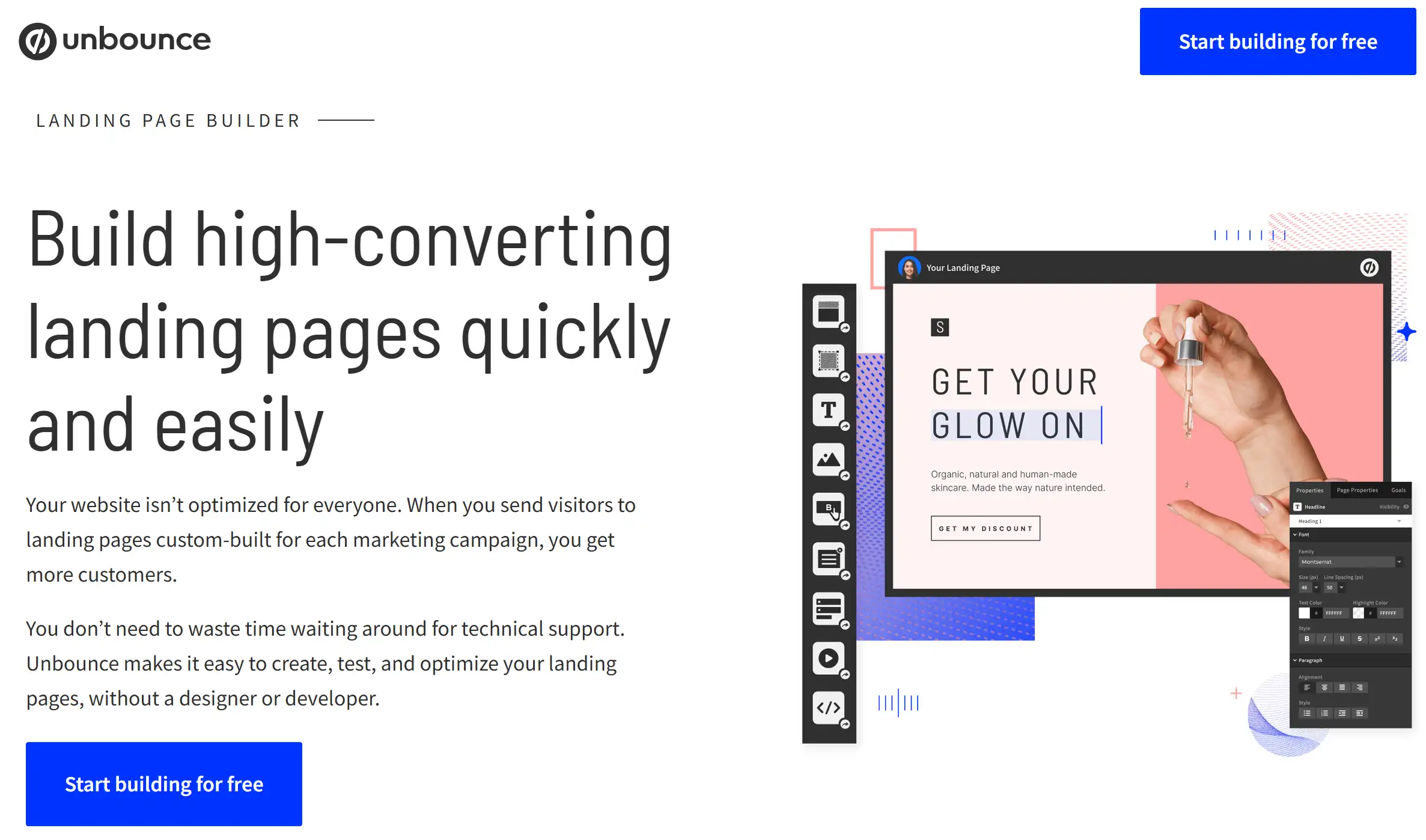
| Unbounce | Conversion Intelligence | High (Smart Builder) | Lead generation & SMBs |
| Shogun | E-commerce integration | Moderate (Visual Merchandising) | Shopify & BigCommerce stores |
Industry-Specific Success Stories
SaaS and Enterprise Software
The standout SaaS landing pages of 2025, such as those from Linear or Vercel, focused on "Developer Experience" (DX). They featured interactive code snippets and "live" product dashboards that users could manipulate before ever signing up. This "try-before-you-buy" transparency built immediate trust.
E-commerce and D2C
In the e-commerce sector, the best pages leveraged Augmented Reality (AR). For example, furniture retailers allowed users to trigger their phone’s camera directly from the landing page to "place" a product in their room. This immersive experience significantly reduced the hesitation associated with high-ticket online purchases.
Professional Services and B2B
For B2B services, 2025 saw a move toward Education-Based Marketing (EBM). Instead of a hard sell, landing pages acted as gateways to high-value assets like whitepapers, interactive calculators, or proprietary research. By solving a small problem for free, these pages successfully moved leads into the nurturing funnel.
Common Mistakes to Avoid (Lessons from 2025)
Despite the technological leaps, many brands struggled by repeating outdated patterns. The following pitfalls were the most common causes of low conversion rates in 2025:
- Over-reliance on AI Copy: While AI can draft content, pages that didn't undergo heavy human editing felt "uncanny" and lacked a distinct brand voice, leading to high bounce rates.
- Excessive Interactive Elements: Too many "scroll-triggered" animations can overwhelm the user. The best pages used motion purposefully to draw attention to the CTA, not just for decoration.
- Neglecting "Dark Mode" Optimization: By 2025, over half of users browsed in dark mode. Pages that didn't have a dedicated dark-themed CSS often looked broken or unappealing to a large segment of the audience.
- Slow Third-Party Scripts: Tracking pixels and chat widgets often became the bottleneck for page speed. Successful teams used "Server-Side Tagging" to keep the client-side experience clean.
Psychological Triggers and UX Patterns
The most effective landing pages of 2025 mastered the art of Micro-copy. This involves the small bits of text—on buttons, under form fields, and in error messages—that guide a user. Instead of a button that says "Submit," a 2025 high-performer used "Get My Free Audit" or "Start Building Now."
Furthermore, the Bento Grid layout became a staple. This design pattern uses a series of rectangular boxes of varying sizes to organize content. It mimics the look of modern operating systems (like iOS or Android), making the interface feel familiar and intuitive. Each "box" in the grid focuses on a single feature or benefit, preventing the user from feeling overwhelmed by a wall of text.
Frequently Asked Questions
What was the average conversion rate for a top-tier landing page in 2025?
While rates varied by industry, the "best-in-class" benchmark for B2B SaaS hovered around 12-15%, while high-performance e-commerce pages often saw 5-8%. These figures were significantly higher than the 2-3% averages seen in previous years, largely due to the implementation of hyper-personalization and faster load speeds.
Did video backgrounds help or hurt landing pages in 2025?
When optimized correctly using modern formats like AV1 or WebM, video backgrounds significantly boosted engagement without sacrificing speed. However, they were most effective when used subtly. High-performing pages used video to demonstrate "product feel" rather than as a distracting cinematic intro.
How important was mobile-first design compared to desktop?
Mobile-first was the absolute standard. In 2025, most designers began the process with the mobile viewport and "scaled up" to desktop. Pages that were merely "responsive" (shrunk-down versions of desktop) often failed to convert because they didn't account for thumb-reach zones or mobile-specific interaction patterns.
Was "Gated Content" still effective in 2025?
Yes, but the "gate" became more transparent. Instead of asking for a phone number and company size upfront, the best pages offered a "partial preview" of the content. Once the user was engaged with the first few pages or insights, they were more willing to provide their details to see the full report.
How did AI change the role of the landing page designer?
AI didn't replace designers; it shifted their focus from execution to curation and strategy. Designers in 2025 used AI to generate dozens of layout variations and color palettes instantly, allowing them to spend more time on user psychology, brand storytelling, and complex data integration.
Final Recommendation for 2026
To achieve success in the current 2026 environment, you must apply the lessons learned from 2025’s top performers. Start by auditing your current technical stack; if your page takes longer than 1.5 seconds to become interactive, you are losing revenue. Move toward a modular design system that supports dynamic content insertion. Most importantly, stop viewing your landing page as a static flyer and start viewing it as a personalized conversation. Focus on gathering zero-party data through interactive elements and use that information to present the most relevant solution to every individual visitor.
Image Gallery