Why the Princess Leia Bikini Scene Still Matters: Culture, Agency, and Cinema History
The Princess Leia gold bikini scene from Star Wars: Episode VI - Return of the Jedi (1983) remains culturally vital because it sits at the intersection of Hollywood objectification, female agency, and pop culture legacy. Far from being...
The Princess Leia gold bikini scene from Star Wars: Episode VI - Return of the Jedi (1983) remains culturally vital because it sits at the intersection of Hollywood objectification, female agency, and pop culture legacy. Far from being just a sexualized trope, Leia’s ultimate strangulation of Jabba the Hutt transformed her bondage into an enduring symbol of self-liberation, while actor Carrie Fisher’s candid advocacy permanently reshaped how audiences critique industry objectification.
Contents
The Origin and Design of an Iconic Costume
When Return of the Jedi debuted in 1983, Princess Leia Organa was already established as a breaking of sci-fi conventions. In Episode IV - A New Hope (1977) and Episode V - The Empire Strikes Back (1980), Leia was depicted as a sharp-witted diplomat, a military strategist, and a leader of the Rebel Alliance who dressed in practical, flowing white gowns and utilitarian combat gear.
The dramatic shift in costume design for the opening act of Return of the Jedi emerged from a specific production request. Carrie Fisher famously remarked to director George Lucas that her characters’ long robes hid her shape so thoroughly that viewers could hardly tell she was a woman. Lucas and the design team—costume designer Aggie Guerard Rodgers and visual concept artist Nilo Rodis-Jamero—conceived a brass-and-leather outfit for Leia's captivity under the alien crime lord Jabba the Hutt on Tatooine.
| Production Quick Facts | Details |
|---|---|
| Film | Star Wars: Episode VI - Return of the Jedi (1983) |
| Costume Designers | Aggie Guerard Rodgers & Nilo Rodis-Jamero |
| Character/Actor | Princess Leia Organa / Carrie Fisher |
| Scene Location | Jabba the Hutt's Palace / Khetanna (Sail Barge) |
| Canon Title Shift | From "Slave Leia" to "Leia Organa (Hutt Slayer)" |
The construction of the garment presented unique technical challenges:
- Materials Used: Metal cast pieces fitted over flexible resin molds, bound together by leather strips and fabric ties.
- Stunt Adaptations: Duplicate versions made of soft rubber were engineered for stunt double Tracy Eddon to prevent injury during physical action scenes.
- On-Set Adjustments: The rigid metal structure required constant realignment between takes because it did not conform naturally to movement.
While designed within the context of narrative captivity, the image of Leia in the metal bikini instantly crossed over into broader visual culture, becoming one of the most recognized—and debated—wardrobe choices in cinematic history.
From Captive to Executioner: Narrative Agency and the "Hutt Slayer"
To understand why the scene retains its cultural power, one must look past the visual aesthetics to the underlying narrative arc. In Return of the Jedi, Leia does not end up in Jabba’s palace as a passive victim. She arrives in disguise as the bounty hunter Boushh, carrying a thermal detonator and negotiating the release of a frozen Han Solo. Her capture is a direct consequence of a high-risk rescue mission.
- Leia's Infiltration as Boushh
- Captive Forced into Chains
- Chaos Erupts on the Sail Barge
- Leia Strangles Jabba with Her Own Chain (Ultimate Subversion)
- Escape & Rejoining the Rebellion
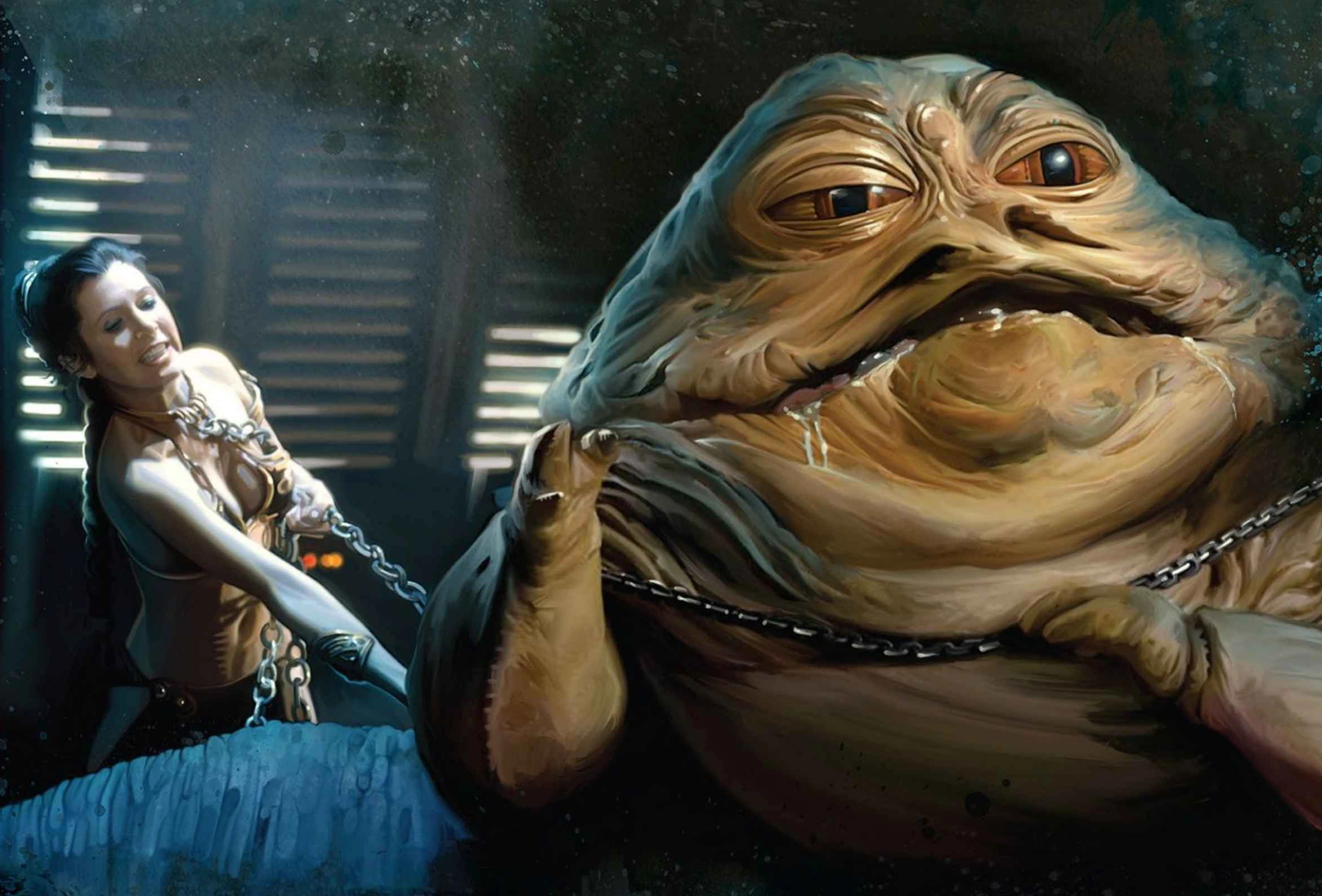
When forced into servitude as Jabba's trophy, Leia is physically restrained by a heavy collar and iron chain. However, during the chaotic battle at the Great Pit of Carkoon, she turns the exact instrument of her enslavement into her weapon of liberation. Dousing the lights in the sail barge, Leia wraps the iron chain around Jabba’s neck and uses her full body weight to choke the crime lord to death.
This act of retributive violence is critical to the scene's longevity. Unlike typical film tropes of the era, where female characters relied on male protagonists for rescue, Leia slays her captor entirely on her own. This narrative resolution reframed the character from an object of male gratification to an agent of vengeance, earning her the title "Hutt Slayer" within canonical literature and fan commentary.
Carrie Fisher’s Unfiltered Voice on Imperial Objectification
The scene's modern resonance is inseparable from the late Carrie Fisher’s lifelong commentary on it. Fisher consistently refused to romanticize the costume, offering a sharp, witty critique of Hollywood's treatment of female actors.
Fisher frequently highlighted the contradiction of the scene in interviews:
"What redeemed it for me was getting to kill the giant slug," Fisher noted in multiple retrospectives. "I killed him with the chain that was holding me captive."
Her public commentary provided a roadmap for how actors can reclaim agency over sexualized roles:
- De-Sexualizing the Stigma: Fisher routinely reminded fans that Leia was forced to wear the outfit against her will within the story, emphasizing that the narrative frames Jabba as a monster for subjecting her to it.
- Mentorship to New Generations: When actor Daisy Ridley joined the franchise as Rey for Episode VII - The Force Awakens (2015), Fisher offered clear advice during a joint conversation published by Interview Magazine: "You should fight for your outfit. Don't be a slave like I was."
- Reframing Parent-Child Discussions: When media outlets raised concerns over whether parents should feel uncomfortable showing the scene to children, Fisher responded with characteristic pragmatism, suggesting parents tell kids that a giant alien forced her to wear the dress, and she killed him for it.
Fisher’s refusal to apologize for the outfit—paired with her blunt refusal to let studios reduce her character to a pin-up—turned the metal bikini into a case study in star advocacy.
Media Theory and the Male Gaze: A Dual Legacy
From the perspective of media literacy and film theory, the gold bikini scene serves as a primary example of Laura Mulvey's concept of the "male gaze." The cinematic choices in Return of the Jedi present a dual narrative:
- The Visual Gaze: The camera angles during the palace scenes framing Leia emphasize her exposed body, aligned with commercial motives to appeal to young male audiences in 1983.
- The Narrative Resistance: The script simultaneously demands that the audience respect Leia's ferocity, intelligence, and refusal to submit emotionally to her captor.
This tension between how the camera looks at Leia and how Leia acts within the story is precisely why scholars continue to analyze the sequence.
| Visual Presentation | Narrative Character |
|---|---|
| Scantily Clad | Unyielding Resolve |
| Bound in Chains | Strategic Tactician |
| Framed by Camera | Kills Her Captor |
The scene demonstrates that visual objectification and character empowerment can exist within the same cinematic space, creating a complex text that defies simple categorization as purely exploitative or purely progressive.
Merchandise Reframing and Modern Pop Culture Resonance
Over the decades, the handling of Leia’s costume by Lucasfilm and parent company Disney has evolved significantly. The shifts in branding reflect broader changes in consumer awareness and corporate ethics.
In the late 1980s and 1990s, merchandise labeled as "Slave Leia"—ranging from action figures to collectible statues—was ubiquitous across toy aisles and comic shops. However, in the mid-2010s, Lucasfilm intentionally pivoted away from the term "Slave," adopting titles such as "Leia Organa (Hutt Slayer)" or simply "Princess Leia (Jabba's Palace)."
| Era | Dominant Cultural & Industrial Perspective |
|---|---|
| 1983 – 1990s | • Promoted primarily as a pop culture sex symbol.• Pervasive "Slave Leia" merchandising in action figures.• Mainstream focus on physical appearance over narrative. |
| 2000s – 2014 | • Growth of cosplay culture highlighting the outfit's iconic status at fan conventions worldwide.• Emerging feminist media critiques debating objectification. |
| 2015 – Present (2026 Context) | • Official rebranding by Lucasfilm to "Hutt Slayer."• Legacy defined by Carrie Fisher's real-world advocacy.• Re-examined as an emblem of survivor agency and triumph. |
This rebranding acknowledges two important cultural realities:
- Empowering Language: Shifting focus from the state of subjugation ("Slave") to the act of self-emancipation ("Hutt Slayer") aligns the character's legacy with her narrative victory.
- Fan Cosplay Culture: Within the convention community, wearing the costume has long served as an act of fandom pride and body positivity, where fans of diverse backgrounds reclaim the imagery on their own terms.
Key Takeaways: Why the Scene Endures
The enduring significance of Princess Leia's gold bikini scene relies on four central factors:
- Subversion of Tropes: Leia takes down her captor without waiting for Luke Skywalker or Han Solo to save her.
- The Power of the Actor: Carrie Fisher used her platform to demystify Hollywood beauty standards and advocate for character integrity.
- Complex Film History: It remains an indispensable teaching tool for analyzing objectification, media framing, and character agency in mainstream blockbuster filmmaking.
- Cultural Reclaiming: Pop culture has successfully reframed the costume from a symbol of captive vulnerability to an emblem of resistance.
Frequently Asked Questions
Who designed the Princess Leia gold bikini?
The costume was created by visual designer Nilo Rodis-Jamero and costume designer Aggie Guerard Rodgers for Star Wars: Episode VI - Return of the Jedi (1983).
Why was Princess Leia put in the metal bikini in the story?
Within the narrative, Leia is captured after attempting to free Han Solo from Jabba the Hutt. Jabba forces her into the revealing attire to humiliate her and display her as a trophy in his throne room.
How did Carrie Fisher feel about wearing the bikini?
Carrie Fisher had complex feelings about the costume. She found it physically uncomfortable and uncomfortable to wear on set, but she embraced the narrative resolution where Leia uses her chains to kill Jabba the Hutt. Later in life, she frequently advised younger actors to resist letting studios objectify them.
Why did Lucasfilm stop using the name "Slave Leia"?
Lucasfilm shifted away from the "Slave Leia" terminology in merchandise to move past derogatory framing and avoid commodifying enslavement. The official designation was updated to focus on her triumph as "Leia Organa (Hutt Slayer)" or her location as "Princess Leia (Jabba's Palace)."
How does the scene fit into feminist film criticism?
The scene is widely discussed in film studies because it features both visual objectification (the "male gaze") and narrative empowerment. While the camera frames Leia as a visual spectacle, her actions—specifically taking down her oppressor—grant her narrative agency that resists simple objectification.
Conclusion
The Princess Leia gold bikini scene matters today because it refuses to remain tied to a single interpretation. While engineered within 1980s studio filmmaking to serve as visual spectacle, the character's violent self-liberation combined with Carrie Fisher’s candid, lifelong commentary permanently shifted the narrative. To examine the scene today is to appreciate how an actor and an audience can reclaim an iconic moment of pop culture history, transforming a symbol of captivity into a lasting monument to female autonomy.
EDITORIAL CATEGORY METADATA
Image Gallery