Understanding the Net Worth and Financial Trajectory of Sachin and Binny Bansal
The net worth of Sachin Bansal and Binny Bansal, the co-founders of Flipkart, is primarily defined by the historic 2018 acquisition of their company by Walmart. While their exact current liquid wealth remains private, financial analyst...
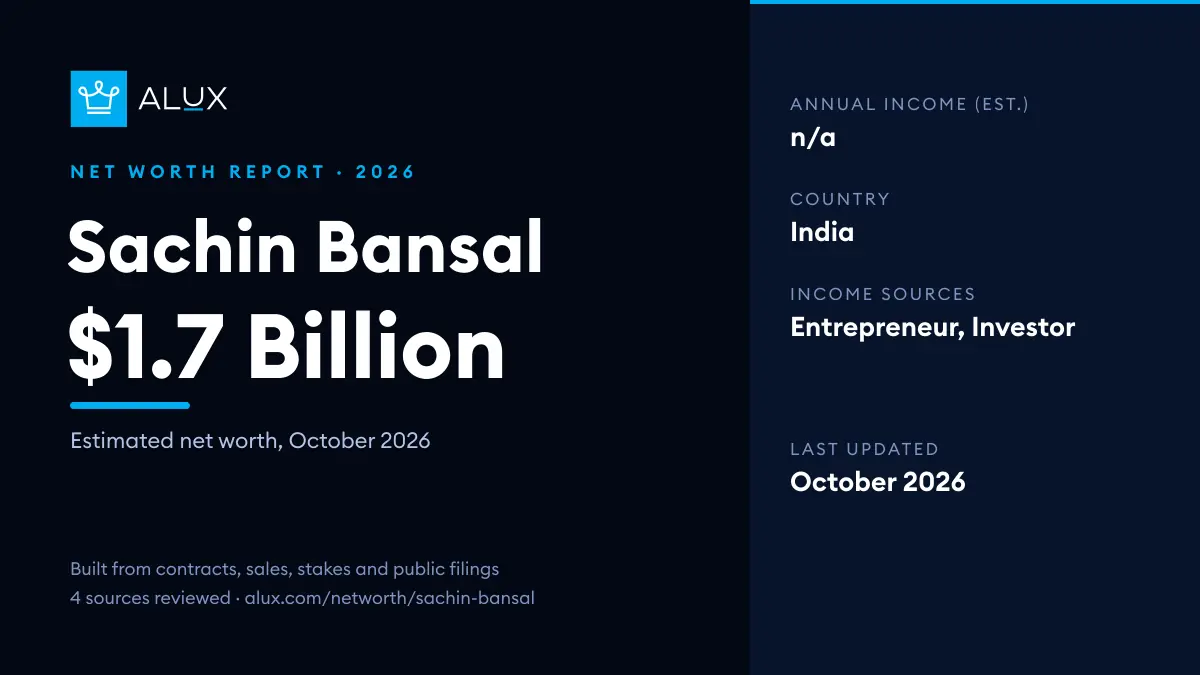
The net worth of Sachin Bansal and Binny Bansal, the co-founders of Flipkart, is primarily defined by the historic 2018 acquisition of their company by Walmart. While their exact current liquid wealth remains private, financial analysts estimate their individual net worths to be in the range of $1 billion to $1.5 billion each as of 2026, largely stemming from their secondary share sales and subsequent venture capital activities.
Contents
The Foundation: The Flipkart Exit
To understand the current financial standing of Sachin and Binny Bansal, one must look at the 2018 watershed moment in Indian startup history. Walmart acquired a 77% controlling stake in Flipkart for approximately $16 billion. At the time of this deal, both founders held significant equity. Sachin Bansal famously exited the company entirely, selling his remaining 5.5% stake for roughly $1 billion. Binny Bansal opted to retain a smaller portion of his equity, remaining involved with the board and the broader ecosystem for several years before fully transitioning to his own investment ventures.
The valuation of Flipkart at the time of the exit—nearly $21 billion—serves as the primary anchor for their wealth. This liquidity event transformed them from startup founders into high-net-worth individuals, providing them with the capital base required for their next professional chapters.
Post-Exit Professional Evolution
Following the sale of Flipkart, the paths taken by the two founders diverged, influencing how they have managed and grown their capital.
Sachin Bansal: The Financial Services Pivot
Sachin Bansal shifted his focus toward the financial technology and banking sector. He founded Navi Technologies, an entity focused on providing personal loans, home loans, and insurance products through a digital-first approach. By injecting a substantial portion of his exit proceeds into Navi, Sachin transitioned from a consumer e-commerce entrepreneur to a fintech founder. His wealth is now intrinsically tied to the performance, valuation, and capital-raising rounds of Navi Technologies, rather than just the passive holding of cash or public market assets.
Binny Bansal: The Venture Capitalist and Ecosystem Builder
Binny Bansal took a more diversified approach. While he founded xto10x Technologies—a startup advisory firm—he became a prolific venture investor. He has deployed capital across various sectors, including artificial intelligence, logistics, and SaaS. By diversifying his holdings, Binny has mitigated the concentration risk associated with having his entire net worth tied to a single enterprise. His wealth represents a portfolio of high-growth technology assets rather than a single operational business.
Comparative Financial Profiles
| Feature | Sachin Bansal | Binny Bansal |
|---|---|---|
| Primary Vehicle | Navi Technologies | xto10x & Venture Portfolio |
| Focus Sector | Fintech, Banking, Insurance | Enterprise SaaS, AI, Investments |
| Risk Profile | High (Operational Control) | Diversified (Investment Strategy) |
| Core Asset Base | Equity in Navi | Portfolio of Startup Equity |
Factors Influencing 2026 Valuations
As of 2026, the net worth of both individuals is subject to market volatility, specifically within the private equity and late-stage startup ecosystem. Unlike public market figures that can be tracked via stock exchange filings, the Bansals' wealth relies heavily on:
- Valuation of Private Entities: The internal valuation of companies like Navi Technologies or the startups in Binny Bansal’s portfolio is subject to periodic funding rounds. When interest rates or market sentiments for "growth-stage" tech companies shift, the mark-to-market value of these holdings fluctuates significantly.
- Asset Allocation: A significant portion of their wealth is likely held in diverse instruments, including private equity funds, real estate, and potentially liquid public market securities. However, because they remain "builders" at heart, the majority of their liquidity is often reinvested into new ventures.
- Capital Gains and Taxation: The original 2018 exit resulted in substantial tax liabilities. Understanding their net worth requires considering the net-of-tax proceeds they retained after the initial liquidation of their Flipkart shares.
Navigating the Complexity of "Net Worth"
For high-net-worth individuals who are also active operators, "net worth" is a fluid concept. It is not equivalent to a bank balance but rather the sum of their various equity stakes. Readers should be cautious of public estimates, which often aggregate historical share prices without accounting for the subsequent reinvestment of capital or the burn rate of their new ventures.
If an investor were to look at the Bansals as indicators of the Indian tech economy, they would see two distinct strategies: one seeking to disrupt traditional banking (Sachin) and the other seeking to institutionalize the scaling of startups (Binny). Both strategies carry inherent risks, and their net worth today is a reflection of the success of these second-act enterprises.
Frequently Asked Questions
1. How much did Sachin and Binny Bansal make from the Walmart deal? Sachin Bansal earned approximately $1 billion from his full exit in 2018. Binny Bansal’s earnings were also in the hundreds of millions, as he chose to retain a portion of his equity to remain involved in the transition and the Flipkart group.
2. Are they still billionaires in 2026? While exact figures remain private, both are widely considered to have maintained billionaire status based on the valuation of their new ventures and the capital they retained from the original Flipkart acquisition.
3. Does the fluctuating value of Flipkart affect their wealth today? Not directly. Since the 2018 sale, the Bansals no longer hold significant stakes in Flipkart. Their wealth is now tied to their new companies, such as Navi Technologies and their investment portfolios, rather than the performance of the e-commerce giant they co-founded.
4. Where do they invest their money? Sachin Bansal has largely concentrated his capital in his own fintech company, Navi. Binny Bansal has opted for a broader approach, investing as an angel and venture capitalist in diverse technology startups across the globe, with a focus on artificial intelligence and supply chain logistics.
5. How is their net worth verified? The figures cited by media outlets are estimates based on their initial exit proceeds, subsequent public disclosures during funding rounds for their new companies, and market analysis of their investment portfolios. There is no public, audited, or official record of their personal net worth.
Practical Implications for Interested Parties
For those tracking the financial success of these founders, it is critical to distinguish between "liquid cash" and "equity value." The Bansals’ wealth is largely tied to illiquid assets in private companies. This means their financial power is best measured by their ability to deploy capital into new projects and influence the direction of the Indian tech ecosystem, rather than by their capacity to liquidate assets instantly.
To track the progress of their respective ventures, one should look at the "Corporate Filings" and "Funding Announcements" of their primary entities: Navi Technologies for Sachin Bansal and xto10x for Binny Bansal. These documents provide the most reliable indicators of the growth and valuation of the assets that underpin their current financial standing.
Image Gallery