SSL Acceleration in Action
SSL acceleration is the process of offloading the processor-intensive tasks of public-key encryption and decryption to a dedicated hardware device or a specialized software layer. By shifting the Secure Sockets Layer (SSL) and Transpor...
SSL acceleration is the process of offloading the processor-intensive tasks of public-key encryption and decryption to a dedicated hardware device or a specialized software layer. By shifting the Secure Sockets Layer (SSL) and Transport Layer Security (TLS) handshake and bulk encryption away from the primary application servers, organizations can significantly reduce latency, increase server capacity, and improve the overall user experience for secure web applications.
Contents
The Mechanics of Cryptographic Overhead
To understand SSL acceleration in action, one must first identify the specific computational burden that encryption places on a standard CPU. While modern processors have integrated instructions for symmetric encryption (such as Intel's AES-NI), the initial phase of a secure connection—the SSL/TLS handshake—remains a resource-heavy operation.
The handshake involves complex mathematical operations, typically based on RSA or Elliptic Curve Cryptography (ECC). These algorithms require the server to perform modular exponentiation on large integers to verify identities and exchange session keys. For a high-traffic web server, performing thousands of these handshakes per second can consume the majority of available CPU cycles, leaving little room for the actual application logic or database queries.
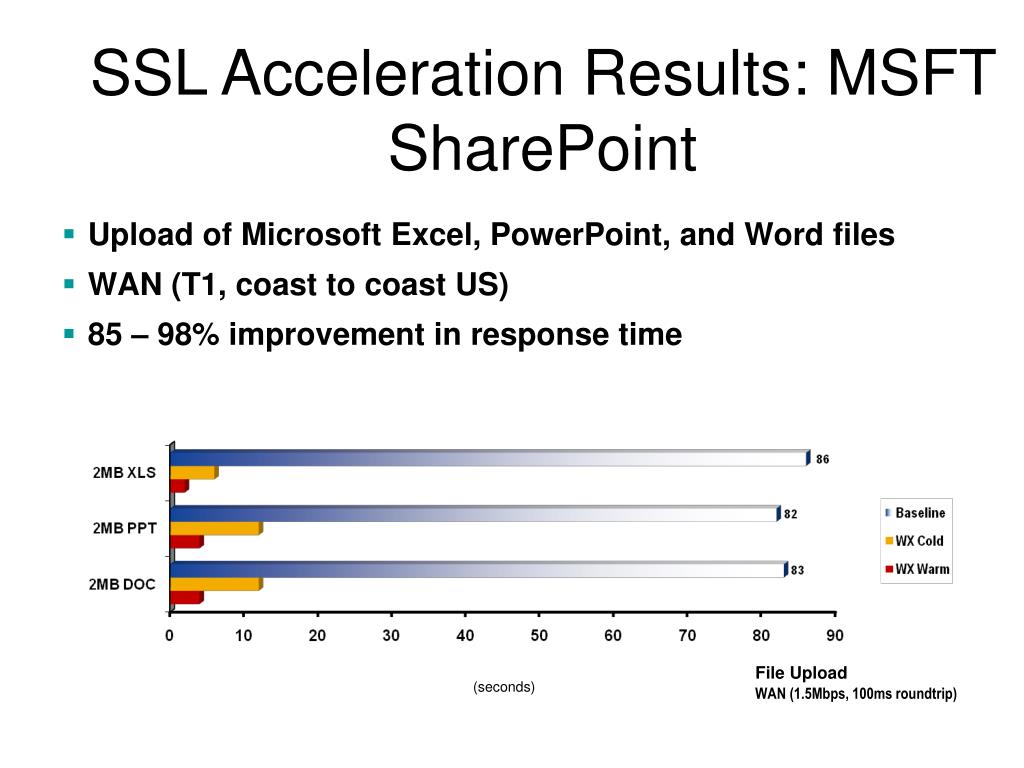
In a typical non-accelerated environment, as traffic spikes, the "Time to First Byte" (TTFB) increases. This happens because the CPU is queued with cryptographic requests. SSL acceleration solves this by intercepting these requests and processing them in parallel or through dedicated hardware, ensuring the application server only receives decrypted, manageable traffic.
Architectural Patterns: SSL Termination vs. SSL Bridging
When implementing SSL acceleration, architects must choose between two primary operational modes: termination and bridging. The choice depends entirely on the organization's security posture and regulatory requirements as of 2026.
SSL Termination (Offloading)
In an SSL termination scenario, the SSL accelerator (often integrated into an Application Delivery Controller or ADC) acts as the endpoint for the secure connection. The client establishes a TLS session with the accelerator. The accelerator decrypts the data and passes it to the backend web servers in plaintext (HTTP).
- Pros: Maximum performance gain; servers are completely unburdened from encryption; easier traffic inspection for Web Application Firewalls (WAFs).
- Cons: Traffic travels across the internal network in plaintext, which may violate certain compliance standards like PCI-DSS or HIPAA if the internal network is not sufficiently isolated.
SSL Bridging (Re-encryption)
SSL bridging involves the accelerator terminating the client-side connection, inspecting the traffic (for load balancing or security scanning), and then initiating a new encrypted session to the backend server.
- Pros: Maintains end-to-end encryption; satisfies strict regulatory requirements.
- Cons: Less performance gain than termination because the backend server still has to perform decryption, though the accelerator can use faster, more efficient internal certificates to mitigate the impact.
Hardware vs. Software Acceleration in 2026
The landscape of SSL acceleration has bifurcated into dedicated hardware appliances and high-performance software-defined solutions. Both have specific roles in modern infrastructure.
Hardware-Based Acceleration
Hardware accelerators use Application-Specific Integrated Circuits (ASICs) or Field-Programmable Gate Arrays (FPGAs) designed specifically for modular math. These devices are common in large-scale data centers where massive throughput (100 Gbps and above) is required.
- F5 BIG-IP and Citrix ADC: These remain the industry standards for hardware-based SSL offloading, providing physical isolation of cryptographic keys in Hardware Security Modules (HSMs).
- Use Case: Ideal for financial institutions and large e-commerce platforms where hardware-level security and predictable latency are paramount.
Software-Based and Cloud Acceleration
In virtualized and cloud-native environments, acceleration is often handled by specialized software stacks like Nginx or HAProxy, or through cloud provider services like AWS Certificate Manager (ACM) and Cloudflare.
- Asynchronous SSL: Modern software accelerators use asynchronous processing, meaning the web server doesn't "block" or wait for the crypto operation to finish before handling other tasks.
- Edge Computing: By moving SSL acceleration to the network edge (Points of Presence), providers can terminate the TLS handshake closer to the user, drastically reducing the round-trip time (RTT).
SSL Acceleration Comparison Matrix
The following table compares the different methods of implementing SSL acceleration based on performance, cost, and security capabilities.
| Feature | Hardware Appliance | Software Load Balancer | Cloud-Edge Acceleration |
|---|---|---|---|
| Primary Mechanism | Dedicated ASICs/FPGAs | CPU (AES-NI / AVX-512) | Distributed Global Edge |
| Handshake Capacity | Extremely High (1M+ CPS) | Moderate to High | Elastic / Scalable |
| Latency Reduction | Localized / Minimal | Minimal | Significant (Edge Proximity) |
| Key Security | Physical HSM Support | Software Key Store | Managed Key Vaults |
| Initial Cost | High CapEx | Low (Subscription/OSS) | Usage-Based OpEx |
| Best For | On-prem Data Centers | Private Clouds / Microservices | Global Web Applications |
Step-by-Step Implementation Strategy
Implementing SSL acceleration requires careful planning to ensure that security is not compromised for the sake of speed. Follow these steps for a standard deployment using an Application Delivery Controller (ADC).
1. Certificate and Key Management
The first step is to import the SSL/TLS certificate and its corresponding private key onto the accelerator. In a secure environment, this key should be stored in an HSM (Hardware Security Module) to prevent it from being extracted even if the management software is compromised. Using Elliptic Curve Cryptography (ECC) certificates is recommended in 2026, as they provide equivalent security to RSA with much shorter key lengths, further speeding up the handshake.
2. Cipher Suite Selection
Configure the accelerator to support only modern, secure cipher suites. In 2026, this typically means prioritizing TLS 1.3 and supporting TLS 1.2 only for legacy compatibility. Ensure that Forward Secrecy (FS) is enabled, which ensures that even if a private key is compromised in the future, past sessions cannot be decrypted.
3. Virtual Server Configuration
Create a "Virtual Server" on the accelerator that listens on port 443. This virtual IP (VIP) will be the destination for all client traffic. Associate the SSL profile (containing your certificates and cipher settings) with this Virtual Server.
4. Backend Pool Definition
Define the pool of backend servers that will receive the decrypted traffic. If using SSL termination, configure these pool members to listen on port 80. If using bridging, configure them for port 443 and ensure the accelerator trusts the backend servers' certificates.
5. Health Monitoring
Implement advanced health checks. The accelerator should not only check if the backend server is "up" but also if the application is responding correctly. If a server becomes overloaded or its own crypto-stack hangs, the accelerator should automatically reroute traffic.
Verifying Performance and Troubleshooting
Once SSL acceleration is in action, it is essential to verify the performance gains and ensure no new vulnerabilities have been introduced.
- Benchmarking: Use tools like
openssl speedto measure the raw throughput of the accelerator versus the backend servers. Compare the TTFB (Time to First Byte) before and after implementation using synthetic monitoring. - Protocol Analysis: Use SSLLabs' Server Test to verify that the accelerator is correctly configured. It should achieve an "A+" rating by supporting HSTS, modern ciphers, and robust key exchange mechanisms.
- Packet Inspection: If application errors occur after enabling offloading, use a tool like Wireshark on the backend network. Since the traffic is decrypted at the accelerator, you should be able to see the plaintext HTTP requests hitting the web servers, which helps in identifying if headers (like
X-Forwarded-For) are being passed correctly.
Common Pitfalls
- Mixed Content Errors: If the accelerator terminates SSL but the application generates absolute links using
http://, browsers will block the "insecure" content. Ensure the application is aware it is behind a proxy and generateshttps://links. - Session Persistence Issues: If the application relies on session cookies, ensure the accelerator is configured for "sticky sessions." Since the accelerator can see the decrypted traffic, it can insert or read cookies to ensure a user stays on the same backend server.
Frequently Asked Questions
Does SSL acceleration work with TLS 1.3?
Yes. While TLS 1.3 simplifies the handshake process and reduces the number of round trips, the cryptographic calculations still require CPU resources. SSL accelerators in 2026 are fully optimized for the 1-RTT (and 0-RTT) handshakes characteristic of TLS 1.3, providing even lower latency than software-only implementations.
Is hardware SSL acceleration still relevant in 2026?
Hardware acceleration remains critical for organizations with massive vertical scaling needs or those subject to high-security compliance (like FIPS 140-2 Level 3). While cloud-based offloading is popular, dedicated hardware provides a level of deterministic performance and physical key protection that multi-tenant cloud environments often cannot match.
Can SSL acceleration improve SEO rankings?
Indirectly, yes. Search engines prioritize page speed and user experience. By reducing the TTFB and overall latency through SSL acceleration, a website becomes faster and more responsive, which is a positive signal for search engine algorithms. Furthermore, maintaining a secure, properly configured TLS environment is a fundamental requirement for modern SEO.
What is the difference between SSL offloading and SSL acceleration?
The terms are often used interchangeably, but there is a nuance. SSL offloading refers to the act of moving the process away from the server. SSL acceleration refers to the use of specialized hardware or optimized software to speed up that process. Effectively, acceleration is the "how" and offloading is the "where."
Does offloading SSL increase the risk of "Man-in-the-Middle" attacks?
If SSL termination is used, the data is unencrypted as it travels from the accelerator to the backend server. If this internal network is compromised, a "Man-in-the-Middle" attack is possible. To mitigate this, organizations should use a dedicated management VLAN for backend traffic or utilize SSL bridging to ensure encryption is maintained across the entire path.
Next Steps for Infrastructure Teams
To put SSL acceleration into action effectively, begin by auditing your current server CPU utilization during peak traffic. If encryption tasks consistently consume more than 20-30% of your resources, it is time to consider an offloading strategy. Start with a software-based load balancer to test compatibility with your application headers, and then evaluate whether a hardware appliance or a cloud-edge solution better fits your long-term scaling and security needs.
Image Gallery