Why Helmsman Management Services Reshapes Workers Compensation
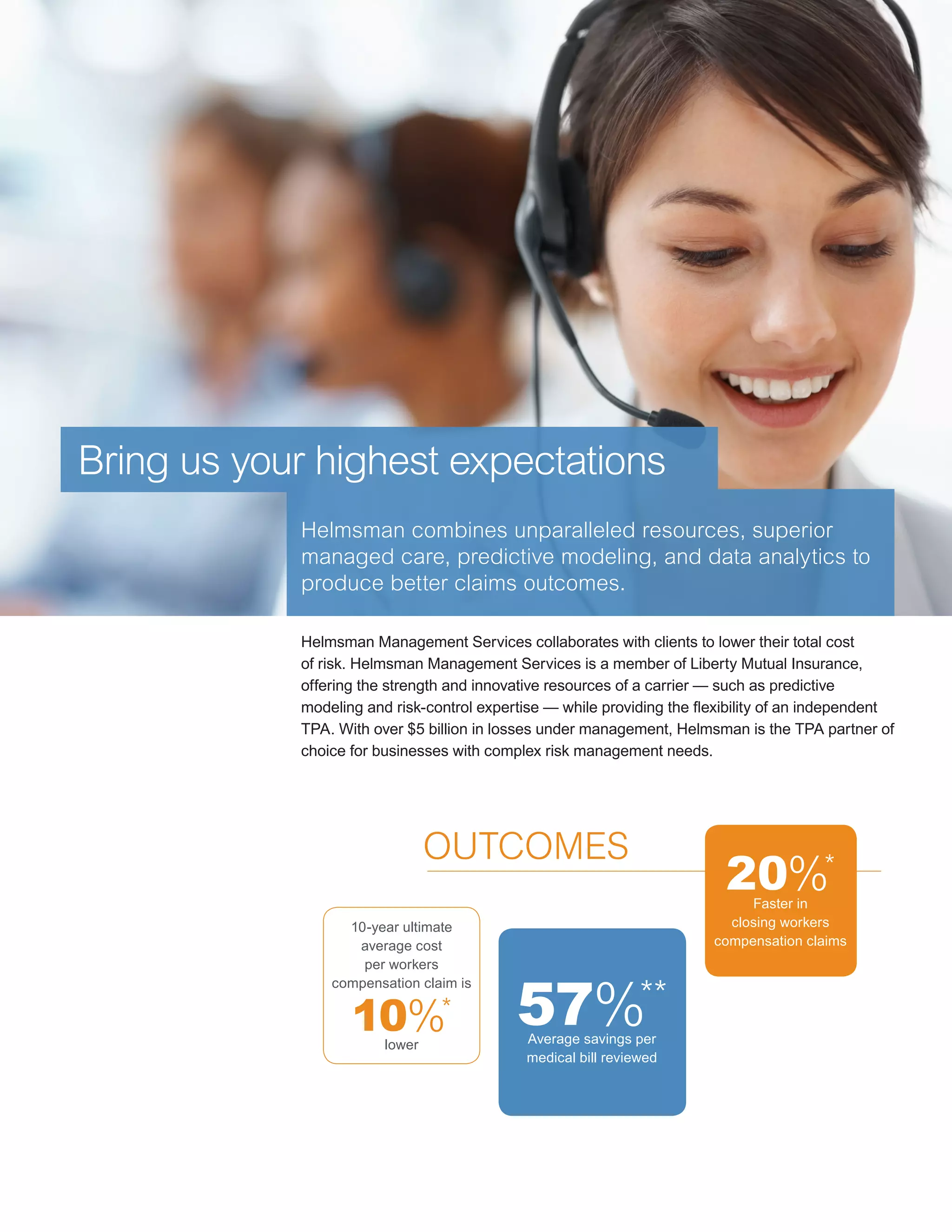
Helmsman Management Services reshapes workers compensation by blending the specialized flexibility of a third-party administrator (TPA) with the massive data resources and financial backing of its parent company, Liberty Mutual. By pri...
Helmsman Management Services reshapes workers compensation by blending the specialized flexibility of a third-party administrator (TPA) with the massive data resources and financial backing of its parent company, Liberty Mutual. By prioritizing predictive analytics and "whole-person" recovery models, Helmsman significantly reduces the total cost of risk while improving long-term medical outcomes for injured employees.
Contents
As we navigate the complexities of the 2026 labor market, the traditional model of insurance claims processing has become insufficient for modern enterprises. The rising costs of medical care, coupled with a more litigious environment and the nuances of remote work injuries, require a more sophisticated approach. Helmsman Management Services has positioned itself at the center of this evolution. By operating as a dedicated TPA, they provide customized service plans that are typically expected from boutique firms, but they do so using the infrastructure of one of the world’s largest property and casualty insurers.
The Strategic Integration of TPA Flexibility and Carrier Strength
One of the primary reasons Helmsman is reshaping the industry is its unique structural position. Most organizations must choose between a standard insurance carrier model and an independent TPA. Standard carriers offer stability and broad resources but often lack the customizable touch required for complex, self-insured programs. Independent TPAs offer customization but often struggle with limited data sets and less financial "muscle" during large-scale negotiations with medical providers.
Helmsman bridges this gap. Because it is a Liberty Mutual company, it possesses access to a vast "data lake" containing millions of historical claims. This allows Helmsman to benchmark performance with a level of precision that smaller competitors cannot match. In 2026, this data-centric approach is the cornerstone of effective risk management. They use this information to help employers understand not just where their losses are occurring, but why they are occurring in specific jurisdictions or industries.
Furthermore, this relationship allows Helmsman to offer "unbundled" services. Large employers can retain their own excess insurance or self-insurance structures while utilizing Helmsman specifically for their claims expertise. This flexibility is essential for Fortune 500 companies that require highly specific workflows, such as integrated reporting or unique return-to-work protocols, without being forced into a "one size fits all" policy.
Redefining Claims Outcomes Through Predictive Analytics
The proactive nature of Helmsman’s claims management is perhaps its most significant contribution to reshaping workers compensation. Historically, claims adjusters were reactive, waiting for a medical bill or a legal notice to take action. Helmsman has shifted this paradigm through the use of advanced predictive modeling.
In the current 2026 landscape, Helmsman utilizes proprietary AI-driven algorithms that analyze claims at the moment of intake. These models identify "creeping catastrophes"—claims that appear minor at the start (such as a simple lower back strain) but possess the demographic or clinical markers of a case that could spiral into a high-cost, long-duration disability.
Key factors their analytics monitor include:
- Comorbidity Identification: Early detection of underlying health issues like diabetes or hypertension that could delay physical healing.
- Psychosocial Indicators: Identifying social or psychological factors that might lead to attorney involvement or "disability syndrome."
- Provider Scoring: Comparing the treating physician’s historical performance against industry benchmarks for recovery time and cost.
By flagging these risks within the first 48 hours, Helmsman adjusters and nurse case managers can intervene early. This might involve assigning a field nurse to visit the injured worker or redirecting the patient to a "Center of Excellence" for specialized treatment. This data-driven intervention prevents the claim from becoming a multi-year financial drain.
The "Whole Person" Approach: Beyond Physical Recovery
Helmsman has been a leading advocate for the "whole person" recovery model, which has fundamentally changed how workers compensation is perceived. In the past, the industry focused almost exclusively on the physical injury—the broken bone or the laceration. Helmsman recognizes that a worker’s mental and emotional state is just as critical to a successful return to work.
This approach incorporates behavioral health screenings into the standard claims process. If a worker is anxious about their financial stability or fearful of re-injury, their physical recovery will likely stall. Helmsman integrates clinical specialists who can address these barriers through cognitive behavioral therapy (CBT) or simply improved communication strategies.
According to the National Council on Compensation Insurance (NCCI), early intervention in behavioral health can reduce claim durations by upwards of 20%. Helmsman applies this by ensuring that every touchpoint with the injured worker is supportive rather than adversarial. This shift in tone helps maintain the employer-employee relationship, which is a primary factor in preventing unnecessary litigation.
Medical Management and Clinical Excellence
The medical component of workers compensation represents the largest portion of claim costs. Helmsman reshapes this by embedding clinical expertise directly into the claims-handling team. Rather than treating nurse case management as an "add-on" service, Helmsman utilizes a collaborative model where nurses and adjusters work in tandem from day one.
Pharmacy Benefit Management (PBM) Innovations
Helmsman’s approach to pharmacy management is particularly robust. In 2026, the focus has shifted away from opioids toward more sustainable pain management and the monitoring of high-cost specialty drugs. Their systems provide real-time alerts if a prescription falls outside of established Official Disability Guidelines (ODG). This prevents the long-term dependency issues that historically plagued the workers' compensation system.
Peer-to-Peer Physician Reviews
When a treatment plan seems excessive or inconsistent with the injury, Helmsman utilizes peer-to-peer reviews. This involves a board-certified physician in the same specialty as the treating doctor reviewing the case. This is not about denying care, but about ensuring the right care is being delivered. This level of clinical oversight ensures that employers are not paying for ineffective treatments while ensuring the employee receives evidence-based medicine.
Comparing Helmsman to Traditional TPA Models
To understand why Helmsman is considered a "reshaper" of the industry, it is helpful to compare their service delivery against traditional TPA standards.
| Feature | Traditional TPA Model | Helmsman Management Services (2026) |
|---|---|---|
| Data Source | Limited to client-specific data. | Access to Liberty Mutual’s global data lake. |
| Claims Strategy | Reactive/Transactional. | Proactive/Predictive AI-driven. |
| Medical Philosophy | Focused on physical healing only. | Holistic "Whole Person" & Behavioral Health. |
| Customization | Low to Moderate (Standardized). | High (Highly tailorable to specific workflows). |
| Nurse Involvement | Often delayed until a claim is "complex." | Early intervention integrated into intake. |
| Pharmacy Oversight | Periodic review of pharmacy bills. | Real-time alerts based on ODG standards. |
| Return to Work | Generic "Light Duty" suggestions. | Industry-specific, transitional duty programs. |
Cost Containment Strategies and TCOR Optimization
For the Chief Financial Officer (CFO) or Risk Manager, the ultimate measure of a TPA is the Total Cost of Risk (TCOR). Helmsman reshapes workers compensation by focusing on the long-term reduction of TCOR rather than just lowering administrative fees.
Many TPAs compete on "per-claim" fees, which can lead to overworked adjusters who simply "pay and file." Helmsman’s model acknowledges that higher-quality (and sometimes higher-cost) claims handling leads to significantly lower medical and indemnity payouts. By maintaining lower caseloads per adjuster, Helmsman ensures that each file receives the attention necessary to close it quickly and fairly.
Their cost containment suite includes:
- Bill Review Services: Utilizing automated systems to ensure all medical charges adhere to state-specific fee schedules and PPO discounts.
- Subrogation Recovery: A dedicated team that identifies when a third party (such as an equipment manufacturer) is responsible for the injury, seeking reimbursement to the employer’s program.
- Litigation Management: Using data to determine which defense firms have the best track record for specific types of injuries or jurisdictions, thereby reducing legal spend.
Expert Guidance for Employers Transitioning to Helmsman
Transitioning to a high-touch TPA like Helmsman requires a shift in internal company culture. Employers who see the best results are those who embrace transparency and collaboration.
To maximize the impact of Helmsman’s services, organizations should:
- Establish Clear Communication Channels: Ensure that internal HR teams are ready to work with Helmsman’s adjusters to facilitate immediate return-to-work opportunities.
- Leverage the Reporting Suites: Helmsman provides deep-dive analytics. Risk managers should use these reports to identify safety trends and implement loss-control measures at the source.
- Focus on the Injured Worker Experience: By adopting the "whole person" philosophy internally, companies can mirror the supportive environment Helmsman creates, further reducing the likelihood of litigation.
FAQ
How does Helmsman handle multi-state workers compensation programs? Helmsman maintains a network of jurisdictional experts who understand the specific statutes and "case law" of every U.S. state. This is crucial because workers compensation laws vary significantly by geography, and Helmsman’s infrastructure allows them to maintain compliance while optimizing outcomes across different legal environments.
Is Helmsman only for large, self-insured corporations? While Helmsman is a premier choice for large, self-insured enterprises due to its customization capabilities, it also serves mid-sized companies that participate in "unbundled" programs. They provide the same level of data analytics and medical management regardless of the company size.
What technology does Helmsman use for claimant communication? In 2026, Helmsman utilizes mobile-first platforms that allow injured workers to track their claims, view payment schedules, and communicate with their adjusters via secure messaging. This transparency reduces anxiety for the worker and decreases the volume of "status check" calls for the adjuster.
How does Helmsman assist with return-to-work (RTW) programs? Helmsman provides specialized consultants who help employers build transitional duty catalogs. If a worker cannot return to their original role, Helmsman uses clinical data to suggest alternative tasks that fit within the worker’s physical restrictions, ensuring they remain active and employed during recovery.
Does Helmsman offer services beyond workers compensation? Yes. While they are a leader in workers compensation, Helmsman also provides TPA services for General Liability, Commercial Auto, and Property claims. This allows for a consolidated risk management approach across multiple lines of insurance.
Practical Recommendation
For organizations looking to reshape their own workers compensation results in 2026, the move to a data-driven, clinically integrated TPA is no longer optional. Helmsman Management Services provides the necessary tools to pivot from a defensive stance to a proactive strategy. If your current claims duration is increasing or your litigation rates are rising, the next step is to conduct a "claims audit" to see where predictive analytics could have intervened. Engaging Helmsman for a diagnostic review of your historical loss data can reveal specifically how their "whole person" model would impact your bottom line.
Image Gallery