Kamailio vs OpenSIPS: Architectural Comparison for Enterprise VoIP Infrastructure
Selecting the right Session Initiation Protocol (SIP) proxy engine is a critical architectural decision for modern Voice over IP (VoIP), Real-Time Communication (RTC), and telecommunications networks. Both Kamailio and OpenSIPS are ent...
Selecting the right Session Initiation Protocol (SIP) proxy engine is a critical architectural decision for modern Voice over IP (VoIP), Real-Time Communication (RTC), and telecommunications networks. Both Kamailio and OpenSIPS are enterprise-grade, open-source SIP servers capable of handling tens of thousands of call setups per second on modest hardware. While both platforms share a common lineage in the historic SIP Express Router (SER) project, they have diverged significantly in architectural philosophy, scripting flexibility, high-availability clustering, and module design.
Contents
Kamailio excels in large-scale Voice over LTE (VoLTE) and IP Multimedia Subsystem (IMS) deployments, offering multilingual embedded scripting via the Kamailio Embedded Interface (KEMI). OpenSIPS focuses on streamlined carrier-grade routing, dynamic clustering engines, and deeply integrated routing primitives that simplify complex Class 4 and Class 5 VoIP topologies. Choosing between them depends on your infrastructure's scripting preference, high-availability requirements, and targeted SIP routing logic.
The SER Heritage and Fundamental Server Architecture
To understand the core differences between Kamailio and OpenSIPS, it is helpful to look at their shared origins. Both platforms stem from SIP Express Router (SER), developed in the early 2000s by the Fraunhofer Institute for Open Communication Systems (FOKUS). In 2005, SER was forked to create OpenSER. In 2008, due to trademark considerations and differing developer roadmaps, OpenSER split into two independent projects: Kamailio (which later merged with the original SER codebase during the SIP-Router project) and OpenSIPS.
Despite their separate evolution over nearly two decades, both systems maintain a shared fundamental core architecture:
- Stateless and Statefully Aware Proxying: Unlike media servers such as Asterisk or FreeSWITCH, neither Kamailio nor OpenSIPS acts as a full media server by default. Instead, they operate as ultra-fast SIP proxies, registrars, redirect servers, and Session Border Controllers (SBCs). They handle SIP signaling (UDP, TCP, TLS, WebSocket) while delegating media (RTP/SRTP) handling to specialized media relays like RTPEngine or RTPProxy.
- Shared Memory Management: Both platforms rely on custom shared memory allocators (such as
q_mallocorf_malloc) to pass transaction data, registration state, and dialog information between worker processes without incurring kernel-level locking overhead. - Event-Driven Multi-Process Architecture: Both run as a set of dedicated worker processes handling incoming network sockets, timer threads, and asynchronous tasks, delivering minimal memory consumption and throughput exceeding 10,000 requests per second per server node.
- Incoming SIP Traffic (UDP / TCP / TLS / WebSockets)
- SIP Proxy / Load Balancer (Kamailio or OpenSIPS)
- Registrar / DB (MySQL, Redis, PostgreSQL)
- Media Control (RTPEngine)
- PSTN Gateway / Carrier Trunks
- SIP Proxy / Load Balancer (Kamailio or OpenSIPS)
Scripting and Configuration Paradigms: Native vs. KEMI
The most immediate practical difference between Kamailio and OpenSIPS lies in how configuration files and routing logics are written and executed.
Kamailio: Native Scripting and KEMI Flexibility
Kamailio supports the legacy kamailio.cfg routing script language, which uses C-like syntax to manage SIP request and reply routes. However, Kamailio’s defining structural innovation is KEMI (Kamailio Embedded Interface).
KEMI allows system architects to write all SIP routing logic in established programming languages rather than relying solely on the proprietary configuration domain-specific language (DSL). Supported languages include:
- Lua (via LuaJIT for maximum execution speed)
- Python 3
- JavaScript (V8 or Duktape)
- Squirrel
With KEMI, every incoming SIP packet invokes execution within an embedded interpreter. This allows developers to use standard software engineering practices—such as unit testing frameworks, object-oriented design patterns, external dependency management, and real-time integration with native software libraries—directly inside the SIP routing layer.
OpenSIPS: Deeply Integrated Native Scripting Language
OpenSIPS chose not to adopt an embedded multi-language engine like KEMI, opting instead to continually rewrite and modernize its native opensips.cfg scripting language. The OpenSIPS script engine supports rich, dynamic language features tailored specifically for telecommunications engineering:
- Native Data Types: Supports key-value arrays, JSON objects, string manipulations, dynamic variables, and custom transformations natively.
- Asynchronous Scripting: Allows non-blocking execution of HTTP queries, database calls, or external REST API requests using an
asyncblock keyword, freeing worker threads to handle other SIP transactions while waiting for slow backends. - Route Types: Features modular route blocks including
route,branch_route,failure_route,onreply_route,error_route, andlocal_route, structured explicitly for standard SIP transaction state transitions.
While OpenSIPS does offer basic integration capabilities with Python or Lua via specific script execution modules, its core philosophy prioritizes maintaining a single, highly optimized native DSL designed explicitly for SIP manipulation.

High Availability, Clustering, and State Replication
In enterprise production deployments, high availability (HA) and distributed state synchronization across multiple redundant nodes are mandatory requirements.
Kamailio: Distributed Message Queue (DMQ) and External Caches
Kamailio manages cluster state through its DMQ (Distributed Message Queue) module or by delegating state management to distributed memory stores like Redis or Hazelcast.
- DMQ Architecture: Uses a full-mesh peer-to-peer SIP-based transport mechanism to broadcast state updates (such as user locations or active dialogs) directly between Kamailio nodes. Nodes auto-discover peers via multicast or fixed IP lists.
- External Storage Integration: Kamailio integrates deeply with Redis (using
ndb_redis) and database clustering models, making it ideal for stateless core proxy tiers sitting in front of stateful storage databases.
OpenSIPS: Native Clustering Engine
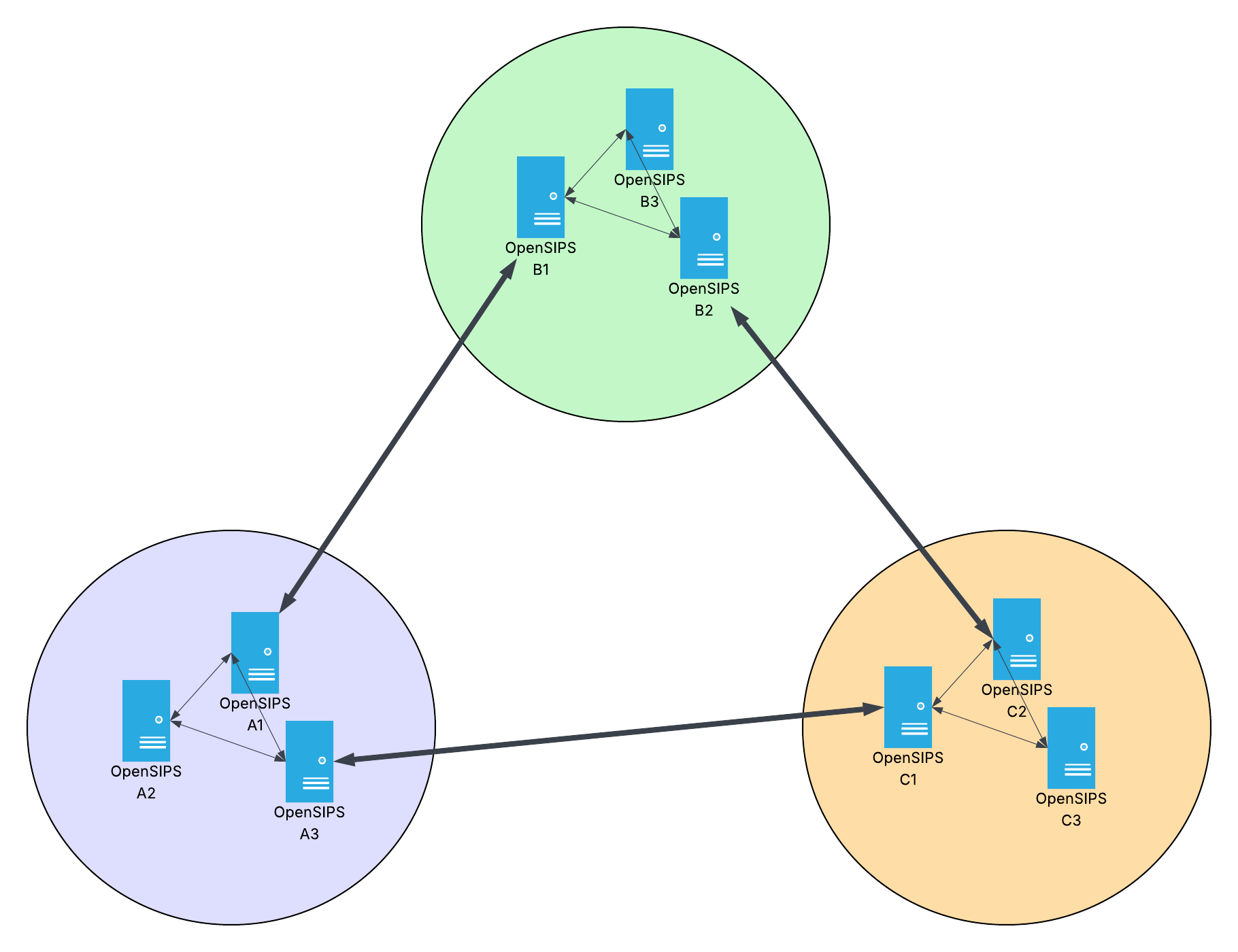
OpenSIPS features a unified, built-in Clusterer Module that provides out-of-the-box state replication across node pools. The OpenSIPS cluster topology supports both active-passive and active-active clustering models without requiring external message brokers.
- Unified State Sharing: Replicas can synchronize user registration data (
usrloc), ongoing active calls (dialog), call rates (ratelimit), and load-balancer state across multiple geographic regions in real time. - Node Topology Management: Supports binary state synchronization over dedicated TCP/TLS sockets, complete with auto-rebalancing, quorum rules, and split-brain recovery mechanisms embedded into the core server binaries.
Feature Comparison Matrix
The following table provides a direct architectural comparison between Kamailio and OpenSIPS across key operational categories:
| Feature / Dimension | Kamailio | OpenSIPS |
|---|---|---|
| Primary Focus | Voluminous IMS/VoLTE topologies, WebRTC, modular language scripting | Advanced carrier routing, integrated clustering, Class 4/5 SBC functions |
| Scripting Languages | Native kamailio.cfg, Lua, Python, JavaScript, Squirrel (via KEMI) |
Native opensips.cfg DSL (with dynamic data types & async support) |
| Clustering Mechanism | DMQ (Distributed Message Queue), Redis, DB replication | Built-in native Clusterer module (TCP/TLS binary replication) |
| IMS Support | Extensive native modules (P-CSCF, S-CSCF, I-CSCF, EPC integration) | Basic IMS functionality; relies on external network functions |
| Asynchronous I/O | Supported via async execution modules and event routes | Deeply integrated native async() block syntax across script commands |
| Media Proxy Integration | RTPEngine, RTPProxy, MediaProxy | RTPEngine, RTPProxy, MediaProxy |
| Back-to-Back User Agent (B2BUA) | Basic via modules (usually delegates to FreeSWITCH/Asterisk) | Built-in b2b_logic and b2b_entities modules |
| WebRTC Capabilities | Native WebSocket layer, outbound MSRP, WebRTC routing primitives | Native WebSocket support, ICE/DTLS handling via RTPEngine |
| Governance Model | Decentralized, community-led management board | Core development led primarily by OpenSIPS Solutions |
Target Use Cases and Deployment Scenarios
Choosing between Kamailio and OpenSIPS often comes down to your organization's deployment architecture and internal engineering skills.
- Deployment Scenario
- Choose KAMAILIO If:
- Building VoLTE / IMS Telecom Networks
- Scripting in Lua/Py via KEMI
- Complex WebRTC RTC Edge Gateways
- Choose OPENSIPS If:
- Class 4 Wholesale Carrier Routing
- Out-of-the-Box Native Stateful Clustering
- Embedded B2BUA Logic Requirements
- Choose KAMAILIO If:
When to Choose Kamailio
- VoLTE, VoWiFi, and 4G/5G IMS Core Networks: Kamailio includes specialized modules for IP Multimedia Subsystem core functions, such as Proxy-CSCF, Serving-CSCF, and Interrogating-CSCF. Telecommunications carriers building mobile packet cores frequently select Kamailio for this reason.
- Engineering Teams Preferring Lua or Python: If your DevOps or software team prefers standard programming languages over learning a proprietary domain-specific syntax, Kamailio with KEMI (LuaJIT or Python) allows developers to build clean routing logic using standard unit tests and development workflows.
- Stateless Edge Edge Routers and WebRTC Gateways: Kamailio’s lightweight core makes it an ideal choice for high-volume stateless routing tiers, TLS termination nodes, and WebRTC-to-SIP gateways.
When to Choose OpenSIPS
- Class 4 Wholesale Carrier Routing: OpenSIPS excels in dynamic prefix routing, carrier least-cost routing (LCR), trunk quality probing, and real-time fraud mitigation. Its built-in
droutingandload_balancermodules are highly optimized for wholesale voice traffic. - Turnkey High-Availability Clusters: If your deployment requires seamless active-active call dialog state replication and user registration sharing across redundant nodes without introducing external datastores like Redis, the OpenSIPS
clusterermodule simplifies architectural complexity. - Lightweight Topology Hiding and B2BUA Applications: OpenSIPS features built-in B2BUA (Back-to-Back User Agent) modules capable of managing top-down call topology hiding, custom call transfer logic, and prepaid session controls directly on the signaling node.
Community, Commercial Ecosystem, and Maintenance
Both projects maintain active open-source communities, but their operational governance models differ:
- Kamailio Community Model: Kamailio is governed by an open community structure with a developer management board. Development is distributed across independent consulting firms, telecom vendors, and individual contributors globally. Annual developer events, such as Kamailio World, serve as central hubs for core engineering discussions.
- OpenSIPS Managed Model: OpenSIPS is heavily driven by OpenSIPS Solutions, a commercial entity founded by primary developer Bogdan-Andrei Iancu. While the core software remains open-source under GPL license models, OpenSIPS Solutions offers official enterprise support plans, user training, and turnkey implementation consulting. The project hosts an annual OpenSIPS Summit.
Practical Implementation: Routing Logic Comparison
To demonstrate the syntax differences, consider a standard routing requirement: receiving an incoming SIP INVITE, checking if an asynchronous HTTP REST request authorizes the call, and routing to a downstream carrier gateway.
Kamailio Example (Using KEMI Lua)
-- Kamailio routing via KEMI interface using Lua function ksr_invite_routing() KSR.info("Processing incoming INVITE for: " .. KSR.pv.get("$rU") .. "\n") -- Perform external API validation via HTTP module local res = KSR.rest.get("http://api.internal.local/v1/authorize?user=" .. KSR.pv.get("$fU")) if res == 200 then -- Set downstream gateway target KSR.seturi("sip:" .. KSR.pv.get("$rU") .. "@192.168.10.50:5060") KSR.tm.t_relay() else KSR.sl.sl_send_reply(403, "Forbidden - Call Unauthorized") end end
OpenSIPS Example (Using Native Scripting)
# OpenSIPS routing via native opensips.cfg syntax route[handle_invite] { xlog("L_INFO", "Processing incoming INVITE for $rU\n"); # Perform asynchronous REST query to external API async(rest_get("http://api.internal.local/v1/authorize?user=$fU", $var(api_res), $var(status)), resume_invite); } route[resume_invite] { if ($var(status) == 200) { $ru = "sip:" + $rU + "@192.168.10.50:5060"; if (!t_relay()) { send_reply(500, "Internal Server Error"); } } else { send_reply(403, "Forbidden - Call Unauthorized"); } }
Frequently Asked Questions
Can Kamailio or OpenSIPS replace Asterisk or FreeSWITCH?
No, they fulfill different roles in a VoIP network architecture. Kamailio and OpenSIPS are ultra-high-throughput SIP signaling proxies designed to route, filter, load balance, and secure control packets. They do not natively handle media transcoding, interactive voice response (IVR) audio playback, or voicemail storage. Typically, Kamailio or OpenSIPS acts as the outer edge tier, load-balancing SIP traffic to back-end media clusters running FreeSWITCH or Asterisk.
Which SIP server performs faster in benchmark tests?
In raw stateless routing throughput, both servers deliver nearly identical performance when deployed on identical hardware. Both process tens of thousands of setups per second with sub-millisecond latencies because they rely on similar shared-memory concepts inherited from the SER codebase. Performance bottlenecks in production are almost always caused by inefficient external database calls or blocking network operations, rather than the core proxy engines themselves.
Can Kamailio and OpenSIPS run together in the same platform?
Yes. It is common for enterprise telecommunications providers to use both platforms within distinct tiers of their network. For example, a company might use Kamailio at the network edge as a WebRTC gateway or IMS P-CSCF node, while routing internal calls through OpenSIPS nodes configured for least-cost routing and dynamic wholesale billing integrations.
How do Kamailio and OpenSIPS handle WebRTC signaling?
Both engines feature native support for WebSockets (ws://) and Secure WebSockets (wss://), as well as SDP payload rewriting required for WebRTC negotiation. They handle signaling transformations between browser-based WebRTC endpoints and traditional SIP trunks, delegating DTLS-SRTP to SRTP media conversion to an instance of RTPEngine.
Which project is easier for developers new to VoIP engineering?
Engineers with strong general-purpose programming backgrounds (such as Python or Lua) often find Kamailio easier to pick up due to its KEMI framework, which lets them write logic in familiar languages. Conversely, engineers seeking structured, out-of-the-box carrier features—such as built-in load balancers, dynamic routing tables, and simplified binary clustering—often find OpenSIPS easier to deploy using its comprehensive native syntax.
Next Actions for Architecture Evaluation
To determine the best fit for your infrastructure, consider taking the following concrete steps:
- Assess Internal Team Skills: Determine whether your engineering team prefers writing logic in a dedicated SIP domain-specific language (favoring OpenSIPS) or in established languages like Lua or Python (favoring Kamailio with KEMI).
- Define Your HA Strategy: Determine if your infrastructure can utilize Redis/DMQ for state sharing, or if you require native, multi-node active-active dialog replication out of the box via the OpenSIPS
clusterermodule. - Prototype a Proof-of-Concept: Build a minimal sandbox deployment using Docker containers for both engines. Benchmark your intended routing, dynamic database lookups, and media proxy control using test tools like
sipp.
Image Gallery