Understanding Taxable Gain on Life Insurance Surrender: Calculating Excess Cash Received
The taxable gain on life insurance surrender is the excess cash received over the policy's cost basis. When a policyholder terminates a permanent life insurance contract for its cash value, the Internal Revenue Service (IRS) treats the...
The taxable gain on life insurance surrender is the excess cash received over the policy's cost basis. When a policyholder terminates a permanent life insurance contract for its cash value, the Internal Revenue Service (IRS) treats the portion of the payout that exceeds the total premiums paid (minus any dividends or prior withdrawals) as taxable ordinary income.
Contents
Surrendering a life insurance policy is a significant financial decision that often carries immediate tax implications. While the death benefit of a life insurance policy is typically received by beneficiaries tax-free, the living benefits—specifically the cash value accumulated within a permanent policy—are subject to different rules. As we navigate the financial landscape of 2026, understanding the mechanics of "cost basis" and "excess cash" is essential for any policyholder considering a full surrender of their coverage.
The Fundamentals of Life Insurance Surrender
Life insurance is generally categorized into two types: term and permanent. Term insurance provides coverage for a specific period and typically does not accumulate cash value. Consequently, surrendering a term policy usually results in no payout and no taxable event. Permanent life insurance, including whole life, universal life, and variable life, includes a savings component known as cash value.
When you surrender a permanent policy, you are essentially canceling the contract and asking the insurance company to pay out the equity built up within it. This "Cash Surrender Value" (CSV) is the amount available to the policyholder after the insurer deducts any applicable surrender charges. The surrender charge is a fee levied by the insurance company for early termination, which typically decreases over the first 10 to 15 years of the policy.
The core principle of taxation here is that the IRS allows you to recover your "investment in the contract" tax-free. Any amount received beyond that investment is considered a gain. Because this gain represents interest or investment growth that was previously tax-deferred, it is taxed as ordinary income rather than capital gains.
Determining the Cost Basis (Investment in the Contract)
To calculate the taxable gain, you must first establish the cost basis. In the context of life insurance, the cost basis is often referred to as the "investment in the contract." This is not simply the sum of all checks you have mailed to the insurance company; several factors can increase or decrease this figure.
Elements That Increase Basis
The primary factor increasing your basis is the total amount of premiums paid into the policy. If you have paid $50,000 in premiums over twenty years, your starting basis is $50,000.
Elements That Decrease Basis
Certain actions or policy features reduce the cost basis, which in turn increases the potential taxable gain upon surrender:
- Dividends Received in Cash: If your policy is "participating" (common with whole life policies from mutual companies) and you received dividends in cash, those payments reduce your basis.
- Dividends Used to Reduce Premiums: If you applied dividends toward your premium payments, only the net out-of-pocket amount you paid counts toward your basis.
- Prior Tax-Free Withdrawals: If you previously withdrew cash from the policy up to the amount of your basis (a "basis-first" withdrawal), those sums are subtracted from your remaining investment.
- Cost of Term Riders: In some specific tax interpretations and policy structures, the portion of the premium attributed to certain riders might be excluded from the investment in the contract, though standard base premiums are always included.
How the Taxable Gain is Calculated
The formula for determining the taxable gain on life insurance surrender is the excess cash received. Mathematically, it looks like this:
Taxable Gain = (Gross Cash Value - Surrender Charges - Outstanding Loans) - (Total Premiums Paid - Dividends Received - Prior Withdrawals)
It is important to note that the "excess cash" includes the value used to pay off any outstanding policy loans. This is a common point of confusion. If a policyholder has a cash value of $100,000 but carries a $30,000 loan, they will only receive $70,000 in a check upon surrender. However, for tax purposes, the IRS considers the "cash received" to be the full $100,000, because the $30,000 loan was a debt that was satisfied by the policy's value.
Example Scenario
Consider a policyholder in 2026 who decides to surrender a whole life policy:
- Total Premiums Paid: $60,000
- Dividends received in cash over the years: $5,000
- Gross Cash Value at time of surrender: $85,000
- Surrender Charges: $2,000
- Outstanding Policy Loan: $0
First, calculate the cost basis: $60,000 (Premiums) - $5,000 (Dividends) = $55,000 Basis. Next, calculate the Net Cash Received: $85,000 (Gross Value) - $2,000 (Surrender Charge) = $83,000. Finally, calculate the taxable gain: $83,000 - $55,000 = $28,000 Taxable Gain.
This $28,000 will be reported as ordinary income on the policyholder's tax return for the year 2026.
The Role of Policy Loans and "Phantom Income"
One of the most dangerous "tax traps" in life insurance is surrendering a policy with a large outstanding loan. Policy loans are generally not taxable when taken out, provided the policy remains in force. However, if the policy is surrendered or lapses, the loan balance is treated as a distribution.
If the loan balance plus the cash you receive exceeds your cost basis, you will owe taxes on the difference. This is often called "phantom income" because you might owe taxes on money you "received" years ago when you took the loan, but you do not receive a fresh check at the time of surrender to pay the tax bill. In extreme cases, the tax liability can actually exceed the physical check you receive upon surrender.
Tax Treatment: Ordinary Income vs. Capital Gains
A frequent question from policyholders is why the gain on a life insurance surrender is taxed as ordinary income rather than at the more favorable long-term capital gains rates. According to the Internal Revenue Code Section 72, distributions from life insurance contracts that are not received as an annuity or death benefit are generally treated as ordinary income to the extent they exceed the investment in the contract.
The logic behind this is that the cash value growth inside the policy is primarily composed of interest credited by the insurer or dividends, which are considered a return of premium or a share of the company's surplus. Since these gains were never taxed while they were accumulating (tax deferral), the IRS taxes them at your full marginal income tax rate upon withdrawal or surrender.
Comparison of Policy Exit Strategies
Before surrendering a policy and triggering a taxable gain, it is useful to compare how different exit strategies are treated by the IRS.
| Strategy | Tax Treatment of Gain | Impact on Death Benefit | Considerations |
|---|---|---|---|
| Full Surrender | Ordinary income on excess over basis. | Eliminated entirely. | Immediate cash, but potentially high tax bill. |
| 1035 Exchange | Tax-deferred (no immediate tax). | Transferred to new policy. | Moves basis to a new, potentially better policy. |
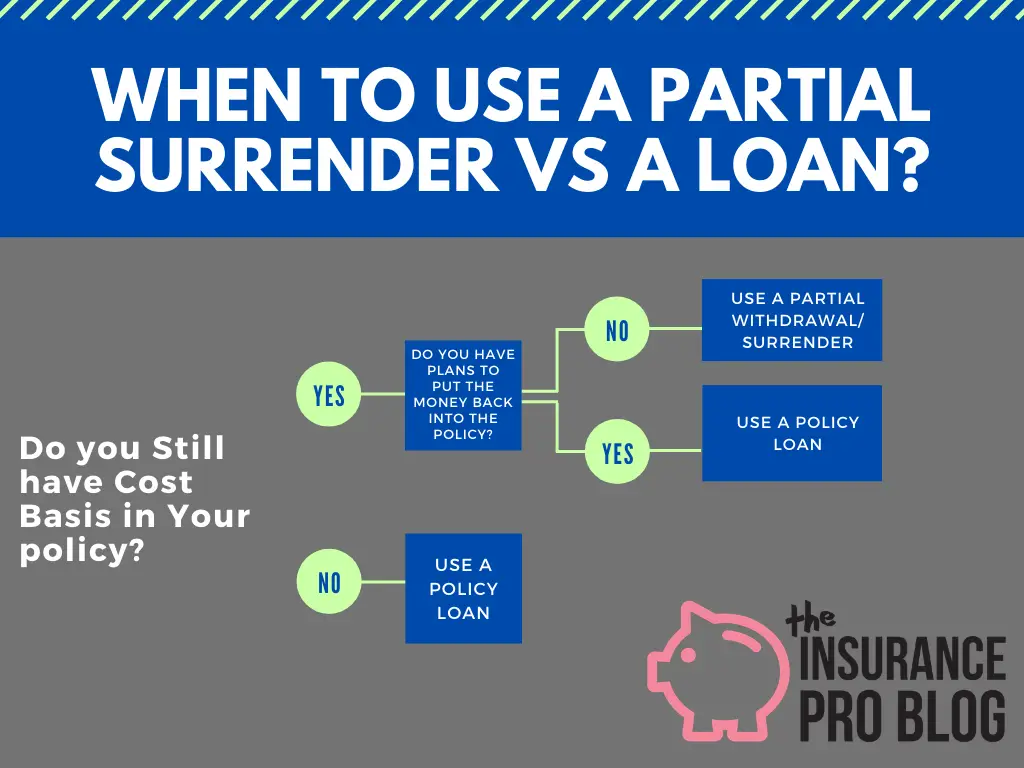
| Partial Withdrawal | Usually tax-free up to basis (FIFO). | Reduced proportionally. | Allows access to cash without surrendering the whole policy. |
| Life Settlement | Combination of basis, capital gains, and ordinary income. | Transferred to a third party. | Often pays more than surrender value; complex taxation. |
| Policy Loan | Tax-free (if policy stays in force). | Reduced by loan amount + interest. | Access to cash without a taxable event or surrendering. |
The 1035 Exchange: A Tax-Saving Alternative
If the goal of surrendering a policy is to move the funds into a different financial product, a Section 1035 Exchange is often the superior choice. Named after a section of the Internal Revenue Code, this provision allows for the "like-kind" exchange of one life insurance policy for another, or for an annuity, without triggering an immediate tax on the gain.
By using a 1035 exchange, your existing cost basis carries over to the new contract. This allows the "excess cash" to continue growing on a tax-deferred basis in a new vehicle that may better suit your current financial needs in 2026, such as a policy with lower fees or different investment options.
Reporting Requirements and Documentation
When a life insurance policy is surrendered for a gain, the insurance company is required to report the transaction to both the policyholder and the IRS. This is done using Form 1099-R.
The form will typically show the "Gross Distribution" in Box 1 and the "Taxable Amount" in Box 2a. It is vital for policyholders to verify these numbers against their own records of premiums paid. Insurance companies sometimes have incomplete records of very old policies, or they may not have correctly factored in certain out-of-pocket payments or complex dividend histories. If the 1099-R appears incorrect, you must contact the insurer to request a corrected form before filing your 2026 tax return.
Practical Considerations for 2026
As of 2026, tax brackets and regulations continue to make life insurance a unique asset class. Because the gain is taxed as ordinary income, the timing of a surrender can be critical. If you are in a high-income year, surrendering a policy with a large gain could push you into an even higher tax bracket. Conversely, surrendering a policy during a lower-income year (such as the first year of retirement) may reduce the effective tax rate paid on that gain.
Additionally, always check for "Surrender Charges." Even if a policy has a high "Account Value," the "Cash Surrender Value" is what matters for your pocketbook. Surrendering a policy just one year before a major drop in surrender charges can be a costly mistake.
FAQs
Is the entire cash value taxable when I surrender my policy?
No, only the portion of the cash value that exceeds your cost basis (total premiums paid minus dividends/withdrawals) is taxable. The portion representing your original premiums is returned to you tax-free.
Can I claim a loss if my surrender value is less than my premiums paid?
Generally, no. The IRS typically views the difference between the premiums paid and the cash value received as the "cost of insurance" (the price paid for the death benefit protection you enjoyed while the policy was active). Therefore, a "loss" on a life insurance surrender is usually considered a personal expense and is not tax-deductible.
What happens if I surrender a Modified Endowment Contract (MEC)?
MECs are subject to less favorable tax rules. Withdrawals and surrenders from a MEC are taxed on a "gain-first" (LIFO) basis, and if you are under age 59½, you may be subject to an additional 10% federal tax penalty on the taxable portion of the distribution.
Are policy dividends taxable?
Dividends are generally not taxable because they are considered a return of premium. However, if the total dividends you have received over the life of the policy exceed the total premiums you have paid, any dividends beyond that point are taxable as ordinary income.
Does surrendering a policy affect my Social Security taxes?
Since the gain on a life insurance surrender is reported as ordinary income, it increases your Adjusted Gross Income (AGI). A higher AGI can potentially increase the portion of your Social Security benefits that are subject to taxation and may also trigger higher Medicare Part B and Part D premiums (IRMAA).
Recommendation for Policyholders
If you are considering surrendering a life insurance policy in 2026, your first step should be to request an "In-Force Illustration" and a "Basis Statement" from your insurance provider. These documents will provide the exact figures needed to calculate your potential tax liability. Before finalizing the surrender, consult with a tax professional to determine how the "excess cash" will impact your overall tax bracket and whether an alternative—such as a 1035 exchange, a policy loan, or a partial withdrawal—might achieve your financial goals with a lower tax burden.
Image Gallery