The Oldest Wooden Roller Coaster Still Standing: A Guide to Leap-the-Dips
The oldest wooden roller coaster still standing in the world is Leap-the-Dips, located at Lakemont Park in Altoona, Pennsylvania. Built in 1902 by the Edward Joy Morris Company, this American treasure has survived over 120 years of ope...
The oldest wooden roller coaster still standing in the world is Leap-the-Dips, located at Lakemont Park in Altoona, Pennsylvania. Built in 1902 by the Edward Joy Morris Company, this American treasure has survived over 120 years of operation, representing the rare "side-friction" era of amusement park history and serving as a National Historic Landmark.
Contents
The Historical Origin of Leap-the-Dips
To understand the significance of Leap-the-Dips, one must look back to the turn of the 20th century. In 1902, the concept of a "thrill ride" was in its infancy. Most early coasters were "gravity railroads" or simple "scenic railways" designed for gentle leisure rather than high-speed adrenaline. Leap-the-Dips was constructed as a figure-eight side-friction coaster, a design that was revolutionary at the time but would soon be eclipsed by more advanced engineering.
The Edward Joy Morris Company designed the ride to replace an earlier, smaller figure-eight coaster at Lakemont Park. During this era, trolley parks—amusement parks located at the end of streetcar lines—were booming across the United States. Lakemont Park, opened in 1894, is the eighth-oldest amusement park in the United States, and Leap-the-Dips quickly became its centerpiece. While hundreds of similar wooden structures were built across North America between 1900 and 1920, almost all were eventually demolished due to fire, decay, or the demand for faster, taller rides. Leap-the-Dips survived largely because of its unique location and the community's commitment to its preservation.
Technical Specifications and Engineering
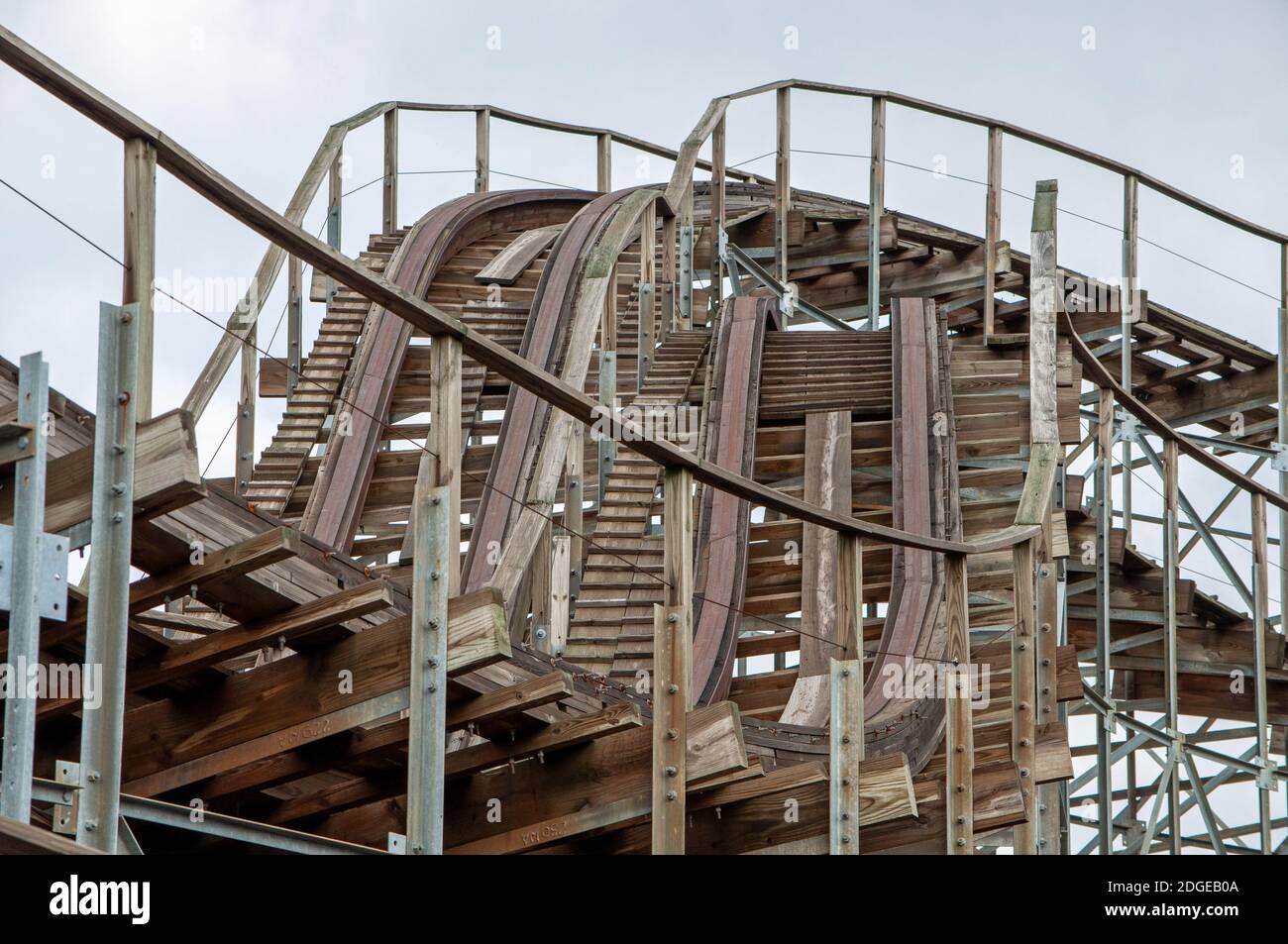
The engineering of Leap-the-Dips is fundamentally different from modern roller coasters. As a side-friction coaster, it lacks the "up-stop" wheels that modern coasters use to lock the train to the track. In a modern coaster, wheels run on the top, side, and bottom of the rail, ensuring the car cannot fly off even during loops or steep drops.
Leap-the-Dips operates on a simpler principle. The cars have wheels that sit on top of the track and a set of side wheels that press against the inner wooden walls of the track to keep the car centered. Because there is nothing holding the car down, the track layout must be carefully designed to ensure the car never gains enough vertical momentum to lift off the rails entirely.
Core Mechanical Data
| Feature | Specification |
|---|---|
| Year Opened | 1902 |
| Track Type | Wood (Southern Yellow Pine) |
| Design Type | Figure-Eight Side-Friction |
| Maximum Height | 41 Feet |
| Total Length | 1,452 Feet |
| Top Speed | 10–18 MPH |
| Number of Drops | 10 |
| Ride Duration | Approx. 1 Minute 56 Seconds |
| Designer | Edward Joy Morris |
The structure itself is made primarily of high-grade wood, which requires constant inspection and replacement. As of 2026, the ride continues to use many of the same mechanical principles established in the early 1900s, including a manual brake system used by operators in the station to bring the three-row, four-passenger cars to a halt.
The Fight for Survival: Restoration and Preservation
The fact that Leap-the-Dips is still standing in 2026 is a miracle of historic preservation. By the mid-1980s, the ride had fallen into a state of severe disrepair. It was closed in 1985 due to structural concerns, and for over a decade, it sat rotting, seemingly destined for the scrap heap.
The turnaround began in the 1990s when the Leap-the-Dips Foundation was formed. This group of enthusiasts and historians collaborated with the American Coaster Enthusiasts (ACE) to raise the funds necessary for a complete restoration. In 1996, the United States Department of the Interior designated Leap-the-Dips as a National Historic Landmark, a prestigious title held by very few amusement park rides.
The restoration process was grueling. Workers had to replace nearly 70% of the original wood while maintaining the historical integrity of the design. They used traditional carpentry methods and sourced specific types of timber to match the original 1902 specifications. The ride finally reopened to the public in 1999, and it has operated intermittently since then, depending on the park’s maintenance schedules and financial status.
The Modern Ride Experience
Riding Leap-the-Dips in 2026 is less about "thrills" in the modern sense and more about time travel. While modern coasters like those at Cedar Point or Six Flags focus on G-forces and inversions, Leap-the-Dips offers a unique, rhythmic vibration and a sense of vulnerability that modern engineering has largely eliminated.
The sensation of the car cresting a hill on a side-friction coaster is distinct. Because there are no up-stop wheels, you can feel the car "lighten" as it reaches the top of a dip. The dips themselves are not steep—the largest is only about nine feet—but the lack of modern restraints (riders generally sit in open, padded benches) makes the 10-18 mph speed feel significantly faster. The wooden structure creaks and groans, providing an auditory experience that enthusiasts call "the song of the wood."
Safety and Accessibility
Despite its age, Leap-the-Dips is subject to modern safety inspections required by the Commonwealth of Pennsylvania.
- Restraints: Unlike modern coasters with lap bars or over-the-shoulder harnesses, Leap-the-Dips uses simple seatbelts or, in some historical configurations, no mechanical restraint at all beyond the deep seat.
- Height Requirements: Visitors usually need to be at least 48 inches tall to ride alone, though smaller children can often ride with an adult.
- Operational Status: Because it is a fragile historic structure, the ride may close during high winds or rain. Prospective visitors in 2026 should check the Lakemont Park official website or social media channels before traveling.
Comparing Global Historic Coasters
While Leap-the-Dips is the oldest standing wooden roller coaster, it is often compared to other centenarian coasters around the world. These rides represent the evolution of the industry from the 1910s through the "Golden Age" of the 1920s.
- Scenic Railway (1912) - Luna Park, Melbourne, Australia: This is the oldest continuously operating roller coaster. Unlike Leap-the-Dips, which was closed for 14 years, the Melbourne Scenic Railway has remained active since its opening. It also requires a "brakeman" to stand on the train and manually control the speed.
- Rutschebanen (1914) - Tivoli Gardens, Copenhagen, Denmark: Another side-friction coaster that still utilizes an on-board brakeman. It is known for its mountain-themed facade.
- Jack Rabbit (1920) - Seabreeze Park, Rochester, NY: The oldest continuously operating coaster in North America. It features "under-friction" wheels, making it technically more "modern" than Leap-the-Dips.
- The Roller Coaster (1921) - Lagoon, Farmington, Utah: A classic wooden coaster that has survived fires and several redesigns.
Visiting Lakemont Park in 2026
Lakemont Park has transitioned over the years from a traditional high-volume amusement park to a more community-focused "pay-as-you-go" model. This makes it an affordable destination for families and history buffs.
- Location: Altoona, Pennsylvania (near the famous Horseshoe Curve).
- Admission: In 2026, the park generally offers free gate admission, with tickets or wristbands required for specific rides.
- Other Attractions: Besides Leap-the-Dips, the park features the Skyliner, a wooden coaster moved from Roseland Park in 1985, as well as mini-golf, go-karts, and a small water park.
For those planning a visit, it is recommended to visit during the "Summer Heritage Days" or similar local festivals when the park is at its most vibrant. Visiting Leap-the-Dips is more than just a ride; it is an act of supporting the continued existence of the world's most significant piece of amusement park engineering.
Common Myths and Misconceptions
Myth: Leap-the-Dips is dangerous because it has no bottom wheels. Fact: While it lacks up-stop wheels, the track layout is mathematically designed to ensure gravity keeps the car on the rails. It is inspected regularly and maintains a strong safety record.
Myth: It is the fastest ride in the park. Fact: Not at all. With a top speed of roughly 18 mph, it is one of the slowest coasters in existence. Its value lies in its history and the unique "side-friction" sensation.
Myth: The ride is original wood from 1902. Fact: Wood decays over time. While the design and structure are original from 1902, most of the actual timber has been replaced during various maintenance cycles and the major 1990s restoration to ensure structural integrity.
Frequently Asked Questions
Is Leap-the-Dips still operating in 2026?
Yes, Leap-the-Dips is currently operational at Lakemont Park, though it may undergo periodic maintenance. It typically operates during the summer season (May through September). It is always wise to confirm status directly with Lakemont Park before visiting, as historic wooden structures are sensitive to weather and mechanical wear.
Why is it called a "side-friction" coaster?
It is called "side-friction" because the car is kept on the track by wheels that rub against the sides of the wooden trough. Unlike modern coasters that "clamped" onto the rail with wheels above, below, and beside it, Leap-the-Dips relies on these side-rubbing wheels and gravity to stay on its path.
How much does it cost to ride Leap-the-Dips?
Pricing at Lakemont Park in 2026 follows a community-friendly model. Individual ride tickets for Leap-the-Dips typically range from $3.00 to $6.00, or it can be included in an all-day ride pass, which generally costs between $15.00 and $25.00 depending on the day of the week and available promotions.
Is Leap-the-Dips a National Historic Landmark?
Yes, it was officially designated a National Historic Landmark in 1996. This is the highest level of historic recognition in the United States, placing it on the same level of cultural importance as sites like Independence Hall or the Statue of Liberty. It is recognized specifically for its rare engineering and its status as the last of its kind.
Can children ride Leap-the-Dips?
Generally, yes. Children usually need to meet a minimum height requirement of 48 inches to ride alone, or 36–42 inches to ride with a responsible adult. Because the ride is relatively slow and does not have steep drops, it is often a "first coaster" for many children in the Altoona area.
Final Recommendation for Visitors
If you are a fan of history, engineering, or Americana, Leap-the-Dips is a must-visit destination. Do not expect the gut-wrenching drops of a modern hyper-coaster. Instead, go for the atmosphere, the smell of the old wood and grease, and the knowledge that you are sitting in a piece of living history. To ensure a successful trip, always plan your visit for a clear-weather day and consider visiting the nearby Railroaders Memorial Museum in Altoona to round out a weekend of Pennsylvania industrial history.
Image Gallery