Traditional Italian Granita: Origins, Flavors, and Regional Varieties in 2026
Italian granita is a semi-frozen dessert made from sugar, water, and various flavorings, originating in Sicily. Unlike sorbet, it has a distinctively grainy, crystalline texture that varies by region. Traditionally served for breakfast...
Italian granita is a semi-frozen dessert made from sugar, water, and various flavorings, originating in Sicily. Unlike sorbet, it has a distinctively grainy, crystalline texture that varies by region. Traditionally served for breakfast with a warm brioche bun, it represents a core pillar of Southern Italian culinary heritage and seasonal living.
Contents
To understand what granita is in Italy, one must look beyond the generic "shaved ice" found in global food courts. In its home country, granita is a sophisticated balance of temperature, chemistry, and local agriculture. While the basic components—water, sugar, and fruit or nuts—remain consistent, the technique used to freeze and agitate the mixture creates a spectrum of textures that define different provincial identities.
The Historical Evolution of Granita
The roots of granita are deeply intertwined with the history of Sicily and the influence of the Arab occupation between the 9th and 11th centuries. The Arabs introduced the concept of "sharbat," a chilled drink flavored with fruit syrups or flower waters. This concept evolved in the Sicilian climate, where the proximity to Mount Etna provided a unique resource: volcanic snow.
Historically, specialized workers known as nivaroli harvested snow from the peaks of Mount Etna, the Peloritani, and the Nebrodi mountains during winter. This snow was stored in deep, stone-lined pits called neviere, which were often insulated with straw and leaves to keep the ice frozen well into the blistering summer months. In the summer, the ice was transported down to the coastal towns by mule.
By the 16th century, the recipe was refined. Sicilians discovered that mixing the snow with sea salt created a cryogenic mixture that could freeze liquids more effectively. They developed the pozzetto, a wooden vat containing a zinc bucket. The space between the wood and metal was filled with a salt-and-snow mixture, and a handle was used to rotate the inner bucket. This manual agitation prevented the formation of large ice blocks, resulting in the fine, crystalline slush we recognize today as granita.
The Technical Distinction: Granita vs. Sorbetto vs. Gelato
It is common for travelers to confuse granita with other frozen Italian treats, but the technical specifications and mouthfeel are remarkably different.
- Granita: Contains no dairy (traditionally) and is not "overrun" with air. The freezing process is slower and less aggressive than gelato. The texture is characterized by perceptible ice crystals that melt quickly on the tongue.
- Sorbetto (Sorbet): While also dairy-free, sorbet is churned more consistently in a batch freezer, resulting in much smaller ice crystals and a smoother, more uniform consistency.
- Gelato: A dairy-based product (milk and cream) that is churned to incorporate a specific amount of air and served at a slightly warmer temperature than American ice cream to preserve its dense, silky texture.
- Grattachecca: Primarily found in Rome, this is not a granita. It consists of ice manually shaved from a large block and then topped with sweet syrups or fruit juices. In granita, the flavor is frozen into the liquid; in grattachecca, the flavor is poured over the ice.
Comparison Table: Italian Frozen Desserts
| Feature | Granita | Sorbetto | Gelato | Grattachecca |
|---|---|---|---|---|
| Primary Base | Water, Sugar, Flavor | Water, Sugar, Fruit | Milk, Cream, Sugar | Shaved Ice Block |
| Texture | Crystalline / Grainy | Smooth / Velvety | Dense / Creamy | Crunchy / Flaked |
| Air Content | Very Low | Moderate | Low to Moderate | None |
| Standard Flavors | Lemon, Almond, Coffee | Fruit, Dark Chocolate | Nut, Cream, Fruit | Fruit Syrups |
| Typical Region | Sicily | National | National | Rome |
Regional Variations Across Sicily
In 2026, regional pride regarding granita remains as fierce as ever. If you travel across the island of Sicily, you will notice that the "correct" texture of granita changes every few miles.
Catania: The Grainy Standard
In the shadow of Mount Etna, Catanian granita tends to be coarser. The crystals are larger and provide a satisfying "crunch." Catania is famous for its Mandorla (almond) and Cioccolato (chocolate) granitas. The chocolate version here is often deep, dark, and slightly bitter, mirroring the cocoa traditions of nearby Modica.
Messina: The Smooth Refinement
Messina claims the title of the smoothest granita. The texture is often so fine it borders on creamy, despite containing no dairy. The signature order here is the Mezzo con Panna, which is half coffee granita and half whipped cream, usually layered or topped with a generous dollop of fresh, lightly sweetened panna montata.
Palermo: The Citrus Specialist
On the western side of the island, Palermo favors a balance between the grainy and the smooth. Lemon granita is the undisputed king here, using the fragrant, thick-skinned lemons of the Conca d'Oro. It is often served as a refreshing palate cleanser or a light afternoon snack during the intense summer heat.
The Traditional Flavors and Seasonal Ingredients
Authentic Italian granita relies entirely on the quality of raw ingredients. Because the recipe is so simple, there is nowhere for low-quality fruit or artificial extracts to hide.
- Limone (Lemon): The most traditional flavor. It must be made with fresh-squeezed juice, never concentrate. In 2026, many high-end shops specify the variety of lemon, such as the Femminello Siracusano or the Interdonato.
- Mandorla (Almond): This is not made with almond extract but with "pasta di mandorla" (almond paste) or fresh almond milk. In Sicily, the almonds are often sourced from Avola. The result is a milky-white, opaque granita with a deep, nutty complexity.
- Pistacchio: Real pistachio granita should be a dusty, earthy green, not neon. The best versions use Pistacchio di Bronte, a PDO (Protected Designation of Origin) product grown in the volcanic soil of Etna. It has a savory-sweet profile that is unique to the region.
- Gelsi (Mulberry): A highly seasonal delicacy available only in the early summer months. The black mulberry (gelsi neri) creates a deep purple, stain-inducing granita that is both tart and floral.
- Caffè (Coffee): Often the base for the Sicilian breakfast. It is made with strong espresso and sugar. In the eastern provinces, it is almost always topped with whipped cream.
The Ritual of the Sicilian Breakfast
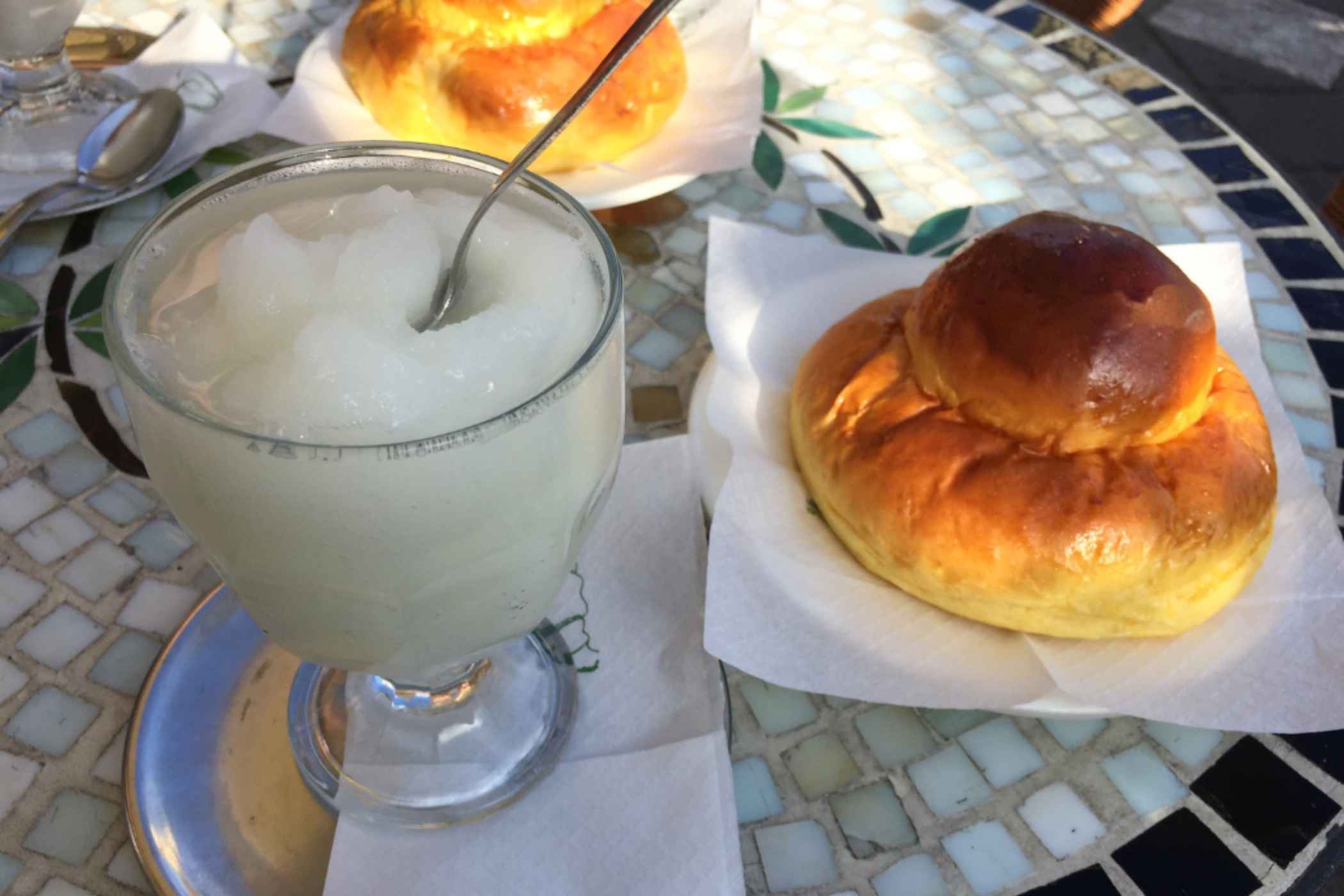
To eat granita like an Italian in 2026, you must understand the "Colazione Siciliana." In the heat of the Mediterranean summer, a heavy pastry or a hot bowl of oatmeal is unappealing. Instead, Sicilians turn to granita e brioche.
The brioche used for this ritual is the brioche col tuppo. The name "tuppo" refers to the traditional chignon hairstyle worn by Sicilian women, which the bun resembles with its small spherical top. The brioche is served warm, providing a thermal contrast to the freezing granita.
The etiquette involves tearing off the "tuppo" first and dipping it into the granita. The brioche is yeasty, buttery, and slightly sweet, acting as a sponge for the melting ice. This combination of coffee or almond granita and a warm bun provides enough calories and hydration to sustain workers and locals through the midday sun.
Identifying Authentic Granita in Italy
As a traveler or a culinary enthusiast, identifying "true" granita versus a commercial imitation is essential for an authentic experience. Use the following criteria to verify quality:
- The Container: Authentic granita is almost always kept in pozzetti—deep metal tubs with lids. If the granita is swirling in a clear plastic machine (a "slushie" machine), it is likely a commercial product filled with stabilizers and artificial colors.
- The Color: Pistachio should be olive-colored, not bright green. Lemon should be slightly opaque or translucent white, not yellow. If the colors look like neon lights, they are artificial.
- The Texture: It should not be a solid block of ice, nor should it be a liquid juice. It should hold its shape on a spoon but melt immediately upon contact with the mouth.
- The Seasonality: If a shop is offering mulberry or strawberry granita in the middle of December, it is a sign that they are using frozen pulps or syrups rather than fresh, seasonal fruit.
Common Mistakes to Avoid
When ordering granita in Italy, keep these cultural nuances in mind:
- Don't ask for a straw: Granita is meant to be eaten with a spoon, especially the grainier varieties.
- Don't skip the brioche: Even if you aren't hungry, the brioche is half the experience. The salty-sweet interaction of the butter and the ice is a culinary highlight.
- Don't assume it's just a dessert: While it can be eaten as a treat, in the south, it is a legitimate meal replacement for breakfast or a light lunch.
Frequently Asked Questions
Is Italian granita vegan?
Most traditional fruit-based and nut-based granitas (lemon, strawberry, almond, pistachio) are naturally vegan as they consist only of water, sugar, and the flavoring ingredient. However, you must be careful with the "brioche col tuppo," which is made with eggs and butter. Additionally, if you order it "con panna," you are adding dairy whipped cream.
What is the best time of year to eat granita in Italy?
While available year-round in many parts of Sicily, the peak season is from May to September. This is when the widest variety of seasonal fruits, such as mulberries, peaches, and figs, are available to be turned into granita.
Can I find authentic Sicilian granita in Northern Italy?
Yes, but you must be more selective. Look for gelaterias that specifically advertise "Granita Siciliana" and use the pozzetti storage method. Many Sicilian expats have opened authentic shops in cities like Milan, Turin, and Rome to bring their heritage to the north.
Why is it called "Granita"?
The name is derived from the word "grana," meaning "grain." This refers to the grainy, crystalline texture of the ice that distinguishes it from the smooth, creamy texture of sorbet or gelato.
Is there a difference between "Granita" and "Crema di Caffè"?
Yes. Crema di caffè is a modern, frothy, dairy-based coffee cream often served from a rotating dispenser. It contains fats (cream or milk) and has a mousse-like consistency. Granita di caffè is water-based and crystalline.
Practical Recommendation for Travelers
If you are visiting Italy in 2026, prioritize a visit to the eastern coast of Sicily (Catania, Taormina, or Messina) specifically for a granita breakfast. Order a Granita di Mandorla or Caffè con Panna and ask for a "brioche tiepida" (warm brioche). For the most authentic experience, seek out historic bars rather than modern kiosks, and look for the "DOP" or "IGP" labels on the ingredients used, which guarantee the geographic origin and quality of the nuts and fruits.
Image Gallery