Understanding What the Fastest Car Ever Made Is: Absolute Records vs. Production Standards
Determining the fastest car ever made requires distinguishing between absolute land speed record vehicles and production road cars. The absolute fastest land vehicle in history is the jet-powered ThrustSSC, which reached 763.035 mph (1...
Determining the fastest car ever made requires distinguishing between absolute land speed record vehicles and production road cars. The absolute fastest land vehicle in history is the jet-powered ThrustSSC, which reached 763.035 mph (1,227.985 km/h) in 1997. For production hypercars, Bugatti's Chiron Super Sport 300+ achieved an independently verified 304.773 mph (490.484 km/h).
Contents
Defining the "Fastest Car": Thrust-Driven vs. Wheel-Driven Vehicles
When evaluating the fastest car ever built, automotive engineers and record-keeping organizations split vehicles into two primary classifications: thrust-driven land speed record (LSR) vehicles and engine-driven (wheel-driven) production hypercars. Comparing these two categories directly is inaccurate because they operate under fundamentally different physical and mechanical principles.
Thrust-driven vehicles do not use their wheels to propel themselves forward. Instead, they rely on jet or rocket engines to blast exhaust gases backward, pushing the vehicle forward across flat dry lake beds. The wheels on these machines exist solely to keep the vehicle off the ground and provide basic steering stability.
In contrast, production hypercars must transmit thousands of horsepower directly through their tires to the road surface. These vehicles must comply with safety regulations, run on commercial or specialized pump fuels, incorporate passenger cabins, and manage drag and downforce to maintain steering control at extreme velocities. Understanding which car is the "fastest" depends entirely on whether you are analyzing non-production thrust vehicles or road-going hypercars.
The Absolute Fastest Land Vehicle: ThrustSSC and the Sound Barrier
The undisputed holder of the absolute land speed record is ThrustSSC (Thrust SuperSonic Car), a British jet-propelled car developed by project director Richard Noble, chief aerodynamicist Ron Ayers, and lead designer Glynne Bowsher. On October 15, 1997, RAF fighter pilot Andy Green drove ThrustSSC across the Black Rock Desert in Nevada, USA, achieving an officially sanctioned speed of 763.035 mph (1,227.985 km/h) over a measured mile.
| ThrustSSC Performance |
|---|
| Engine: 2x Rolls-Royce Spey 202 Turbofans |
| Total Thrust: ~50,000 lbs (approx. 110,000 horsepower) |
| Peak Speed: 763.035 mph (1,227.985 km/h) / Mach 1.016 |
| Location: Black Rock Desert, Nevada, USA (October 15, 1997) |
ThrustSSC remains the first and only land vehicle to officially break the sound barrier, reaching a velocity of Mach 1.016. To accomplish this feat, the vehicle was equipped with two Rolls-Royce Spey 202 turbofan engines—the same engines used in the McDonnell Douglas F-4 Phantom II jet fighter—generating a combined thrust of roughly 50,000 pounds (equivalent to approximately 110,000 mechanical horsepower).
Engineering the Supersonic Frontier
Breaking the sound barrier on land presents aerodynamic challenges far beyond those experienced by aircraft at high altitudes:
- Ground Effect and Shockwaves: When an aircraft breaks the sound barrier at 30,000 feet, the supersonic shockwave expands outward into open air. On land, a vehicle traveling at Mach 1 creates a shockwave that strikes the ground surface and reflects back up beneath the vehicle. If unaccounted for, this localized high-pressure wave can generate massive lift, pitching the vehicle nose-up and causing a catastrophic crash.
- Solid Aluminum Wheels: Conventional rubber tires would instantly shred due to centrifugal forces at speeds exceeding 400 mph. ThrustSSC utilized solid forged aluminum alloy wheels without rubber tires, designed to withstand spin rates over 8,400 RPM and sink slightly into the desert alkali surface to maintain directional tracking.
- Rear-Wheel Steering: Because the massive twin turbofan engines occupied the front and center chassis, ThrustSSC utilized a rear-wheel steering configuration, which made high-speed adjustments delicate and counterintuitive for the pilot.
While project teams have proposed modern successor projects—such as the Bloodhound LSR initiative aimed at reaching 800+ mph—ThrustSSC continues to hold the official record certified by the Fédération Internationale de l'Automobile (FIA).
The Fastest Wheel-Driven Production Cars
For automotive enthusiasts seeking the fastest road-legal or production-based vehicle, the battleground shifts to internal combustion and hybrid hypercars. In this category, speed is constrained not by jet thrust, but by tire friction, thermal management, gear ratios, and atmospheric drag.
Bugatti Chiron Super Sport 300+
In August 2019, test driver Andy Wallace piloted a modified pre-production variant of the Bugatti Chiron Super Sport 300+ to a peak speed of 304.773 mph (490.484 km/h) at the Volkswagen Group testing facility in Ehra-Lessien, Germany. Verified by Germany’s Technical Inspection Association (TÜV), this run made Bugatti the first hypercar manufacturer to officially break the 300-mph barrier with a road-car derivative.
Powered by an 8.0-liter quad-turbocharged W16 engine delivering 1,578 horsepower (1,600 PS), the Super Sport 300+ featured a re-engineered "longtail" carbon-fiber body extended by approximately 25 centimeters to minimize drag and maintain aerodynamic equilibrium at speeds exceeding 400 feet per second.
- Bugatti Chiron Super Sport 300+ (304.773 mph / 490.484 km/h)
- SSC Tuatara (282.9 mph / 455.3 km/h)
- Koenigsegg Agera RS (277.87 mph / 447.19 km/h)
- Hennessey Venom GT (270.49 mph / 435.31 km/h)
Koenigsegg Agera RS
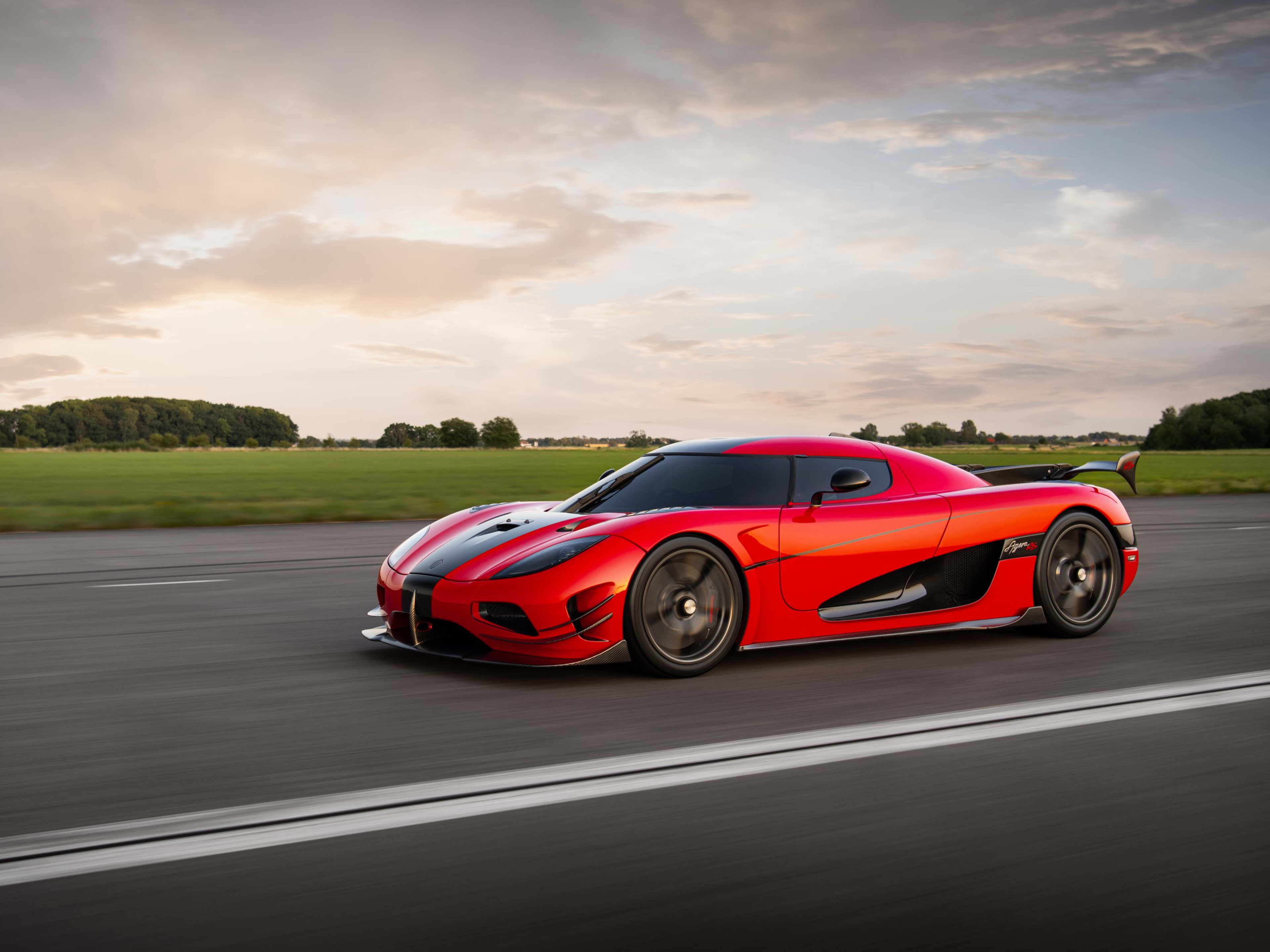
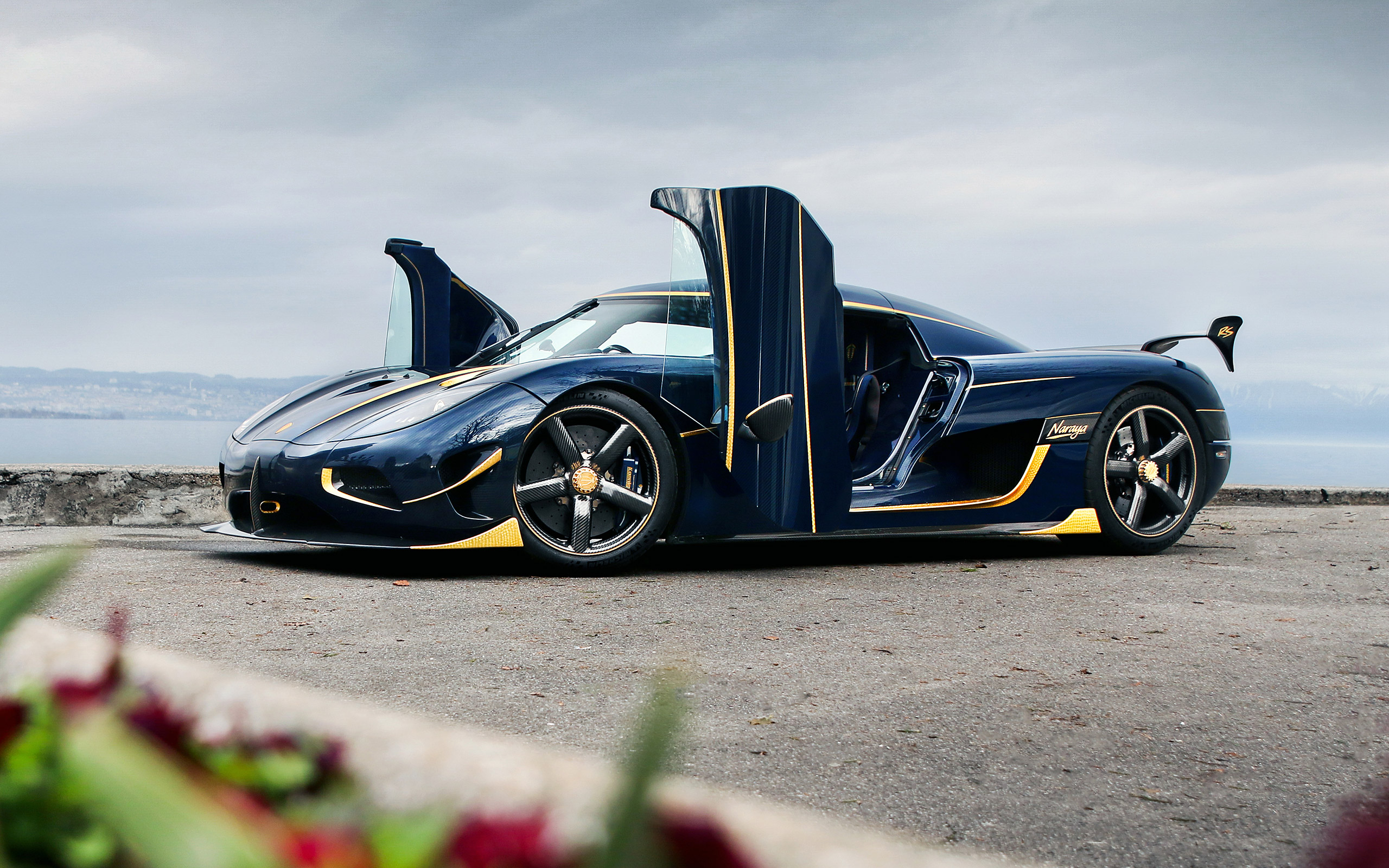
While Bugatti achieved the highest single-direction speed, Swedish manufacturer Koenigsegg held the official, two-way average world record for a production car for several years. In November 2017, factory driver Niklas Lilja drove a customer-owned Koenigsegg Agera RS on a closed 11-mile stretch of Nevada State Route 160.
The Agera RS achieved a two-way average speed of 277.87 mph (447.19 km/h), including an individual run peak of 284.55 mph. Powered by a 5.0-liter twin-turbocharged V8 engine producing 1,360 horsepower on E85 ethanol, the Agera RS met every stringent requirement for an official world record:
- It completed two consecutive runs in opposite directions within one hour to account for wind assistance and road gradient.
- It used standard production equipment, including road-legal Michelin Pilot Sport Cup 2 tires.
- The run was recorded using certified VBOX GPS data-logging equipment.
SSC Tuatara
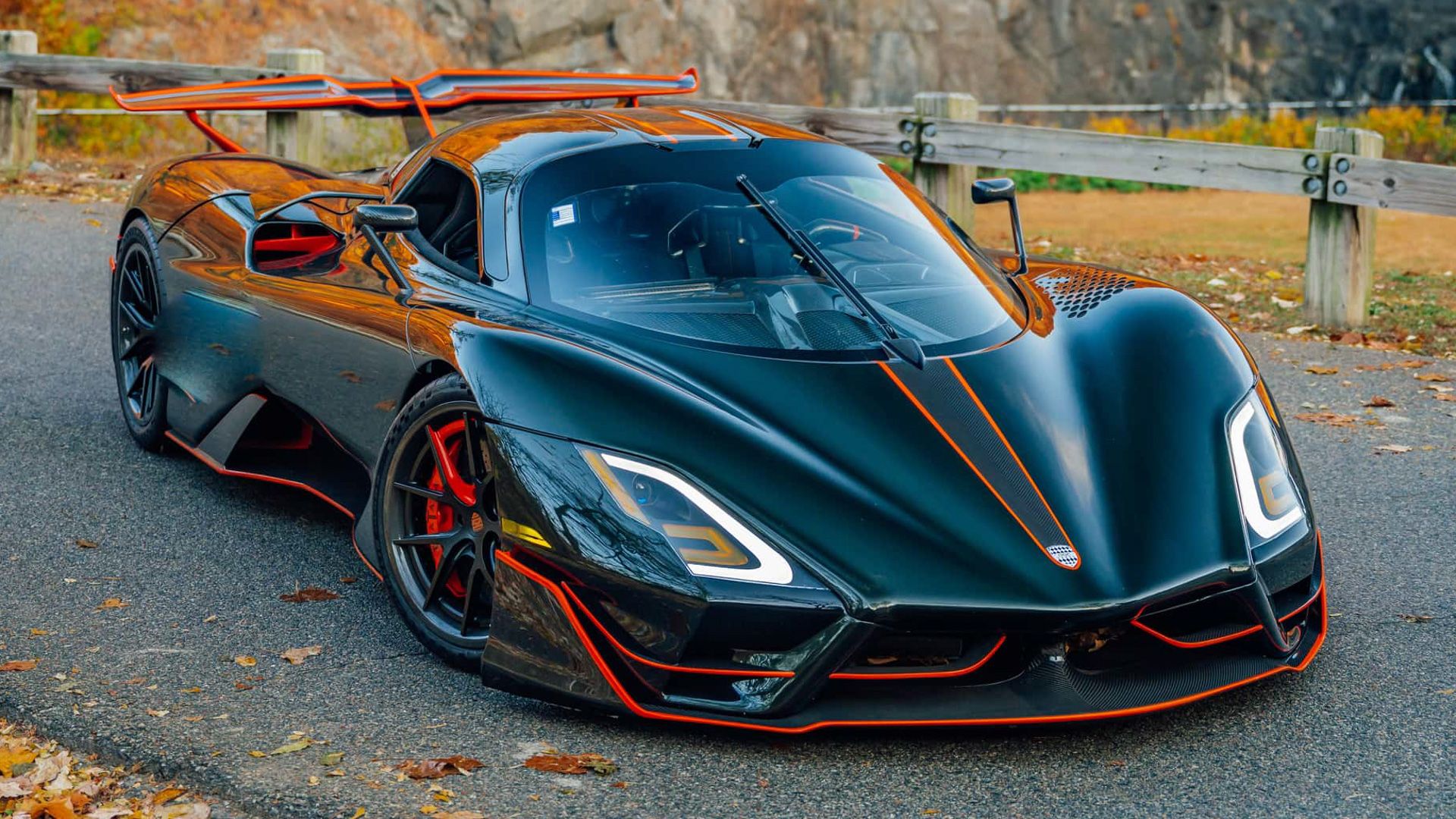
American supercar manufacturer SSC North America developed the SSC Tuatara, powered by a 5.9-liter twin-turbo flat-plane crank V8 generating up to 1,750 horsepower on E85 fuel. Following re-testing after an initial unverified attempt, SSC officially logged a two-way average speed of 282.9 mph (455.3 km/h) in January 2021 at the Johnny Bohmer Proving Grounds in Florida, confirming its placement among the fastest wheel-driven production vehicles in existence.
Emerging Contenders: Koenigsegg Jesko Absolut & Hennessey Venom F5
The pursuit of high-speed dominance remains ongoing among low-volume hypercar manufacturers:
- Koenigsegg Jesko Absolut: Engineered specifically for minimum drag (with a low drag coefficient of 0.278 $C_d$), computer simulations indicate the Jesko Absolut is theoretically capable of speeds exceeding 310 to 330 mph, pending suitable tire development and location selection for testing.
- Hennessey Venom F5: Built around a custom 6.6-liter twin-turbocharged "Fury" V8 engine producing 1,817 horsepower, Texas-based Hennessey Performance Engineering designed the Venom F5 to target speeds beyond 300 mph, conducting high-speed stability testing above 270 mph during validation phases.
Technical Comparison of Speed Record Holders
The following table details the key specifications, speed achievements, and operational categories of the world's most prominent speed-record vehicles:
| Vehicle Name | Vehicle Category | Top Verified Speed (mph / km/h) | Powertrain / Engine Type | Official Verification Status |
|---|---|---|---|---|
| ThrustSSC | Jet-Powered LSR | 763.035 mph (1,227.985 km/h) | Twin Rolls-Royce Spey 202 Turbofans | Official FIA World Land Speed Record |
| Bloodhound LSR | Jet-Powered LSR | 628.000 mph (1,010.661 km/h) | EJ200 Turbofan (Testing Phase Record) | Verified High-Speed Test Track Run |
| Bugatti Chiron Super Sport 300+ | Hypercar (Production Derivative) | 304.773 mph (490.484 km/h) | 8.0L Quad-Turbo W16 (1,578 hp) | Certified One-Way Run (TÜV Verified) |
| SSC Tuatara | Production Hypercar | 282.900 mph (455.300 km/h) | 5.9L Twin-Turbo V8 (1,750 hp) | Verified Two-Way Average (VBOX Verified) |
| Koenigsegg Agera RS | Production Hypercar | 277.870 mph (447.190 km/h) | 5.0L Twin-Turbo V8 (1,360 hp) | Official Guinness World Record (Two-Way) |
| Hennessey Venom GT | Low-Volume Hypercar | 270.490 mph (435.310 km/h) | 7.0L Twin-Turbo V8 (1,244 hp) | Unofficial Two-Way (Single-Run Verified) |
| Bugatti Veyron 16.4 Super Sport | Production Hypercar | 267.856 mph (431.072 km/h) | 8.0L Quad-Turbo W16 (1,183 hp) | Official Guinness World Record (2010) |
The Engineering Physics of Reaching 300+ MPH
Designing a vehicle capable of pushing through ambient air at 300 mph or faster requires resolving extreme mechanical and thermodynamic challenges.
Aerodynamic Drag and Downforce Balance
Aerodynamic drag increases exponentially with velocity according to the drag equation:
$$F_d = \frac{1}{2} \rho v^2 C_d A$$
Where:
- $F_d$ is the drag force,
- $\rho$ is air density,
- $v$ is vehicle velocity,
- $C_d$ is the drag coefficient,
- $A$ is the frontal surface area.
Because velocity ($v$) is squared, doubling a vehicle's speed requires four times the force to overcome air resistance, which equates to eight times the power output from the engine ($P = F \times v$).
- DRAG VS VELOCITY
- Power required increases with the CUBE of velocity.
- 150 mph: ~150-200 hp required
- 300 mph: ~1,500-1,600 hp required
Furthermore, aerodynamic engineers must carefully balance low drag with sufficient downforce. Without adequate downforce, high-speed lift can render steering ineffective or cause total loss of traction. However, excess downforce overloads the suspension and tires, generating destructive heat.
Tire Centrifugal Forces and Heat Management
At 300 mph, a hypercar tire rotates over 40 times per second. Centrifugal forces exert extreme outward pull on the tire tread and steel belts, equivalent to thousands of times the acceleration of gravity ($g$-force).
To prevent tire delamination or explosive blowout, tire manufacturers like Michelin collaborate directly with hypercar designers. Special tires—such as the Michelin Pilot Sport Cup 2 radial developed for Bugatti and Koenigsegg—integrate carbon-fiber threads woven into the tire casing to limit radial expansion under rotational load.
| Tire Forces at 300+ MPH |
|---|
| Rotations: >40 Rev/Sec |
| Forces: Thousands of Gs |
| Solution: Carbon-Fiber Belts |
Thermal Dissipation
Combustion engines operating at 1,500+ horsepower produce massive thermal waste. Hypercar cooling systems utilize complex networks of high-capacity radiators, air intakes, and heat shields to cool engine oil, intake air (via intercoolers), transmission fluid, and engine coolant simultaneously without significantly disrupting the vehicle's drag profile.
Standard Protocols for Speed Record Certification
To claim an official automotive speed record recognized worldwide, testing teams must comply with standardized testing protocols established by bodies such as the FIA or Guinness World Records:
- Two-Way Run Requirement: The vehicle must complete two runs in opposite directions over a measured distance (typically 1 kilometer or 1 mile) within a strict time limit (usually 60 minutes). This eliminates performance advantages gained from tailwinds or elevation descents. The official speed is calculated as the average of the two peak speeds.
- Production Run Minimums: To qualify for the "production car" title, manufacturers must produce a minimum number of road-going units sold to the public (typically 25 to 30 units) with identical mechanical specifications. Vehicles equipped with specialized gear ratios, slick tires, or missing safety systems do not qualify for production records.
- Calibrated Telemetry: Record attempts require independent verification using high-frequency differential GPS data loggers (such as Racelogic VBOX systems) accompanied by certified third-party observers.
Frequently Asked Questions
What is the absolute fastest vehicle ever driven on land?
The absolute fastest land vehicle in history is ThrustSSC, a jet-powered record car that reached 763.035 mph (1,227.985 km/h) on October 15, 1997. Driven by Andy Green in the Black Rock Desert, Nevada, it is the only land vehicle to officially break the sound barrier.
What is the fastest production road car in the world?
Depending on how records are classified, the fastest production derivatives are:
- Bugatti Chiron Super Sport 300+: Highest single-direction speed by a production-derived vehicle at 304.773 mph.
- Koenigsegg Agera RS: Highest verified two-way average record for a fully production-compliant street car at 277.87 mph.
Why don't record attempts count single-direction runs?
Single-direction runs can be aided by favorable wind conditions or downhill gradients. Standard international rules set by the FIA require two runs in opposite directions within one hour, averaging the speeds to ensure environmental conditions do not skew the results.
What is the fastest electric car in the world?
The Rimac Nevera holds multiple electric vehicle performance marks, including a top speed of 256.10 mph (412 km/h). Electric hypercars achieve rapid acceleration due to instant motor torque, but face top-speed limits due to battery thermal management and single-speed gearing constraints.
Could a car ever travel faster than 1,000 mph on land?
Engineers designing thrust-powered vehicles believe traveling 1,000 mph (1,609 km/h) is theoretically possible using hybrid rocket-and-jet propulsion systems. However, controlling ground-effect shockwaves, designing solid metal wheels capable of surviving 10,000+ RPM, and securing funding present immense practical hurdles.
Assessing Speed Claims and Next Steps
When evaluating automotive speed claims, readers should verify whether a stated speed represents a computer simulation, an unverified single run, or an independently logged two-way average.
For enthusiasts following ongoing developments:
- Monitor official FIA announcements for land speed record attempts.
- Review telemetry methodology (such as VBOX GPS logs) published during top-speed runs.
- Distinguish between low-drag prototype run conditions and consumer-ready production specifications.
EDITORIAL CATEGORY METADATA:
Image Gallery