How Does a Pre-Approved Car Loan Work? A Comprehensive Guide for 2026
A pre-approved car loan is a conditional commitment from a lender stating they are willing to lend you a specific amount at a defined interest rate. It involves a hard credit inquiry and verification of your financial documents, allowi...
A pre-approved car loan is a conditional commitment from a lender stating they are willing to lend you a specific amount at a defined interest rate. It involves a hard credit inquiry and verification of your financial documents, allowing you to shop for vehicles like a cash buyer within a 30-to-60-day window.
Contents
Navigating the automotive market in 2026 requires more than just a preference for a specific make or model; it requires a strategic financial foundation. As vehicle prices remain high and lending criteria have tightened, obtaining a pre-approval has transitioned from a helpful tip to a near-necessity for the savvy consumer. Understanding the mechanics of pre-approval allows you to separate the financing process from the car-buying process, granting you significant leverage at the dealership and providing a clear boundary for your budget.
The Fundamental Mechanics of Pre-Approval
At its core, a pre-approved car loan is an agreement between you and a financial institution—typically a bank, credit union, or online lender—that occurs before you ever set foot on a dealership lot. Unlike "pre-qualification," which is often a surface-level estimate based on a soft credit pull, pre-approval is a formal process. The lender conducts a deep dive into your credit history, income stability, and debt-to-income (DTI) ratio to determine exactly how much risk you represent.
Once the lender completes this assessment, they issue a pre-approval letter. This document outlines the maximum loan amount you are eligible for, the interest rate (APR) you have secured, and the required down payment. In the eyes of a car salesperson, this letter transforms you from a "monthly payment shopper" into a "total price buyer." Because the financing is already handled, the dealership cannot easily manipulate the vehicle price by hiding costs in a high-interest loan package.
Why Pre-Approval Differs from Pre-Qualification
It is common for consumers to use these terms interchangeably, but in 2026, the distinction is legally and financially significant. Pre-qualification is an informal "look-over" of your finances. It is excellent for getting a ballpark figure of what you might afford without impacting your credit score. However, it carries no weight during a negotiation because the lender has not yet verified your claims.
Pre-approval, conversely, is a rigorous verification process. It requires a hard credit pull, which may slightly lower your credit score temporarily. However, because it involves a verified analysis of your pay stubs, tax returns, and current debt obligations, it serves as a firm offer. When you present a pre-approval letter to a dealer, you are essentially saying, "I have the money; let's talk about the price of the car."
| Feature | Pre-Qualification | Pre-Approval |
|---|---|---|
| Credit Inquiry Type | Soft (No score impact) | Hard (Temporary minor impact) |
| Verification Level | Self-reported data | Document-verified data |
| Commitment Level | Estimated/Non-binding | Conditional commitment |
| Negotiation Power | Low | High |
| Validity Period | Often indefinite | Typically 30–60 days |
| Required Documents | Minimal/None | Income, Identity, Residency proofs |
The Step-by-Step Pre-Approval Process
Understanding the workflow of a pre-approval can help you time your car search effectively. Since pre-approvals have expiration dates, you should only initiate the process when you are ready to buy within the next month or two.
1. Credit Report Audit and Preparation
Before applying, you must know what the lenders will see. In 2026, lenders prioritize borrowers with clean credit histories and low utilization ratios. Obtain your reports from Equifax, Experian, and TransUnion. Look for errors, such as accounts you didn't open or incorrectly reported late payments. Correcting these errors before the hard pull can move you from a "Prime" rate to a "Super-Prime" rate, potentially saving you thousands in interest over the life of the loan.
2. Documentation Gathering
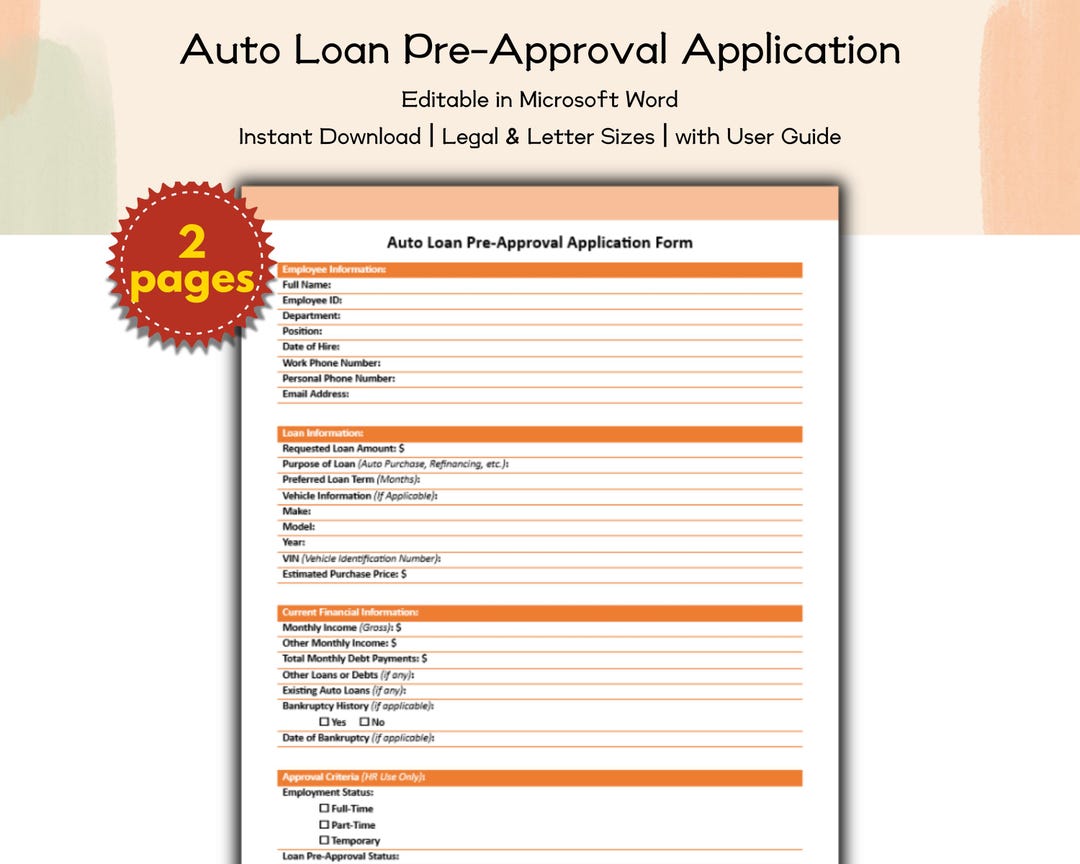
Lenders require evidence of your ability to repay. You will typically need to provide:
- Proof of Identity: A valid driver’s license or passport.
- Proof of Income: Recent pay stubs (usually the last 30 days), W-2 statements, or tax returns if you are self-employed.
- Proof of Residency: Utility bills or a signed lease agreement.
- Existing Debt Information: A list of monthly obligations like student loans, credit cards, or mortgages.
3. Application Submission
You can apply for pre-approval at multiple institutions. In the United States, the Consumer Financial Protection Bureau (CFPB) notes that multiple inquiries for the same type of loan within a short window (usually 14 to 45 days) are often treated as a single inquiry for credit scoring purposes. This "rate shopping" window allows you to compare offers from a traditional bank, a local credit union, and a specialized online auto lender to find the lowest APR.
4. Reviewing the Pre-Approval Letter
If approved, the lender will provide a letter or a "blank check" up to a certain amount. Pay close attention to the Loan-to-Value (LTV) ratio mentioned in the fine print. This ratio dictates how much the lender will provide relative to the car's actual value. If you choose a car that is overpriced, the lender may refuse to cover the full amount, even if it falls under your total pre-approved limit.
Strategic Advantages at the Dealership
The true power of a pre-approved car loan manifests during the negotiation phase. Dealerships often make a significant portion of their profit through "finance reserve"—the practice of marking up the interest rate provided by their partner lenders. If a lender offers the dealer a 5% rate for you, the dealer might present it to you as 7%, pocketing the 2% difference.
When you walk in with a pre-approval for 5.5%, you effectively set a "ceiling" on what you are willing to pay for financing. You can tell the Finance and Insurance (F&I) manager, "I am already pre-approved at 5.5%. If you can beat that rate, I'm happy to finance through you. If not, I’ll use my own bank." This forces the dealership to compete for your business, often resulting in a lower rate than you could have secured otherwise.
Furthermore, pre-approval simplifies the transaction. Because you aren't haggling over monthly payments, the dealer cannot use "the four-square method"—a common sales tactic used to confuse buyers by mixing trade-in value, down payment, monthly payments, and total price. You keep the focus entirely on the "out-the-door" price of the vehicle.
The Impact on Your Credit Score
A common concern is whether applying for pre-approval will "trash" your credit score. It is important to understand the nuance of hard inquiries. A single hard inquiry typically drops a FICO score by fewer than five points.
As mentioned previously, the credit scoring models used in 2026 recognize that consumers need to compare rates. If you apply for five different car loans within a two-week period, your score will only reflect the impact of one inquiry. This encourages competition among lenders and benefits the consumer. However, avoid applying for other types of credit—like a new credit card or a mortgage—during this same window, as those will be counted as separate inquiries and can have a compounding negative effect.
Understanding Loan Limitations and Restrictions
A pre-approval is not a universal ticket to buy any car. Lenders often place specific "stipulations" on the loan. These may include:
- Vehicle Age and Mileage: Many lenders will not finance vehicles older than 10 years or with more than 100,000 miles.
- Excluded Brands/Models: Some lenders avoid financing "salvage titles," commercial vehicles, or certain high-maintenance luxury brands.
- Dealership Requirements: Some online lenders require you to purchase from a "franchised" dealership (e.g., a Ford or Toyota dealer) rather than an independent "buy-here-pay-here" lot.
- Maximum Loan-to-Value (LTV): If the car's market value is $20,000 but the dealer is asking $25,000, your lender will likely only finance up to a certain percentage of that $20,000 (often 100% to 120%), leaving you to cover the gap in cash.
Frequently Asked Questions
Does a pre-approval guarantee that I will get the loan?
No, a pre-approval is a "conditional" commitment. The final approval depends on the specific vehicle you choose. The lender must verify that the car's value supports the loan amount and that the title is clear of liens or "salvage" designations. Additionally, if your financial situation changes significantly (e.g., you lose your job or take on a new large debt) between pre-approval and the final purchase, the lender can rescind the offer.
How long does a car loan pre-approval last?
In the 2026 lending environment, most pre-approvals are valid for 30 to 60 days. If you do not find a vehicle within this timeframe, the offer expires. You can usually ask the lender to renew the pre-approval, but this may require a fresh credit pull and updated income documentation if more than 90 days have passed.
Can I use a pre-approval for a private party sale?
It depends on the lender. Many traditional banks and credit unions allow for private party car loans, but they often require additional steps, such as a vehicle inspection and a meeting at a local branch to sign the title over. Some specialized online lenders only work with established dealership networks. Always clarify with your lender if you intend to buy from an individual.
Is it better to get pre-approved by a bank or a credit union?
Generally, credit unions offer the most competitive rates for auto loans because they are member-owned, non-profit entities. However, large national banks often have more streamlined digital application processes and integrated tools for vehicle history checks. It is advisable to get a quote from both to ensure you are seeing the full spectrum of available rates.
What happens if the dealer offers a lower rate than my pre-approval?
This is a "win" for you. If the dealership can beat your pre-approved rate (often through manufacturer-subsidized "incentive" financing, like 0% or 1.9% APR), you should take their offer. Your pre-approval served its purpose as a safety net and a negotiation tool. You are under no legal obligation to use your pre-approved loan if a better deal appears.
Final Recommendation
Before visiting a dealership, secure at least two pre-approval offers from different types of institutions (e.g., one credit union and one online lender). This provides you with a clear budget and a powerful "best-rate" benchmark. By treating the financing as a separate product from the car itself, you protect your financial interests and ensure that your 2026 vehicle purchase is a calculated investment rather than an emotional or pressured decision.
Image Gallery