How to Read the Yamaha Grand Piano Serial Number
To read a Yamaha grand piano serial number, locate the 6- or 7-digit number stamped into the gold-painted cast iron plate near the tuning pins on the right side of the soundboard. Cross-reference this number with Yamaha’s official prod...
To read a Yamaha grand piano serial number, locate the 6- or 7-digit number stamped into the gold-painted cast iron plate near the tuning pins on the right side of the soundboard. Cross-reference this number with Yamaha’s official production year charts to determine the piano's age, manufacturing origin, and target market destination.
Contents
Locating the Serial Number on a Yamaha Grand Piano
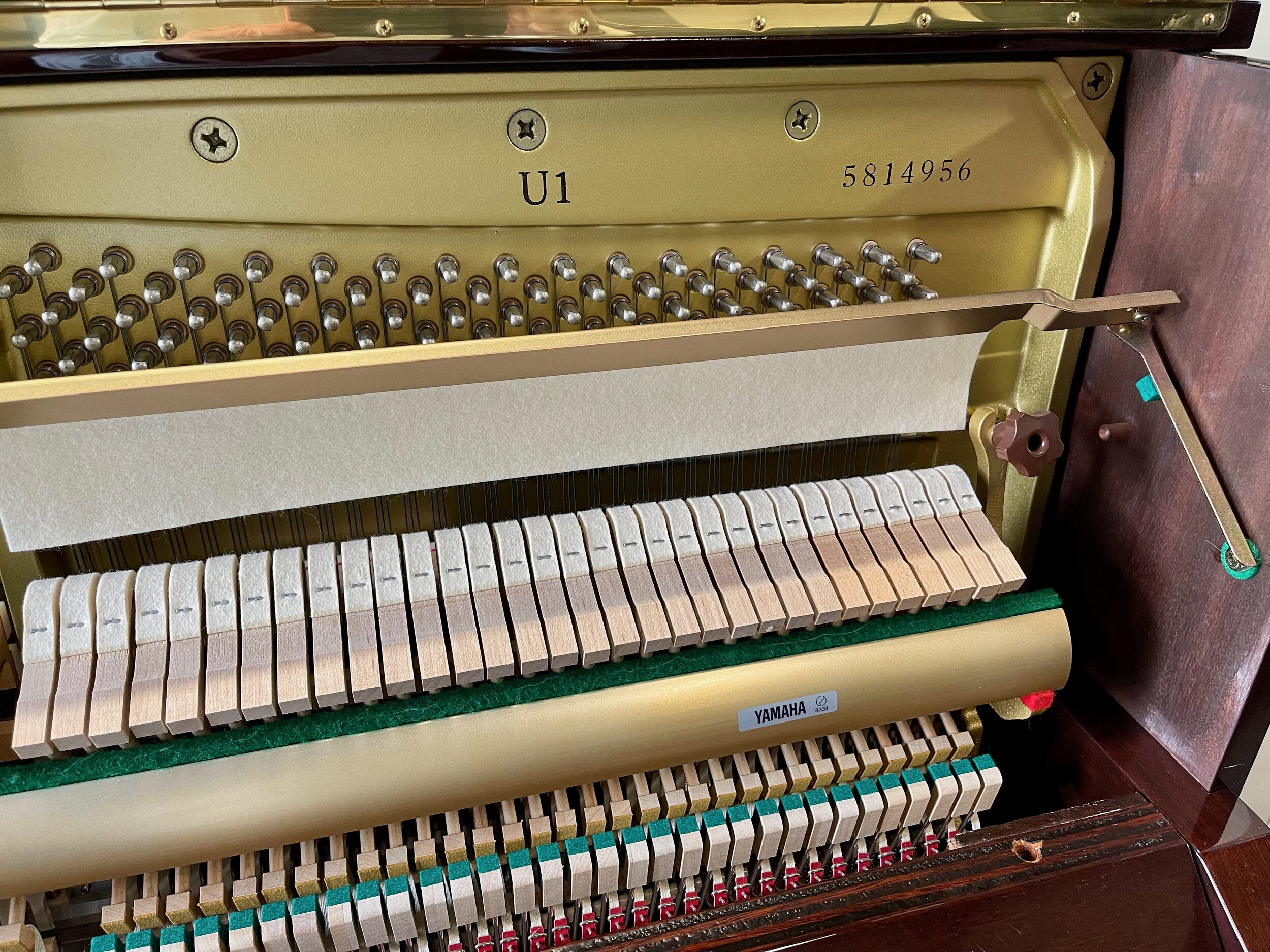
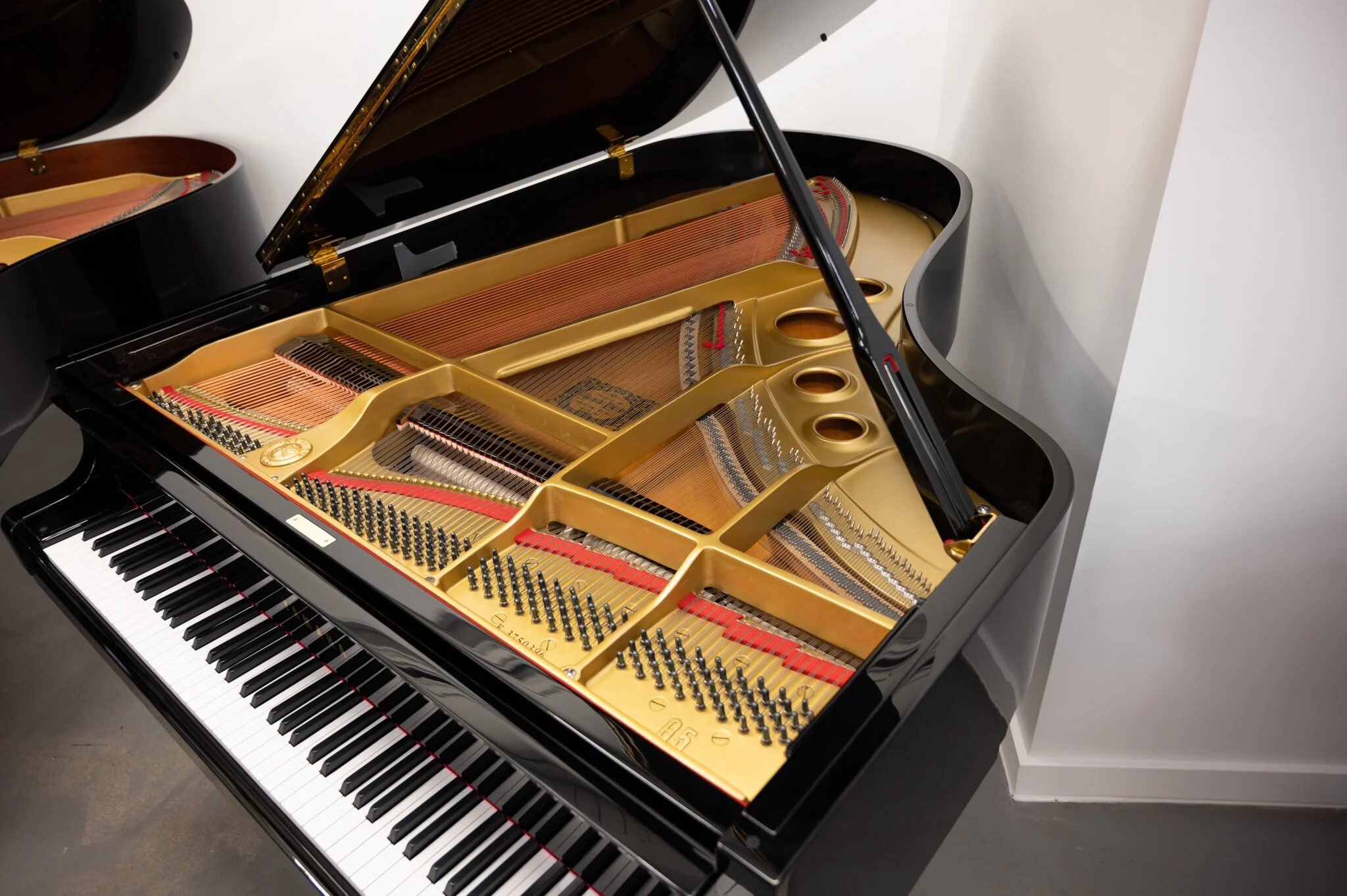
Finding the serial number on a Yamaha grand piano requires opening the top lid and examining the internal cast iron plate (often referred to as the harp or frame). Unlike upright pianos, where serial numbers are frequently printed on the upper backboard or gold plate near the top lid hinge, grand pianos feature their identification markings directly on the visible structural framework.
- Yamaha Grand Piano
- Tuning Pin Block
- Model Name (e.g., C3)
- Serial Number (e.g., 5849201)
- Cast Iron Plate (Harp / Frame)
- Tuning Pin Block
Primary Location: The Cast Iron Plate (Harp)
Set the grand piano prop stick securely in place. Stand on the right side of the keyboard facing the interior of the instrument. Look directly at the polished gold cast iron plate between the tuning pins and the soundboard.
You will typically see two distinct sets of stamped or raised markings:
- Model Designation: Stamped on the left or center section of the plate above the tuning pins (for example, G2, C3, GC1, or CX3).
- Serial Number: Stamped into a recessed cut-out or smooth panel on the right side of the plate, near the tuning pin block and soundboard bridge section.
Secondary Locations for Verification
If the primary number on the cast iron plate is worn, obstructed, or painted over during a past restoration, technicians locate secondary serial numbers stamped onto structural wooden components:
- The Stretcher Bar: The thick wooden beam directly under the front lid hinge and behind the fallboard (key cover). On many older models, the serial number is ink-stamped into the raw wood on the top face or underside of this bar.
- The Soundboard Rim: On the underside of the piano cabinet, inspect the wooden structural beams (struts) and the lower edge of the inner rim. Serial numbers or frame batch numbers are often stamped into the wood near the keybed assembly.
- The Keybed and Action Frame: When a qualified piano technician pulls the mechanical action out for regulating, the serial number is frequently handwritten or stamped on the front edge of the keybed wood or the side of the action frame.
Anatomy of a Yamaha Serial Number: Prefix Codes and Serial Formats
Reading a Yamaha serial number involves distinguishing between the model name, the numerical serial sequence, and letter prefixes that indicate factory origin or destination markets.
- Model Revision Prefix (Appears with Model Name)
- Example: C3X
- Meaning: Model Designation
- Factory Origin Prefix (Appears BEFORE Serial Number)
- Example: T 5849201
- Meaning: Serial Sequence
Model Revisions vs. Serial Number Prefixes
A common point of confusion is mixing up letter prefixes attached to the model designation with letter prefixes attached to the serial number itself.
- Model Revision Letters: Letters placed immediately after or within the model name (such as C3A, C3B, C3E, C3L, or C3X) denote design revisions, cabinet structural updates, or scale design improvements over time. They do not indicate the serial number.
- Serial Number Prefixes: A single letter placed directly in front of the 6- or 7-digit serial number (such as T, H, J, or E) indicates the specific manufacturing plant or export configuration.
Manufacturing Plant Codes
While the vast majority of premium Yamaha grand pianos are manufactured at Yamaha’s flagship facility in Hamamatsu, Japan, certain entry-level, mid-range, and regional grand series are built at secondary facilities. The prefix letter in front of the serial number identifies where the instrument was assembled:
| Prefix Letter | Manufacturing Facility Location | Common Grand Piano Models Produced |
|---|---|---|
| No Prefix | Hamamatsu, Japan | Premium & Standard Lines (C Series, CX Series, CF Series, Original G Series) |
| T | Thomaston, Georgia, USA | Select North American Cabinetry Runs & Assembled Uprights/Grands (Historical) |
| H | Hangzhou, China | Entry-Level Grand & Upright Lines (Select Cable-Nelson & Yamaha Consoles) |
| J | Jakarta, Indonesia | Mid-Range Baby Grands (GB1K, Select GA/GC Series) |
| A | Kaohsiung, Taiwan | Regional Asia-Pacific Market Models (Historical Production) |
| E | Kemble / European Assembly | Select European Export Models (Historical Joint Facilities) |
Japanese Production Serial Number Chart for Yamaha Grand Pianos
Because standard Yamaha grand pianos produced in Hamamatsu, Japan, account for the majority of instruments in global circulation, their serial numbers follow a continuous numerical progression.
The following table provides verified production year ranges for Japanese-made Yamaha grand pianos without a factory prefix.
| Serial Number Range | Year of Manufacture | Production Context & Key Design Eras |
|---|---|---|
| 100,000 – 130,000 | 1960 | Early global export era; traditional scale designs |
| 400,000 – 550,000 | 1965 | Expansion of the original G-Series grand line |
| 1,000,000 – 1,150,000 | 1970 | Standardized automated manufacturing methods in Hamamatsu |
| 2,000,000 – 2,150,000 | 1975 | Introduction of refined scale engineering across G2 and G3 models |
| 3,000,000 – 3,200,000 | 1980 | Widespread international adoption in conservatories and homes |
| 4,000,000 – 4,200,000 | 1985 | Transition period; early experimentation leading to the Conservatory (C) Series |
| 5,000,000 – 5,150,000 | 1991 | Official rollout of the modern Conservatory (C-Series) redesigns |
| 5,500,000 – 5,650,000 | 1996 | Implementation of upgraded pinblock materials and acoustic soundboard woods |
| 6,000,000 – 6,100,000 | 2002 | Refinement of action geometry and hammer felt density |
| 6,200,000 – 6,280,000 | 2007 | Production of late C-Series (C3L, C5L) prior to CX redesigns |
| 6,300,000 – 6,380,000 | 2011 | Launch of the CFX concert grand technology integration |
| 6,400,000 – 6,480,000 | 2015 | Full transition to the CX-Series (CX1, CX2, CX3, CX5, CX7) |
| 6,500,000 – 6,550,000 | 2020 | Modern production run with refined music wire and crown retention |
| 6,560,000+ | 2024 – 2026 | Contemporary production standards across all Hamamatsu grand lines |
Note: Pianos manufactured in non-Japanese facilities (e.g., prefix J for Indonesia or H for China) follow independent, separate numerical sequences. A 6-digit number with a "J" prefix does not map to the Japanese year table above.
Decoding Non-Japanese Serial Numbers
When inspecting a baby grand or compact grand piano, you may encounter serial numbers that do not fit the standard 7-digit Japanese sequence.
Indonesian Production (Prefix "J")
Yamaha's Jakarta plant manufactures compact grand models such as the GB1K and GC1. These instruments feature a capital J preceding the serial sequence:
- Serial numbers starting with J began production in the late 1990s and early 2000s.
- Unlike Japanese numbers, an Indonesian serial number like J 1234567 follows a localized registry managed directly by Yamaha's regional factory systems.
- To verify exact production dates for J prefix instruments, cross-reference the number with Yamaha’s customer support database or consult an authorized dealer with access to global factory shipping logs.
American Production (Prefix "T")
During the operation of Yamaha’s manufacturing facility in Thomaston, Georgia, pianos built for the North American market received a T prefix:
- A grand piano stamped T 123456 was manufactured or final-assembled in the United States.
- Production at the Georgia facility ceased in the mid-2000s, meaning all T series instruments were built prior to 2007.
The "Grey Market" Factor: Destination Climate Seasoning
One of the most vital reasons to read and check a Yamaha grand piano's serial number is to verify its original target destination market. Pianos intended for export to dry North American or European environments undergo a specific wood-seasoning process that differs from instruments built for the humid domestic Japanese climate.
Seasoning for Climate Explained
Wood is a hygroscopic material that expands and contracts based on ambient relative humidity. During manufacturing in Hamamatsu, Yamaha seasons the wood components—including the soundboard, pinblock, rim, and action parts—to specific equilibrium moisture content (EMC) levels:
- North American Market Destination: Soundboard and pinblock woods are dried down to approximately 5% to 8% moisture content to withstand indoor winter heating systems across North America.
- Japanese Domestic Market Destination: Wood is seasoned for an environment with higher average ambient humidity levels (around 10% to 12% moisture content).
Identifying Grey Market Imports
Used pianos originally sold in Japan and later exported to North America by third-party liquidators are commonly referred to as "grey market" or "used domestic Japanese" pianos.
If a Japanese-seasoned piano is moved into a dry North American home with central heating, the wood can lose moisture rapidly. This accelerated drying increases the risk of:
- Loose tuning pins caused by shrinkage in the multi-ply pinblock.
- Cracks or acoustic separation in the soundboard and bridge joints.
- Glue joint failures in the rim and structural braces.
How to Check Destination Status
Yamaha maintains an official online database where buyers enter a grand piano's serial number. The system instantly confirms whether the serial number was originally manufactured for and distributed to the North American market by Yamaha Corporation of America.
If the database reports that the serial number is not found in the North American distribution record, the instrument is a grey-market import designed for the Japanese domestic market.
Step-by-Step Guide to Verifying a Yamaha Grand Piano
Follow this systematic process when inspecting a prospective Yamaha grand piano purchase or preparing a valuation report.
- Open Lid & Locate Serial Stamping (Right Side of Cast Iron Plate)
- Note the Letter Prefixes (Distinguish Model vs. Serial Prefix)
- Identify Factory Origin (No Prefix = Japan, J = Indonesia, T = USA)
- Cross-Reference Serial Number with Year Range Tables
- Run Serial Number Through Market Verification Lookup (Climate Seasoning Check)
1. Document the Full Inscription
Record the complete text found on the plate, including any preceding letters, spaces, or hyphenations. Note down the model code (e.g., C3X) and the serial number (e.g., 6450123) on separate lines.
2. Inspect Secondary Wood Stamps
Check the stretcher bar behind the fallboard and the underside of the soundboard rim to verify that the cabinet wood stamps match the plate serial number. Mismatched numbers indicate that the piano may have been rebuilt using components from different donor instruments.
3. Verify the Year via Serial Charts
Compare the numerical sequence against verified production tables. If the number has 7 digits without a prefix, use the main Hamamatsu chart above. If the serial contains a J or T prefix, use regional facility lookup indices.
4. Perform a Market Destination Lookup
Visit Yamaha’s official serial lookup portal or contact an authorized Yamaha service technician. Provide the 7-digit serial to confirm whether the instrument was seasoned for your region's moisture profile.
5. Evaluate Mechanical and Structural Condition
While the serial number confirms age and origin, physical condition dictates value. Have a registered piano technician perform an onsite inspection to evaluate pin torque, soundboard crown, hammer wear, and key action regulation.
Frequently Asked Questions
Where is the serial number located on a Yamaha baby grand piano?
On a Yamaha baby grand piano (such as the GB1K, GA1, or GC1), the serial number is stamped on the right side of the gold cast iron plate near the tuning pins, directly adjacent to the soundboard bridge area. It is also often ink-stamped onto the wooden stretcher bar behind the fallboard.
What is the difference between a Yamaha C3 and a C3X?
The C3 represents the classic Conservatory series grand built from roughly 1967 through 2012. The C3X represents the redesigned CX-Series launched around 2012, which incorporates scale design innovations, crowned soundboard construction techniques, and music wire technology adapted from Yamaha’s flagship CFX concert grand.
Can a grey market Yamaha grand piano still be a good instrument?
Yes, grey market Yamaha grand pianos can perform well if they are maintained in environments with strict relative humidity control (40% to 50% RH). However, they carry higher risks of pinblock shrinkage and soundboard cracking in dry climates, and authorized distributors may not stock region-specific replacement parts for non-export models.
Does a letter after the model name (e.g., G2F, C5L) change how I read the serial number?
No. Letters appended to model names (such as F in G2F or L in C5L) denote internal factory engineering revisions and generation updates. They do not alter how you read the 6- or 7-digit serial number located elsewhere on the iron plate.
Why does my Yamaha grand piano have a 6-digit serial number instead of 7 digits?
Yamaha grand pianos manufactured prior to the late 1990s used 6-digit serial numbers (for example, numbers below 5,500,000). As total factory production surpassed five million units in the 1990s, the system naturally expanded into 7-digit sequences.
Practical Recommendations & Next Steps
When evaluating a Yamaha grand piano, never rely on a seller’s verbal description of its age. Always locate the physical serial number stamped into the iron harp, confirm whether any factory prefix letters are present, and cross-reference the digits with official manufacturing records.
If you are buying a used grand piano in North America or Europe, verify the serial number through Yamaha's destination database to determine whether it was properly seasoned for dry indoor climates.
Finally, hire an independent Registered Piano Technician (RPT) to conduct a structural inspection prior to purchase. A verified serial number provides the necessary historical context, but an on-site physical evaluation ensures the soundboard, pinblock, action, and structural integrity match the piano's documented origin.
Image Gallery