Automatic Number Plate Recognition Cameras: A Comprehensive Technical Guide for 2026
Automatic Number Plate Recognition (ANPR) cameras are specialized surveillance devices that use optical character recognition (OCR) to read vehicle registration plates. In 2026, these systems are essential for automated tolling, fricti...
Automatic Number Plate Recognition (ANPR) cameras are specialized surveillance devices that use optical character recognition (OCR) to read vehicle registration plates. In 2026, these systems are essential for automated tolling, frictionless parking, law enforcement, and intelligent traffic management, providing real-time data processing and high-accuracy identification without human intervention.
Contents
The Evolution and Mechanics of ANPR Technology in 2026
The technology behind automatic number plate recognition cameras has transitioned from simple pattern matching to advanced deep-learning neural networks. As of 2026, the standard for a professional-grade ANPR system involves a multi-stage process that ensures accuracy even in challenging environmental conditions.
The process begins with Image Acquisition. Unlike standard CCTV cameras, ANPR cameras use high-powered Infrared (IR) illuminators. This is critical because registration plates are designed to be retro-reflective. By using IR light, the camera can "blind" the glare from headlights and sun reflections, making the plate appear as a high-contrast image while the rest of the vehicle remains dark.
Once the image is captured, the Localization phase begins. The camera’s internal software scans the frame for specific shapes and aspect ratios that match known license plate formats. Following localization, Character Segmentation breaks the plate into individual alphanumeric symbols. The final and most complex stage is Optical Character Recognition (OCR), where AI models compare these segments against a database of character profiles to determine the exact plate number.
Modern 2026 systems often employ Edge Computing, meaning the processing happens inside the camera housing itself rather than on a distant server. This reduces latency, saves bandwidth, and allows for near-instantaneous triggers, such as opening a security gate or logging a tolling event.
Key Components of a Professional ANPR System
Building or procuring an effective ANPR solution requires an understanding of several hardware and software intersections. A system is only as strong as its weakest link, whether that is the sensor resolution or the backend database integration.
High-Resolution Sensors and Shutter Speeds
For vehicles traveling at high speeds (e.g., on motorways or highways), a standard 30 frames-per-second camera is insufficient. In 2026, high-speed ANPR cameras utilize global shutter sensors capable of capturing 60 to 120 frames per second. High shutter speeds—often set at 1/1000th of a second or faster—are necessary to freeze motion and prevent "motion blur," which is the primary cause of OCR failure.
Specialized Optics and IR Filtering
The lens of an ANPR camera must be optimized for the specific distance of the "capture zone." Long-range cameras (capturing plates at 30+ meters) require motorized varifocal lenses that can be tuned remotely. Furthermore, a physical IR-pass filter is often used to ensure the sensor only sees the light reflected back from the license plate, ignoring the visible light spectrum that causes visual noise.
On-Board Processing Units (The AI Engine)
Contemporary cameras are essentially specialized computers. They house System-on-Chip (SoC) architectures dedicated to running convolutional neural networks (CNNs). These chips are trained on millions of plate variations from different countries, allowing the camera to recognize different fonts, colors, and stacked character formats common in various international jurisdictions.
Primary Applications and Use Cases
The utility of ANPR cameras extends far beyond simple law enforcement. Their ability to turn a physical vehicle into a digital data point makes them invaluable for operational efficiency across several sectors.
Frictionless Parking Management
In 2026, the most common encounter with ANPR is in "ticketless" parking lots. Upon entry, the camera logs the plate and timestamp. Upon exit, the system calculates the duration and allows the driver to pay via a mobile app or at a kiosk, automatically lifting the barrier once payment is verified. This eliminates the need for physical tickets, reducing waste and maintenance costs for hardware like ticket dispensers.
Traffic Enforcement and Toll Collection
Governments utilize ANPR for "Average Speed Enforcement" (SPECS). By capturing a vehicle at point A and again at point B, the system calculates the average speed over the distance. It is also the backbone of electronic tolling, where vehicles can bypass booths at full speed, with invoices sent automatically to the registered owner.
Logistics and Site Security
For large distribution centers, ANPR cameras integrate with Warehouse Management Systems (WMS). When a known delivery truck arrives, the system verifies its plate against a scheduled appointment and automatically directs the driver to the correct loading dock. For private residential estates, "White Lists" allow residents' vehicles to enter while flagging "Black Listed" or unknown vehicles for security review.
Technical Specifications Comparison
When selecting hardware for 2026 deployments, it is vital to match the camera's capabilities with the environmental demands of the site.
| Feature | Entry-Level (Gated Entry) | Mid-Range (Urban Traffic) | Enterprise (Highway/High Speed) |
|---|---|---|---|
| Max Vehicle Speed | Up to 30 km/h | Up to 80 km/h | Up to 250 km/h |
| Detection Range | 2 - 8 Meters | 5 - 20 Meters | 15 - 50+ Meters |
| Sensor Resolution | 2MP (1080p) | 4MP - 5MP | 8MP (4K) |
| Illumination | Built-in IR (30m) | External/High-Power IR | Adaptive IR + Strobe Support |
| Connectivity | PoE+ (Ethernet) | 5G / Fiber | Dual-Fiber / Satellite Link |
| Accuracy Rating | 95% - 97% | 98% - 99% | 99.5%+ |
Implementation and Legal Compliance
Deploying automatic number plate recognition cameras is not merely a technical challenge; it is a significant legal responsibility. Because a license plate is considered Personal Identifiable Information (PII) in many jurisdictions, including the EU under GDPR and various US state laws, compliance is mandatory.
Data Privacy and Retention
Operators must define a clear Data Retention Policy. For example, in many regions, if a vehicle is not flagged for a violation or a specific security concern, its data must be purged within 24 to 48 hours. Storing "patterns of life" data without a valid legal basis can lead to significant fines.
Privacy by Design
Modern cameras include "Privacy Masking" features. This allows the installer to black out areas of the frame that are not relevant to the road, such as the windows of nearby residential buildings. This ensures that only the necessary vehicle data is captured, adhering to the principle of data minimization.
Quality Standards
In the United Kingdom, for instance, ANPR systems used for law enforcement must comply with the National ANPR Standards for Policing and Law Enforcement (NASPLE). Similar standards exist globally to ensure that the data produced by these cameras is robust enough to be used as evidence in a court of law.
Troubleshooting and Performance Optimization
Even the most advanced ANPR cameras can suffer from performance degradation if not maintained correctly. Understanding common failure points is essential for long-term reliability.
- Plate Obstruction: Dirt, snow, or physical damage to a license plate can prevent the OCR from functioning. Advanced 2026 AI models can often "guess" missing characters based on partial strokes, but physical cleanliness remains the best solution.
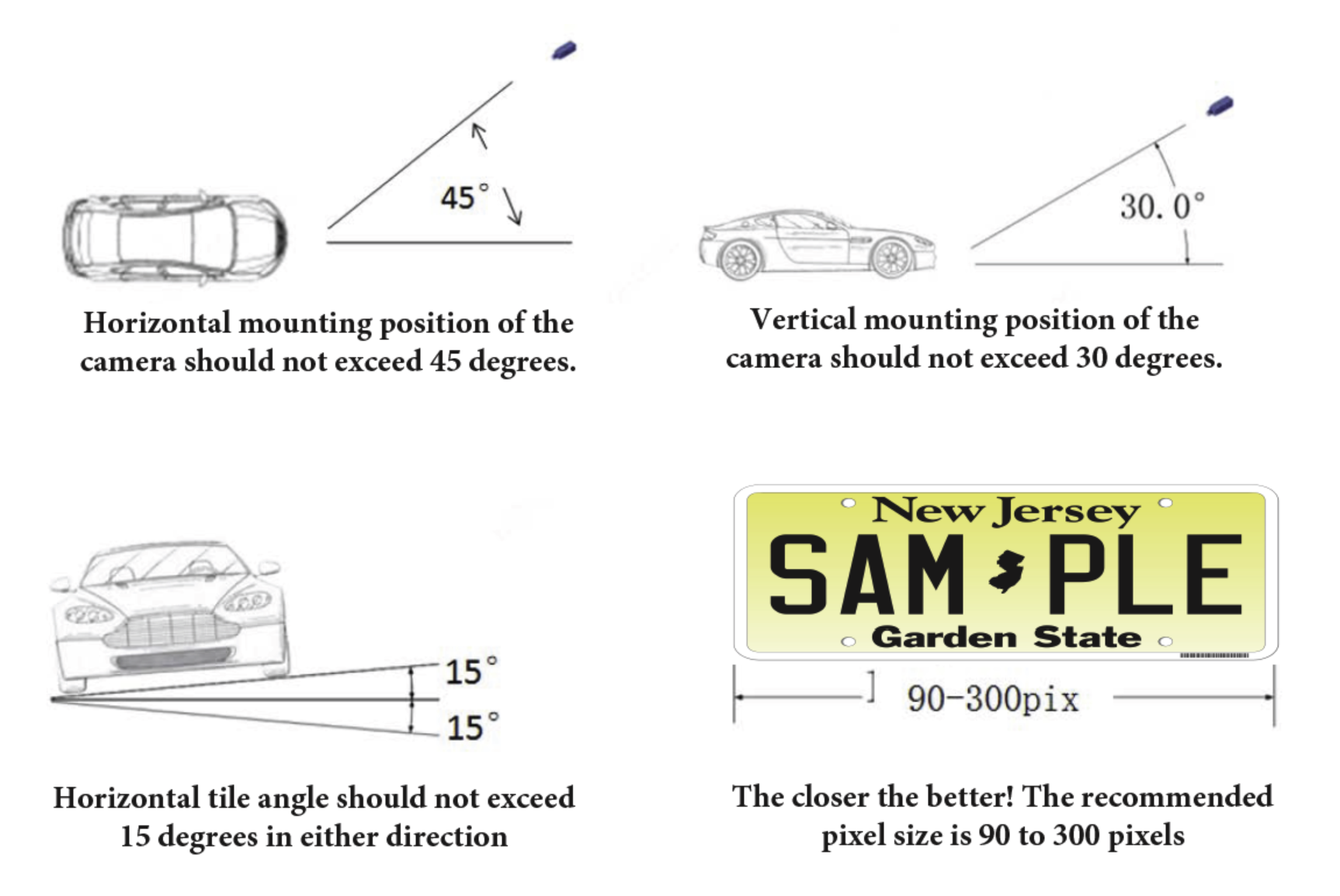
- Camera Misalignment: If a camera shifts due to wind or vibration, the "angle of incidence" may change. ANPR works best when the horizontal angle to the plate is less than 30 degrees. If the angle is too steep, the characters appear distorted (skewed), leading to misreads.
- Lighting Overpower: While IR solves many problems, extremely bright ambient sunlight hitting a highly reflective plate can "wash out" the image. Using cameras with a high Wide Dynamic Range (WDR)—measured in decibels (dB)—helps the sensor balance the darkest and brightest parts of the image.
Frequently Asked Questions
Can ANPR cameras read plates in total darkness?
Yes. Professional ANPR cameras rely on Infrared (IR) illumination, which is invisible to the human eye but clearly illuminates the retro-reflective material of license plates. This allows the camera to capture high-contrast images in complete darkness without needing traditional street lighting.
How accurate are these cameras in heavy rain or fog?
Accuracy typically drops slightly in extreme weather, but high-end 2026 models use "De-fog" algorithms and intense IR strobes to cut through particulates. While a clear day might yield 99.8% accuracy, heavy fog might reduce this to 95-96%, which is still sufficient for most operational needs.
Are there legal requirements for signage when using ANPR?
In most jurisdictions, yes. To comply with transparency requirements, operators must usually display signs informing drivers that ANPR is in use, the purpose of the data collection (e.g., parking enforcement), and who the data controller is. Failure to provide this notice can make any subsequent fines or logs legally unenforceable.
Can these cameras recognize plates from different countries?
Modern AI-driven ANPR cameras are "multi-region." They are pre-loaded with regional libraries that understand the differing syntax, fonts, and plate sizes of various countries. In 2026, high-end cameras can even identify the "Country Code" or state identifier on the plate.
What is the difference between ANPR and LPR?
There is effectively no difference; they are synonymous. ANPR (Automatic Number Plate Recognition) is the term more commonly used in Europe and the UK, while LPR (License Plate Recognition) is the standard terminology in North America.
Final Recommendation for 2026 Deployment
When investing in automatic number plate recognition cameras, prioritize Edge-AI capability over raw resolution. A 4K camera with poor OCR software is less effective than a 1080p camera with a dedicated neural processing unit. For business owners, ensure your chosen system offers an open API (Application Programming Interface), allowing you to integrate the plate data with your existing billing, security, or customer relationship management (CRM) software. Finally, always consult a legal professional to ensure your data retention and privacy policies align with the current 2026 regulations in your specific territory.
Image Gallery