Abhimanyu Mishra Age: Chronology, Records, and Career Milestones
Born on February 5, 2009, Abhimanyu Mishra is 17 years old as of 2026. He achieved international chess fame on June 30, 2021, when he became the youngest Grandmaster in chess history at 12 years, 4 months, and 25 days, breaking a world...
Born on February 5, 2009, Abhimanyu Mishra is 17 years old as of 2026. He achieved international chess fame on June 30, 2021, when he became the youngest Grandmaster in chess history at 12 years, 4 months, and 25 days, breaking a world record that had stood for nineteen years.
Contents
Early Life and Childhood Milestones
Abhimanyu Mishra was born in Englishtown, New Jersey, into an Indian-American family. Introduced to chess by his father, Hemant Mishra, at the age of two and a half, Abhimanyu demonstrated an exceptional memory and an innate grasp of spatial patterns far beyond his age group. By age five, he was actively competing in local tournament circuits across New Jersey and New York.
Mishra's progression through the United States Chess Federation (US Chess) rating hierarchy was unusually rapid. He consistently set age-based national benchmarks before transitioning to the international stage supervised by the International Chess Federation (FIDE).
- USCF Expert (Age 7)
- USCF National Master (Age 9)
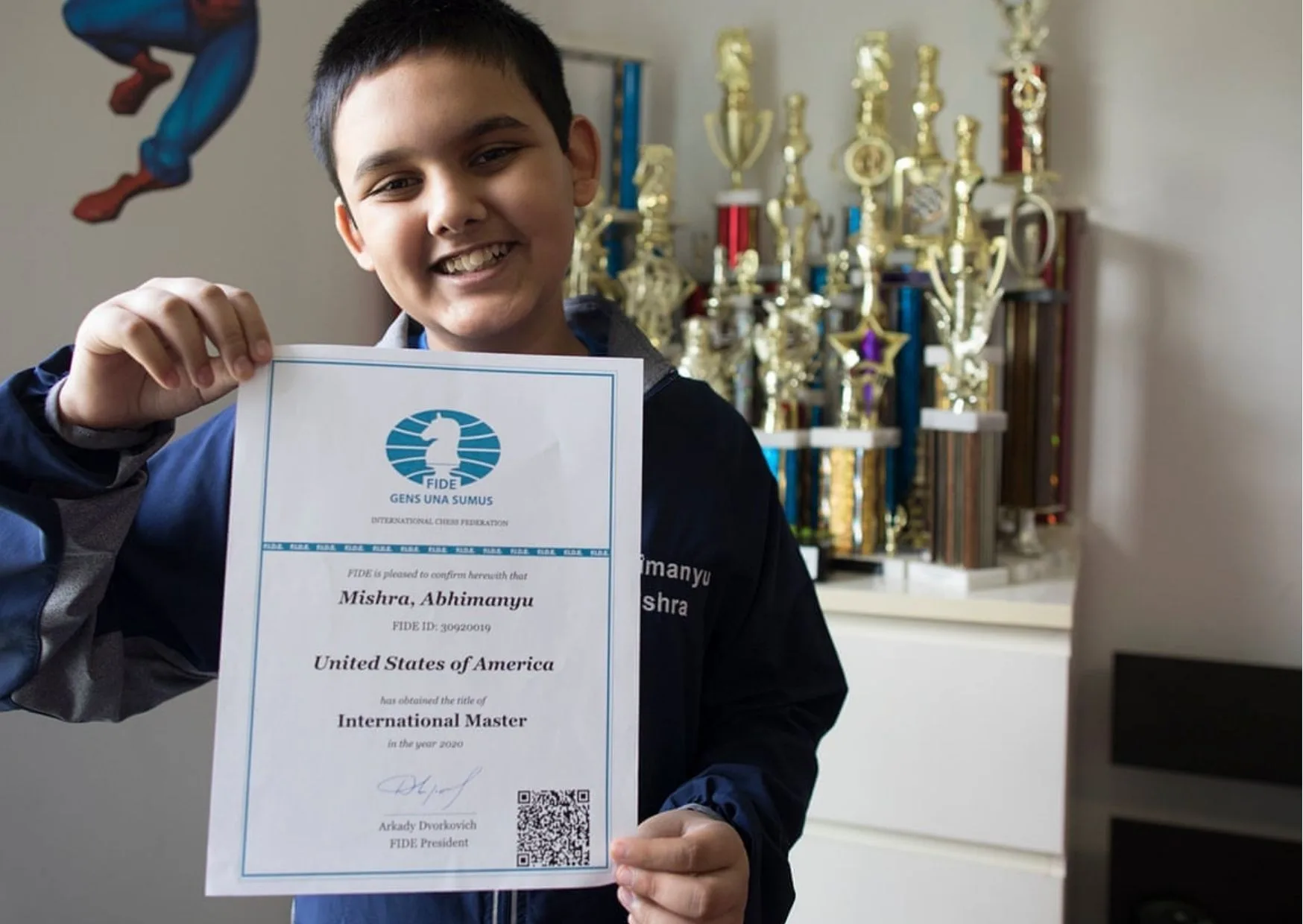
- FIDE International Master (Age 10)
- FIDE Grandmaster (Age 12)
Key Age-Based Milestones
- Age 7 (2016): Became the youngest USCF Expert in history, breaking the previous record for achieving a 2000 USCF rating.
- Age 9 years, 2 months, 17 days (2018): Became the youngest USCF National Master by crossing the 2200 USCF rating threshold.
- Age 10 years, 9 months, 3 days (2019): Attained the title of International Master (IM), breaking the previous world record held by Indian Grandmaster Rameshbabu Praggnanandhaa.
- Age 12 years, 4 months, 25 days (2021): Qualified for the Grandmaster (GM) title, becoming the youngest player ever to hold chess's highest competitive rank.
The Historic Grandmaster Achievement at Age 12
To earn the Grandmaster title, FIDE regulations require a player to fulfill two distinct conditions: achieving a published FIDE classical rating of at least 2500 and securing three Grandmaster "norms"—performance benchmarks earned in international tournaments meeting strict criteria regarding opponent ratings, title density, and federation diversity.
Mishra spent late 2020 and early 2021 traveling extensively through Europe during a period when international travel was severely restricted. His primary training and tournament grounds centered around Budapest, Hungary, where dedicated round-robin norm events were organized.
| Abhimanyu Mishra GM Norm Timeline |
|---|
| Norm 1: Vezerkepzo GM Tournament (Budapest, April 2021) |
| Norm 2: First Saturday GM Tournament (Budapest, May 2021) |
| Norm 3: Vezerkepzo GM Mix Tournament (Budapest, June 30, 2021) |
| 2500 Rating Threshold: Cleared concurrently with Norm 3 |
On June 30, 2021, at the Vezerkepzo GM Mix tournament in Budapest, Mishra defeated Indian Grandmaster Leon Luke Mendonca in the ninth round. This victory secured his third and final GM norm while simultaneously pushing his live FIDE rating past the required 2500 threshold.
At exactly 12 years, 4 months, and 25 days, Mishra shattered the long-standing record set in 2002 by Sergey Karjakin, who had achieved the title at 12 years and 7 months.
Comparative Chronology: Youngest Grandmasters in History
The quest for the youngest Grandmaster title has accelerated over the past three decades. The widespread availability of powerful chess engines, online training platforms, and international competition networks has lowered the age at which prodigies achieve master-level positional understanding and tactical calculation.
The table below summarizes the youngest players in chess history to complete all requirements for the Grandmaster title:
| Player | Country | Age Achieved | Year Title Earned |
|---|---|---|---|
| Abhimanyu Mishra | United States | 12 years, 4 months, 25 days | 2021 |
| Sergey Karjakin | Ukraine / Russia | 12 years, 7 months, 0 days | 2002 |
| Gukesh D | India | 12 years, 7 months, 17 days | 2019 |
| Javokhir Sindarov | Uzbekistan | 12 years, 10 months, 5 days | 2018 |
| Praggnanandhaa R | India | 12 years, 10 months, 13 days | 2018 |
| Nodirbek Abdusattorov | Uzbekistan | 13 years, 1 month, 11 days | 2017 |
| Parimarjan Negi | India | 13 years, 4 months, 22 days | 2006 |
| Magnus Carlsen | Norway | 13 years, 4 months, 27 days | 2004 |
| Wei Yi | China | 13 years, 8 months, 23 days | 2013 |
| Bu Xiangzhi | China | 13 years, 10 months, 13 days | 1999 |
Training Methodology and Financial Logistics
Achieving the Grandmaster title at age 12 requires sustained financial backing, dedicated parental involvement, and structured technical coaching.
Technical Preparation
Mishra’s training regimen involved up to eight hours of daily study, balancing tactical calculation, opening preparation, and endgame mastery. His coaching team has included prominent figures such as Grandmaster Arun Prasad, Grandmaster Magesh Chandran, and Grandmaster Alexander Chernin.
His preparation incorporated high-intensity engine analysis, standard classical games study, and target-specific opening preparation tailored to exploit opponent weaknesses in round-robin conditions.
- Tactical Calculation
- Engine Analysis
- Endgame Memorization
- Targeted Opening Prep
- Engine Analysis
- Endgame Memorization
Financial and Logistical Investments
Pursuing international chess titles requires substantial financial expenditure. Earning norms obligates young players to travel internationally to attend closed classical tournaments, often paying entry fees, living expenses, and coaching retainers.
- International Travel: To bypass the scarcity of classical norm tournaments in North America, Mishra’s family organized multi-month stays in Hungary.
- Crowdfunding and Sponsorships: The Mishra family relied on personal savings, community crowdfunding, and corporate sponsorships to cover the high expenses associated with overseas competition.
- Coaching Fees: Private instruction from high-level Grandmasters often requires significant hourly rates, creating a high financial barrier to entry for prospective prodigies.
Evolution Beyond the World Record
In competitive chess, securing an early record does not guarantee long-term elite success. The transition from an extraordinarily talented child to a top-tier Grandmaster capable of competing for the World Chess Championship involves a distinct set of challenges.
Post-Title Development
Since earning the GM title in 2021, Mishra has focused on scaling his classical rating toward the 2600 and 2700 thresholds—the benchmark for elite super-Grandmasters.
- FIDE World Cup Participation: Competing against established world-class opposition in knockout formats.
- Invitational Super-Tournaments: Gaining access to events like the Tata Steel Chess Tournament (Challengers section) and top open tournaments globally.
- U.S. Chess Championships: Regularly testing his skills against leading American Grandmasters such as Hikaru Nakamura, Fabiano Caruana, and Wesley So.
By maintaining a rigorous competitive schedule through his mid-teens, Mishra has focused on converting early tactical calculation skills into broad positional understanding and endgame consistency.
Frequently Asked Questions
What is Abhimanyu Mishra's exact birthdate?
Abhimanyu Mishra was born on February 5, 2009.
At what age did Abhimanyu Mishra become a Grandmaster?
He became a Grandmaster at the age of 12 years, 4 months, and 25 days on June 30, 2021.
What record did Abhimanyu Mishra break?
He broke the world record for the youngest Grandmaster in chess history, previously set by Sergey Karjakin in 2002 at 12 years and 7 months.
What is the difference between an International Master and a Grandmaster?
An International Master (IM) requires a FIDE rating of at least 2400 and three IM norms. A Grandmaster (GM) is the highest title awarded by FIDE and requires a minimum FIDE rating of 2500 alongside three GM norms against higher-rated competition. Mishra broke the world records for both titles during his career progression.
How many hours a day does a junior chess prodigy train?
Most elite junior Grandmasters, including Mishra, devote between 6 to 10 hours daily to chess instruction, engine analysis, physical fitness, and game reviews.
Guidance for Aspiring Players and Parents
For young players aiming to replicate structured rating growth, focusing solely on age-based records can lead to premature burnout. Instead, development should be guided by sustainable long-term practices:
- Prioritize Classical Formats: While online blitz and rapid games build quick intuition, classical time controls are essential for developing deep calculation and positional strategy.
- Analyze Losses with Engines and Coaches: Objective evaluation of personal mistakes provides far greater rating improvement than winning easy games against weaker opponents.
- Balance Tactical Speed with Physical Stamina: Classical tournament games can last up to six hours. Physical conditioning, adequate sleep, and nutrition play an important role in maintaining high performance late in long rounds.
- Focus on Rating Stability over Norm Hunting: Reaching a solid, stable rating baseline naturally makes securing tournament norms easier and less stressful.
Image Gallery