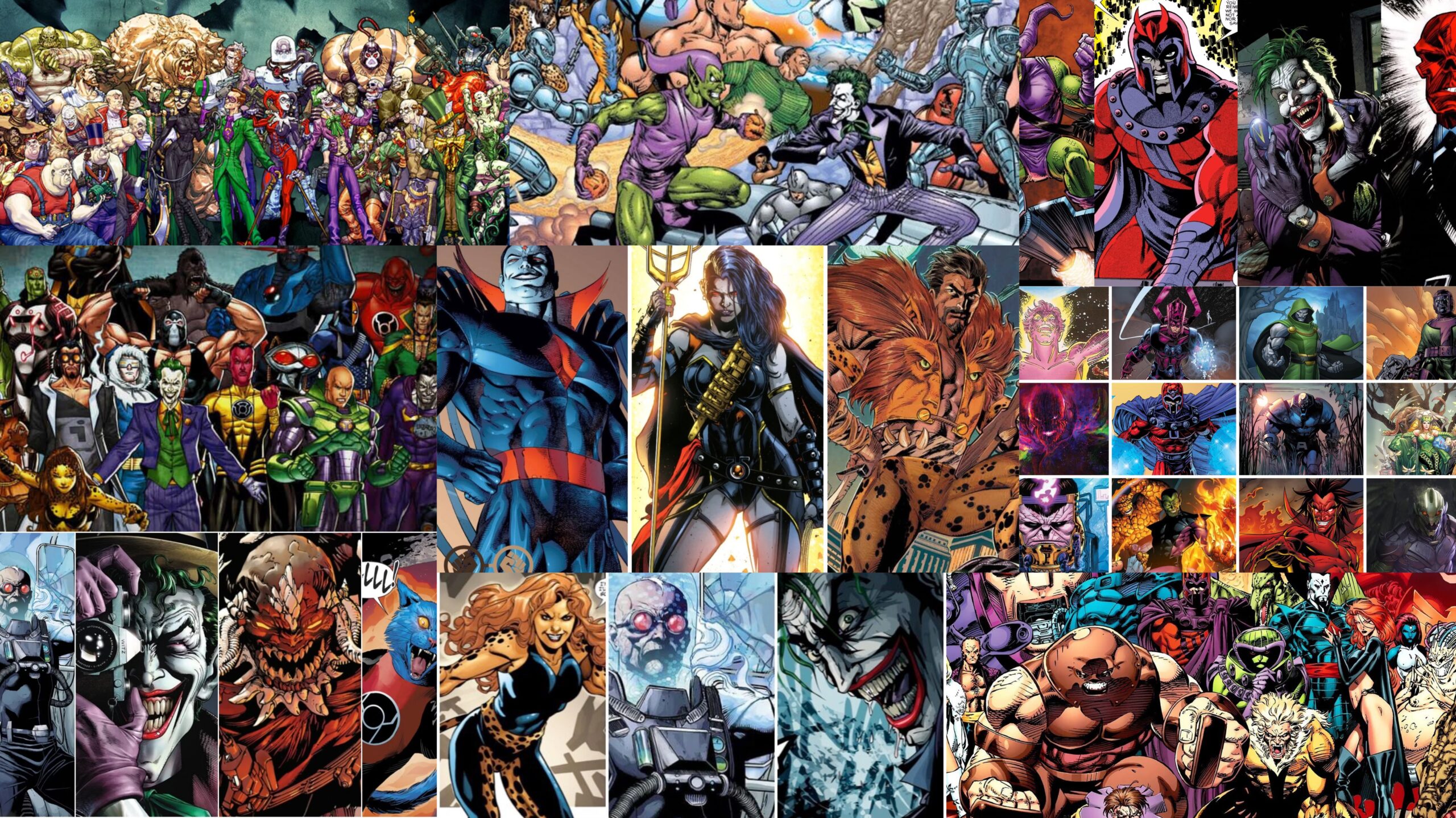
Dumb DC Villains: A Review of Comic Book Antagonists
The dumbest DC villains are characterized by nonsensical motifs, non-threatening weaponry, or powers that offer more inconvenience than utility. Iconic examples include Condiment King, who uses food additives as weapons, and Killer Mot...
The dumbest DC villains are characterized by nonsensical motifs, non-threatening weaponry, or powers that offer more inconvenience than utility. Iconic examples include Condiment King, who uses food additives as weapons, and Killer Moth, a failed attempt at a criminal counterpart to Batman. While often ridiculed, these antagonists provide essential levity and historical context for the evolution of comic book storytelling.
Contents
The Architectural Roots of Absurdity in DC Comics
To understand why "dumb" villains exist, one must examine the era of their inception. The majority of these characters emerged during the Silver Age of Comics (roughly 1956 to 1970). During this period, the Comics Code Authority (CCA) imposed strict regulations on content, effectively banning gore, extreme violence, and moral ambiguity. Writers were forced to innovate within a sanitized framework, leading to a surplus of "gimmick" villains whose primary threat was a theme rather than actual menace.
In 2026, we look back at these characters not merely as failures of imagination, but as products of a specific regulatory environment. The "dumb" factor usually stems from a disconnect between the villain’s high-tech effort and the low-impact result. When a criminal spends thousands of dollars on a custom-themed helicopter just to steal a tray of cupcakes, the internal logic of the narrative collapses, creating the "dumb" villain archetype we recognize today.
High-Profile "Dumb" Antagonists: A Detailed Review
Several characters have stood the test of time specifically because their concepts are so fundamentally flawed. These villains often serve as "palette cleansers" between world-ending threats like Darkseid or the Anti-Monitor.
Condiment King (Mitchell Mayo)
Perhaps the most self-aware of the "dumb" villains, Condiment King was originally created for Batman: The Animated Series as a parody of the 1960s camp aesthetic. He eventually made his way into DC canon. Armed with dual tanks of mustard and ketchup, his primary "threat" is staining the costumes of heroes or causing anaphylactic shock in those with severe allergies.
The absurdity of Condiment King lies in the logistics. The pressure required to make a ketchup gun a lethal projectile would likely cause the delivery system to explode. In a world where the Joker uses neurotoxins, a man wielding honey mustard is objectively non-threatening, making him a perennial favorite in discussions of comic book failures.
Killer Moth (Drury Walker)
Killer Moth is a fascinating study in "dumb" because he was intended to be a serious mirror to Batman. Drury Walker designed a "Moth-mobile," a "Moth-signal," and a "Mothcave." He even wore a garish purple and orange suit with fuzzy antennae.
The failure of Killer Moth is a failure of branding. While a bat represents darkness and primal fear, a moth represents a harmless insect attracted to lightbulbs. By positioning himself as the "anti-Batman" but choosing a non-threatening insect as his avatar, Walker ensured he would never be taken seriously by the Gotham underworld or the Justice League.
Polka-Dot Man (Abner Krill)
Before his cinematic redemption in recent years, Polka-Dot Man was a bottom-tier antagonist. His power involved a suit covered in removable dots that could transform into various objects—saws, gliders, or suns. The sheer randomness of the gimmick, combined with the visual ridiculousness of a man in a polka-dot unitard, made him a laughingstock. As of 2026, while the character has been given more "tragic" backstories in modern media, the core concept of "weaponized fashion patterns" remains inherently silly.
The Mechanics of Ineffective Power Sets
Some villains are considered "dumb" not because of their outfits, but because their literal superpowers are impractical or counter-intuitive.
The Ten-Eyed Man (Philip Reardon)
A Vietnam veteran blinded in an explosion, Philip Reardon had his optic nerves reattached to his fingertips. While this grants him 360-degree vision, it introduces a catastrophic physical weakness: he cannot touch anything without "blinding" himself. Simple combat maneuvers, like catching a punch or holding a weapon, become sources of immense pain and sensory deprivation. The Ten-Eyed Man represents a "dumb" villain whose very existence is a tactical nightmare for the user.
Rainbow Raider (Roy G. Bivolo)
Roy G. Bivolo was a colorblind artist who used "prism goggles" to project solid rainbows that could influence people's emotions or be used as physical bridges. Aside from the irony of a colorblind man choosing a color-themed gimmick, the Rainbow Raider’s primary weakness was simply... the dark. His powers relied entirely on light refraction. Furthermore, his "emotional" colors were often predictable, making him one of the Flash’s least intimidating Rogues.
Comparative Analysis of DC's Least Threatening Villains
The following table compares several prominent "dumb" villains based on their primary gimmick, their logistical flaw, and their first historical appearance.
| Villain | Primary Gimmick | The "Dumb" Factor / Flaw | First Appearance |
|---|---|---|---|
| Condiment King | Food-based weaponry | Low lethality; high laundry bill impact. | BTAS (1994) / Batgirl #13 |
| Killer Moth | Anti-Batman themes | Non-threatening insect motif; poor branding. | Batman #63 (1951) |
| Kite Man | Specialized kites | Highly dependent on wind conditions; easily grounded. | Batman #133 (1960) |
| Ten-Eyed Man | Eyes on fingertips | Extreme vulnerability to manual labor or touch. | Batman #226 (1970) |
| Clock King | Time-themed gadgets | Obsession with punctuality makes him predictable. | World's Finest #111 (1960) |
| Blue Snowman | Blue snow/ice suit | Bulky, slow, and easily outmaneuvered by Wonder Woman. | Sensation Comics #59 (1946) |
The Role of "Dumb" Villains in the DC Multiverse
In the broader context of DC’s 2026 publishing landscape, these characters serve a vital purpose. They represent the "street-level" reality of a world filled with gods. Not every criminal in Gotham or Central City can be a genius mastermind; some are simply desperate individuals with bad ideas and access to experimental technology.
Furthermore, "dumb" villains allow for a unique type of storytelling: the Subversive Deconstruction. Writers like Tom King and James Gunn have found success by taking these ridiculous characters and giving them immense pathos. By starting with a "dumb" premise, a writer can surprise the audience by revealing a core of humanity or tragedy. Kite Man’s "Hell Yeah" catchphrase transitioned from a joke to a heartbreaking coping mechanism, proving that even the silliest antagonists have potential if handled with care.
The Legacy of the Silver Age
The persistence of these characters also preserves the history of the medium. To remove Condiment King or Penny Plunderer from the archives would be to ignore the whimsical, experimental nature of mid-century comics. These villains are a testament to a time when comics were primarily for children and the primary goal was to provide a colorful, twenty-page distraction from reality.
Frequently Asked Questions
Who is considered the most useless DC villain?
Most historians point to Section 8 member Dogwelder, though he is often considered a parody. Among "mainstream" villains, Condiment King is frequently cited as the most useless because his weapons (ketchup and mustard) have no inherent tactical advantage against armored heroes like Batman or super-powered beings like Superman.
Why did DC create so many silly villains in the 1960s?
The Comics Code Authority was the primary driver. Because writers could not use realistic violence or mature themes, they leaned heavily into science fiction and "pun-based" gimmicks. This resulted in a wave of characters whose identities were built around single objects, such as clocks, kites, or mirrors.
Have any "dumb" villains ever become serious threats?
Yes. The Eraser, who was originally a man in a pencil-shaped costume who "erased" crime scenes, was reimagined in later years as a professional evidence destroyer for the mob. Similarly, Polka-Dot Man was transformed into a tragic figure with a lethal, interdimensional skin condition in modern film adaptations.
Is Kite Man still considered a joke?
In current 2026 continuity, Kite Man (Chuck Brown) is often treated with a "lovable loser" status. While his gimmick remains inherently funny, his character has been fleshed out to include a tragic backstory involving his son, making him a fan favorite rather than a target of pure derision.
What is the "Silver Age" of comics?
The Silver Age was a period of artistic advancement and commercial success in mainstream American comic books, lasting from approximately 1956 to 1970. It is known for its focus on sci-fi elements and the creation of many of DC's most enduring (and some of its most ridiculous) characters.
Final Recommendation for Readers
For those interested in exploring the lighter side of the DC Universe, the best entry point is the "The War of Jokes and Riddles" arc in the Batman (Vol. 3) series, which features a prominent role for Kite Man. Additionally, watching The Suicide Squad (2021) provides an excellent modern perspective on how these characters can be effectively updated for a contemporary audience without losing their original, quirky charm. Exploring the DC Universe Infinite digital library is the most efficient way to access the original Silver Age appearances of these antagonists.
Image Gallery