Understanding Tax Deferred Accumulation Life Insurance: A Strategic Financial Tool
Tax-deferred accumulation life insurance refers to permanent life insurance policies—such as Whole Life, Universal Life, or Variable Life—that include a cash value component. These policies allow policyholders to grow their cash surren...
Tax-deferred accumulation life insurance refers to permanent life insurance policies—such as Whole Life, Universal Life, or Variable Life—that include a cash value component. These policies allow policyholders to grow their cash surrender value over time without triggering immediate annual income taxes on the interest, dividends, or market gains, provided the policy remains in force and satisfies specific tax code requirements.
Contents
The Mechanics of Tax-Deferred Growth
The core value proposition of tax-deferred accumulation life insurance lies in the internal structure of the policy. When you pay premiums into a permanent policy, a portion covers the cost of insurance (the death benefit), while the remainder is directed into the cash value account. This account functions similarly to a tax-sheltered investment vehicle.
Unlike a standard brokerage account where you may owe annual taxes on capital gains or dividends, the growth within a life insurance policy is shielded from the Internal Revenue Service (IRS) as long as it remains within the policy’s ecosystem. Because the growth is not considered "realized" income for the policyholder, it avoids annual taxation. This creates a compounding effect, where the earnings are reinvested to generate their own returns without being eroded by yearly tax liabilities.
Types of Policies Supporting Accumulation
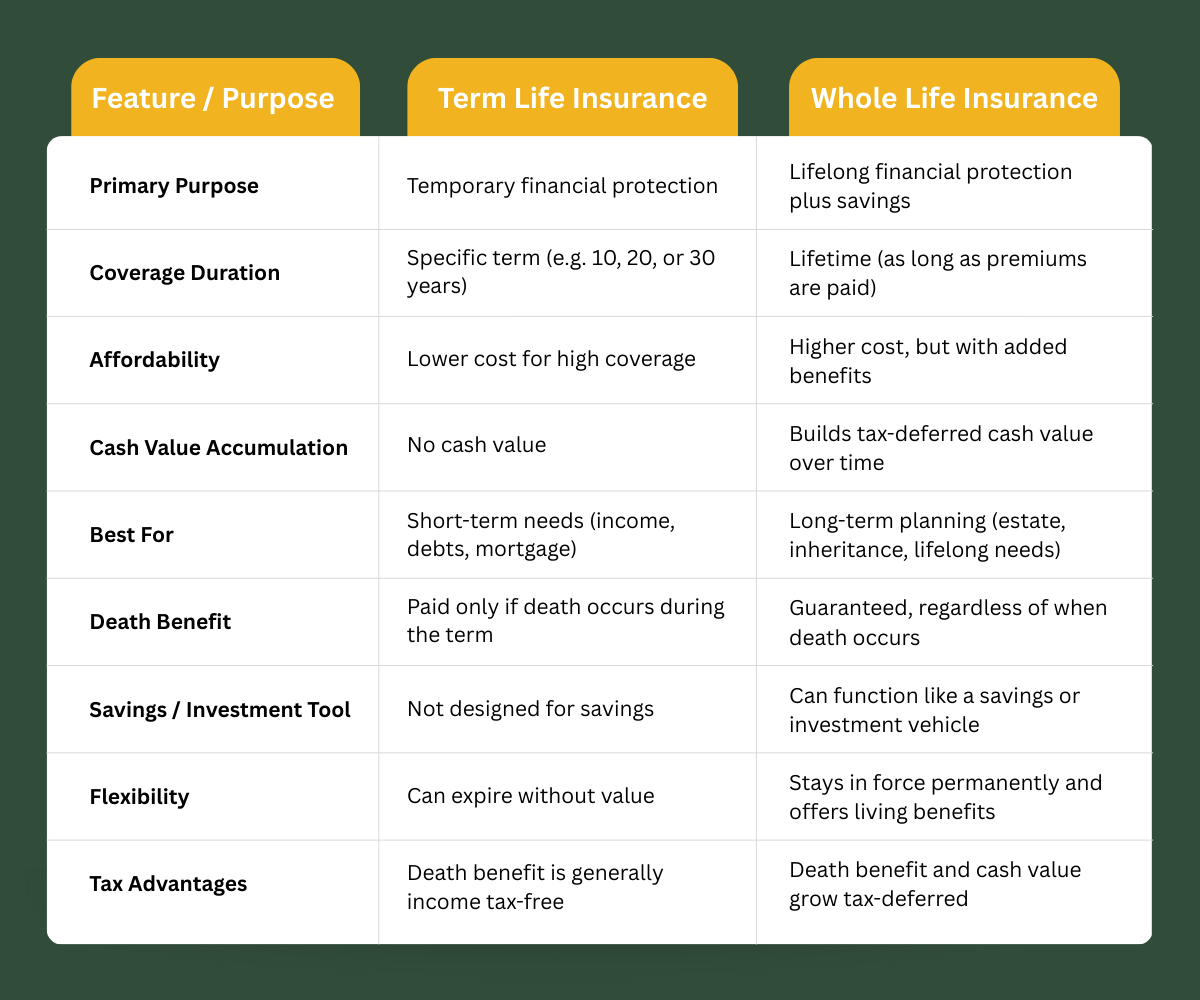
Not all life insurance policies offer accumulation features. Term life insurance, for instance, is a pure death benefit product with no cash value component and therefore cannot be used for accumulation. The primary vehicles for this strategy include:
- Whole Life Insurance: This is the most conservative path. It provides a guaranteed death benefit and a guaranteed rate of return on cash value. The insurance company typically pays dividends, which can be reinvested to accelerate growth.
- Universal Life (UL) Insurance: UL policies offer more flexibility in premium payments and death benefit amounts. They generally credit interest based on the performance of the insurer’s general account.
- Indexed Universal Life (IUL): IUL policies link cash value growth to a specific stock market index, such as the S&P 500. These policies typically feature floors and caps, providing a measure of downside protection against market losses while allowing for upside participation.
- Variable Universal Life (VUL): These are the most aggressive options, allowing policyholders to allocate cash value into sub-accounts that act like mutual funds. While this offers the greatest potential for growth, it also carries the highest risk, as the cash value can fluctuate based on market performance.
Comparing Accumulation Vehicles
The suitability of each policy depends on your risk tolerance, liquidity needs, and time horizon.
| Policy Type | Growth Driver | Risk Level | Primary Benefit |
|---|---|---|---|
| Whole Life | Guaranteed interest/Dividends | Low | Predictability and safety |
| Universal Life | Insurer-declared interest rates | Low to Moderate | Premium flexibility |
| Indexed Universal Life | Market index performance | Moderate | Balance of growth and protection |
| Variable Universal Life | Sub-account market performance | High | High growth potential |
Tax Implications and Compliance
For these financial benefits to hold, the policy must meet the definition of "life insurance" under Internal Revenue Code Section 7702. If a policy is over-funded relative to the death benefit, it may be classified as a Modified Endowment Contract (MEC).
Avoiding the MEC Status
An MEC is a policy that fails the "seven-pay test," a calculation determining if you have paid too much premium into the policy within the first seven years. If your policy becomes an MEC, it loses its favorable tax status regarding withdrawals. Distributions from an MEC are taxed on a "last-in, first-out" (LIFO) basis, meaning any gains are taxed as ordinary income before any principal is recovered. Furthermore, withdrawals made before age 59½ may be subject to a 10% IRS penalty.
To maintain the standard tax treatment, ensure your policy is properly structured by your insurance agent or financial advisor. By adhering to the premium limits, you ensure that the growth remains tax-deferred and that withdrawals or policy loans can be executed efficiently.
Accessing Your Accumulated Value
One of the most significant advantages of this insurance structure is the ability to access funds without necessarily triggering a tax event. Policyholders generally have two primary methods:
- Policy Loans: Most permanent policies allow you to borrow against your cash value. Because this is a loan—using your policy as collateral—the proceeds are generally not considered taxable income. Interest rates on these loans are determined by the insurance carrier. If the policy remains in force, these loans do not have to be repaid, though they will reduce the eventual death benefit paid to beneficiaries.
- Partial Surrenders: You can choose to withdraw a portion of your cash value. As long as the amount withdrawn does not exceed the "basis" (the total premiums you have paid into the policy), the withdrawal is typically tax-free.
Critical Considerations and Limitations
While tax-deferred accumulation is a powerful strategy, it is not without costs and limitations. It is vital to recognize that these products are long-term commitments.
- High Initial Costs: Permanent policies have significant upfront commissions and administrative fees, often referred to as "load." It takes time for the policy to build enough cash value to exceed the cost of the premiums paid.
- Cost of Insurance (COI): As you age, the cost of the insurance component increases. In some poorly structured policies, particularly Universal Life, if the cash value growth does not keep pace with the increasing COI, the policy can lapse.
- Complexity: The nuances of crediting rates, caps, floors, and policy fees require a solid understanding of how your specific contract operates. Regular policy reviews with a licensed professional are essential to ensure the policy remains on track to meet your financial objectives.
Frequently Asked Questions
Can I use tax-deferred life insurance for retirement income?
Yes. Many individuals use the cash value of a permanent life insurance policy as a supplemental retirement income stream. By utilizing policy loans, you can access the growth accumulated in the policy tax-free, provided the policy is not an MEC and is managed correctly to avoid a lapse.
Is the growth in my policy guaranteed?
This depends entirely on the type of policy. Whole life insurance offers guaranteed growth, while Variable Universal Life offers no guarantees regarding market performance. Always review your policy’s "Illustrations," which show both guaranteed and non-guaranteed projections.
What happens if I surrender my policy?
If you surrender (cancel) the policy, you will receive the net cash surrender value. If the amount received exceeds the total premiums you have paid (the cost basis), the gain is considered taxable income in the year of surrender.
Are there age limits for starting these policies?
While there is no legal age limit, insurers have underwriting guidelines regarding age and health. It is generally easier and less expensive to obtain these policies at a younger age when health risks are lower.
Do I need a professional to help me set this up?
Yes. Given the complexities of tax law, policy design, and underwriting, it is highly recommended to work with a qualified financial advisor or insurance professional. They can help you structure the policy to meet your goals while avoiding pitfalls like the MEC designation.
Next Steps for Prospective Policyholders
If you are considering tax-deferred accumulation life insurance as part of your financial plan, start by defining your primary objective. Are you looking for a guaranteed, conservative asset, or are you comfortable with market-linked growth?
Request an "in-force illustration" from your current provider if you already have a policy, or ask a licensed advisor to run multiple scenarios for a new policy. Evaluate the "guaranteed" versus "non-guaranteed" columns carefully. Ensure you understand the fee structure, specifically how the cost of insurance and administrative charges impact the net cash value over a 20- to 30-year horizon.
Before committing, consult with a tax professional regarding your specific financial situation to ensure this vehicle aligns with your broader tax and estate planning goals.
Image Gallery