Understanding the India Green Card Backlog: Causes, Timeline Projections, and Legal Strategies
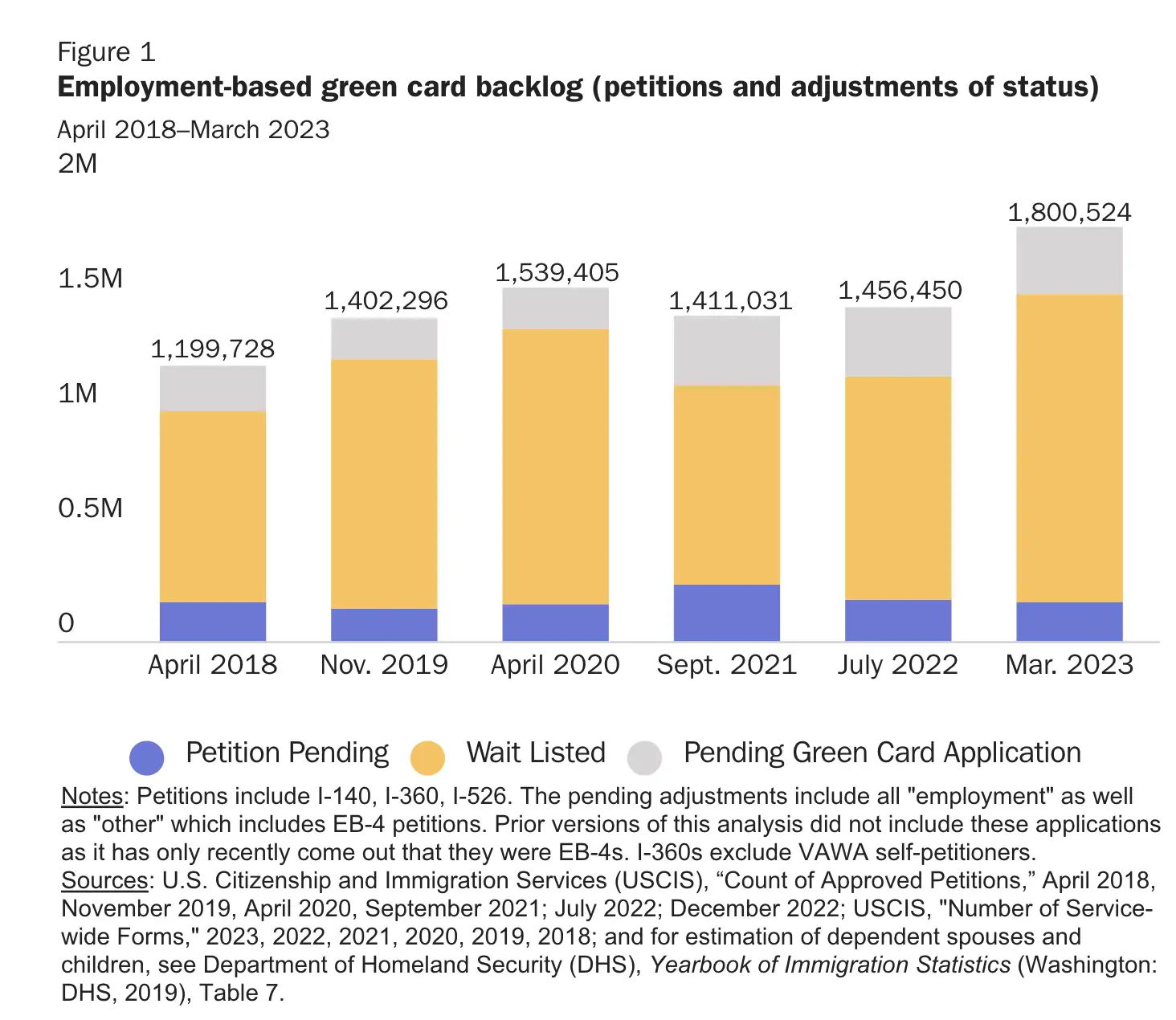
The India green card backlog is a severe delay in U.S. employment-based permanent residency, driven by a 7% per-country statutory cap established by the Immigration and Nationality Act. Because demand from qualified Indian professional...
The India green card backlog is a severe delay in U.S. employment-based permanent residency, driven by a 7% per-country statutory cap established by the Immigration and Nationality Act. Because demand from qualified Indian professionals vastly exceeds this annual allocation, hundreds of thousands of applicants face multi-decade wait times, relying on temporary visa extensions and specific statutory protections to remain legally employed in the United States.
Contents
Professional Disclaimer
This article provides general informational and educational analysis regarding U.S. immigration laws, procedures, and statutory policies. It does not constitute formal legal advice. Individuals facing specific immigration issues or priority date strategy decisions should consult a qualified immigration attorney licensed to practice law in the United States.
The Structural Root: Why the Backlog Exists
To understand the extraordinary waiting times facing Indian employment-based green card applicants, one must examine the legal framework governing U.S. immigrant visa issuance. The modern statutory foundation rests primarily on the Immigration and Nationality Act (INA) of 1990, which established fixed annual numerical ceilings for employment-based (EB) preference categories.
Under current U.S. law, the government issues approximately 140,000 employment-based green cards each fiscal year. This total allocation is distributed across five distinct preference tiers:
- EB-1 (Priority Workers): 28.6% of the global limit (plus unused EB-4 and EB-5)
- EB-2 (Professionals with Advanced Degrees or Exceptional Ability): 28.6% of the global limit (plus unused EB-1)
- EB-3 (Skilled Workers, Professionals, and Other Workers): 28.6% of the global limit (plus unused EB-2)
- EB-4 (Certain Special Immigrants): 7.1% of the global limit
- EB-5 (Employment Creation/Investors): 7.1% of the global limit
Crucially, Section 202 of the INA imposes a strict 7% per-country limit (also known as the per-country cap) on preference-based immigrant visas. This means that no single country of birth can receive more than roughly 9,800 employment-based green cards across all preference tiers in a standard fiscal year, regardless of that country's population size or the volume of qualified applicants holding approved petitions.
Total Global Annual Employment-Based Limit: ~140,000
- Subject to 7% Per-Country Limit (~9,800 total per nation/year):
- EB-1 (28.6%): ~40,040
- EB-2 (28.6%): ~40,040
- EB-3 (28.6%): ~40,040
- EB-4 (7.1%): ~9,940
- EB-5 (7.1%): ~9,940
High-Skilled Labor Demand vs. Fixed Statutory Allocations
Over the past three decades, the growth of the U.S. technology, healthcare, and engineering sectors created massive demand for specialized international talent. The primary bridge for bringing international professionals into the U.S. corporate workforce has been the temporary H-1B specialty occupation visa.
Because foreign professionals born in India represent a significant percentage of international STEM graduates from U.S. universities and global technology recruits, a large share of annual H-1B visas are awarded to Indian nationals. When U.S. employers subsequently sponsor these H-1B workers for permanent residency (green cards), the demand floods into the employment-based preference categories—predominantly EB-2 and EB-3.
Because the supply of green cards for Indian natives is restricted to roughly 2,800 visas per year each in EB-2 and EB-3 (excluding spillover), while tens of thousands of new applications are filed annually, the queue expands exponentially. Comprehensive analyses by the Congressional Research Service have consistently documented that the underlying structural imbalance between high-volume nonimmigrant recruiting and rigid statutory immigrant caps makes a multi-decade backlog mathematically inevitable without legislative intervention.
How Priority Dates and the Visa Bulletin Function
Navigating the green card backlog requires a technical mastery of how the U.S. Department of State (DOS) and U.S. Citizenship and Immigration Services (USCIS) manage visa issuance through the monthly Visa Bulletin.
Priority Dates and the Processing Pipeline
An applicant's place in the immigrant visa queue is marked by their Priority Date:
- PERM Labor Certification: For most EB-2 and EB-3 petitions, the Priority Date is the official date on which the U.S. Department of Labor accepts the employer's Form ETA-9089 (Labor Certification application) for filing.
- I-140 Petitions Exempt from PERM: For EB-1 filings or EB-2 National Interest Waivers (NIW), the Priority Date is established on the date USCIS receives the initial Form I-140 (Immigrant Petition for Alien Workers).
An applicant cannot file Form I-485 (Application to Register Permanent Residence or Adjust Status) or receive an immigrant visa at a U.S. embassy abroad until their Priority Date becomes "current."
Deciphering Dates for Filing vs. Final Action Dates
Each month, the Department of State publishes the Visa Bulletin, which features two primary charts for employment-based preferences:
- Final Action Dates: The cutoff dates that determine when an actual green card can be approved or an immigrant visa issued. If an applicant's Priority Date is earlier than the date listed in this column, a visa number is legally available to complete green card issuance.
- Dates for Filing: The cutoff dates that indicate when applicants living in the U.S. may submit their Form I-485 adjustment-of-status applications, assuming USCIS designates this chart for use in a given month. Filing Form I-485 grants crucial interim benefits, such as an Employment Authorization Document (EAD) and Advance Parole (AP) travel permission, even while waiting for the Final Action Date to become current.
Priority Date Hierarchy:
- PERM / I-140 Filed: Priority Date Established
- Visa Bulletin: Dates for Filing Current: Submit Form I-485 (Obtain EAD/AP)
- Visa Bulletin: Final Action Date Current: Final Green Card Approval
The Mechanics of Visa Spillover
The speed at which Priority Dates advance in the Visa Bulletin depends heavily on visa spillover—the process by which unused immigrant visa numbers from one category or country flow to another under statutory formulas set out in the INA:
- Vertical Spillover: Unused visa numbers in higher preference tiers flow downward. For instance, any unused numbers in EB-1 automatically drop to EB-2, and unused numbers in EB-2 drop down to EB-3.
- Horizontal (Unreserved) Spillover: Under INA 202(e), if total global demand in a preference category drops below the statutory ceiling for non-backlogged countries, the remaining unused visa numbers are made available to applicants from backlogged countries (like India and China) strictly in priority date order, exceeding the standard 7% cap for that fiscal year.
During years when extraordinary numbers of family-based visas go unused (such as during international consular processing slowdowns), those unused numbers spill over into the employment-based categories, temporarily accelerating priority date progression for India EB-2 and EB-3. However, when global demand rebounds, spillover drops, and priority date movement can stall or even undergo retrogression (moving backward in time).
Comparative Breakdown: Employment-Based Preference Categories for India
Different employment-based preference categories carry distinct requirements, statutory allocations, and backlog dynamics. The following table illustrates the operational realities for Indian beneficiaries across the primary employment categories.
| Preference Category | Target Applicant Group | Statutory Share of Global Cap | Estimated Backlog Status & Dynamic | Primary Strategy / Mitigation Potential |
|---|---|---|---|---|
| EB-1A | Individuals with Extraordinary Ability | ~28.6% (~40,040 globally) | Relatively short backlog compared to EB-2/3; experiences periodic retrogression. | Direct self-petition; requires international acclaim, awards, or peer-reviewed evidence. |
| EB-1B | Outstanding Professors and Researchers | ~28.6% (~40,040 globally) | Brief delays; priority dates advance much faster than lower tiers. | Requires employer sponsorship and proof of international recognition in an academic field. |
| EB-1C | Multinational Executives and Managers | ~28.6% (~40,040 globally) | Moderate backlogs; dynamic shifts based on global corporate transfer volume. | Requires employment abroad as a manager/executive for 1 out of the preceding 3 years before U.S. transfer. |
| EB-2 | Advanced Degree Professionals or Exceptional Ability | ~28.6% (~40,040 globally) | Severe long-term backlog; estimated multi-decade wait for recent priority dates. | Requires Master's degree or Bachelor's plus 5 years post-degree experience; dependent on PERM. |
| EB-3 (Professional/Skilled) | Professionals with Bachelor's Degrees and Skilled Workers | ~28.6% (~40,040 globally) | Severe long-term backlog; fluctuates relative to EB-2 via category porting. | Requires U.S. Bachelor's equivalent or 2+ years skilled training; lower baseline requirement than EB-2. |
| EB-5 | Immigrant Investors (Unreserved & Reserved) | ~7.1% (~9,940 globally) | Set-aside categories (Rural/High Unemployment) offer current dates; unreserved face delays. | Minimum capital investment ($800k in TEA / $1.05M standard) into qualifying commercial enterprises. |
Navigating Life in Legal Limbo: Key Protections and Rules
Because the wait times for EB-2 and EB-3 green cards for Indian nationals extend over long periods, the U.S. Congress and administrative agencies created statutory mechanisms to permit workers to remain and work legally in the country while waiting for their priority dates to become current.
AC21 Extensions Beyond the 6-Year H-1B Limit
Under normal statutory conditions, an foreign worker can hold H-1B nonimmigrant status for a maximum cumulative period of six years. However, the American Competitiveness in the Twenty-First Century Act of 2000 (AC21) established vital exceptions that allow workers trapped in green card backlogs to extend their H-1B status indefinitely:
- Section 106(a) / 106(b) (1-Year Extensions): If a PERM Labor Certification or Form I-140 petition was filed on the worker's behalf at least 365 days prior to reaching their 6-year H-1B limit, the worker is eligible to extend their H-1B status in one-year increments until a final decision is reached on the underlying application.
- Section 104(c) (3-Year Extensions): If an individual is the beneficiary of an approved Form I-140 petition in the EB-1, EB-2, or EB-3 preference category, but cannot file an adjustment of status application because their priority date is retrogressed under the per-country cap, USCIS is authorized to grant H-1B extensions in three-year increments.
These AC21 provisions allow foreign professionals to maintain valid nonimmigrant status, continue working for U.S. employers, and retain authorization for indefinite continuous stay as long as their underlying green card process remains active.
- H-1B Standard Maximum (6 Years)
- Is PERM / I-140 Pending > 365 Days?
- YES: AC21 §106(a): Grant 1-Year Extensions
- NO:
- Is Form I-140 Approved & Priority Date Backlogged?
- YES: AC21 §104(c): Grant 3-Year Extensions
- Is Form I-140 Approved & Priority Date Backlogged?
- Is PERM / I-140 Pending > 365 Days?
Priority Date Porting Across Employers and Categories
Under federal regulations administered by USCIS, an approved Form I-140 grants the beneficiary a permanent property right over their established Priority Date. This leads to two critical operational mobility rules:
- Employer Porting: If an employee changes employers, the new employer must re-file a PERM Labor Certification and a new Form I-140. However, once the new I-140 is approved, the worker can port (transfer) their original Priority Date to the new petition. This ensures the worker does not lose their place in the green card line despite switching jobs.
- Category Upgrading/Downgrading: An applicant can port priority dates between preference tiers. For example, an applicant with an established EB-3 priority date who subsequently acquires advanced qualifications or takes on higher managerial duties can have an employer file a new PERM and I-140 under the EB-2 category (or EB-1), retaining the original earlier priority date. Conversely, if EB-3 Final Action Dates move faster than EB-2 in the Visa Bulletin, EB-2 applicants can file an I-140 "downgrade" to EB-3 to capture a current date.
Spousal Employment via H-4 EAD
In 2015, the Department of Homeland Security (DHS) promulgated a regulation codified under 8 CFR 214.2(h)(9)(iv), allowing certain H-4 dependent spouses of H-1B nonimmigrants to apply for an Employment Authorization Document (EAD).
To qualify for an H-4 EAD, the principal H-1B worker must either:
- Be the beneficiary of an approved Form I-140 Immigrant Petition; or
- Have been granted H-1B status beyond the six-year limit under AC21 §106(a)/(b).
The H-4 EAD provides unrestricted open-market employment authorization for spouses, mitigating financial and career constraints for families waiting long periods in the backlog.
Aging Out and the Child Status Protection Act (CSPA)
One of the most complex human implications of the India green card backlog is the risk of unmarried children "aging out." Under U.S. immigration law, a dependent child must be under 21 years of age to receive a derivative green card along with their primary applicant parent.
The Child Status Protection Act (CSPA) attempts to protect minor children from losing eligibility due to administrative agency delay. CSPA calculates a child's "immigration age" using a statutory formula:
$$\text{CSPA Age} = \text{Biological Age at Visa Availability} - \text{Days I-140 Petition Was Pending}$$
- Visa Availability Date: The date the priority date officially becomes current in the Visa Bulletin (typically determined by USCIS using the Final Action Date or Dates for Filing chart).
- The Seek-to-Acquire Requirement: To freeze this calculated CSPA age, the child (or primary applicant on their behalf) must formally "seek to acquire" permanent residence—such as by filing Form I-485 or submitting an DS-260 application—within one year of visa availability.
If the calculated CSPA age remains 21 or older when a visa becomes available, or if the priority date remains backlogged past the child's 21st birthday after accounting for the I-140 pending time subtraction, the child ages out. Upon aging out, the child loses derivative eligibility and must independently transition to a student (F-1) or work (H-1B) visa to remain legally in the United States.
Policy Reforms and Potential Legislative Relief
Overcoming the India employment-based backlog requires formal legislative changes to the governing statutory framework. Several legislative and regulatory proposals are frequently discussed in federal policy debates:
Legislative Initiatives: Phasing Out Per-Country Caps
Proposals such as the EAGLE Act (Equal Access to Green Cards for Legal Employment Act) and its predecessor, the Fairness for High-Skilled Immigrants Act, seek to eliminate the 7% per-country ceiling for employment-based visas while incrementally raising the per-country cap for family-sponsored visas.
- Mechanism: Visa issuance would shift entirely to a first-come, first-served model based purely on Priority Date regardless of country of birth.
- Impact: This would dramatically reduce the wait time for Indian applicants in the short-to-medium term. However, without increasing the total number of global green cards, it would create equalized long waiting lists for applicants from all countries.
Visa Recapture Mechanisms
During past fiscal years, tens of thousands of authorized employment-based and family-based green card numbers went unused due to administrative processing backlogs, statutory misallocations, or consular closures. Policy proposals for "visa recapture" seek to authorize USCIS to add these historical, unused visa numbers back into the annual pool, instantly releasing tens of thousands of green cards to high-demand queues.
Executive and Administrative Action
Where legislative reform stalls in Congress, immigration policies focus on executive flexibility:
- Standardizing the use of the Dates for Filing chart year-round to allow earlier adjustment of status filings.
- Granting interim work authorization (EAD) and travel permission (Advance Parole) to individuals with approved I-140 petitions regardless of priority date status.
- Expanding employment authorization protections for aging-out dependent children.
Strategic Next Steps for Impacted Applicants
For Indian professionals operating within the green card backlog, managing an immigration portfolio requires proactive planning, rigorous compliance, and periodic strategy reassessments.
Strategic Action Plan for Backlogged Applicants:
- Maintain Status: Keep H-1B active; track 6-yr limit & AC21 extensions.
- Audit Documents: Archive all PERM, I-797 approval notices & filings.
- Evaluate Upgrades: Explore EB-1 (A/B/C) or EB-5 options for earlier relief.
- Protect Dependents: Calculate CSPA age; seek to acquire within 1 year.
1. Protect Nonimmigrant Status Diligently
Do not rely exclusively on pending green card procedures. Maintain continuous, valid nonimmigrant status (such as H-1B or L-1) even after filing Form I-485 whenever feasible. Maintaining H-1B status provides an essential safety net if an underlying I-485 application experiences unexpected procedural issues or administrative denials.
2. Archive Complete Records of Immigrant Filings
Ensure you obtain and safely archive full copies of your PERM Labor Certification filings, Form I-140 approval notices (Form I-797), labor market testing documentation, and wage records. Having access to these documents ensures you can verify your priority date, transfer your priority date to a new employer, or exercise job flexibility options under AC21 §104(c).
3. Continually Evaluate Alternative Preference Categories
Regularly review your professional milestones with qualified counsel to determine if you qualify for higher preference tiers:
- EB-1A (Extraordinary Ability): Reassess whether published research, industry citations, major awards, high salary, or commercial success qualify you for an EB-1 self-petition.
- EB-1C (Multinational Manager): If working for an international corporate entity, explore whether an overseas managerial assignment could position you for an EB-1C petition.
- EB-5 (Investor Visa): If capital is available, evaluate the reserved target employment area (TEA) categories created under recent investment legislation, which currently offer current priority dates for qualified global investors.
4. Monitor Dependent Child Ages and CSPA Eligibility
For families with teenage children, establish an active tracking schedule for CSPA calculations:
- Document the precise number of days the Form I-140 petition remained pending with USCIS.
- Track monthly Visa Bulletin announcements carefully. As soon as the Priority Date becomes current under the governing USCIS chart, immediately take steps to complete the "seek-to-acquire" requirement by filing Form I-485 or completing the DS-260 consular processing steps before the child's CSPA age exceeds 21.
Frequently Asked Questions
Why is the green card backlog specifically severe for applicants born in India?
The backlog is severe for Indian applicants due to a structural mismatch between nonimmigrant visa recruitment and statutory green card limits. U.S. technology and specialized professional sectors heavily recruit Indian professionals on H-1B visas. However, the Immigration and Nationality Act imposes a 7% per-country limit on annual employment-based green cards (~9,800 total across all preference categories). As a result, tens of thousands of Indian workers enter the green card queue annually, far exceeding the small fixed annual allotment.
What is the difference between EB-2 and EB-3 for Indian applicants?
EB-2 is designed for foreign professionals holding advanced degrees (Master's or higher, or a Bachelor's plus five years of progressive post-baccalaureate work experience) or exceptional ability. EB-3 covers professionals with U.S. Bachelor's equivalents, skilled workers (requiring at least two years of training/experience), and unskilled workers. While EB-2 requires higher entry qualifications, priority date movement for India can fluctuate between the two categories based on demand trends and cross-category porting (downgrading/upgrading).
How does changing jobs impact my established priority date?
If you hold an approved Form I-140, your established priority date is retained permanently for future employment-based green card petitions filed on your behalf. If you switch employers, your new employer must complete a new PERM Labor Certification and file a new Form I-140. Once the new I-140 is approved by USCIS, the prior priority date can be ported to the new petition, preserving your original place in line.
Can an approved I-140 petition be revoked if I leave my employer?
Under DHS regulations, if an employer withdraws an approved Form I-140 or goes out of business after the petition has been approved for at least 180 days (or after an accompanying Form I-485 has been pending for 180 days), USCIS will not revoke the approval for priority date retention or AC21 H-1B extension purposes. The employee retains the original priority date for use with a subsequent employer's petition.
What happens if my priority date retrogresses after I file Form I-485?
If your priority date was current when you filed Form I-485, but the Visa Bulletin subsequently retrogresses (moves backward), USCIS holds your adjustment of status application in abeyance. While your I-485 is paused, you remain in a legal period of stay, and your interim employment (EAD) and travel authorizations (Advance Parole) remain valid and renewable until a green card number becomes available again.
What is the primary function of the Child Status Protection Act (CSPA)?
The Child Status Protection Act provides a legal mechanism to prevent minor children from losing green card eligibility by "aging out" (turning 21) due to administrative processing delays. CSPA subtracts the time an I-140 petition was pending with USCIS from the child's biological age on the date an immigrant visa becomes available, freezing their immigration age if they satisfy the statutory "seek to acquire" step within one year.
Image Gallery