How an IoT System Connects Devices: Architecture, Protocols, and Data Flow
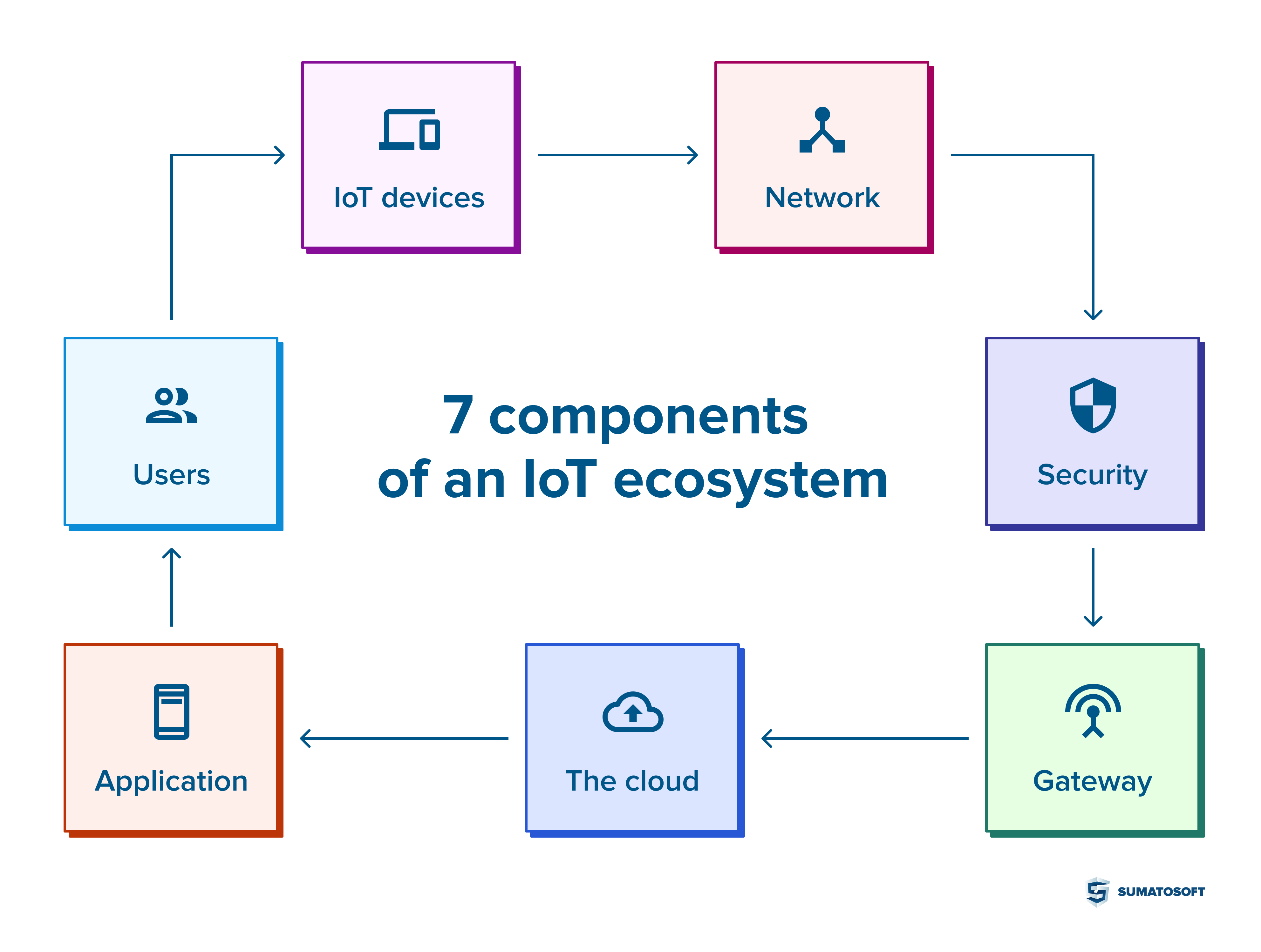
An Internet of Things (IoT) system connects devices through a layered architecture that bridges hardware sensors, local networks, communication gateways, and cloud servers. End-node devices collect physical data, encode it using specia...
An Internet of Things (IoT) system connects devices through a layered architecture that bridges hardware sensors, local networks, communication gateways, and cloud servers. End-node devices collect physical data, encode it using specialized communication protocols, and transmit it wirelessly or over cables to gateways or local networks. These channels route the encrypted data across the internet to centralized software platforms for processing and control.
Contents
The 4-Layer Architecture of IoT Connectivity
Connecting physical objects to a digital ecosystem requires a structured framework. Rather than establishing direct, unstructured links between individual sensors and application servers, enterprise and industrial IoT frameworks rely on a four-layer architecture. This model establishes clear boundaries between data collection, edge routing, network transport, and high-level software application.
- Layer 4: Application & Processing (Cloud, Dashboards, Analytics)
- MQTT / CoAP / HTTPS over TLS
- Layer 3: Network & Transport (Cellular 5G/NB-IoT, LoRaWAN, Wi-Fi)
- IP Routing / Cloud Gateways
- Layer 2: Edge & Gateway (Protocol Translation, Aggregation)
- BLE / Zigbee / Z-Wave / Serial
- Layer 1: Perception & Sensing (Sensors, Actuators, Microcontrollers)
Layer 1: Perception and Sensing (Edge End-Nodes)
The base layer consists of physical hardware deployed in the field, factory, or home. This layer includes microcontrollers, single-board computers, sensors (such as temperature, humidity, vibration, or optical sensors), and actuators (such as valves, relays, and motors).
These edge devices monitor physical conditions and convert analogue signals into digital readings. Microcontrollers like the ESP32, STM32, or Nordic nRF series manage low-level operations, formatting data payloads and handling power states before initiating network communication.
Layer 2: Local Network and Edge Gateways
Many microcontrollers operate on extreme energy budgets and lack the processing capacity or network hardware required to run full TCP/IP stacks or connect directly to the internet. Layer 2 bridges this gap using local area communication protocols and hardware gateways.
An IoT gateway acts as an intermediary node. It receives raw or formatted data from surrounding sensors over short-range radio frequencies, aggregates packet transmissions, filters noise, and performs protocol conversion. For instance, an industrial gateway might ingest Modbus RTU telemetry over an RS-485 serial connection and convert those messages into encrypted MQTT payloads transmitted over Ethernet or cellular links.
Layer 3: Network Transport Layer
Once edge nodes or gateways package the telemetry data, the network layer handles mid-range and long-range routing to bring those packets to regional servers or enterprise data centers.
This layer spans the physical routing hardware, cellular infrastructure, Wi-Fi access points, and Internet Service Provider (ISP) backbones. It operates primarily over standardized networking stacks such as IPv4 and IPv6, ensuring data packets reach their designated cloud endpoint regardless of physical distance.
Layer 4: Application and Processing Layer
At the top of the stack sit cloud platforms, database clusters, analytics engines, and user interfaces. Platforms like AWS IoT Core, Azure IoT Hub, or self-hosted broker architectures ingest telemetry from millions of concurrent streams.
This layer decrypts, validates, and stores data, while executing business logic. It can generate real-time alerts, trigger automated workflows, feed machine learning models, or issue command-and-control instructions back down through the network stack to actuate edge hardware.
How Devices Communicate: Key IoT Wireless Protocols
Choosing the right communication protocol dictates an IoT system’s range, bandwidth, hardware cost, and power consumption. Wireless technologies generally fall into three spatial categories: short-range local area networks, long-range low-power networks, and broad-coverage cellular or satellite links.
- Wi-Fi 6 / Ethernet: High bandwidth, short range (High power)
- Cellular 4G/5G: High bandwidth, long range (High power)
- Zigbee / Z-Wave / BLE: Low bandwidth, short range (Low power)
- LoRaWAN / NB-IoT: Low bandwidth, long range (Low power)
Short-Range Wireless Networks
Short-range radio protocols operate primarily in localized environments, such as residential buildings, smart offices, and factory floors.
- Wi-Fi (IEEE 802.11a/b/g/n/ac/ax): Wi-Fi delivers high data throughput (up to several gigabits per second) over ranges up to 50–100 meters. However, its high power requirements make it unsuitable for battery-powered field sensors. It is ideal for line-powered devices like video surveillance cameras, smart displays, and heavy machinery monitors.
- Bluetooth Low Energy (BLE): Designed specifically for low-power operation, BLE transmits small data packets over short distances (up to 30 meters) while drawing minimal energy. Modern BLE implementations support mesh networking, allowing devices to relay messages across dozens of nodes without connecting directly to a central gateway.
- Zigbee and Z-Wave: Built upon the IEEE 802.15.4 specification, Zigbee creates self-healing mesh networks operating at 2.4 GHz. Z-Wave operates on sub-GHz frequencies (around 800–900 MHz), avoiding crowded 2.4 GHz bands. Both protocols allow low-power sensors to pass messages through adjacent nodes to reach a gateway server.
- Matter and Thread: Managed by the Connectivity Standards Alliance, Matter is an IP-based application layer standard built on top of Thread (a low-power, IPv6-based mesh protocol) and Wi-Fi. Matter solves smart home interoperability by standardizing how devices discover, authenticate, and control one another regardless of manufacturer.
Long-Range Low-Power Networks (LPWAN)
Low-Power Wide-Area Networks (LPWAN) send small data payloads across several kilometers while preserving battery life for years on end.
- LoRaWAN: An open network specification maintained by the LoRa Alliance, LoRaWAN uses unlicensed sub-GHz radio spectrum (e.g., 868 MHz in Europe, 915 MHz in North America) via Chirp Spread Spectrum (CSS) modulation. It allows sensors in remote agricultural fields or utility infrastructure to transmit readings across 10 to 15 kilometers to a central gateway.
- Sigfox: A proprietary LPWAN system that uses ultra-narrowband radio technology to send small messages (up to 12 bytes payload). Sigfox relies on dedicated global network operators, offering simple, long-range tracking for assets that only need to report status a few times per day.
Cellular and Satellite Communication
For wide geographic mobility or locations lacking local gateways, cellular networks offer broad infrastructure coverage.
- NB-IoT (Narrowband IoT) & LTE-M (eMTC): Standardized by 3GPP, these cellular standards operate within licensed radio bands. NB-IoT uses narrow 200 kHz bandwidths optimized for stationary sensors sending tiny data bursts deep inside buildings. LTE-M provides higher bandwidth (up to 1 Mbps), supports mobility, and allows voice features, making it suitable for fleet management and wearable medical trackers.
- 5G Massive Machine-Type Communications (mMTC): 5G networks accommodate up to one million connected devices per square kilometer. With ultra-reliable low-latency communication (URLLC), 5G powers industrial automation, robotic control, and connected autonomous vehicle telemetry.
- Satellite IoT: Low Earth Orbit (LEO) satellite networks connect remote maritime tracking units, mining installations, and forestry equipment that operate outside traditional cellular coverage areas.
Data Transfer Protocols: How IoT Payload Data Moves
Wireless protocols define how radio waves transport raw bits through the air. Above that layer, software messaging protocols dictate how application data is structured, addressed, and routed across networks.
MQTT Publish/Subscribe Model
- Publisher (Sensor): Sends Publish requests to MQTT Broker (Central Hub)
- MQTT Broker (Central Hub):
- Sends Publish requests to Subscriber (App/DB)
- Receives Subscribe requests from Subscriber (Dashboard)
MQTT (Message Queuing Telemetry Transport)
MQTT is an extremely lightweight, publish-subscribe messaging protocol designed for constrained devices and bandwidth-limited networks. Maintained as an open standard by OASIS, MQTT runs over TCP/IP and uses small header footprints (as low as 2 bytes).
In an MQTT architecture:
- An MQTT Broker acts as a central hub.
- Publishers (sensors) send data tagged with a specific hierarchy topic (e.g.,
factory/line1/temp). - Subscribers (cloud apps, dashboards, control units) register interest in specific topics.
- The broker relays incoming messages from publishers directly to all active subscribers.
MQTT supports three Quality of Service (QoS) levels: QoS 0 (At most once / fire and forget), QoS 1 (At least once / requires acknowledgment), and QoS 2 (Exactly once / four-step handshake).
CoAP (Constrained Application Protocol)
Documented in IETF RFC 7252, CoAP brings the RESTful architecture of the web (GET, POST, PUT, DELETE) to resource-constrained microcontrollers. Unlike HTTP, which relies on heavy TCP handshake connections, CoAP runs over UDP (User Datagram Protocol). This dramatically reduces connection overhead, power draw, and memory usage while enabling simple IP multicast data distribution.
HTTP/REST and WebSockets
Standard web protocols remain common in line-powered IoT systems. HTTP/REST APIs handle high-bandwidth transmissions, configuration updates, and binary payload uploads. WebSockets establish persistent full-duplex TCP connections, allowing cloud applications to push continuous real-time data feeds directly to monitoring dashboards without constantly polling the server.
Protocol Comparison for IoT Systems
Selecting the right protocol stack involves balancing throughput, power consumption, maximum operational range, and underlying network topology.
| Protocol | Primary Range | Typical Bandwidth | Power Usage | Network Topology | Best Use Case |
|---|---|---|---|---|---|
| Wi-Fi 6 | Short (~50-100m) | Up to 9.6 Gbps | High | Star / AP-based | HD Video streaming, line-powered industrial hub |
| BLE Mesh | Short (~10-30m) | 125 kbps - 2 Mbps | Very Low | Mesh | Smart lighting, indoor asset tracking |
| Zigbee | Short (~10-100m) | 250 kbps | Low | Mesh | Home automation, HVAC sensors |
| LoRaWAN | Long (5-15 km) | 0.3 kbps - 50 kbps | Extremely Low | Star-of-Stars | Smart agriculture, city utility meters |
| NB-IoT | Long (10-15 km) | ~26-127 kbps | Low | Cellular Star | Underground water meters, smart parking |
| 5G (mMTC) | Long (Cellular coverage) | Up to 20 Gbps | Moderate to High | Cellular Star | Autonomous vehicles, industrial robotics |
| MQTT | Global (IP-based) | Overhead: ~2 bytes | Low | Broker Pub/Sub | Vehicle telemetry, field sensor reporting |
| CoAP | Global (IP-based) | Overhead: ~4 bytes | Very Low | Client-Server / UDP | Battery-powered microcontrollers, smart grids |
Step-by-Step: End-to-End Data Flow Journey
To illustrate how these components connect in practice, consider a smart cold-storage transport truck monitoring refrigerated cargo:
Sensor Signal: Physical temperature triggers analogue change
Digital Encoding: Microcontroller reads ADC, packages payload
Local Transmit: BLE broadcast sent to truck's edge gateway
Gateway Process: Gateway translates BLE packet into JSON/MQTT
Long-Range Tx: Gateway sends packet over LTE-M to cellular tower
Cloud Ingestion: Broker authenticates device via TLS 1.3
Processing & App: Database records data; alert sent if threshold breached
Sensing the Physical World: A digital temperature sensor inside the cargo box registers a thermal change. It sends an analogue voltage change to its connected microcontroller unit (MCU).
Analog-to-Digital Conversion & Encoding: The MCU converts the voltage reading into a digital value (e.g.,
4.2°C). The MCU packages this value alongside a device identifier, timestamp, and battery status into a small data structure.Local Transmission: The sensor node turns on its low-power radio module and broadcasts the packet using BLE Mesh to save power.
Gateway Aggregation & Protocol Translation: An edge gateway mounted in the truck cab picks up the BLE signal. The gateway filters out redundant records, converts the raw binary payload into a structured JSON string, and wraps it in an MQTT message (
truck42/cooler/temp).Long-Range Network Transport: The gateway uses an LTE-M modem to connect to a nearby cellular tower, sending the packet across the mobile network and public internet backhaul.
Cloud Ingestion & Security Validation: An AWS IoT Core cloud broker receives the packet on port 8883. It validates the gateway's X.509 digital certificate, decrypts the TLS 1.3 payload, and confirms the sender is authorized to publish to
truck42/cooler/temp.Data Processing & User Action: The cloud platform routes the payload to a real-time analytics database. If the temperature exceeds a set safety threshold, the system triggers an API call that pushes a high-priority notification to the fleet manager's dashboard and smartphone app.
Architectural Challenges and Best Practices
Building a reliable IoT system requires overcoming network bottlenecks, security risks, and hardware limitations.
Managing Power Consumption vs. Bandwidth
Batteries must often power field devices for 5 to 10 years without replacement. To preserve battery life, engineers must minimize radio transmission times. Transmitting over Wi-Fi drains small lithium batteries within days, whereas using sub-GHz LPWAN protocols with deep sleep modes allows devices to wake up, send a 20-byte payload within milliseconds, and immediately drop back into a micro-ampere sleep state.
Interoperability and Standard Fragmentation
Historically, proprietary communication protocols created isolated hardware silos. The industry has shifted toward unified, IP-based open standards. Adopting Matter for consumer devices or standardized OPC UA and MQTT-SN formats for industrial deployments prevents vendor lock-in and allows multi-manufacturer hardware networks to communicate without custom API bridges.
Security, Authentication, and Encryption
Unsecured IoT networks can give attackers entry into enterprise systems. Modern IoT connectivity stacks enforce defense-in-depth security measures:
- Hardware Security Modules (HSMs): Secure elements (such as ATECC608 chips) store private cryptographic keys inside tamper-proof silicon, preventing key extraction even if physical hardware is compromised.
- Transport Layer Security (TLS/DTLS): All network transmissions between gateways and servers should be encrypted using TLS (for TCP) or DTLS (for UDP).
- Mutual Authentication (mTLS): Instead of simple passwords, IoT platforms use mutual X.509 certificate authentication. Both the server and the connecting device must present valid cryptographic certificates before establishing a network socket.
Frequently Asked Questions
Do all IoT devices require a direct internet connection?
No. Many low-power IoT sensors communicate exclusively over short-range local networks like Zigbee, BLE, or Modbus to a local gateway. The gateway acts as the sole internet-connected device, translating local radio signals and proxying data to cloud platforms.
What is the difference between an IoT gateway and a standard router?
A standard home or office router routes IP-based traffic between local Wi-Fi or Ethernet devices and the internet. An IoT gateway performs specialized protocol conversions (e.g., translating non-IP Zigbee, LoRa, or CAN bus data into IP-based MQTT payloads), executes edge-computing scripts, filters data streams, and manages local offline automation when cloud connectivity drops.
Why is MQTT preferred over HTTP for IoT applications?
HTTP requires establishing and tearing down heavy TCP connections with extensive header overhead for every single request. MQTT maintains an open connection with tiny 2-byte packet headers, dramatically reducing power consumption, network bandwidth usage, and latency. This pub/sub model also allows servers to push commands to devices instantly without continuous polling.
How does edge computing fit into IoT connectivity?
Edge computing runs data processing algorithms directly on local gateways or edge devices rather than sending every raw reading to the cloud. By analyzing data locally, edge computing cuts cloud bandwidth usage, reduces latency for critical automated actions (such as emergency shut-off valves), and allows systems to run uninterrupted even during internet outages.
What is the role of Matter in modern smart device connections?
Matter is an open application-layer standard that sits on top of Thread, Wi-Fi, and Ethernet networks. It provides a common language for smart devices from different manufacturers, allowing them to communicate directly over local IP networks without relying on third-party cloud bridges or proprietary hubs.
Recommended Next Steps for Designing IoT Architecture
To design an optimal IoT connectivity system, align your network selection with your operational requirements:
- Map Operational Constraints: Determine your system's battery life requirements, payload sizes, update frequencies, and physical environment (indoor, outdoor, or deep underground).
- Select the Physical Network Layer: Choose BLE or Zigbee for short-range indoor mesh environments; LoRaWAN or NB-IoT for remote, low-bandwidth, battery-powered sensors; and Wi-Fi, 5G, or Ethernet for high-throughput, line-powered applications.
- Define Application Messaging Standards: Implement MQTT for low-footprint publish-subscribe streaming, CoAP for lightweight RESTful UDP communication, or Matter for consumer smart-device ecosystems.
- Implement Security from Day One: Equip edge microcontrollers with hardware secure elements, require mTLS authentication for all network handshakes, and isolate IoT devices on dedicated VLANs or secure APNs.
Image Gallery