When Index Options Settle in Practice: A Complete Guide to Timing and Mechanics
In practice, index options settle in cash rather than through the delivery of shares. For standard monthly contracts, settlement typically occurs on the third Friday of the month based on the opening prices of the index's components (A...
In practice, index options settle in cash rather than through the delivery of shares. For standard monthly contracts, settlement typically occurs on the third Friday of the month based on the opening prices of the index's components (AM settlement). Weekly and end-of-month contracts usually settle based on the closing prices on Friday (PM settlement).
Contents
Understanding the precise mechanics of index option settlement is a prerequisite for any serious derivatives trader. Unlike equity options, which involve the physical transfer of underlying stocks, index options are "notional" instruments. Because you cannot easily deliver a basket of 500 stocks (as with the S&P 500) or 100 stocks (as with the Nasdaq-100), the Options Clearing Corporation (OCC) facilitates a cash transfer between the buyer and the seller. However, the timing of this transfer and the price used to calculate it are often sources of significant confusion.
As of 2026, the landscape of index options has expanded with daily expirations and various settlement cycles. Navigating these requires a firm grasp of the "Settlement Gap," the "Special Opening Quotation," and the differences between AM and PM settlement cycles.
The Fundamental Distinction: Cash Settlement vs. Physical Delivery
To understand when and how index options settle, one must first recognize that they are governed by different rules than equity options (like those for Apple or Tesla).
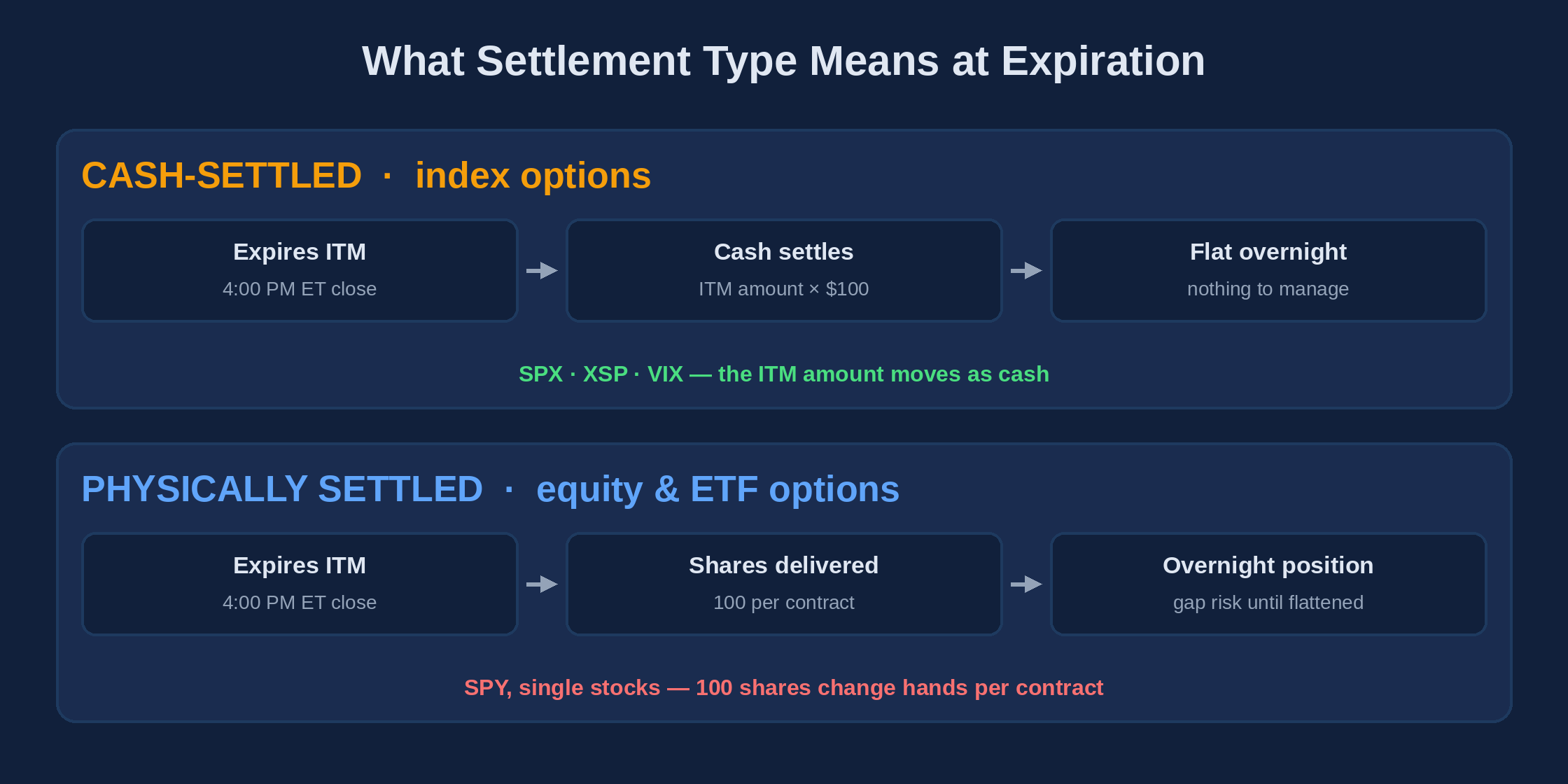
- No Physical Delivery: If you hold an SPY (ETF) option through expiration, you may end up owning or selling 100 shares of the ETF. If you hold an SPX (Index) option, you will never own shares. Instead, your account will simply be credited or debited the difference between the strike price and the settlement value.
- The Role of the OCC: The Options Clearing Corporation acts as the central counterparty. On the settlement date, they calculate the net gain or loss for every open position and move the cash accordingly.
- Section 1256 Contracts: In the United States, most broad-based index options are classified as Section 1256 contracts. This provides a significant tax advantage, where 60% of capital gains are taxed at the long-term rate and 40% at the short-term rate, regardless of how long the position was held. This tax treatment is directly tied to the "settlement" status of the index.
AM Settlement: The "Standard" Monthly Cycle
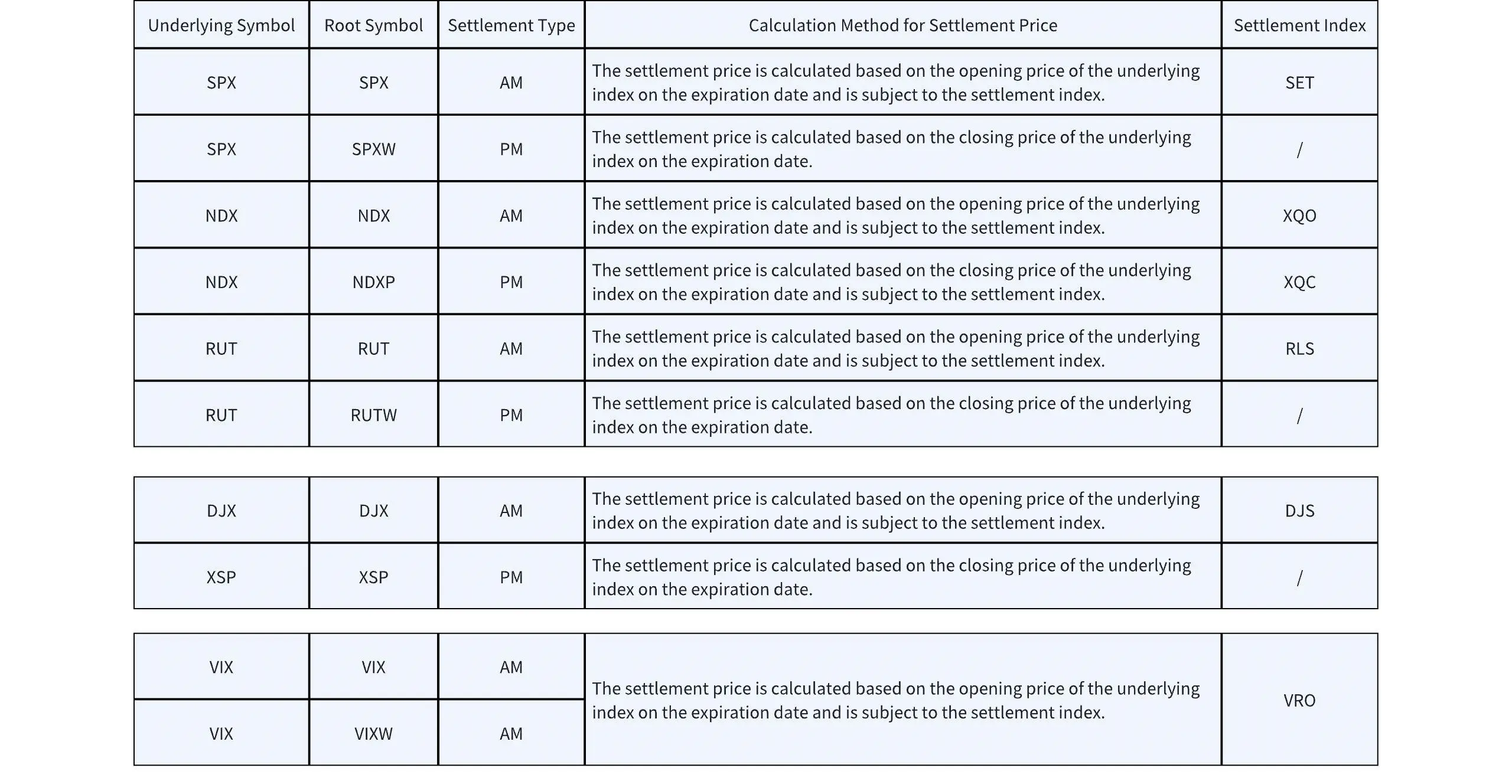
The most common point of confusion in the options market involves the "Standard Monthly" contracts, which expire on the third Friday of every month. For major indices like the S&P 500 (SPX), the Nasdaq-100 (NDX), and the Russell 2000 (RUT), these monthly contracts are AM-settled.
The Trading Deadline
For an AM-settled index option, the last day to trade the contract is the Thursday before the third Friday. Once the market closes at 4:00 PM ET on Thursday, these options stop trading. If you hold a position past this deadline, you are committed to the settlement process. You cannot sell your calls or buy back your puts on Friday morning to avoid the settlement price.
The Special Opening Quotation (SOQ)
The settlement value for AM contracts is not the "price" of the index you see on your screen at 9:30 AM ET on Friday. Instead, it is a calculated value known as the Special Opening Quotation (SOQ).
The SOQ is determined by the actual opening trade price of every single stock within the index. For the SPX, this means the CBOE waits for all 500 stocks to record an opening print on their respective exchanges (NYSE, Nasdaq, etc.). If a particular stock is delayed in opening due to an imbalance or news, the final SOQ cannot be calculated until that stock opens. Consequently, the SOQ—often ticker symbol SET for the S&P 500—can be significantly higher or lower than the index's "print" at 9:30 AM.
The "Overnight Gap" Risk
The primary risk of AM settlement is the "Overnight Gap." Because trading stops on Thursday afternoon but the settlement price is determined Friday morning, traders are exposed to market-moving events that occur overnight. A major geopolitical event or an earnings surprise from a heavyweight constituent can cause the SOQ to gap far beyond the strike price, turning a profitable trade into a loss with no way for the trader to exit the position during the gap.
PM Settlement: Weekly and Daily Options
In contrast to the standard monthlies, most "Weekly" (SPXW) and "Daily" index options utilize PM settlement. This has become the preferred vehicle for retail traders and short-term institutional hedgers in 2026 because it eliminates the overnight gap risk.
The Trading Deadline
For PM-settled options, the last trading day is the actual day of expiration (usually Friday, but also Monday through Thursday for daily expirations). Traders can continue to buy or sell these options right up until the market close, typically 4:00 PM ET (or 4:15 PM ET for certain products).
Calculation Methodology
The settlement value for PM options is simply the official closing price of the index on that day. For example, if you hold an SPXW call expiring on a Tuesday, the settlement value is based on the closing level of the S&P 500 index at 4:00 PM ET. There is no SOQ or "SET" value to wait for; the closing price of the index is the definitive settlement price.
Comparison of AM vs. PM Settlement Dynamics
| Feature | AM Settlement (Standard Monthly) | PM Settlement (Weeklies/Dailies) |
|---|---|---|
| Primary Ticker Example | SPX (Monthly) | SPXW (Weeklies) |
| Last Trading Day | Thursday before 3rd Friday | Day of Expiration (Friday) |
| Settlement Price Basis | Special Opening Quotation (SOQ/SET) | Official Closing Price of Index |
| Overnight Risk | High (Thursday night to Friday open) | Minimal (Trading ends at settlement) |
| Tax Treatment | Section 1256 (60/40) | Section 1256 (60/40) |
| Liquidity | High (Institutional focus) | Very High (Active retail/HFT) |
The Practical Settlement Timeline: What Happens in Your Account?
Understanding the theory is one thing; seeing the cash move is another. Here is the chronological sequence of events for a standard AM-settled index option in 2026:
- Thursday, 4:00 PM ET: Trading ceases. The option is now "frozen" in your brokerage platform. It may still show a "mark" or price based on Thursday's close, but you cannot interact with it.
- Friday, 9:30 AM ET: The underlying stocks begin to open. The exchange begins calculating the SOQ.
- Friday, 10:30 AM - 12:00 PM ET: The official settlement value (e.g., the SET price) is usually published. Most brokerage platforms will update the "unrealized" P/L to reflect this value, though the position remains in your account.
- Saturday Morning: The OCC processes all expirations. The index option ticker disappears from your "Open Positions" list.
- Monday Morning: The cash resulting from the settlement (the "Intrinsic Value") is officially credited to or debited from your "Buying Power" or "Cash Balance."
For PM-settled options, the process is identical, except that the "freeze" happens at 4:00 PM on Friday, and the settlement price is known immediately at the market close.
Common Pitfalls and Professional Tips
1. The "Ghost" Position
New traders often panic on Friday morning when they see an AM-settled option still in their account while the market is moving against them. They may try to "close" the position, only to find their order rejected. In practice, if it is an AM-settled monthly, you are locked in once Thursday's closing bell rings.
2. European vs. American Style
Nearly all broad-based index options (SPX, NDX, RUT) are European-style. This means they cannot be exercised early. This is a benefit for sellers, as it eliminates the risk of "assignment" before expiration. The only way out of a position is to trade out of it before the deadline or let it go to settlement.
3. The SET vs. Index Price Discrepancy
It is vital to remember that the S&P 500 Index (SPX) and the Settlement Value (SET) are different tickers. On the third Friday of the month, do not look at the SPX chart to see if your options are in the money. You must look for the SET value. In volatile markets, the SET can differ from the Friday 9:30 AM SPX price by several points.
4. Liquidity Migration
In 2026, much of the retail liquidity has shifted to PM-settled "Weeklies." However, the AM-settled "Monthlies" still command massive institutional open interest. If you are trading large blocks, the AM-settled contracts may offer tighter bid-ask spreads despite the overnight risk.
Final Practical Recommendation
If you are a retail trader looking to avoid the complexities of the Special Opening Quotation and the risk of overnight gaps, stick to PM-settled options (the SPXW or NDXW tickers). These allow you to manage your risk right up until the final seconds of the trading session. If you choose to trade the standard AM-settled monthlies for tax or liquidity reasons, ensure you have closed your positions by Thursday afternoon unless you are comfortable with the "morning surprise" that often accompanies the Friday open.
For further verification of specific settlement values, traders should consult the CBOE Index Settlement Page or the OCC Information Memo archives, which provide the definitive SOQ data for every expiration cycle.
Frequently Asked Questions
Can I trade SPX options on Friday morning? You can trade "Weekly" SPXW options on Friday morning because they are PM-settled. However, you cannot trade "Standard Monthly" SPX options on Friday morning; their last trading day is Thursday.
How do I find the settlement price for my index options? For AM-settled options, look for the symbol SET (for S&P 500), NQS (for Nasdaq-100), or RLS (for Russell 2000) on your trading platform. These symbols update only once a month on the third Friday morning.
Is there a risk of being assigned early on index options? No. Most major index options are European-style, meaning they can only be exercised at expiration. This removes the risk of early assignment that exists with stock options.
What happens if an index option expires exactly at the strike price? If the settlement value (SET or Closing Price) is exactly equal to the strike price, the option expires worthless (At-the-Money). Since index options are cash-settled, there is no "pin risk" where you might accidentally end up with a large stock position.
Are the settlement rules different for ETF options like SPY or QQQ? Yes. ETF options (SPY, QQQ, IWM) are physically settled and American-style. They trade until 4:00 PM (or 4:15 PM) on their expiration day, and if they expire in the money, you will be assigned shares of the underlying ETF.
Image Gallery