Thrift Savings Plan for Federal Employees: The Definitive Guide to Retirement Wealth
The Thrift Savings Plan (TSP) is a defined contribution retirement savings and investment plan structured specifically for federal government employees and members of the uniformed services. It functions much like a private-sector 401(...
The Thrift Savings Plan (TSP) is a defined contribution retirement savings and investment plan structured specifically for federal government employees and members of the uniformed services. It functions much like a private-sector 401(k) plan, offering tax-advantaged ways to build long-term wealth, automatic payroll deductions, and valuable matching contributions from government agencies.
Contents
Understanding the Thrift Savings Plan Framework
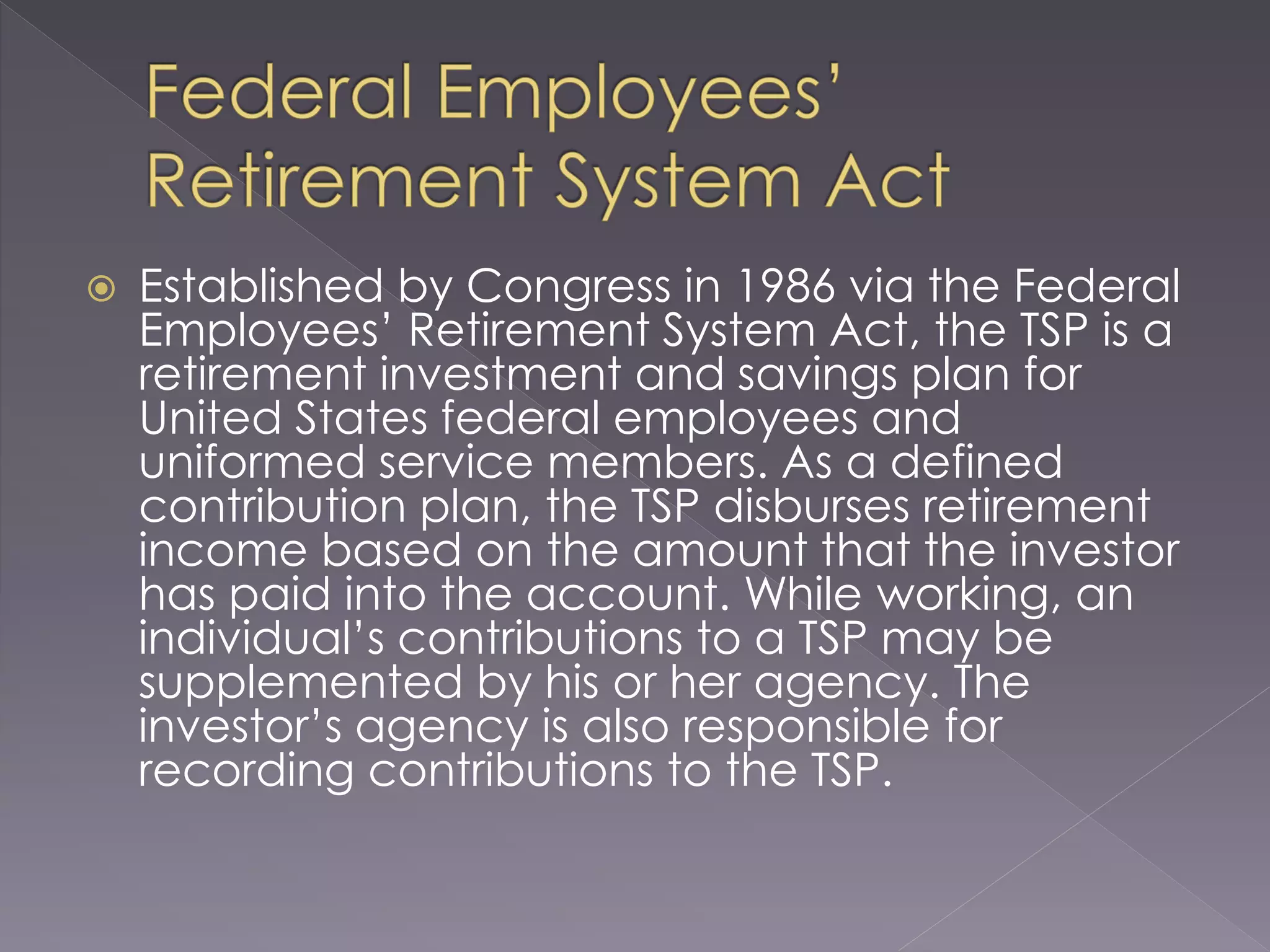
The Thrift Savings Plan operates under the oversight of the Federal Retirement Thrift Investment Board (FRTIB), an independent agency of the United States government. Established by the Federal Employees' Retirement System Act of 1986, the TSP was designed to give public servants a portable, low-cost investment vehicle that parallels private-sector retirement plans. For federal employees navigating the transition from public service to retirement, understanding the mechanics of this plan is foundational to financial security.
Unlike traditional defined-benefit pensions that guarantee a fixed monthly payout based on salary and years of service, the TSP relies on accumulated contributions and investment returns. Federal employees under both the Federal Employees Retirement System (FERS) and the Civil Service Retirement System (CSRS) are eligible to participate, though the matching contribution structures differ significantly between the two systems.
FERS vs. CSRS Participation Mechanics
For FERS employees—who make up the vast majority of the modern federal workforce—the TSP forms the middle pillar of a three-tiered retirement strategy that also includes Social Security and the FERS basic annuity. FERS participants receive automatic agency contributions equal to 1% of their basic pay, regardless of whether they contribute their own money. Furthermore, the agency matches employee contributions dollar-for-dollar up to the first 3%, and 50 cents on the dollar for the next 2%, making a total potential agency contribution of 5% when an employee contributes 5% or more.
CSRS employees, who belong to the legacy retirement system predating 1987, may also participate in the TSP to supplement their annuities. However, CSRS participants do not receive agency matching contributions or the automatic 1% contribution, as their primary pension formula is more generous than the modern FERS equivalent. Despite the lack of matching funds, CSRS employees frequently utilize the TSP for its tax-advantaged growth and diversified investment funds.
Contribution Limits and Regulatory Guidelines
Managing contributions effectively requires strict adherence to Internal Revenue Service (IRS) regulations and plan limits. Each calendar year, the IRS establishes maximum contribution caps for defined contribution plans. Participants must calculate their per-pay-period contributions to maximize their savings without accidentally halting contributions prematurely, which can sometimes forfeit matching dollars on a per-paycheck basis under certain administrative setups.
Catch-Up Contributions for Older Participants
Federal employees who are age 50 or older by the end of the calendar year are permitted to make additional catch-up contributions above the standard elective deferral limit. These catch-up contributions allow senior personnel and late-career switchers to accelerate their retirement savings rapidly.
| Contribution Type | Standard Limit (Under Age 50) | Catch-Up Limit (Age 50 and Older) | Total Maximum Annual Contribution |
|---|---|---|---|
| Traditional (Pre-Tax) | Varies by IRS annual cap | Additional statutory allowance | Combined statutory max |
| Roth (After-Tax) | Varies by IRS annual cap | Additional statutory allowance | Combined statutory max |
| Agency Automatic | 1% of basic pay (FERS) | N/A | Dependent on salary |
| Agency Matching | Up to 4% matching (FERS) | N/A | Dependent on salary |
Investment Options: Core Funds and Lifecycle Strategies
The TSP offers a carefully curated selection of investment funds designed to balance simplicity with diversification. Rather than overwhelming participants with thousands of individual stocks and mutual funds, the plan concentrates choices into individual core funds and pre-mixed target-date portfolios known as Lifecycle (L) Funds.
Individual Core Funds Explained
The core funds represent distinct asset classes managed through passive indexing strategies to keep administrative expenses exceptionally low:
- G Fund (Government Securities Investment Fund): Invests in specially issued short-term U.S. Treasury securities guaranteed by the U.S. government. It offers protection against principal loss while providing a modest yield that generally outpaces standard inflation over short horizons.
- F Fund (Fixed Income Index Investment Fund): Tracks the Bloomberg U.S. Aggregate Bond Index, holding a broad mix of U.S. government, corporate, and mortgage-backed bonds.
- C Fund (Common Stock Index Investment Fund): Tracks the Standard & Poor's 500 (S&P 500) Index, capturing large-cap U.S. equities across major industries.
- S Fund (Small Cap Stock Index Investment Fund): Tracks the Dow Jones U.S. Completion Total Stock Market Index, targeting small- to mid-sized U.S. companies not included in the S&P 500.
- I Fund (International Stock Index Investment Fund): Tracks the MSCI ACWI ex USA IMI Index, exposing portfolios to developed and emerging international equity markets.
Lifecycle (L) Funds
For participants seeking a hands-off approach, Lifecycle Funds automatically adjust their asset allocation over time. As a participant approaches their target retirement date, the fund gradually shifts from a growth-oriented equity posture to a conservative income posture dominated by the G and F funds.
Traditional vs. Roth TSP: Tax Optimization
Choosing between Traditional (pre-tax) and Roth (after-tax) contributions is a critical decision that impacts current take-home pay and future tax liability during retirement.
Traditional TSP Mechanics
Contributions are deducted from employee earnings before federal and state income taxes are calculated, reducing current taxable income. Earnings grow tax-deferred, but withdrawals during retirement are treated as ordinary income and taxed at the prevailing rates.
Roth TSP Mechanics
Contributions are made with after-tax dollars, meaning they do not reduce current taxable income. However, qualified withdrawals—including all accumulated investment earnings—are entirely tax-free, provided certain IRS conditions regarding age and account tenure are met. Federal employees who expect their tax bracket to be higher in retirement often favor the Roth option.
Withdrawals, Loans, and Separation from Service
The TSP provides structured mechanisms for accessing funds during employment and after retirement, though strict rules govern each option to discourage premature depletion of retirement assets.
TSP Loan Programs
Participants can borrow against their TSP accounts under two distinct categories: general purpose loans and primary residence loans. Loans must be repaid with interest through payroll deductions, and the interest paid goes directly back into the participant's own account. Failing to repay a loan according to the amortization schedule can trigger a taxable distribution and potential early withdrawal penalties.
Withdrawal Options in Retirement
Upon separation from federal service, participants have multiple paths for managing their balances:
- Partial or Full Withdrawals: Taking lump-sum distributions or scheduling recurring monthly, quarterly, or annual payments.
- Annuities: Purchasing a life annuity through the TSP’s annuity provider, guaranteeing a fixed monthly income for life.
- Rollovers: Transferring TSP balances directly into an Individual Retirement Account (IRA) or another employer-sponsored retirement plan to maintain tax-advantaged status.
Frequently Asked Questions
Can I contribute to both a TSP and a private IRA simultaneously?
Yes. Federal employees are fully permitted to contribute to both the Thrift Savings Plan and a traditional or Roth IRA, provided their income and contributions comply with individual IRS annual limits for IRAs.
What happens to my TSP if I leave federal service before retirement age?
Your money remains invested in the TSP, and you continue to earn interest and investment returns. You cannot make regular employee contributions after separation, but you retain the option to roll the balance over or manage withdrawals according to plan rules.
How do I change my investment allocation or contribution percentage?
Changes can be executed online through the official TSP participant portal or by calling the ThriftLine. Updates to contribution percentages typically take effect within one or two pay periods, while fund reallocations or transfers usually process on the next business day.
Are TSP administrative expenses higher than private-sector accounts?
No. One of the primary advantages of the Thrift Savings Plan is its exceptionally low expense ratio. Because of the massive scale of the federal workforce, operational and administrative costs are kept to fractions of a percent, preserving more returns for the investor.
Can military members in the Uniformed Services use the TSP?
Yes. Members of the active-duty military, National Guard, and Reserve components are eligible to participate in the TSP. Those serving under the Blended Retirement System (BRS) also receive automatic and matching government contributions.
Next Actions for Federal Employees
To maximize your Thrift Savings Plan benefits, log into your official account portal to verify that your contribution rate captures the full 5% government match if you are under FERS. Review your current asset allocation to ensure it aligns with your personal risk tolerance and target retirement horizon, and consult qualified tax professionals when evaluating complex rollover or Roth conversion strategies.
Image Gallery