Can the FMLA Cover Migraines?
Yes, the Family and Medical Leave Act (FMLA) can cover chronic migraines, provided the condition meets the strict medical criteria for a "serious health condition" and the employee and employer both meet basic statutory eligibility req...
Yes, the Family and Medical Leave Act (FMLA) can cover chronic migraines, provided the condition meets the strict medical criteria for a "serious health condition" and the employee and employer both meet basic statutory eligibility requirements. Because migraines can cause debilitating pain, nausea, and sensitivity to light and sound, they frequently qualify for protected leave when properly documented by a licensed healthcare provider.
Contents
Navigating workplace leave policies while managing a chronic neurological condition like migraines can feel overwhelming. Many employees suffer in silence, fearing professional repercussions or job loss when an unexpected attack forces them to miss work. Fortunately, federal labor laws provide explicit protections for individuals dealing with serious medical issues that require ongoing treatment or intermittent time away from the office. Understanding how the Family and Medical Leave Act applies to migraines is the first step toward securing job-protected leave and maintaining peace of mind while managing your health.
Understanding the Family and Medical Leave Act (FMLA)
Enacted in 1993, the Family and Medical Leave Act is a federal law designed to help employees balance their work and family responsibilities by taking unpaid, job-protected leave for specified family and medical reasons. The Department of Labor (DOL) Wage and Hour Division administers these regulations, which apply to covered employers and eligible employees across the United States.
Under the FMLA, eligible employees are entitled to a total of 12 workweeks of unpaid leave during a 12-month period for several qualifying events. These include the birth or adoption of a child, caring for an immediate family member with a serious health condition, or managing the employee's own serious health condition that makes them unable to perform the essential functions of their job.
A critical benefit of FMLA leave is the preservation of group health insurance coverage. Employers must maintain health benefits during the leave period under the same conditions as if the employee had continued to work. Furthermore, upon returning from FMLA leave, the employee must be restored to their original job or to an equivalent position with equivalent pay, benefits, and other employment terms and conditions.
How Migraines Qualify as a Serious Health Condition
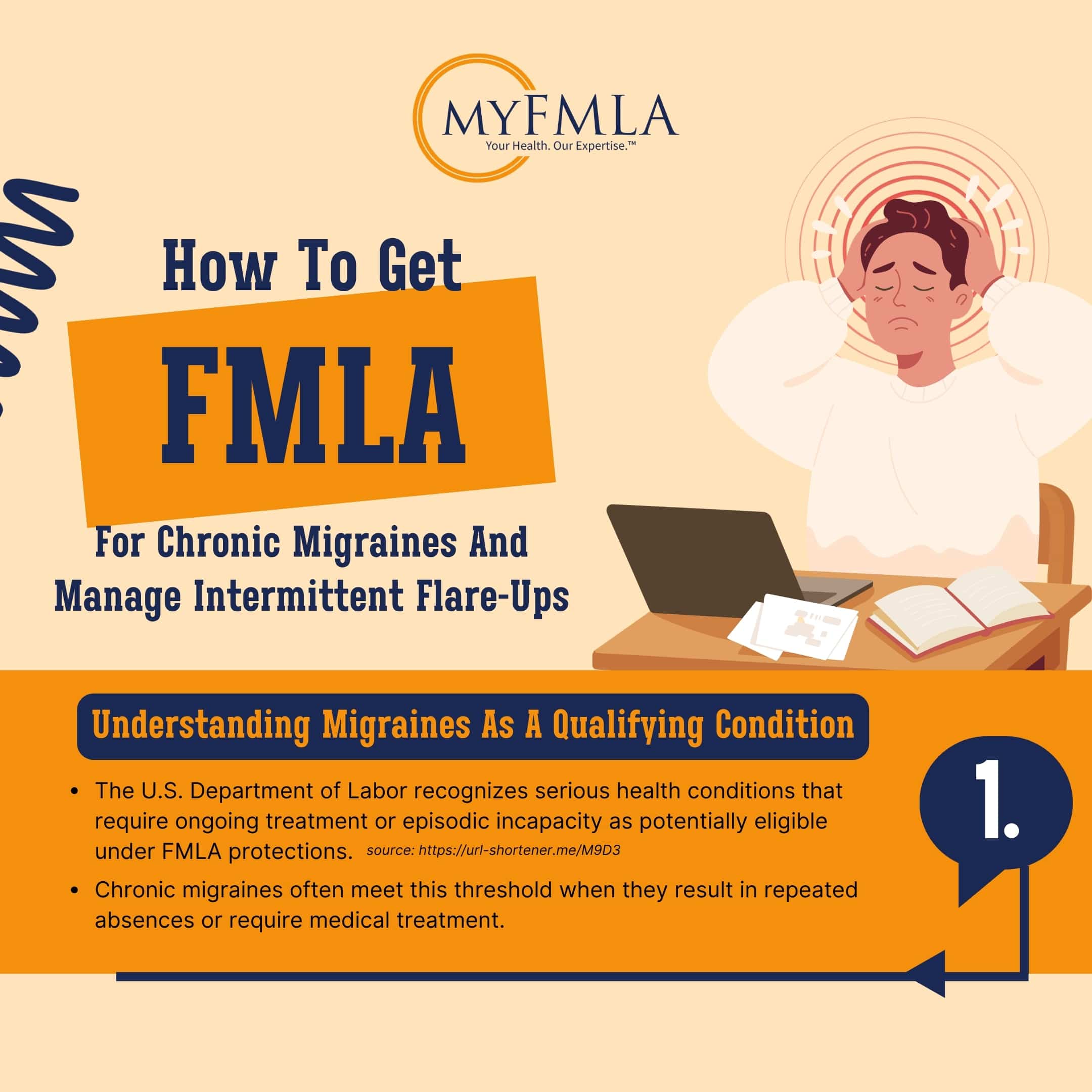
To determine whether migraines are covered under the FMLA, one must look at how the statute defines a "serious health condition." The law does not list specific illnesses by name; instead, it establishes functional criteria that a medical condition must satisfy. Migraines typically qualify under the provision for chronic conditions requiring treatments.
According to Department of Labor guidelines, a chronic serious health condition is one that requires periodic visits for treatment by a healthcare provider, continues over an extended period of time, and may cause episodic rather than continuous periods of incapacity. Migraines fit this exact profile. An individual may go weeks functioning normally, only to be struck by a severe attack that renders them completely unable to work, drive, or concentrate for hours or even days.
To meet the legal threshold, the chronic condition must also involve a course of treatment overseen by a healthcare provider, such as a neurologist or primary care physician. Occasional headaches that respond immediately to over-the-counter pain relievers generally do not rise to the level of a serious health condition under the law. However, diagnosed migraine disorders characterized by severe, recurring episodes that disrupt daily activities routinely satisfy the statutory requirements.
Employee Eligibility Requirements
Qualifying medical conditions are only one part of the equation. To take FMLA leave for migraines, the employee must satisfy specific statutory criteria regarding their tenure and the size of their employing organization.
- Employer Coverage: The FMLA applies to all public agencies, public and private elementary and secondary schools, and private-sector employers who employ 50 or more employees for each working day during each of 20 or more calendar workweeks in the current or preceding calendar year.
- Length of Service: The employee must have worked for the employer for at least 12 months total.
- Hours Worked: The employee must have accumulated at least 1,250 hours of service during the 12-month period immediately preceding the start of the leave.
- Worksite Threshold: The employee must work at a location where the employer employs at least 50 employees within a 75-mile radius.
Meeting these conditions is mandatory. Even if an employee has a severely debilitating medical condition, they cannot access FMLA protections if their employer falls below the employee threshold or if they have not yet logged the required 1,250 hours of service.
Intermittent Leave: The Practical Solution for Chronic Migraines
One of the most valuable aspects of the FMLA for individuals with chronic health conditions is the availability of intermittent leave. Unlike traditional medical leave, which is taken all at once—such as for a scheduled surgery or a standard maternity leave—intermittent leave allows employees to take time off in separate blocks of time for a single qualifying reason.
Because migraines are unpredictable, episodic, and vary widely in frequency and duration, continuous leave is rarely practical or necessary. Instead, an employee with chronic migraines can utilize intermittent FMLA leave to:
- Miss work entirely on days when a severe acute migraine attack strikes.
- Arrive late to work after managing morning migraine symptoms or treatment side effects.
- Leave work early when a migraine begins to develop during the shift.
- Attend scheduled medical appointments, follow-ups, or infusion treatments with a neurologist.
Employers cannot penalize employees for using approved intermittent FMLA leave. However, employees are generally required to make a reasonable effort to schedule planned treatments so as not to unduly disrupt the employer's operations and must follow the employer's usual and customary call-in procedures for reporting an unexpected absence.
| Leave Type | Description | Best Suited For |
|---|---|---|
| Continuous Leave | A single, unbroken block of time away from work (e.g., 4 consecutive weeks). | Scheduled surgeries, major injuries, or extended recovery periods. |
| Intermittent Leave | Separate blocks of time taken periodically over a 12-month period. | Chronic, episodic conditions like severe migraines, asthma attacks, or chemotherapy sessions. |
| Reduced Schedule | A permanent or temporary reduction in the employee's usual number of working hours per day or week. | Gradual return to work or managing debilitating fatigue and chronic pain. |
The FMLA Certification Process for Migraines
Securing FMLA coverage requires formal documentation. When an employee requests leave for migraines, the employer has the right to require medical certification from a licensed healthcare provider to substantiate the request.
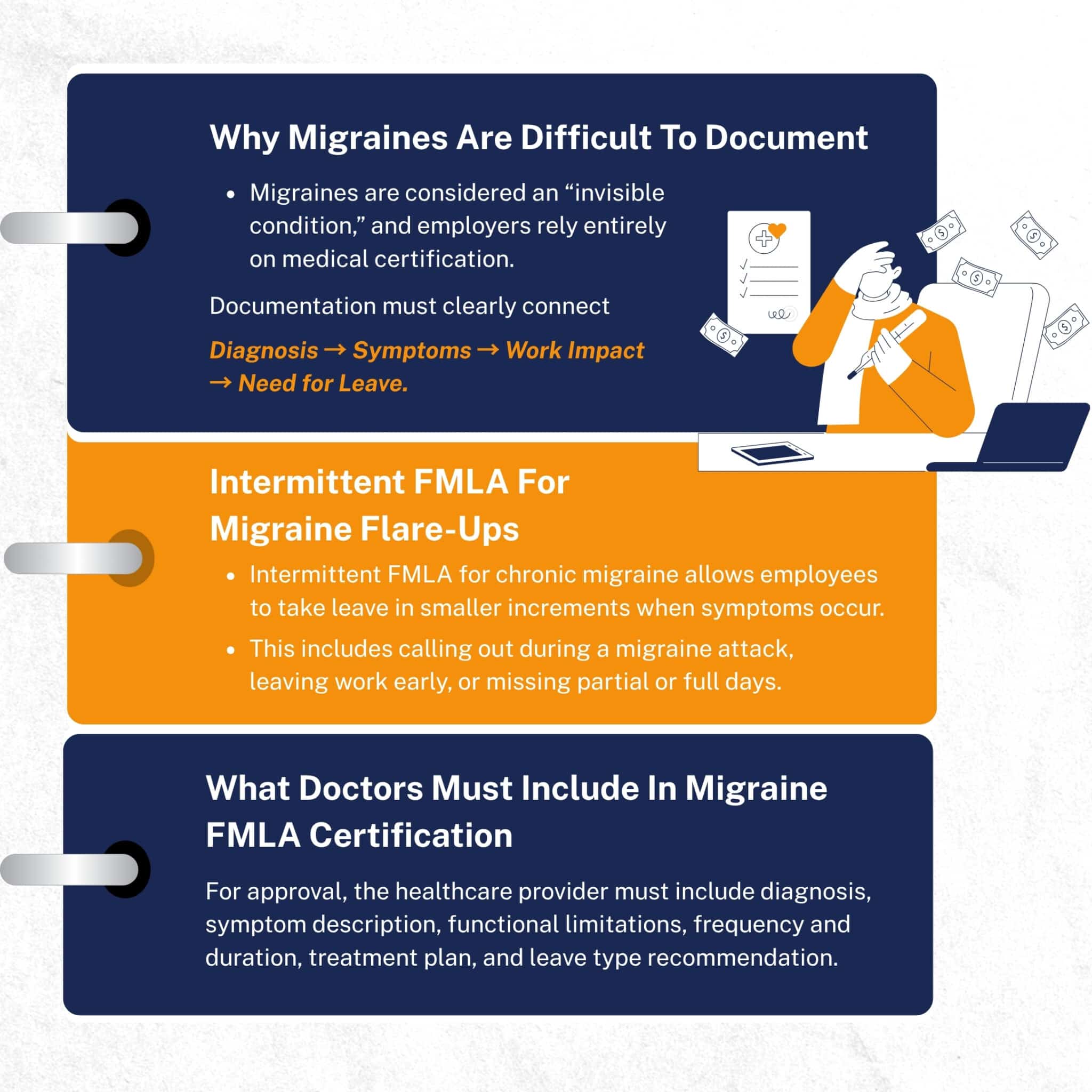
The standard tool for this process is the Department of Labor Form WH-380-E (Certification of Health Care Provider for Employee’s Serious Health Condition). The employee must provide this form to their treating physician, who must complete and sign it. For a migraine condition, the physician will typically document:
- The approximate date the condition commenced and its probable duration.
- Appropriate medical facts regarding the condition, including symptoms, frequency of attacks, and typical duration of episodes.
- A statement indicating that the employee is incapacitated from performing the essential functions of their job during a migraine attack.
- An estimate of the frequency and duration of flare-ups, allowing the employer to calculate the necessary intermittent leave allotment (e.g., estimating 1 to 3 episodes per month lasting between 8 and 24 hours each).
Employers must allow employees at least 15 calendar days to return the completed medical certification. If the initial certification is incomplete or vague, the employer may request clarification or authentication, but they cannot demand additional medical information beyond what is required on the official form without the employee's explicit consent.
Common Pitfalls and Employer Rights
While the FMLA provides robust protections, employers also possess specific rights under the law to prevent abuse and manage operational continuity. Understanding these boundaries helps employees avoid common missteps during the leave process.
One common pitfall is failing to provide adequate notice. For foreseeable leave, such as scheduled appointments, employees must provide at least 30 days' advance notice. When leave is unforeseeable—such as a sudden morning migraine attack—employees must notify the employer as soon as practicable, typically following the company's standard call-in procedures for unexpected absences.
Employers also have the right to request recertification under specific circumstances, though generally no more often than every 30 days in conjunction with an absence, unless circumstances have changed significantly or the employer receives information casting doubt on the validity of the certification. Additionally, employers may require a second (and occasionally third) medical opinion at their own expense if they have reason to doubt the validity of the initial certification.
Alternative and Complementary Workplace Protections
If an employee does not qualify for FMLA leave—perhaps because they have been with their employer for less than a year or the company has fewer than 50 employees—other legal frameworks may offer relief or accommodation.
The Americans with Disabilities Act (ADA) applies to private employers with 15 or more employees, as well as state and local governments. Under the ADA, a chronic, severe medical condition like migraines may be classified as a disability if it substantially limits one or more major life activities.
Unlike the FMLA, which provides time off, the ADA focuses on reasonable accommodations that enable an employee to perform their job duties. For a worker with migraines, reasonable accommodations might include:
- Adjusting office lighting to reduce glare and fluorescent flicker.
- Providing a quiet, dimly lit space to recover during an acute attack.
- Allowing flexible working hours or remote work options.
- Permitting scent-free policies if environmental triggers provoke attacks.
Exploring both FMLA and ADA provisions ensures that workers understand their complete spectrum of rights when managing a chronic illness in the workplace.
Frequently Asked Questions
Can my employer fire me for missing work due to migraines if I have FMLA?
No, an employer cannot legally terminate, discipline, or demote you for taking leave that has been officially approved under the FMLA. FMLA leave is job-protected, meaning you must be restored to your position or an equivalent role upon your return. However, you must follow proper call-in procedures and stay within your approved leave limits.
How do I report an unexpected migraine absence under intermittent FMLA?
You must follow your employer's standard call-in policy for unexpected absences (such as calling or emailing a supervisor before your shift starts) and explicitly state that the absence is related to your approved FMLA condition or migraines. You do not necessarily need to go into explicit medical detail every time, but the employer must be given enough information to link the absence to the certified condition.
What happens if my employer denies my FMLA request for migraines?
If an employer denies your FMLA request, they must provide a reason. Common reasons include an incomplete certification form, failure to meet eligibility hours, or an insufficient medical definition of a serious health condition. You have the right to ask for clarification, correct any deficiencies in your physician's certification, or file a complaint with the U.S. Department of Labor's Wage and Hour Division if you believe your rights have been violated.
Does FMLA leave for migraines have to be paid time off?
No, FMLA leave itself is strictly unpaid. However, you may choose—or your employer may require you—to substitute accrued paid time off, such as vacation, sick leave, or personal time, to cover some or all of the FMLA period. When paid leave is substituted for unpaid FMLA leave, it runs concurrently with your FMLA entitlement.
Can my employer demand a doctor's note for every single migraine absence?
If you have an approved intermittent FMLA certification on file, your employer generally cannot require a new doctor's note for every single absence. The original certification establishes the frequency and duration of your flare-ups. However, if an absence departs significantly from the certified pattern, the employer may request recertification.
Next Actions and Recommendations
If you suffer from chronic migraines and find that your condition is impacting your job performance or attendance, begin by consulting your neurologist or primary care physician to discuss your symptoms and treatment history. Ask your physician to document the chronic nature of your condition and help you complete the necessary Department of Labor certification paperwork.
Next, contact your human resources department to formally request FMLA paperwork, ensuring you meet the basic eligibility criteria regarding hours and tenure. Maintaining open, transparent communication with your employer and HR department regarding your certification and call-in procedures will protect your job stability while allowing you to prioritize your health and effective migraine management.
Image Gallery