How IBM Watson Supercomputer Shapes AI Research: Legacy and Evolution in 2026
IBM Watson serves as a cornerstone of artificial intelligence research by shifting the industry focus from narrow, rule-based systems to probabilistic, large-scale data processing. Through its evolution from a specialized Jeopardy-winn...
IBM Watson serves as a cornerstone of artificial intelligence research by shifting the industry focus from narrow, rule-based systems to probabilistic, large-scale data processing. Through its evolution from a specialized Jeopardy-winning hardware cluster to the modern Watsonx platform, it has pioneered methodologies in natural language processing (NLP), hybrid cloud supercomputing, and transparent AI governance.
Contents
In the landscape of 2026, the term "Watson" no longer refers merely to a single physical machine but to a distributed ecosystem of AI research and deployment. The influence of this technology spans over fifteen years of development, during which it has fundamentally altered how researchers approach machine learning, data ethics, and enterprise-grade foundation models. By analyzing its trajectory, we can understand the current state of AI research and the specific methodologies that IBM has institutionalized across the global scientific community.
The Architectural Genesis: From DeepQA to Neural Networks
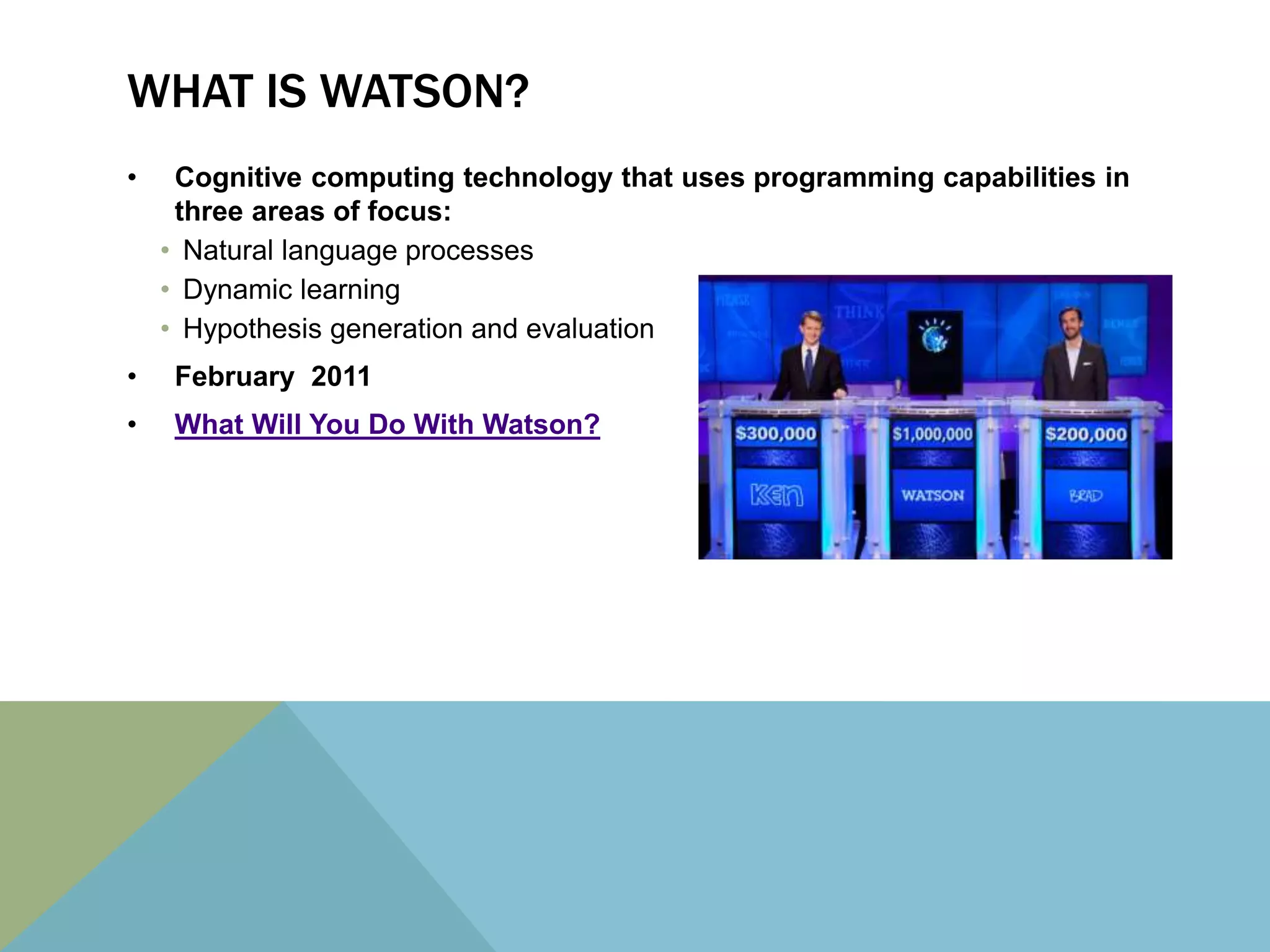
The origin of Watson’s impact on AI research began with the DeepQA architecture. Unlike the rigid expert systems of the 1990s, Watson was designed to handle the ambiguity of human language. This required a massive leap in parallel processing and the synthesis of thousands of different algorithms to evaluate "evidence" in milliseconds.
The Shift to Probabilistic Reasoning
Prior to Watson’s public debut, AI research was often siloed into specific domains. Watson’s architecture proved that a "system of systems" approach—where multiple specialized models compete and collaborate—could outperform a single monolithic algorithm. This research direction paved the way for the ensemble methods and transformer-based architectures that dominate the 2020s. Researchers learned that the key to understanding human nuance was not a better dictionary, but a more robust statistical framework for weighing conflicting information.
Hardware as a Research Catalyst
While software was the star, the physical supercomputer was the engine. The original Watson ran on a cluster of IBM Power 750 servers. This hardware-software synergy pushed the boundaries of high-performance computing (HPC). It forced researchers to solve the "latency problem" in real-time AI, a challenge that remains central to the development of modern edge computing and real-time generative agents in 2026.
The Modern Era: Watsonx and the Vela Supercomputer
As we look at the research landscape in 2026, the focus has shifted from specialized question-answering to Foundation Models. IBM’s research division has transitioned its efforts toward the Watsonx platform, underpinned by Vela, IBM’s first cloud-native AI supercomputer.
Vela: Redefining AI Infrastructure
Launched in the early 2020s and matured by 2026, Vela represents a significant departure from traditional supercomputer design. Traditionally, supercomputers were built with specialized hardware that was difficult to scale. IBM research proved that using Ethernet-based networking and standard cloud nodes—if optimized correctly—could rival InfiniBand-based systems for training large models. This research has democratized AI development, allowing more institutions to build "supercomputing-class" models without proprietary, bespoke hardware.
The Rise of Foundation Models
IBM’s research into foundation models (such as the Granite series) emphasizes efficiency over raw size. While some industry players pursued trillion-parameter models, IBM research focused on "compact" models that deliver high performance in specific enterprise domains like COBOL translation, climate modeling, and legal analysis. This has shaped a broader research trend in 2026 toward Model Distillation—the process of making AI smaller, faster, and more environmentally sustainable.
Impact on Vertical Research Domains
The Watson legacy is perhaps most visible in how it tailored AI for highly regulated industries. This specialized research proved that general-purpose AI is often insufficient for professional rigor.
| Era | Focus Area | Key Research Contribution | Technical Implementation |
|---|---|---|---|
| 2011–2014 | Natural Language | Evidence-based QA | DeepQA on Power7 Hardware |
| 2015–2020 | Vertical AI | Medical & Financial NLP | Watson Discovery & APIs |
| 2021–2024 | Generative AI | Foundation Models | Watsonx & Vela Supercomputer |
| 2025–2026 | Trusted AI | AI Governance & Ethics | Open-source Granite & AI Alliance |
Healthcare and Life Sciences
Despite early challenges in commercializing "Watson for Oncology," the research generated during that period was invaluable. It highlighted the "data silos" problem in medicine and spurred research into Federated Learning. This allows AI models to learn from sensitive patient data across multiple hospitals without the data ever leaving the secure local servers. In 2026, this remains the standard for privacy-compliant medical AI research.
Climate and Geospatial Research
IBM’s partnership with NASA to create a geospatial foundation model using Watson technology has redefined environmental research. By training on vast amounts of satellite data, researchers can now predict flood patterns, track deforestation, and model urban heat islands with a precision that was impossible using traditional meteorological simulations.
Pioneering Trusted AI and Open Science
One of the most significant ways IBM Watson has shaped AI research is through the lens of Ethics and Transparency. In an era where "black box" models are common, IBM has advocated for "Explainable AI" (XAI).
The AI Alliance and Open Source
By 2026, the AI Alliance—co-founded by IBM and Meta—has become a dominant force in research. This move was a direct result of Watson research showing that proprietary, closed-source AI creates systemic risks. By open-sourcing the Granite models and contributing to platforms like Hugging Face, IBM has shifted the research culture toward collective verification and safety.
AI Governance Frameworks
IBM Research has been instrumental in developing tools like AI FactSheets. Much like nutrition labels for food, these provide standardized documentation for AI models, detailing their training data, biases, and intended use cases. This research has influenced global policy, including the EU AI Act and subsequent international standards, ensuring that "Supercomputer-class" AI remains accountable.
Technical Specifications of Modern Watson-Era Systems
The supercomputing power behind 2026's AI research is characterized by massive GPU clusters and high-bandwidth memory. The systems supporting current IBM research typically include:
- Processor Architecture: Integration of IBM Power10 and newer iterations, optimized for matrix math and memory bandwidth.
- GPU Acceleration: Massive deployments of NVIDIA H-series and B-series (and subsequent) tensors, networked via high-speed Ethernet fabrics.
- Hybrid Cloud Integration: The ability to move workloads seamlessly between on-premise supercomputers and global cloud zones via Red Hat OpenShift.
- Liquid Cooling: Advanced thermal management systems designed to handle the intense heat of training runs involving tens of thousands of GPUs.
Practical Guidance for Researchers Using Watson Technologies
For researchers looking to leverage the legacy of Watson supercomputing in 2026, the entry point is the Watsonx.ai studio. This platform provides the tools to tune foundation models with specific datasets.
Steps to Implement Watson-Based Research:
- Data Curation: Use Watsonx.data to clean and tokenize domain-specific information.
- Model Selection: Choose a base model (e.g., Granite for language or geospatial models for environmental data).
- Tuning: Utilize Parameter-Efficient Fine-Tuning (PEFT) to adapt the model without the massive computational cost of full re-training.
- Governance: Deploy the model through Watsonx.governance to monitor for drift, bias, and hallucination in real-time.
Frequently Asked Questions
Is IBM Watson still a physical supercomputer?
In 2026, Watson is primarily a brand for a suite of AI software and services. However, it is powered by Vela, IBM's cloud-native supercomputer infrastructure. While the original 2011 "room-sized" Watson is a museum piece, its spiritual successor lives in distributed data centers globally, utilizing thousands of interconnected nodes.
How did Watson change Natural Language Processing (NLP)?
Watson shifted NLP from simple keyword matching to semantic understanding. It introduced the concept of "confidence scores," where the system doesn't just give an answer but provides a statistical probability of its correctness based on the evidence it found in its training corpus.
Can independent researchers access Watson supercomputing power?
Yes, through the IBM Cloud and the Watsonx platform. IBM also provides significant resources to the academic community through the IBM Academic Initiative and the AI Alliance, allowing researchers to access high-performance computing resources and pre-trained models for non-commercial scientific advancement.
What is the difference between Watson and generic Generative AI?
While generic AI is often trained on the broad internet to be a "jack of all trades," Watson research focuses on targeted, trusted AI. This means models are trained on curated, high-quality data with a focus on auditability, legal compliance, and domain-specific accuracy (e.g., specifically for the legal, financial, or engineering sectors).
How does IBM Watson impact AI safety research?
IBM has been a leader in Adversarial Robustness. Their research involves "red-teaming" AI models—essentially trying to trick them—to find vulnerabilities before they are deployed. This methodology has become a standard requirement for enterprise AI safety in 2026.
Final Recommendation: Navigating the Future of AI Research
For organizations and researchers aiming to stay at the forefront of the field, the key is to move beyond the "black box" approach. The primary lesson from the evolution of IBM Watson is that transparency and domain specificity are more valuable than raw model size.
In 2026, the most successful AI projects are those that integrate robust governance frameworks from day one. Researchers should focus on the AI Alliance's open-source standards and utilize hybrid cloud architectures to ensure their models are scalable, ethical, and verifiable. The legacy of Watson is not just in the hardware that won a game show, but in the rigorous, evidence-based approach to machine intelligence that now defines modern science.
Image Gallery