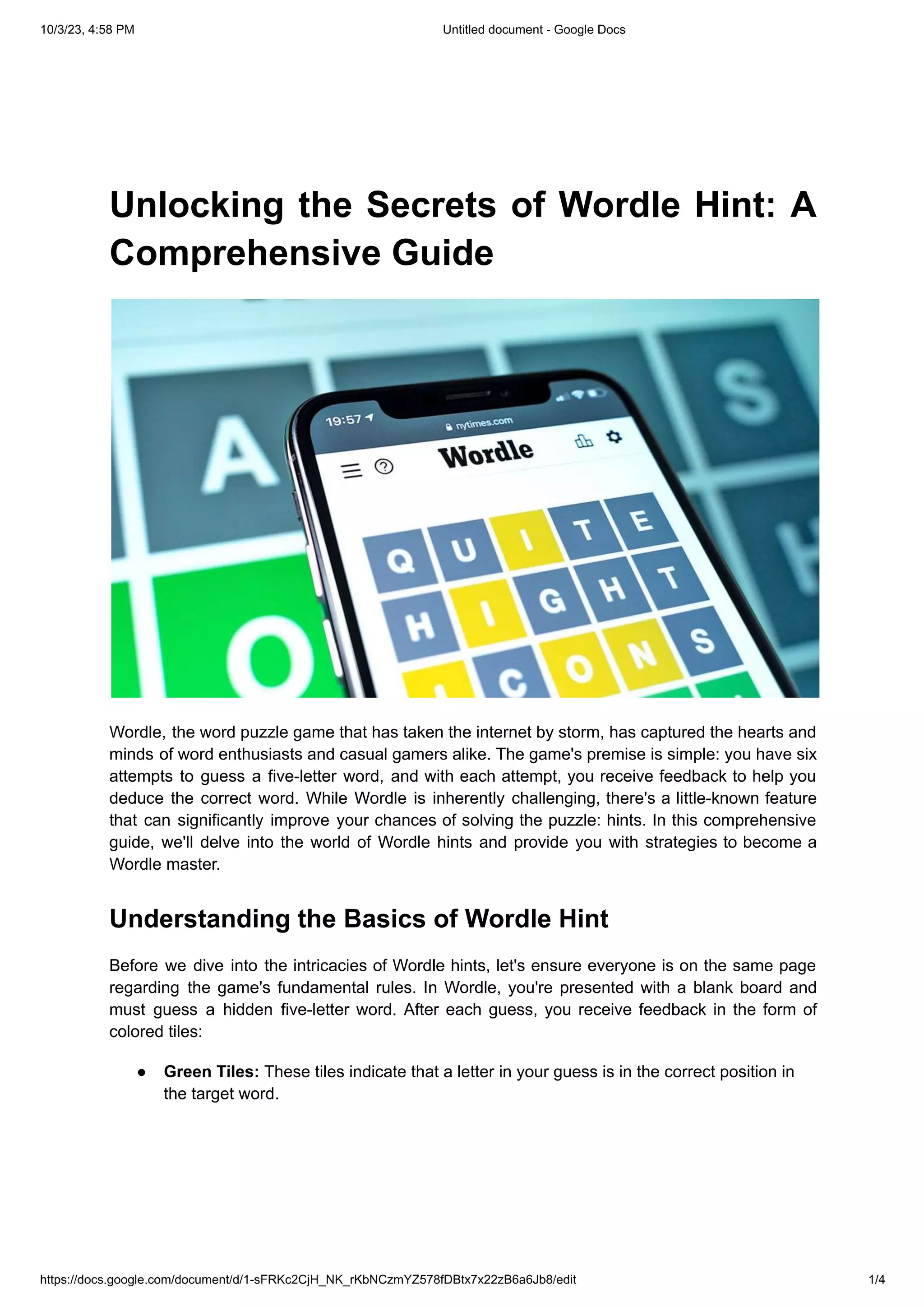
Decoding Wordle Hints and Strategies for 2026: The Mashable Daily Approach
The search intent for "wordle hint mashable today" is primarily informational and navigational. Users are seeking daily competitive advantages to solve the New York Times Wordle puzzle while leveraging the specific editorial methodolog...
The search intent for "wordle hint mashable today" is primarily informational and navigational. Users are seeking daily competitive advantages to solve the New York Times Wordle puzzle while leveraging the specific editorial methodology employed by Mashable. This article focuses on the high-level linguistic strategies and analytical frameworks required to maintain a consistent solving streak in 2026.
Contents
The Evolution of Daily Wordle Strategy in 2026
As of 2026, the Wordle landscape has matured significantly. Players are no longer just guessing; they are employing sophisticated algorithmic thinking and linguistic patterns to narrow down the search space within the required six attempts. Mashable’s approach to daily hints centers on balancing "starter word" efficiency with subsequent deductive reasoning.
When approaching the daily puzzle, the objective is to maximize information density—the amount of unique character feedback gained per guess—rather than attempting to solve the puzzle in a single shot. By 2026 standards, an effective strategy involves testing the most frequently occurring vowels and consonants in the English language early in the sequence.
Essential Linguistic Foundations for Success
Success in Wordle requires a foundational understanding of orthography and phonotactics. Words that appear in the NYT Wordle library typically follow specific structural constraints. Understanding these constraints allows players to filter their candidate list effectively.
- Vowel Distribution: Prioritize words containing A, E, I, O, U, and Y. In the 2026 meta, high-frequency vowel starters remain the gold standard for thinning out potential solutions.
- Consonant Clusters: Focus on common pairings such as ST, TH, CH, SH, and NG. Identifying these early significantly reduces the computational complexity of the remaining grid.
- Positional Frequency: Certain letters are statistically more likely to occupy specific positions (e.g., S as a starting letter, E as a terminal letter).
Comparative Analysis of Solving Methodologies
To maintain consistency, it is essential to compare the "Mashable Style" of hint delivery against other common analytical frameworks. Understanding how these strategies differ can help you choose the best path for your specific cognitive style.
| Strategy Methodology | Primary Focus | Best For | Risk Profile |
|---|---|---|---|
| Mashable Deductive Hinting | Clue-based gradual narrowing | Players seeking hints without spoilers | Moderate |
| Hard Mode Constraint | Forced inclusion of discovered letters | Experts looking for technical rigor | High |
| Frequency-First Starter | Maximum character density | Efficiency-focused players | Low |
| Pattern Recognition | Identifying suffixes/prefixes | Advanced vocabulary users | Low |
Applying Analytical Deductive Reasoning
When you receive a hint, the goal is not to solve the puzzle instantly but to engage in a process of elimination. If a hint suggests a particular vowel placement, you should construct a secondary guess that tests the remaining vowels while utilizing consonants that have not yet been evaluated.
The Power of the Feedback Loop
Systematic observation involves tracking the gray, yellow, and green indicators. A green indicator locks the letter and position, while a yellow indicator confirms the letter’s existence but requires testing in a new position. The most common error in 2026 is failing to account for double letters, which often trip up even seasoned players during the fourth or fifth turn.
Step-by-Step Execution for Daily Challenges
- Start with a word that contains at least three distinct vowels and two high-frequency consonants.
- Evaluate the feedback provided by the grid. Ignore the temptation to guess a "lucky" word for the second turn.
- Construct your second word to incorporate the confirmed letters in new, untested positions.
- If you have three or more green letters, switch your strategy from elimination to synthesis; identify the most logical word pattern that fits the remaining vacant slots.
- Utilize "buffer" words if you are stuck between multiple valid possibilities (e.g., words like WATCH vs BATCH). This forces the game to reveal the correct starting character.
Common Obstacles and Failure Remedies
Even with the best hints, players often face "the trap"—a situation where multiple words fit the remaining letter slots, such as LIGHT, NIGHT, MIGHT, SIGHT. This scenario is the primary cause of lost streaks in 2026.
- The Buffer Strategy: If you suspect a trap, do not guess one of the potential solutions. Guess a word that contains as many of the varying first letters as possible.
- Frequency Checking: Refer to established word frequency lists. The NYT Wordle library favors common vocabulary over obscure archaic terms. When in doubt, lean toward the word most commonly used in contemporary daily conversation.
Frequently Asked Questions
What is the most effective way to use hints provided by sites like Mashable? The most effective way is to use them as a "nudge" rather than a solution, allowing you to maintain your streak while sharpening your own deductive skills. By reading the hint and attempting to solve the puzzle yourself, you build long-term pattern recognition.
Why does my strategy fail when I reach the fourth turn? Failure at the fourth turn usually indicates a failure to optimize the first two guesses for high-frequency letter coverage. Ensure your early guesses are not just "good" words, but words that cover the maximum number of high-utility letters.
Are there specific words to avoid as starters in 2026? Avoid words that rely on rare letters like Z, Q, J, or X, as these provide very little information if they are not in the solution. Stick to standard, high-frequency character sets.
Does Wordle use proper nouns or plurals? The current iteration of the game primarily uses common nouns and verbs. While some plurals have appeared, they are the exception rather than the rule; therefore, focusing on base-form vocabulary is generally the smarter play.
How do I handle the "trap" scenario efficiently? The "trap" scenario is handled by sacrificing one turn to play a word that features the potential consonants in the word's primary position. While this feels like a wasted turn, it guarantees the correct letter and prevents an unnecessary loss of your streak.
Optimizing Your Performance
Consistency in Wordle is a byproduct of discipline. By applying the analytical frameworks discussed above and treating each puzzle as a data-entry problem rather than a test of raw vocabulary, you can maintain your streak indefinitely. Integrate these strategies into your daily morning routine to ensure you are consistently engaging with the game at an elite level. Stay committed to the process of elimination, respect the power of high-frequency letters, and always look for the most logical path through the linguistic constraints.
Image Gallery