Understanding the Townshend Act Reaction in Context: Ideology, Resistance, and Imperial Escalation
The reaction to the Townshend Acts of 1767 represented a pivotal escalation in the imperial crisis between Great Britain and its North American colonies. Colonial leaders rejected Parliament's authority to tax them for revenue, organiz...
The reaction to the Townshend Acts of 1767 represented a pivotal escalation in the imperial crisis between Great Britain and its North American colonies. Colonial leaders rejected Parliament's authority to tax them for revenue, organizing coordinated economic boycotts and political petitions. Britain responded by military occupation and dissolving assemblies, setting off a chain reaction that directly led to the American Revolution.
Contents
Historical Context: The Path from the Stamp Act to 1767
To understand the colonial and British reactions to the Townshend Acts, one must examine the imperial political landscape following the Seven Years' War (1756–1763). The war ended with Great Britain holding immense territorial gains in North America, but also carrying a national debt that had nearly doubled during the conflict. British political leadership, under the reign of King George III, determined that the North American colonies—which had benefited directly from British military protection—should contribute systematically to the maintenance of the empire.
The initial attempt to raise revenue, the Stamp Act of 1765, triggered fierce colonial resistance. The colonists argued against "taxation without representation," asserting that only their local colonial assemblies possessed the constitutional right to levy internal taxes upon them. Surprised by the unified opposition, violent riots, and economic pressure from colonial boycotts, British Parliament repealed the Stamp Act in March 1766.
However, alongside the repeal, Parliament passed the Declaratory Act of 1766, affirming its absolute power to bind the American colonies "in all cases whatsoever." This legislative maneuver created a profound constitutional disagreement:
- The British Imperial Perspective: Parliament held supreme legislative sovereignty across the entire British Empire. Any distinction between taxing power and legislative power was considered legally invalid.
- The Colonial Perspective: Colonists viewed themselves as British subjects entitled to traditional rights guaranteed under the English Bill of Rights (1689). They maintained a distinction between Parliament's right to regulate imperial trade and its right to levy taxes directly on citizens who lacked parliamentary representation.
When Charles Townshend became Chancellor of the Exchequer in 1766, he sought to resolve the imperial revenue deficit by exploiting what he perceived as a constitutional loophole in colonial logic. Townshend believed the colonists had objected specifically to internal taxes (like stamp duties) rather than external taxes (customs duties collected at ports on imported goods).
The Anatomy of the Townshend Acts: What Parliament Enacted
Passed by Parliament between June and July 1767, the legislative bundle known collectively as the Townshend Acts was not a single law, but a strategic series of five distinct statutes designed to generate revenue, enforce customs compliance, and reassert political control over provincial administrations.
- Townshend Acts (1767 Bundle)
- Revenue Act (Import Duties)
- Restraining Act (NY Assembly)
- Customs Act (Board in MA)
- Indemnity Act (Tea Subsidies)
- Admiralty Act (Vice Courts)
1. The Revenue Act of 1767
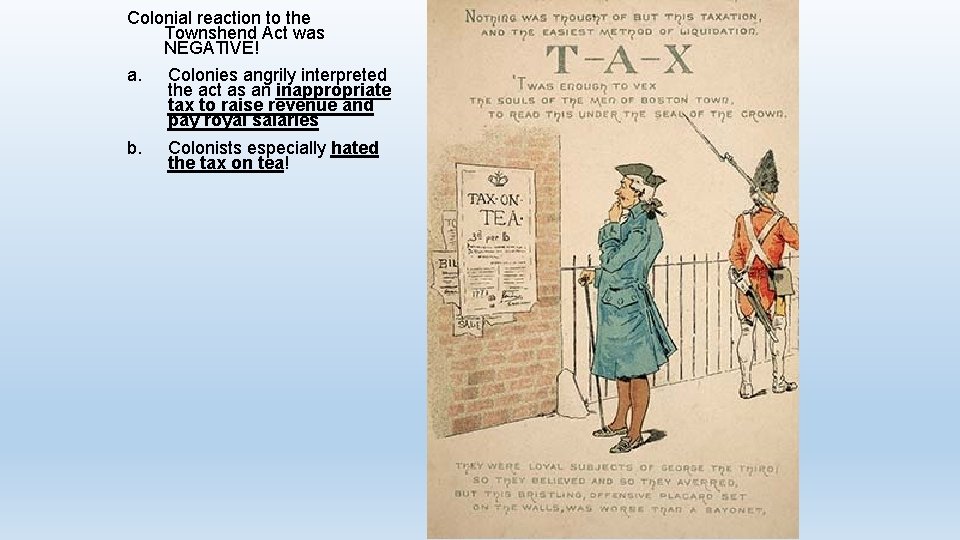
This statute placed external duties on specific manufactured goods imported into the American colonies from Great Britain: glass, lead, painters' colors, paper, and tea. Crucially, the revenue generated was designated to pay the salaries of colonial governors and judges. Previously, local colonial assemblies controlled the "power of the purse," holding financial leverage over royal officials by withholding salaries if administrative actions infringed on colonial interests. By paying royal governors directly, the Revenue Act severed this local accountability.
2. The New York Restraining Act
This act targeted the New York Assembly specifically, suspending its legislative authority until it fully complied with the Quartering Act of 1765, which mandated that colonial assemblies provide housing, supplies, and provisions for British troops stationed within their borders.
3. The Customs Enforcement Act
To stop widespread smuggling and ensure full collection of import duties, this law created the American Board of Customs Commissioners, headquartered in Boston. This board operated independently of local authorities and utilized aggressive enforcement tactics.
4. The Indemnity Act of 1767
Designed to make British East India Company tea competitive with smuggled Dutch tea, this act lowered duties on tea imported into England, allowing the company to re-export it to the American colonies more cheaply, where it would then be subject to the Townshend import duty.
5. The Vice-Admiralty Court Act of 1768
This statute established specialized maritime courts in Halifax, Boston, Philadelphia, and Charleston to prosecute customs violators without juries. Colonial trials had routinely acquitted smugglers; vice-admiralty courts operated under royal judges who received direct financial incentives from confiscated contraband.
The Colonial Reaction: Constitutional Arguments and Mass Mobilization
The colonial reaction to the Townshend Acts was swift, organized, and structurally sophisticated. Colonial political leaders immediately recognized that Charles Townshend’s distinction between "internal" and "external" taxation was a dangerous precedent. If Parliament could impose duties on essential manufactured items that the colonies were legally prohibited from purchasing from other nations, it held total economic control over the provinces.
Intellectual Resistance and Constitutional Defense
The ideological framework for colonial opposition was articulated by Pennsylvania lawyer John Dickinson in his widely distributed series of essays titled Letters from a Farmer in Pennsylvania (1767–1768). Dickinson argued that while Parliament possessed the authority to regulate imperial commerce, it had no constitutional authority to levy duties on imports for the sole purpose of raising revenue.
"If Great Britain can order us to pay what taxes she pleases for the commodities she obliges us to take from her, then we are as abject slaves as France and Poland can show." — John Dickinson, Letters from a Farmer in Pennsylvania
In February 1768, the Massachusetts House of Representatives issued the Massachusetts Circular Letter, drafted by Samuel Adams and James Otis Jr. The letter urged all colonial assemblies to unite and formulate a harmonious response against the Townshend duties. It reasserted that taxation without representation violated the British constitution and highlighted the dangerous implications of royal governors becoming financially independent from local legislatures.
Economic Mobilization: Non-Importation and "Homespun"
Colonial opposition shifted from intellectual discourse to mass political action through economic boycotts. Merchants and citizens across major port cities formed Non-Importation Agreements, agreeing not to import British goods listed in the Townshend Acts until the taxes were repealed.
Colonial Resistance Progression (1767–1770):
- [1767] Intellectual Opposition: Dickinson's "Letters from a Farmer"
- [1768] Legislative Unity: Massachusetts Circular Letter
- [1768] Economic Mobilization: Non-Importation Agreements & Homespun
- [1769] Popular Radicalization: Sons/Daughters of Liberty Action
The success of these boycotts relied heavily on public participation, transforming everyday consumption into a political statement:
- The Sons of Liberty enforced the boycotts through public pressure, intimidation of customs officials, and publishing the names of non-compliant merchants in colonial newspapers.
- The Daughters of Liberty played a critical operational role by promoting self-sufficiency. Women organized public "spinning bees" to produce local textiles ("homespun"), allowing households to decline British fabric imports. They also produced herbal tea alternatives, effectively reducing colonial dependency on taxable goods.
By late 1769, non-importation agreements had severely crippled British trade to the colonies. Imports of British goods fell by over 38 percent in New York, Pennsylvania, and Massachusetts, causing British merchants to petition Parliament for relief.
Imperial Countermeasures: The British Response to Colonial Defiance
Rather than defusing tension, British imperial authorities met colonial resistance with administrative crackdowns and military enforcement. The reaction of the British government was coordinated primarily by Lord Hillsborough, the newly appointed Secretary of State for the Colonies.
Political Suppression and Assembly Dissolutions
When Lord Hillsborough received a copy of the Massachusetts Circular Letter, he viewed it as an act of open rebellion. In April 1768, he ordered Governor Francis Bernard of Massachusetts to demand that the assembly rescind the letter. When the Massachusetts legislature voted 92 to 17 to refuse Hillsborough's demand, Governor Bernard dissolved the assembly.
Hillsborough issued parallel instructions to royal governors across the continent: any assembly that endorsed the Massachusetts Circular Letter was to be dissolved immediately. Assemblies in Maryland, Virginia, Georgia, and South Carolina were subsequently shut down, leaving several colonies without functioning legislative representation.
Military Occupation of Boston
Tensions reached a boiling point in Boston in June 1768, when customs officers seized the Liberty, a merchant sloop belonging to prominent colonial trader John Hancock, on charges of smuggling. A riot erupted in the streets, forcing customs officials to flee to Castle William in Boston Harbor.
In response, the British ministry dispatched four regiments of British Regulars to Boston to restore order, protect customs officials, and enforce the Townshend Acts. In October 1768, warships anchored off the coast, landing roughly 2,000 armed troops in a civilian city of roughly 15,000 residents. The permanent military occupation of an American city during peacetime created an unprecedented level of friction between soldiers and civilians.
Comparative Analysis: Townshend Acts Dynamics
The table below outlines the core legal components of the Townshend Acts, Parliament's strategic intent, the colonial response, and the corresponding imperial enforcement action.
| Legislative Measure | Primary Imperial Intent | Colonial Reaction & Resistance | Imperial Countermeasure |
|---|---|---|---|
| Revenue Act (1767) | Raise colonial revenue to pay royal governors and judges directly. | Non-Importation Agreements; boycotts of taxed goods; creation of "homespun" alternatives. | Seizure of non-compliant vessels; strict enforcement of import declarations. |
| New York Restraining Act (1767) | Punish New York Assembly for refusing to comply with the Quartering Act. | Widespread condemnation of parliamentary overreach against colonial self-governance. | Temporary suspension of the New York provincial assembly's legal authority. |
| Customs Enforcement Act (1767) | Establish American Board of Customs Commissioners in Boston to end smuggling. | Public harassment of customs officials; riots over vessel seizures (e.g., the Liberty). | Request for military backing; military occupation of Boston by British troops (1768). |
| Vice-Admiralty Court Act (1768) | Bypass local colonial juries when prosecuting customs violations. | Arguments that constitutional rights to trial by jury of peers were being systematically destroyed. | Expansion of non-jury admiralty court jurisdictions across major port cities. |
Climax and Consequences: From Occupation to Partial Repeal
The military presence in Boston created an unstable operational environment. Daily interactions between Bostonians and British soldiers—who competed with local laborers for off-duty jobs—led to growing hostility.
The Boston Massacre (1770)
On the night of March 5, 1770, an angry crowd gathered outside the Custom House on King Street, confronting a small detachment of British soldiers. Civilians threw snowballs, ice, and debris while shouting insults at the troops. Amid the confusion, British soldiers fired into the crowd without formal orders, killing five civilians and wounding six others.
The event, quickly termed the Boston Massacre by local leaders like Paul Revere and Samuel Adams, was widely publicized as evidence of military tyranny. Though legal defense by John Adams resulted in the acquittal of most of the soldiers involved, the event permanently eroded trust between the colonies and the British Crown.
Timeline of Escalation to Repeal:
- June 1767: Townshend Acts Passed by Parliament
- Feb 1768: Massachusetts Circular Letter Drafted
- June 1768: Seizure of John Hancock's "Liberty"
- Oct 1768: British Troops Land in Boston
- March 1770: The Boston Massacre (March 5)
- April 1770: Parliament Repeals Townshend Duties (Except Tea)
The Partial Repeal of 1770
Ironically, on the exact day of the Boston Massacre—March 5, 1770—the new British Prime Minister, Lord North, introduced a motion in Parliament to repeal most of the Townshend duties. Lord North recognized that the import duties were economically counterproductive: they harmed British manufacturers by encouraging colonial boycotts while generating minimal net revenue.
On April 12, 1770, Parliament formally repealed the duties on glass, lead, paint, and paper. However, Lord North insisted on retaining the tax on tea. This decision was explicitly political rather than financial: Parliament retained the tea tax as a symbolic assertion of its legal authority to tax the colonies under the Declaratory Act.
- Townshend Acts Repeal (April 1770)
- REPEALED DUTIES: Glass, Lead, Paint, and Paper
- RETAINED DUTIES: Tea Duty (Kept as symbol of sovereignty)
- Paved the way for Boston Tea Party (1773)
Long-Term Impact on the Revolutionary Movement
The reaction to the Townshend Acts reshaped the colonial movement in fundamental ways:
- Institutionalized Inter-Colonial Communication: The crisis established organized networks of resistance. The coordination surrounding the Massachusetts Circular Letter directly inspired the later formation of permanent Committees of Correspondence in 1772 and 1773.
- Shift in Political Philosophy: The failure of the Townshend Acts demonstrated to colonists that Parliament would continuously attempt new mechanisms to tax them. The debate shifted from distinguishing between internal vs. external taxes to a broader questioning of whether Parliament held any jurisdiction over the colonies without direct representation.
- The Unresolved Tea Issue: Retaining the duty on tea preserved the constitutional conflict. This lingering tax directly set the stage for the Tea Act of 1773, the Boston Tea Party, the passage of the Coercive (Intolerable) Acts of 1774, and ultimately the outbreak of armed conflict at Lexington and Concord in 1775.
Frequently Asked Questions
What was the main difference between the Stamp Act and the Townshend Acts?
The Stamp Act of 1765 levied direct, internal taxes on paper goods produced within the colonies. The Townshend Acts of 1767 placed external import duties on specific manufactured goods imported into the colonies from Britain. While British ministers believed colonists would accept external duties, colonists rejected both on constitutional grounds because both raised revenue without colonial representation.
Why did Britain retain the tax on tea when repealing the Townshend Acts in 1770?
Lord North’s administration kept the tea tax to preserve the principle of parliamentary sovereignty. Repealing all taxes would have appeared as a complete capitulation to colonial defiance. Retaining the tea duty signaled that Parliament retained the legal right to tax the colonies under the Declaratory Act.
How did the Townshend Acts affect royal officials in the colonies?
The Revenue Act of 1767 allocated duties collected at colonial ports to pay the salaries of royal governors, judges, and customs officials directly. This made royal officials financially independent of colonial assemblies, removing the primary administrative check colonial legislatures historically used to influence royal governance.
What role did women play in the reaction to the Townshend Acts?
Women were central to the economic resistance movement through organizations like the Daughters of Liberty. They organized public spinning bees to produce homespun clothing, reducing colonial reliance on taxed British textiles. They also boycotted taxable British tea in favor of locally produced herbal substitutes.
How did the Townshend Acts lead to the Boston Massacre?
The Townshend Acts established the American Board of Customs Commissioners in Boston. Resistance to customs seizures led to public riots, prompting Britain to send four regiments of troops to occupy Boston in late 1768. The daily tension between armed troops and civilians culminated in the violent confrontation on March 5, 1770.
Next Steps for Historical Inquiry
To explore the primary legal and political documents surrounding the Townshend Acts, consult the following archival resources:
- Primary Statutes: Read the original legislative text of the Revenue Act of 1767 via the UK National Archives.
- Colonial Writings: Examine John Dickinson's complete essays, Letters from a Farmer in Pennsylvania, hosted through the Library of Congress.
- Official Correspondence: Review the historical records of the Massachusetts House of Representatives and the text of the 1768 Circular Letter made accessible by the Massachusetts Historical Society.
Image Gallery