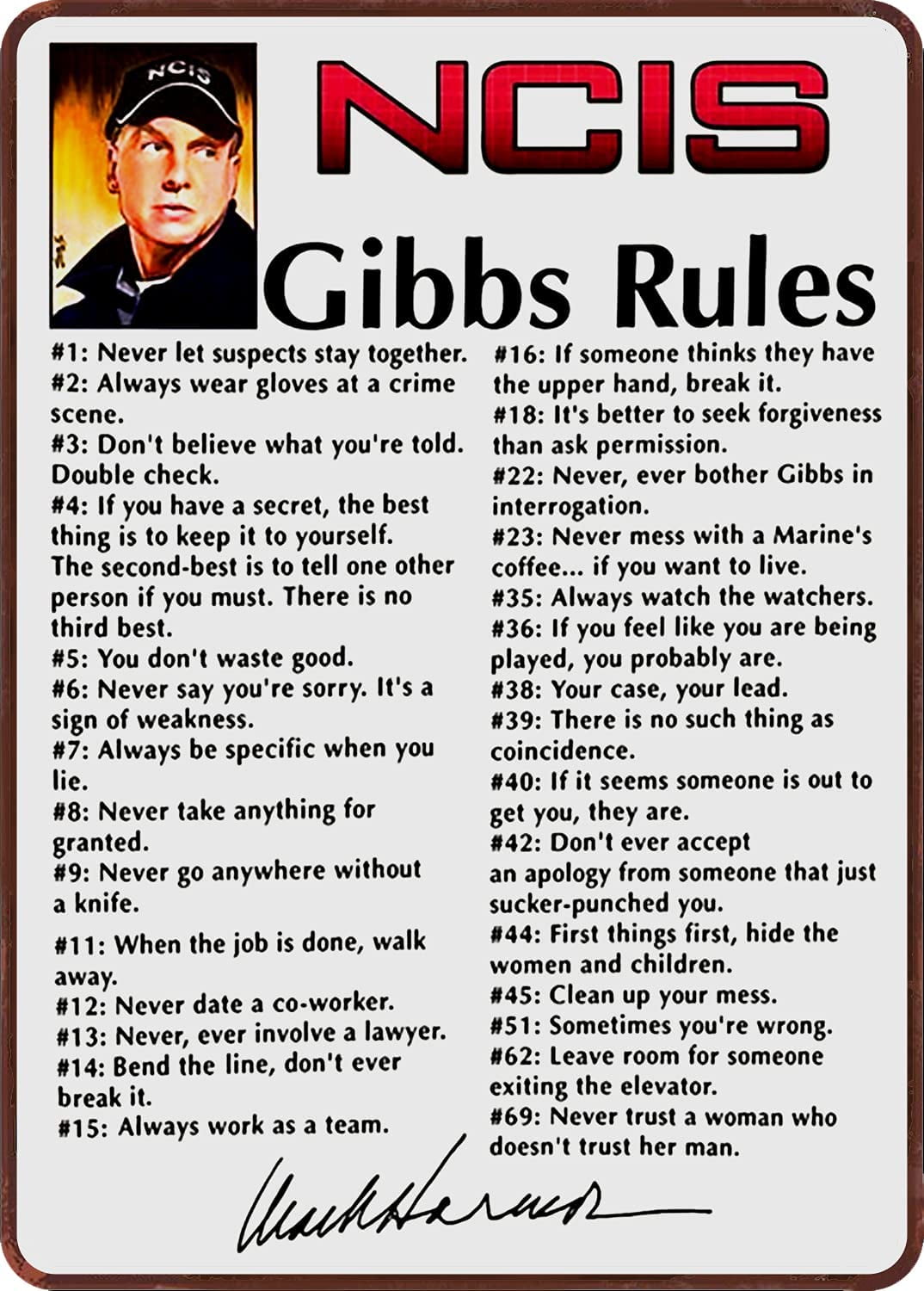
The Gibbs Rules List Explained for Investigators: A Complete Breakdown
The Gibbs Rules list is a set of personal and operational guidelines popularized by the fictional Naval Criminal Investigative Service (NCIS) Special Agent Leroy Jethro Gibbs. For real-world investigators, analysts, and law enforcement...
The Gibbs Rules list is a set of personal and operational guidelines popularized by the fictional Naval Criminal Investigative Service (NCIS) Special Agent Leroy Jethro Gibbs. For real-world investigators, analysts, and law enforcement personnel, these rules serve as informal mental models and tactical heuristics—bridging sharp street smarts with operational security, evidence handling, and team dynamics.
Contents
The Origins and Investigative Value of Gibbs’ Rules
Originally created by television writers for the long-running CBS series NCIS, the rules attributed to Special Agent Leroy Jethro Gibbs (played by Mark Harmon) resonated far beyond military drama fandom. Law enforcement officers, private investigators, intelligence analysts, and corporate fraud examiners frequently download and study summarized PDF lists of these rules. While written as fictional character traits, many of the maxims mirror actual principles taught in police academies, federal law enforcement training centers, and tactical operations briefings.
In investigative work, a heuristic is a mental shortcut or rule of thumb that helps an operator make rapid decisions under uncertain, high-stress conditions. Gibbs’ rules function precisely as cognitive heuristics. They emphasize hyper-vigilance, strict operational security (OpSec), skepticism during witness interviews, and team accountability.
However, professional investigators must draw a strict distinction between fictional guidelines and statutory requirements. Fictional rules prioritize dramatic tension and immediate results, whereas official investigations are bound by constitutional limits, statutory authority, written Agency Standard Operating Procedures (SOPs), and strict legal rules of evidence.
Legal & Professional Limitation Disclaimer: This analysis is for educational and operational reference purposes. Fictional investigative rules do not replace statutory law, constitutional mandates (such as Fourth and Fifth Amendment protections in the United States), agency SOPs, or formal legal advice from qualified prosecutorial or legal counsel.
Key Categories of Gibbs’ Rules Explained for Investigators
The complete list of Gibbs’ rules spans over 60 maxims revealed across multiple seasons. For professional investigators, these rules are best analyzed by grouping them into core operational categories.
1. Operational Security and Evidence Handling
Operational security (OpSec) and evidence preservation are the bedrock of any successful criminal or civil investigation. Compromised evidence or leaked information can ruin a prosecution before it reaches a courtroom.
- Rule 1 (Variant B): Never let suspects stay together.
- Investigative Application: In real-world police work, separating co-suspects immediately upon detention prevents collusion, alibi synchronization, and intimidation. It allows investigators to spot discrepancies across independent interrogation streams using techniques such as the PEACE model or strategic use of evidence (SUE).
- Rule 2: Always wear gloves at a crime scene.
- Investigative Application: This is fundamental forensic hygiene. Cross-contamination destroys latent fingerprints, touch DNA, and trace evidence. Wearing protective gear safeguards both the integrity of the crime scene and the health of the investigator against biohazards.
- Rule 3: Never believe what you are told. Double-check.
- Investigative Application: Skepticism is mandatory. Statements from victims, witnesses, and suspects are subject to bias, misremembering, or deliberate deception. Investigators rely on independent verification—corroborating verbal claims with physical evidence, digital forensics, surveillance footage, and financial records.
- Rule 8: Never take anything for granted.
- Investigative Application: Assumptions lead to confirmation bias and tunnel vision. Investigators who assume a scene is secure, or that an apparent suicide lacks foul play, risk missing critical evidence. Every hypothesis must be rigorously tested against verifiable facts.
- Rule 9: Never go anywhere without a knife.
- Investigative Application: In field operations, carrying basic utility tools is a core tactical readiness principle. Beyond personal defense, multi-tools and pocket knives serve practical field functions, such as cutting evidence tape, freeing entanglements, or securing physical evidence in emergency situations.
2. Interrogation Strategy and Tactical Mindset
Interrogations and subject interviews require psychological discipline, emotional control, and acute situational awareness.
- Rule 4: The best way to keep a secret? Keep it to yourself. Second best? Tell one other person—if you must. There is no third best.
- Investigative Application: Need-to-know access controls are essential during sensitive investigations, public corruption probes, and undercover operations. Loose talk compromises informants, alerts subjects, and leaks critical case details to the media.
- Rule 7: Always be specific when you lie.
- Investigative Application: While law enforcement officers in many jurisdictions are legally permitted to use deception during interrogations (subject to local legal limitations), detailed deception is far more believable than vague statements. However, modern investigative standards increasingly favor objective interviewing techniques over deceptive tactics to avoid false confessions.
- Rule 16: If someone thinks they have the upper hand, break it.
- Investigative Application: Tactical control during an interview or field encounter relies on managing authority. When a suspect attempts to control the flow of an interrogation, investigators use strategic reveals of evidence or shift questioning lines to regain psychological leverage.
- Rule 36: If it feels like you're being played, you probably are.
- Investigative Application: Intuition in veteran investigators is usually unconscious pattern recognition. If a witness or informant appears overly cooperative, or if evidence appears suspiciously convenient, investigators must audit the case for counter-intelligence or staging.
- Rule 39: There is no such thing as a coincidence.
- Investigative Application: Known in analytical circles as the principle of non-accidental correlation, this rule pushes investigators to search for hidden links between seemingly unrelated suspects, locations, assets, or events.
3. Team Dynamics, Case Management, and Leadership
Investigative units operate under high stress. Clear boundaries and mutual support prevent burn-out and operational failure.
- Rule 1 (Variant A): Never screw over your partner.
- Investigative Application: Tactical safety depends entirely on mutual trust. Field operators must know their partner has their back during high-risk entries, surveillance operations, and court testimonies.
- Rule 5: You don't waste good.
- Investigative Application: Resource management is critical in investigative agencies. Skilled forensic analysts, reliable confidential informants, and high-quality surveillance assets must be protected, valued, and utilized efficiently.
- Rule 15: Always work as a team.
- Investigative Application: Complex cases cannot be solved by single "lone wolf" operators. Modern investigations require seamless coordination among primary investigators, forensic technicians, digital analysts, prosecutors, and intelligence officers.
- Rule 38: Your case, your lead.
- Investigative Application: Clear lines of authority prevent operational confusion. The lead investigator carries final responsibility for case direction, task assignment, search warrant preparation, and court presentation.
- Rule 51: Sometimes you're wrong.
- Investigative Application: Intellectual humility is a vital trait for investigators. When new forensic data or alibis contradict a primary theory of the crime, lead agents must be willing to abandon flawed hypotheses rather than forcing facts to fit a broken narrative.
Comparative Matrix: Fictional Gibbs Rules vs. Real-World Law Enforcement Standards
The following table compares key entries from popular Gibbs Rules PDF cheat sheets against established real-world law enforcement and investigative standards:
| Gibbs Rule # & Statement | Fictional / Tactical Mindset | Real-World Investigative SOP Equivalent | Primary Operational Purpose |
|---|---|---|---|
| Rule 1: Never let suspects stay together. | Prevent alibi coordination and story alignment. | Suspect Separation Protocol (Field Operations) | Preserves independent recall; prevents witness/suspect contamination and intimidation. |
| Rule 2: Always wear gloves at a crime scene. | Protect physical evidence from contamination. | Forensic Evidence Preservation Guidelines (NIST / ISO standards) | Avoids cross-contamination of biological DNA, touch evidence, and latent prints. |
| Rule 3: Never believe what you are told. Double-check. | Healthy skepticism of all witness statements. | Corroborative Evidence Verification Model | Ensures oral testimony is backed by physical, financial, or digital documentation. |
| Rule 8: Never take anything for granted. | Combat complacency and assumption. | Objective Case Audit & Bias Avoidance | Prevents confirmation bias, tunnel vision, and overlooked investigative leads. |
| Rule 13: Never involve lawyers. (Fictional exaggeration) | Avoid legal delays in television drama. | Prosecutorial Consultation & Legal Review (Opposite of rule) | Real-world requirement: Early prosecutor involvement ensures search warrant validity. |
| Rule 14: Bend the line, don't break it. | Push boundaries to achieve fast results. | Strict Constitutional Compliance (4th & 5th Amendments) | Warning: "Bending" legal lines in real life leads to suppressed evidence and civil liability. |
| Rule 18: It's better to seek forgiveness than permission. | Action-oriented field execution. | Command Structure & Warrant Authorization | Field entries generally require judicial warrants or verified exigent circumstances. |
| Rule 39: There is no such thing as a coincidence. | Look for hidden connections between events. | Link Analysis & Pattern Mapping | Identifies organized criminal networks, financial fraud webs, and repeated modus operandi. |
| Rule 51: Sometimes you're wrong. | Operational humility and self-correction. | Case Peer Review & Hypothesis Testing | Encourages re-evaluating cold cases or flawed leads when new evidence emerges. |
Why Investigators Use Gibbs Rules PDF Cheat Sheets as Heuristics
Investigative PDF reference sheets summarizing Gibbs' rules remain popular downloads among law enforcement cadets, private investigators, and intelligence professionals. While no federal agency adopts the list as official policy, it serves several functional purposes in training and professional development:
- Cognitive Load Reduction: In complex field scenarios, simple maxims help operators maintain core priorities—such as scene security, personal safety, and evidence preservation—without overthinking basic tasks.
- Promoting Healthy Skepticism: New investigators often suffer from over-reliance on early witness testimony. Maxims like Rule 3 ("Double-check") and Rule 8 ("Never take anything for granted") reinforce an analytical mindset that demands objective proof.
- Fostering Team Loyalty and Accountability: Operational stress can strain team dynamics. Rules emphasizing team loyalty (Rule 1, Rule 15, Rule 45) remind agents that field safety and case integrity depend on mutual trust and personal accountability.
- Stress Management under Fire: Short, memorable maxims act as psychological anchors during high-velocity incidents, keeping agents focused on systematically securing suspects, establishing perimeters, and preserving evidence.
Operational Limitations: Where Fictional Rules Conflict with Law and Agency SOPs
While Gibbs’ rules offer valuable tactical inspiration, applying fictional TV rules directly to real-world policing can lead to severe legal and professional failures. Investigators must understand where dramatic television writing conflicts with established law.
Statutory and Constitutional Protections
- Rule 13 ("Never involve lawyers") is entirely unviable in professional law enforcement. Early, close collaboration with Assistant District Attorneys or Assistant U.S. Attorneys is critical when drafting search warrants, establishing probable cause, and structuring grand jury subpoenas. Furthermore, ignoring a suspect's invocation of their right to counsel under the Fifth Amendment violates Miranda v. Arizona, rendering subsequent statements inadmissible in court.
- Rule 14 ("Bend the line, don't break it") and Rule 18 ("Better to seek forgiveness than ask permission") present serious legal liabilities. In real-world criminal procedure, "bending" constitutional search standards risks violating Fourth Amendment protections against unreasonable searches and seizures. Under the Fruit of the Poisonous Tree doctrine, evidence gathered through illegal searches or unauthorized entries is suppressed in court, potentially destroying an entire prosecution.
Documentation and Chain of Custody
Fictional dramas rarely showcase the hours of administrative documentation required in real criminal investigations. Every physical item collected under Rule 2 must be logged with an unassailable chain of custody, detailed property receipts, and precise environmental logs. Skipping documentation in favor of rapid field movement risks evidence exclusion at trial.
Frequently Asked Questions
What are the main Gibbs Rules used by real-world investigators?
Real-world investigators primarily reference rules focused on operational security, evidence protection, and analytical skepticism. These include Rule 1 (separating suspects), Rule 2 (wearing gloves at crime scenes), Rule 3 (verifying all statements), Rule 8 (avoiding assumptions), and Rule 39 (searching for non-accidental patterns).
Is there an official government PDF containing Gibbs’ Rules for law enforcement?
No. Gibbs’ Rules originate from the fictional television series NCIS. While law enforcement officers and training instructors frequently compile PDF reference guides and use them as informal educational tools, they are not part of any official federal agency manual or legal statute.
How do Gibbs' rules compare to official investigative procedures?
Gibbs' rules act as informal cognitive heuristics (mental rules of thumb). Official procedures, such as Federal Rules of Evidence, agency Standard Operating Procedures (SOPs), and constitutional case law, are mandatory legal standards that strictly govern evidence collection, search warrants, suspect interrogations, and court testimony.
Why is Rule 13 ("Never involve lawyers") dangerous for real investigators?
In real-world law enforcement, failing to involve prosecutors early can result in defective search warrants or procedural mistakes that ruin a case. Additionally, denying a suspect's constitutional right to legal representation during custodial interrogation violates Fifth Amendment rights and leads to the suppression of evidence.
What does Rule 39 ("There is no such thing as a coincidence") mean in link analysis?
In analytical and intelligence work, Rule 39 encourages investigators to look past superficial explanations. It prompts analysts to map relationships between phone logs, financial transactions, co-location data, and shared associates to reveal organized criminal activity or premeditated actions.
Can evidence obtained by following "Rule 18" (seeking forgiveness rather than permission) be used in court?
Generally, no. Warrantless searches conducted without established legal exceptions—such as clear exigent circumstances, hot pursuit, or valid consent—violate Fourth Amendment protections. Evidence seized during unauthorized searches is typically suppressed under the exclusionary rule.
Practical Next Steps for Investigators and Analysts
To effectively incorporate the useful tactical mindsets of the Gibbs Rules while maintaining strict adherence to legal standards, operational personnel should take the following steps:
- Audit Case Files for Assumptions: Periodically review active cases using Rule 3 and Rule 8. Cross-check every key assumption against hard physical, digital, or documentary evidence to eliminate confirmation bias.
- Standardize Field OpSec and Scene Hygiene: Ensure all field team members consistently apply Rule 2 (wearing protective gear and preserving evidence integrity) and Rule 4 (restricting sensitive case data to a strict need-to-know basis).
- Cross-Reference Heuristics with Agency SOPs: Use fan or training PDF lists as informal discussion prompts during team debriefs, but always benchmark tactical actions against your jurisdiction's legal guidelines, Fourth Amendment constraints, and agency policy manuals.
- Establish Early Legal Consultation: Reject the fictional premise of avoiding legal counsel. Build strong communication channels with agency legal advisors and local prosecutors prior to executing complex operations or search warrants.
Image Gallery