The 2018 Tesla Model 3 Performance Horsepower Story: Specs, Dyno Numbers, and Upgrades
When Tesla launched the Model 3 Performance in mid-2018, it transformed the sport sedan market by offering supercar-level acceleration in a mid-segment electric vehicle. However, Tesla deliberately omitted an official SAE horsepower ra...
When Tesla launched the Model 3 Performance in mid-2018, it transformed the sport sedan market by offering supercar-level acceleration in a mid-segment electric vehicle. However, Tesla deliberately omitted an official SAE horsepower rating from its marketing materials, sparking widespread technical debates, independent chassis dynamometer runs, software reverse-engineering, and unexpected over-the-air performance upgrades.
Contents
- 2018 Tesla Model 3 Performance Drivetrain Stack
- Front Motor: AC Induction (~147 hp / 110 kW Peak)
- Rear Motor: 3D1 PM-SRM (~335 hp / 250 kW Peak)
- High-Current Silicon Carbide (SiC) Inverter
- Battery Pack Voltage (350V–400V DC Stack)
- Peak Measured Output (Wheel Horsepower): ~450 whp (Launch) to ~480 whp (Post-OTA)
Why Tesla's Horsepower Figures Were Shrouded in Mystery
For decades, traditional automakers communicated vehicle performance through standardized SAE net horsepower ratings measured on engine dynamometers. Electric vehicles, however, do not generate output along a conventional internal combustion torque curve. Power delivery in an EV is restricted by whichever component reaches its thermal, voltage, or current threshold first: the battery chemistry, the power electronics (inverters), or the electric motors themselves.
When the 2018 Tesla Model 3 Performance (often designated by enthusiasts as the P3D) hit the market, Tesla advertised zero-to-sixty miles per hour (mph) acceleration times (initially 3.5 seconds) and top speed (155 mph), but refrained from listing total system horsepower. This omission created significant confusion among enthusiasts and automotive journalists.
The primary reason for Tesla’s reticence was the dynamic nature of electric vehicle output. Unlike a gasoline engine with fixed mechanical displacement, an EV's output varies heavily based on state of charge (SoC), cell temperature, line voltage, and inverter current limits. Combining the peak rated output of the front and rear motors individually yields an inaccurate theoretical figure because the battery pack cannot supply maximum peak current to both motors across their entire operating RPM range simultaneously.
Dissecting the Drivetrain: 3D1 Motors and Inverter Silicon Carbide Binning
To understand how the 2018 Model 3 Performance achieved its output, one must analyze its underlying hardware architecture. The vehicle features an all-wheel-drive dual-motor setup incorporating two distinct motor technologies:
- Front Motor: An AC induction motor (internally designated within the 3D2/3D4 motor families) capable of producing roughly 147 horsepower (110 kW). Induction motors are inherently free-wheeling when unpowered, reducing drag losses during light cruising.
- Rear Motor: A Permanent Magnet Switched Reluctance Motor (PM-SRM, designated as the 3D1 motor variant). This motor delivered superior energy efficiency at low-to-mid loads while handling significant current density at wide-open throttle, contributing up to ~335 horsepower (250 kW) individually.
| Drivetrain Component | Front Motor (AC Induction) | Rear Motor (PM-SRM 3D1) |
|---|---|---|
| Magnet Type | None (Induction) | Neodymium-Iron-Boron Magnets |
| Primary Strengths | Zero drag when unpowered | High torque density & energy efficiency |
| Peak Electrical Power | ~110 kW (~147 hp) | ~250 kW (~335 hp) |
| Main Inverter Tech | Standard Si MOSFETs | Binned High-Current SiC |
The defining revelation of the 2018 Performance model hardware centered on the process of inverter binning. Tesla engineered the rear inverter using Silicon Carbide (SiC) MOSFET power semiconductors supplied by STMicroelectronics. During early production, Tesla sorted (binned) these SiC power modules based on electrical resistance and heat dissipation capabilities.
The highest-grade inverters—capable of handling up to 800 continuous amperes of electrical current without thermal breakdown—were paired exclusively with the 3D1 rear motor for the Performance trim. Standard Long Range Dual Motor variants received lower-rated inverters restricted by firmware to roughly 600 amperes. This mechanical and electrical distinction enabled the Performance trim to dump massive current into the rear motor instantly, producing violent off-the-line torque.
Factory Claims vs. Dyno Reality: Uncovering the Real Horsepower Numbers
Because Tesla declined to provide an official SAE net combined rating, independent performance shops and engineering outlets took the 2018 Model 3 Performance to chassis dynamometers to measure wheel horsepower (whp) and wheel torque (wtq).
Initial Launch Dynamometer Testing
Early dyno tests conducted in late 2018 produced baseline readings that surprised automotive engineers. On standard Dynojet chassis dynamometers, a stock 2018 Model 3 Performance at a 90% or higher state of charge consistently registered:
- Wheel Horsepower: ~450 whp to 460 whp at peak output (occurring between 45 mph and 65 mph).
- Wheel Torque: ~490 lb-ft to 510 lb-ft of instant torque.
Accounting for traditional dual-motor EV driveline parasitic losses (typically estimated between 8% and 12% due to single-speed reduction gearsets and differential friction), the 2018 Model 3 Performance produced an equivalent engine crankshaft output of approximately 470 to 490 horsepower.
Peak Horsepower vs. Battery State of Charge (SoC):
- 100% Battery SoC: ~475–480 whp (Post-OTA)
- 80% Battery SoC: ~430–440 whp
- 60% Battery SoC: ~390–400 whp
- 40% Battery SoC: ~340–350 whp
State of Charge (SoC) Dependency
Dynamometer testing confirmed that EV horsepower is directly tied to pack voltage. A high-voltage lithium-ion pack registers roughly 400 volts at 100% charge, dropping toward 350 volts or lower as the battery depletes.
Because power output (Watts) equals Voltage (V) multiplied by Current (Amps), a lower battery voltage results in lower peak power output even if the inverter maintains maximum amperage. At a 50% state of charge, peak wheel horsepower on the 2018 Model 3 Performance dropped by roughly 10% to 15%, reducing peak output to around 390–400 whp.
The Over-the-Air (OTA) Horsepower Upgrades
One of the most remarkable chapters in the 2018 Model 3 Performance story was Tesla's deployment of firmware updates that literally increased the vehicle's horsepower post-purchase without any physical hardware modifications.
Timeline of 2018 Model 3 Performance Power Evolution:
- July 2018: Initial Launch: 0-60 mph in 3.5s (~450 whp measured baseline)
- March 2019: Firmware 2019.8.2: 5% Peak Power Increase (~460-465 whp measured)
- October 2019: Firmware 2019.36.2.1: 5% Peak Power Increase & 0-60 mph down to 3.2s
- Late 2019: Track Mode V2 introduced: Custom thermal & power splitting controls
Firmware Version 2019.8.2 (Spring 2019)
In March 2019, Tesla released software update 2019.8.2. Through thermal management optimizations in the stator windings and revised drive inverter gate firing algorithms, Tesla unlocked a 5% peak power increase across the Model 3 lineup. Dyno runs confirmed an immediate jump of roughly 15 to 20 wheel horsepower, pushing peak numbers close to 465 whp.
Firmware Version 2019.36.2.1 (Autumn 2019)
In October 2019, Tesla issued another over-the-air update (2019.36.2.1). This release unlocked an additional 5% peak power increase and optimized high-speed motor timing (field weakening control).
With both updates applied, a 2018 Model 3 Performance operating at 100% state of charge on a fully warm battery pack generated between 475 whp and 485 whp. This brought calculated crank-equivalent horsepower to over 500 hp, dropping the vehicle's official 0–60 mph sprint time down to 3.2 seconds (with 1-foot rollout).
Technical Comparison of 2018 Model 3 Variants
The table below outlines how the 2018 Model 3 Performance compares to contemporary trims, highlighting hardware, power outputs, and measured performance metrics.
| Feature / Metric | Model 3 Mid Range / RWD | Model 3 Long Range Dual Motor (AWD) | Model 3 Performance (Launch Firmware) | Model 3 Performance (Post-OTA Firmware) |
|---|---|---|---|---|
| Drivetrain Layout | Single Rear Motor | Dual Motor AWD | Dual Motor AWD | Dual Motor AWD |
| Rear Motor Code | 3D3 or 3D1 | 3D3 (Standard) | 3D1 (High Output) | 3D1 (High Output) |
| Inverter Tech | Standard SiC | Standard 600A SiC | Binned 800A SiC | Binned 800A SiC |
| Est. Crank HP Equivalent | ~283 hp | ~346 hp | ~470 hp | ~500+ hp |
| Peak Wheel HP (Dyno) | ~245 whp | ~310 whp | ~450 whp | ~480 whp |
| Peak Wheel Torque | ~307 lb-ft | ~375 lb-ft | ~490 lb-ft | ~510 lb-ft |
| 0-60 MPH Acceleration | 5.6 seconds | 4.4 seconds | 3.5 seconds | 3.2 seconds |
| Top Speed | 125 mph | 145 mph | 155 mph | 162 mph |
| Track Mode Access | No | No | Yes (v1 / v2) | Yes (v1 / v2) |
"Stealth" Performance vs. PUP: The Factory Variant Split
During the late 2018 production run, an unusual variant emerged known in the owner community as the "Stealth Performance" (option code P3D-).
When ordering the Performance model in 2018, buyers could choose to include or omit the $5,000 Performance Upgrade Package (PUP).
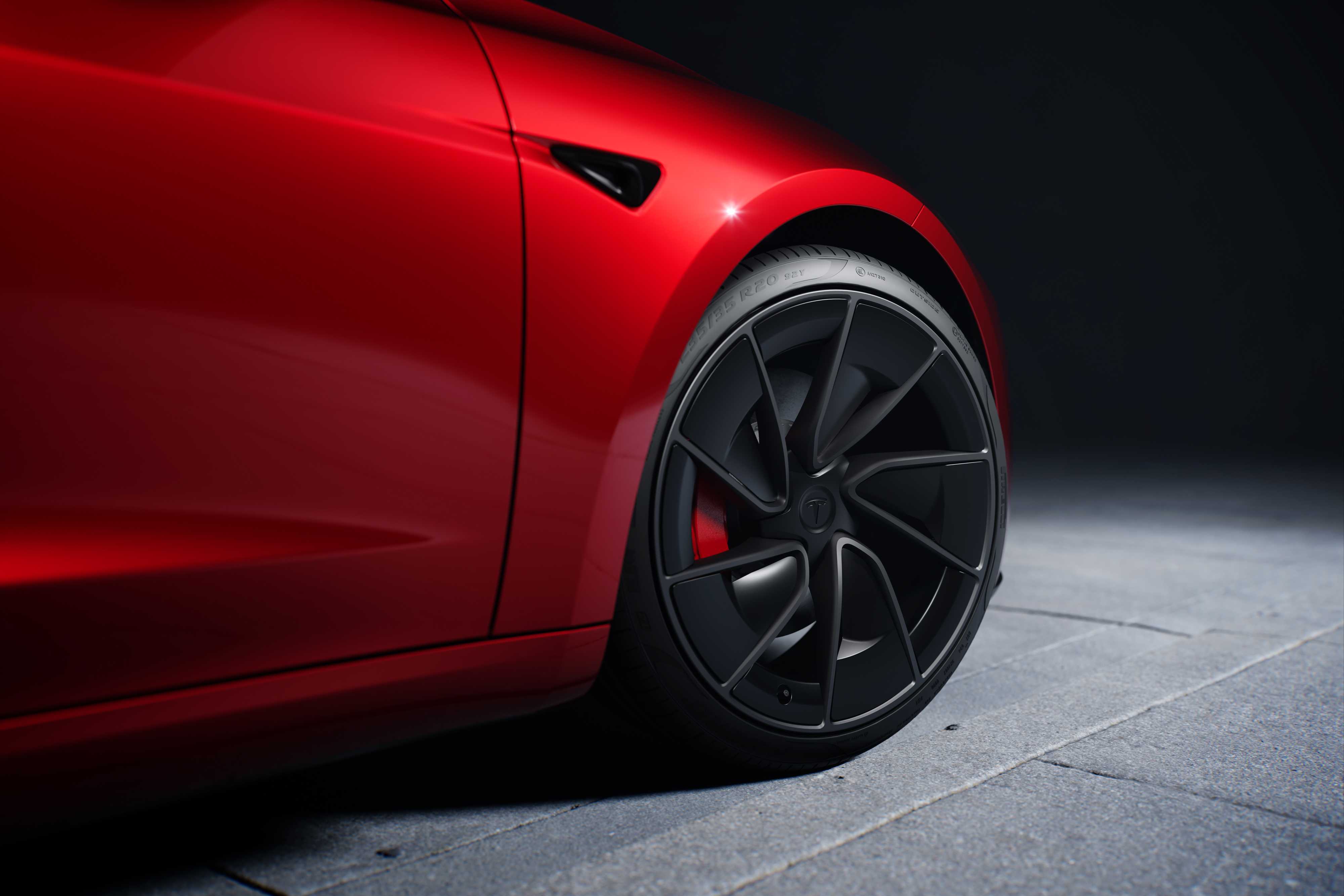
- Full Performance (P3D+): Included 20-inch Sport wheels, Michelin Pilot Sport 4S tires, upgraded Brembo four-piston red brake calipers, larger two-piece iron brake rotors, lowered suspension springs (-10mm), a carbon fiber rear spoiler, and aluminum alloy pedals.
- Stealth Performance (P3D-): Retained the exact same uncorked 3D1 rear motor, 800A binned inverter, track mode firmware, and sub-3.5-second acceleration capability, but was visually identical to a standard Long Range AWD model. It featured 18-inch Aero or 19-inch Sport wheels, standard brakes, standard ride height, and no carbon spoiler.
2018 Model 3 Performance Split:
- P3D+ (Full Performance)
- 800A Binned SiC Inverter
- 3D1 High-Output Rear Motor
- Track Mode Firmware
- 20" Wheels & PS4S Tires
- Upgraded Brembo Brakes
- Lowered Suspension (-10mm)
- Carbon Fiber Spoiler
- P3D- (Stealth Performance)
- 800A Binned SiC Inverter
- 3D1 High-Output Rear Motor
- Track Mode Firmware
- 18" Aero / 19" Sport Wheels
- Standard OEM Brakes
- Standard Ride Height
- Unmarked Exterior
The Stealth variant became highly sought-after on the pre-owned market due to its longer range potential (thanks to lighter 18-inch wheels), lower replacement tire costs, and sleeper aesthetic.
Evaluating a Used 2018 Model 3 Performance
Buying or evaluating a 2018 Model 3 Performance requires verifying specific hardware parameters to ensure the vehicle retains its original performance capabilities.
1. Motor Identification Verification
Inspect the stamped metal plate visible on the bottom casing of the rear drive unit (accessible under the rear subframe). A genuine 2018 Performance model should display the motor code starting with 1120980 or explicitly stamped as a 3D1 motor. Non-performance dual motor models typically carry the 3D3 rear motor code.
2. Software Screen Confirmation
Navigate to Controls > Software on the central touchscreen.
- A genuine unit displays Model 3 Performance with a red underline beneath the text.
- Confirm the presence of Track Mode in the driving menu. Track Mode allows custom front/rear torque bias adjustments, regenerative braking severity control, and forced cooling system priming.
3. Battery Degradation and Power Impact
Because EV power delivery relies directly on battery pack internal resistance, check the vehicle's usable capacity. The 2018 Model 3 Performance shipped with a 75 kWh nominal gross battery pack (Panasonic 2170 NCA cells).
Over extended thermal cycling and mileage, nominal full pack capacity drops. Severe battery degradation increases pack internal resistance ($R_i$), leading to higher voltage drop under wide-open throttle and reducing peak horsepower delivery even at 100% state of charge.
PRE-OWNED CHECKLIST: 2018 Model 3 Performance
- Verify "Model 3 Performance" with red underline in Software menu
- Confirm presence of Track Mode toggle in driving settings
- Inspect physical rear motor casing for "3D1" designation code
- Check full-charge range readout to gauge battery pack degradation
- Inspect 20-inch wheels for inner lip hairline cracks (P3D+ models)
Frequently Asked Questions
What is the true horsepower rating of a 2018 Tesla Model 3 Performance?
Tesla did not publish an official SAE net horsepower figure. However, independent chassis dynamometer testing confirmed that at launch, the vehicle produced approximately 450 wheel horsepower. Following two free over-the-air software updates in 2019, peak output increased to between 475 whp and 485 whp, which translates to a crank-equivalent rating of over 500 horsepower.
Did software updates really increase the vehicle's horsepower post-sale?
Yes. Firmware updates 2019.8.2 and 2019.36.2.1 each delivered roughly 5% increases in peak drive power. These increases were verified by third-party dynamometer logs, showing higher peak power delivery primarily between 30 mph and 70 mph.
Is the rear motor on a 2018 Model 3 Performance different from a standard Dual Motor model?
Yes. The 2018 Model 3 Performance utilizes the 3D1 rear Permanent Magnet Switched Reluctance Motor paired with a factory-binned, 800-ampere Silicon Carbide (SiC) drive inverter. Standard Long Range Dual Motor variants were built with 3D3 rear motors and non-binned inverters software-capped at lower amperage.
Can a standard 2018 Long Range Dual Motor model be unlocked to Performance power?
Not entirely. While Tesla later offered a $2,000 paid software upgrade called "Acceleration Boost" for Long Range Dual Motor vehicles (which dropped 0-60 mph times to 3.7 seconds), it does not turn an AWD model into a full Performance model. Standard AWD vehicles lack the 800A binned inverter hardware, the dedicated Track Mode software suite, and the higher top-speed firmware mapping.
Why does acceleration feel slower when the battery is under 50% state of charge?
Electric vehicle power output depends on battery pack voltage. As the lithium-ion cells discharge, open-circuit voltage decreases. Because power ($P$) is the product of voltage ($V$) and current ($I$), a drop in voltage reduces the total wattage delivered to the drive inverters, resulting in a measurable drop in wheel horsepower at lower states of charge.
Practical Takeaways and Recommendations
The 2018 Tesla Model 3 Performance marked a pivotal moment in EV history, demonstrating that over-the-air software engineering combined with high-grade silicon carbide power electronics could deliver supercar performance in an everyday sedan.
- For Used Buyers: Prioritize verifying the hardware pedigree (3D1 rear motor stamp and red-line Software display) rather than relying solely on exterior badging. Badges can be added retroactively by previous owners.
- For Track Enthusiasts: Ensure the vehicle has updated to the latest software release to take advantage of Track Mode V2, which allows precise adjustments to stability control intervention, thermals, and front/rear power distribution.
- For Daily Performance Maintenance: To achieve maximum horsepower during dynamic driving or drag strip runs, pre-condition the battery pack using the internal navigation system (set to a Supercharger destination or launch mode) and ensure the battery state of charge is maintained above 80%.
Image Gallery