Engineering the World’s Highest Span: A Technical Breakdown of Huajiang Canyon Bridge Construction
The Huajiang Canyon Bridge construction project represents a monumental achievement in structural engineering, spanning the deep gorge of the Beipan River in Guizhou Province, China. Rising 625 meters above the canyon floor with a main...
The Huajiang Canyon Bridge construction project represents a monumental achievement in structural engineering, spanning the deep gorge of the Beipan River in Guizhou Province, China. Rising 625 meters above the canyon floor with a main span of 1,420 meters, this steel truss suspension bridge sets a record as the highest bridge in the world, overcoming extreme karst topography, severe wind shear, and complex high-altitude hoisting logistics.
Contents
Project Overview and Technical Specifications
Located along the Liuzhi-Anlong Expressway (Liu-An Expressway) in southwestern Guizhou, the Huajiang Canyon Bridge was designed to cross the formidable "Earth's Crack"—the Huajiang Canyon. The primary goal of the project is to bypass treacherous mountain detours, cutting travel time across the canyon from over an hour to mere minutes while improving regional freight efficiency.
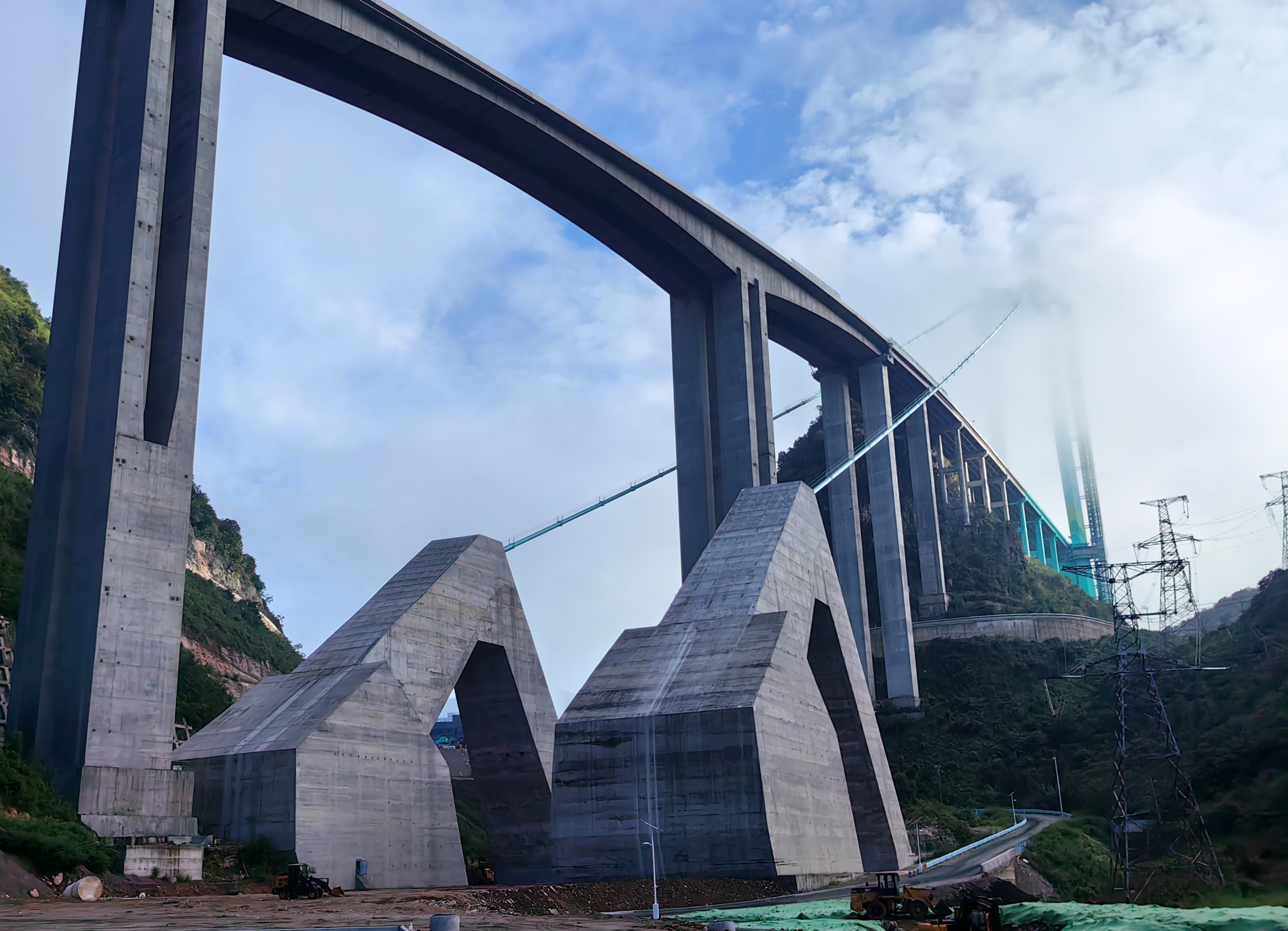
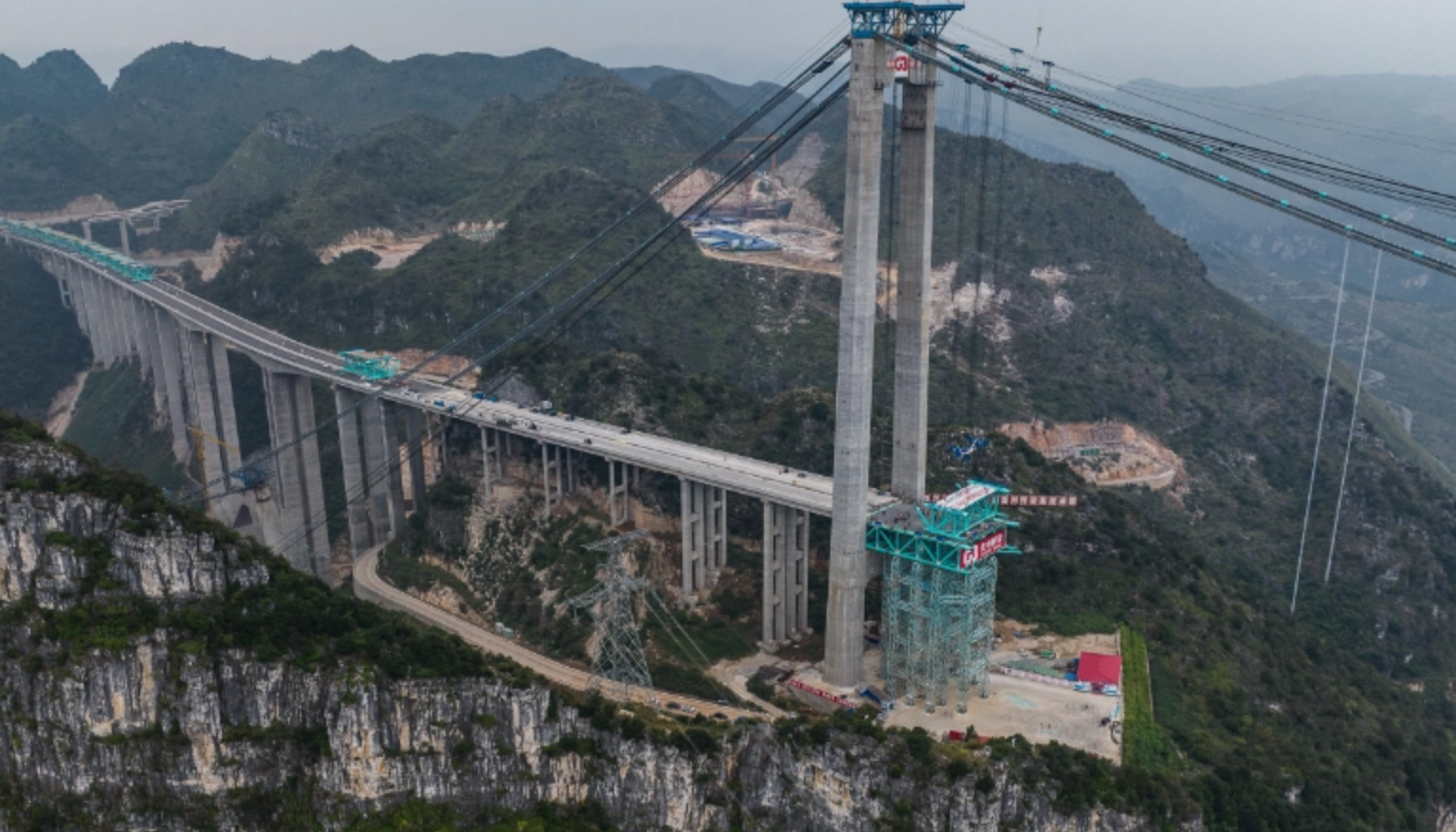
The bridge relies on a single-span suspension system supported by two massive reinforced concrete towers anchored into steep limestone cliffs. Achieving structural stability at a deck height of 625 meters required unprecedented engineering solutions in foundation anchoring, material pumping, wind resistance, and erection methods.
| Specification Parameter | Value / Technical Metric |
|---|---|
| Bridge Type | Steel truss suspension bridge |
| Clear Height Above River Deck | 625 meters (2,051 feet) |
| Main Span Length | 1,420 meters (4,659 feet) |
| Total Bridge Length | 2,890 meters (9,481 feet) |
| East Tower Height | ~262 meters |
| West Tower Height | ~204 meters |
| Structural Superstructure | Stiffened steel truss girder |
| Expressway Route | Liuzhi-Anlong Highway, Guizhou Province |
| Dominant Geological Setting | Highly weathered karst limestone canyon |
Karst Foundation Engineering and Geological Stabilization
Constructing a record-breaking suspension bridge in Guizhou’s classic karst topography presented severe geotechnical risks. Karst landscapes are characterized by soluble rock, subterranean caves, underground rivers, and unpredictable sinkholes. Supporting towers exceeding 200 meters in height—and carrying thousands of metric tons of dead and live loads—demanded extensive sub-surface remediation.
Underground Cave Remediation and Grouting
Before pouring foundation footings, engineering teams conducted high-resolution 3D seismic tomography and deep borehole radar imaging to map subterranean voids beneath both abutments. Where caverns and fractured limestone zones were detected, workers executed multi-stage pressure grouting.
- High-Pressure Cement Grouting: Cementitious slurry was injected into rock fractures at pressures exceeding 5 MPa to seal water passages and consolidate weak rock layers.
- Micro-Piling Reinforcement: Intersecting micropiles were driven into heavily weathered zones around the main anchorage foundations to prevent shear failure along natural slope bedding planes.
Rock Anchor Foundation Design
The main suspension cables generate massive tensile pull, requiring immovably secure anchorages. The project utilized gravity-and-tunnel composite anchorage systems embedded directly into the solid rock mass of the canyon walls.
Deep excavation for the anchorage pits required controlled micro-blasting to prevent fracturing the adjacent rock faces. Steel tendon clusters were inserted tens of meters into intact limestone, post-tensioned, and encased in high-strength concrete to form a monolithic mass capable of withstanding tens of thousands of metric tons of continuous pull.
Tower Construction and Ultra-High Concrete Pumping
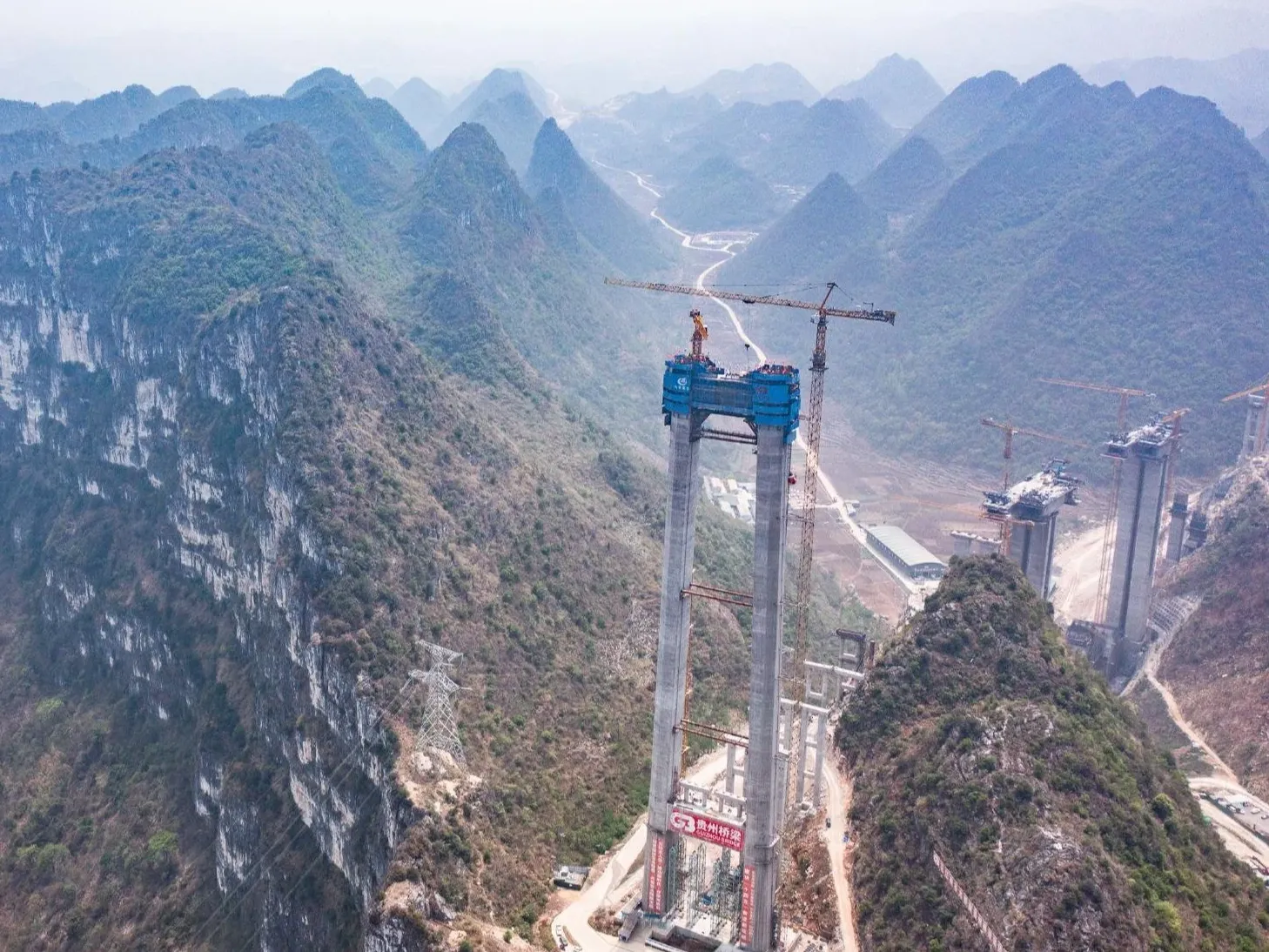
The two main towers of the Huajiang Canyon Bridge serve as the primary vertical load-bearing elements, transferring the weight of the main cables and deck structure into the underlying canyon cliffs.
- Main Cable
- East Tower (~262m)
- Base: Karst Cliff
- Deck (625m Above River)
- West Tower (~204m)
- Base: Karst Cliff
- East Tower (~262m)
Intelligent Slip-Forming and Hydraulic Climbing
To build the main towers efficiently up steep cliff faces, contractors utilized hydraulic self-climbing formwork systems. These automated climbing platforms incorporated integrated weather enclosures, allowing work to proceed safely during high winds and torrential mountain rains. Sensor arrays embedded within the formwork continuously monitored alignment, ensuring verticality tolerances were maintained within millimeters across the entire tower height.
Ultra-High-Pressure Concrete Pumping
Pumping concrete up to heights exceeding 200 meters on top of a 400-meter cliff presents severe rheological challenges. The concrete mixture must maintain low viscosity during pumping to prevent pipe blockages while exhibiting high early strength upon placement.
- Custom Concrete Mix Design: The project utilized an Ultra-High-Performance Concrete (UHPC) formulation incorporating polycarboxylate superplasticizers, silica fume, and fly ash. This mix reduced friction inside the delivery pipes while achieving compressive strengths exceeding C60/C80 grades.
- Pumping Equipment: Heavy-duty, high-pressure concrete pumps equipped with reinforced steel piping were deployed, capable of maintaining continuous discharge pressure at extreme elevations.
Main Cable Spinning and Aerial Catwalk Deployment
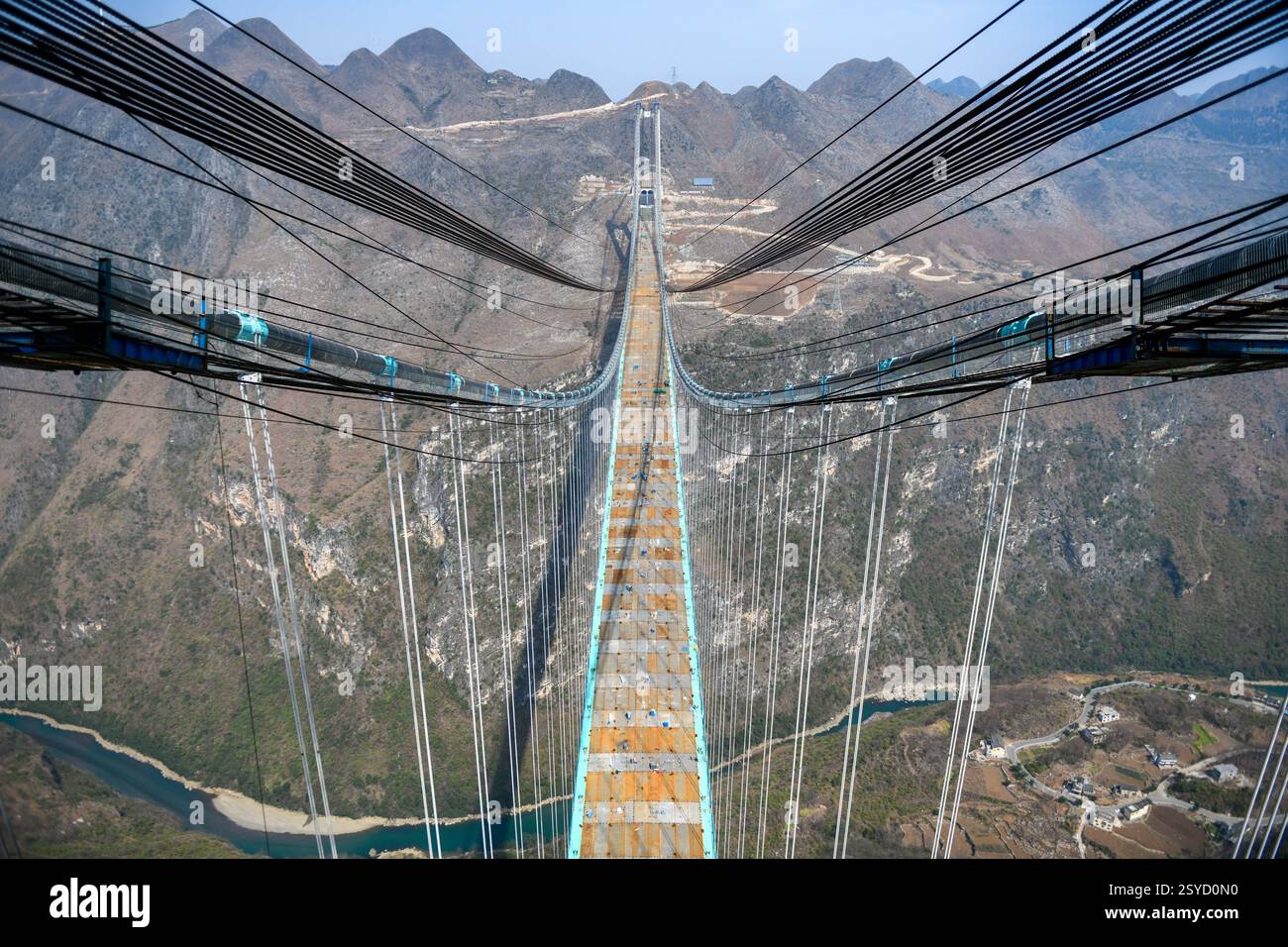
The main suspension cables carry the load of the entire suspended span. Spinning these cables across a 1,420-meter open canyon at an elevation over 600 meters above the valley floor was one of the most critical phases of the Huajiang Canyon Bridge construction.
Pilot Cable Crossing
Establishing the initial connection across the gorge was achieved using advanced unmanned aerial vehicle (UAV) technology. High-capacity drones flew pilot ropes composed of ultra-high-molecular-weight polyethylene across the 1.4-kilometer canyon gap. Once the pilot line was established, it was used to pull progressively thicker steel wire ropes across the canyon until the primary traction system was fully installed.
Catwalk Construction and Aerial Cable Assembly
With the traction system operational, workers erected a temporary aerial catwalk—a suspended mesh walkway following the profile of the main cables. The catwalk provided a stable platform for engineers to monitor cable spinning and clamp placement.
- Strand Haulage: Prefabricated parallel wire strands (PPWS) composed of high-tensile 1,860 MPa galvanized steel wires were hauled individually across the span using automated winch systems.
- Strand Compaction and Squeezing: Hydraulic squeezing machines compacted the individual strands into tight circular main cables.
- Wrapping and Corrosion Protection: The completed main cables were wrapped tightly with protective wire and coated with specialized anti-corrosion sealants to withstand the high humidity and atmospheric moisture of the Huajiang gorge.
Superstructure Assembly: Heavy-Duty Cable Crane Lifting
The main deck structure consists of stiffened steel truss girders designed to provide structural stiffness while minimizing dead weight. Assembling these massive steel segments over a 600-meter-deep canyon required specialized hoisting technology.
High-Capacity Overhead Cable Crane System
Because traditional floating crane barges could not navigate the shallow, rapid-filled Beipan River at the canyon base, engineers constructed a massive, high-capacity overhead cable crane system anchored to the top of the main towers.
- Lifting Capacity: The custom cable crane system was rated to lift individual steel truss segments weighing up to several hundred metric tons from transport vehicles on the cliffside access roads.
- Precision Placement: Equipped with real-time GPS and laser-positioning feedback, the cable crane transported steel deck segments horizontally along the span and lowered them into place with millimeter accuracy.
- Pin and Weld Joinery: As each segment was hoisted to deck level, it was connected to adjacent segments using high-strength structural bolts and field welds, then suspended from the main cable via vertical wire rope hangers.
Aerodynamic Stabilization and Wind Control
Narrow mountain canyons act as natural wind tunnels, subjecting long-span suspension bridges to complex aerodynamic forces including vortex-induced vibration (VIV), flutter, and wind shear.
To guarantee aerodynamic stability both during construction and throughout the bridge's operational lifespan, extensive wind tunnel testing was conducted at sub-scale and full-scale Reynolds numbers.
- Open Steel Truss Configuration: Choosing a lattice steel truss rather than a closed box girder allows high-velocity crosswinds to pass through the deck structure, substantially reducing aerodynamic drag and lateral wind loading.
- Central Venting and Deflectors: Strategic placement of wind fairings, spoiler plates, and continuous central longitudinal gaps along the deck deck surface mitigates vortex shedding, preventing destructive flutter modes at wind speeds exceeding design thresholds.
Bridge-Tourism Integration and Regional Economic Impact
Unlike traditional highway infrastructure projects built purely for transit, the Huajiang Canyon Bridge was planned from its inception as a dual-purpose infrastructure and economic driver.
Integrated Structural Features
- Sightseeing Elevator and Glass Walkways: Structural accommodation was engineered into the main towers and deck truss to support high-speed glass elevators, an under-deck pedestrian glass walkway, and extreme sports platforms (such as bungee jumping facilities).
- Visitor Center and Observation Decks: The bridge abutments incorporate dedicated parking, visitor service centers, and panoramic viewing plazas integrated directly into the cliff-face access roads.
Logistical and Freight Benefits
Prior to the bridge's completion, local agricultural goods and industrial transport had to navigate winding, low-grade mountain roads through the Huajiang Canyon, taking over 60 to 90 minutes to cross. The completed bridge reduces transit time across the gorge to under two minutes. This reduction in travel time lowers transportation costs across southwestern Guizhou, integrating isolated rural counties into national logistics networks.
Frequently Asked Questions
What makes the Huajiang Canyon Bridge the world's highest bridge?
The Huajiang Canyon Bridge achieves a vertical deck height of 625 meters (2,051 feet) above the surface of the Beipan River below. This distance surpasses the previous height record held by the Beipanjiang Bridge Duge (which sits at 565 meters above its riverbed), making it the highest bridge deck relative to underlying terrain on Earth.
How do engineers ensure the bridge can withstand mountain wind shear?
The bridge utilizes an open steel truss design that allows wind to pass through the structure rather than building up massive lateral pressure. Furthermore, wind fairings, aerodynamic deflectors, and internal damping systems were tested extensively in wind tunnels to prevent flutter and vortex-induced vibrations under extreme atmospheric conditions.
Why was a suspension bridge chosen over a cable-stayed design?
With a main span requirement of 1,420 meters across a steep canyon, a cable-stayed design would have required impractically tall towers and extremely long stay cables. A suspension bridge allows the vast span to be supported efficiently by main cables anchored directly into solid bedrock on both canyon rims, minimizing the structural mass required over the gorge.
How were heavy steel truss segments lifted onto the deck at such extreme heights?
Engineers deployed a high-capacity overhead cable crane system stretched between the tops of the main towers. Transport vehicles brought pre-assembled steel truss sections to the canyon rim, where the cable crane picked them up, carried them horizontally across the canyon, and lowered them into position to be connected to the vertical suspension hangers.
How is the foundation protected against karst cave collapse?
Prior to laying the foundations, extensive 3D subsurface imaging mapped all subterranean voids. Caverns and fractured rock layers beneath the tower sites and anchorages were filled using high-pressure cement grouting, combined with deep rock-anchoring tendons driven tens of meters into intact limestone strata to form a unified, solid base.
Technical Recommendations for High-Altitude Suspension Engineering
The successful execution of the Huajiang Canyon Bridge offers essential methodologies for future mega-scale civil engineering projects in extreme terrain:
- Deploy Early Drone-Based Cable Routing: Utilizing high-payload UAVs for initial line pulling through deep mountain valleys eliminates manual wire-hauling hazards and reduces pilot line setup times from weeks to days.
- Standardize Smart Formwork Technologies: Automated hydraulic climbing formwork integrated with real-time tilt monitoring ensures structural verticality while isolating field crews from extreme high-altitude weather conditions.
- Integrate Aerodynamic Damping into Girder Geometry: For suspension spans exceeding 1,000 meters in high-wind mountain corridors, prioritize open truss profiles with integrated longitudinal air gaps over closed box girders to prevent dynamic wind instability.
- Utilize High-Pressure Smart Grouting for Karst Sites: Complete detailed 3D tomographic surveys before foundation excavation and implement multi-stage, pressure-monitored cementitious grouting to reinforce unpredictable limestone bedrocks.
Image Gallery