Taylor GS Mini-E Review: Comprehensive Performance, Tone, and Electronics Analysis
The Taylor GS Mini-E is a compact acoustic-electric guitar engineered to deliver full-scale tonal depth, volume, and professional playability within a reduced 23.5-inch scale length body. Featuring a solid tonewood top, an arched back...
The Taylor GS Mini-E is a compact acoustic-electric guitar engineered to deliver full-scale tonal depth, volume, and professional playability within a reduced 23.5-inch scale length body. Featuring a solid tonewood top, an arched back for enhanced projection, and Taylor’s proprietary ES-B pickup system with an onboard digital tuner, the GS Mini-E serves as a versatile instrument for travel, home practice, recording, and live performance.
Contents
Technical Specifications Overview
The Taylor GS Mini series occupies a unique space between traditional travel guitars and full-sized acoustics. Rather than scaling down every dimension uniformly, Taylor adapted the proportions of their Grand Symphony (GS) body shape to maximize air displacement within a smaller footprint.
The defining structural element of the GS Mini-E is its solid top paired with layered wood back and sides. While solid tops provide dynamic range and resonance that improve with age, the layered back and sides offer structural stability, making the instrument resistant to changes in temperature and humidity. The absence of internal back bracing, made possible by an engineered parabolic arched back, increases the internal cavity volume and projects acoustic energy forward.
| Feature / Specification | Standard GS Mini-E (Spruce / Rosewood) | GS Mini-E Mahogany | GS Mini-E Koa |
|---|---|---|---|
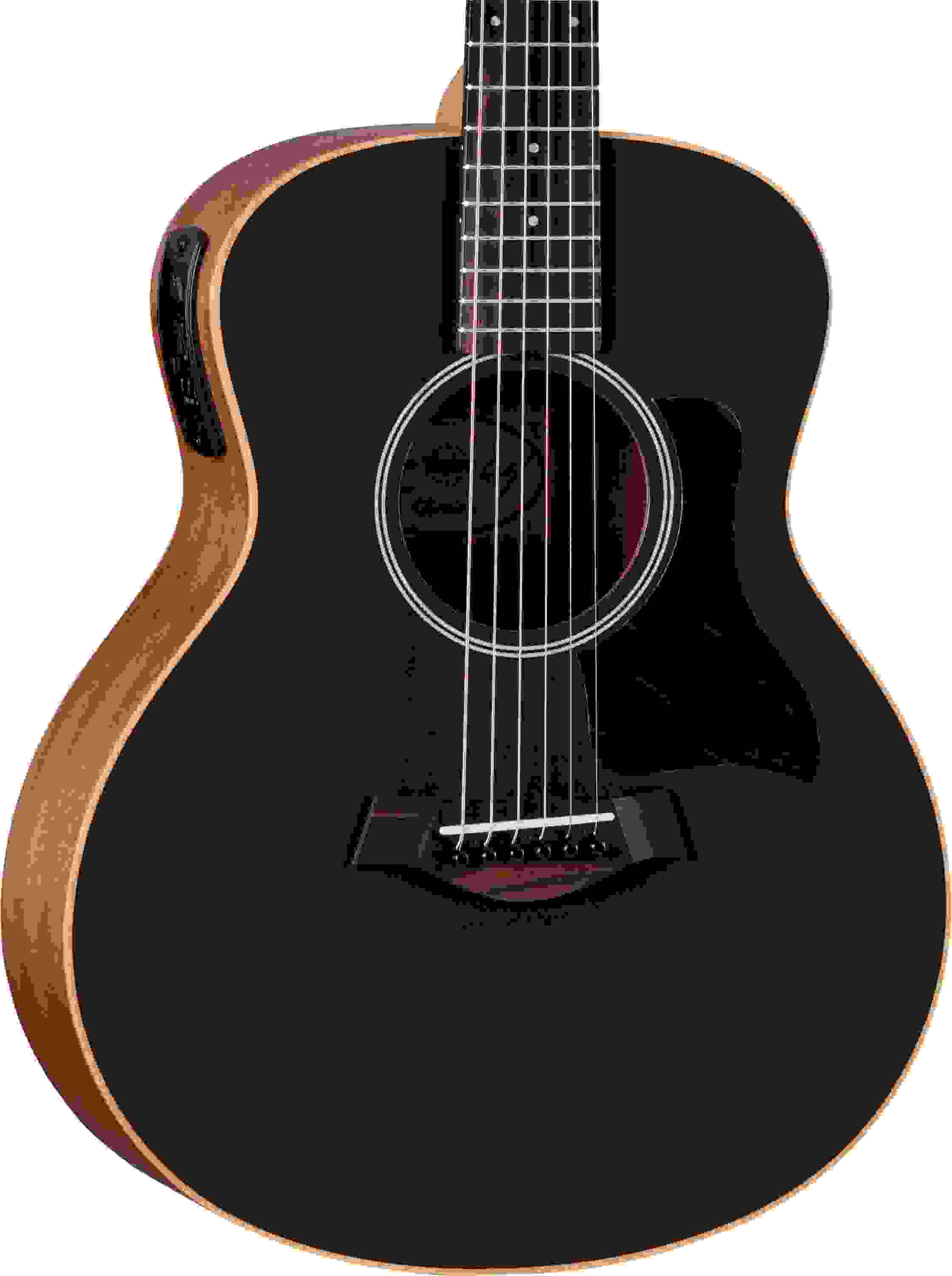
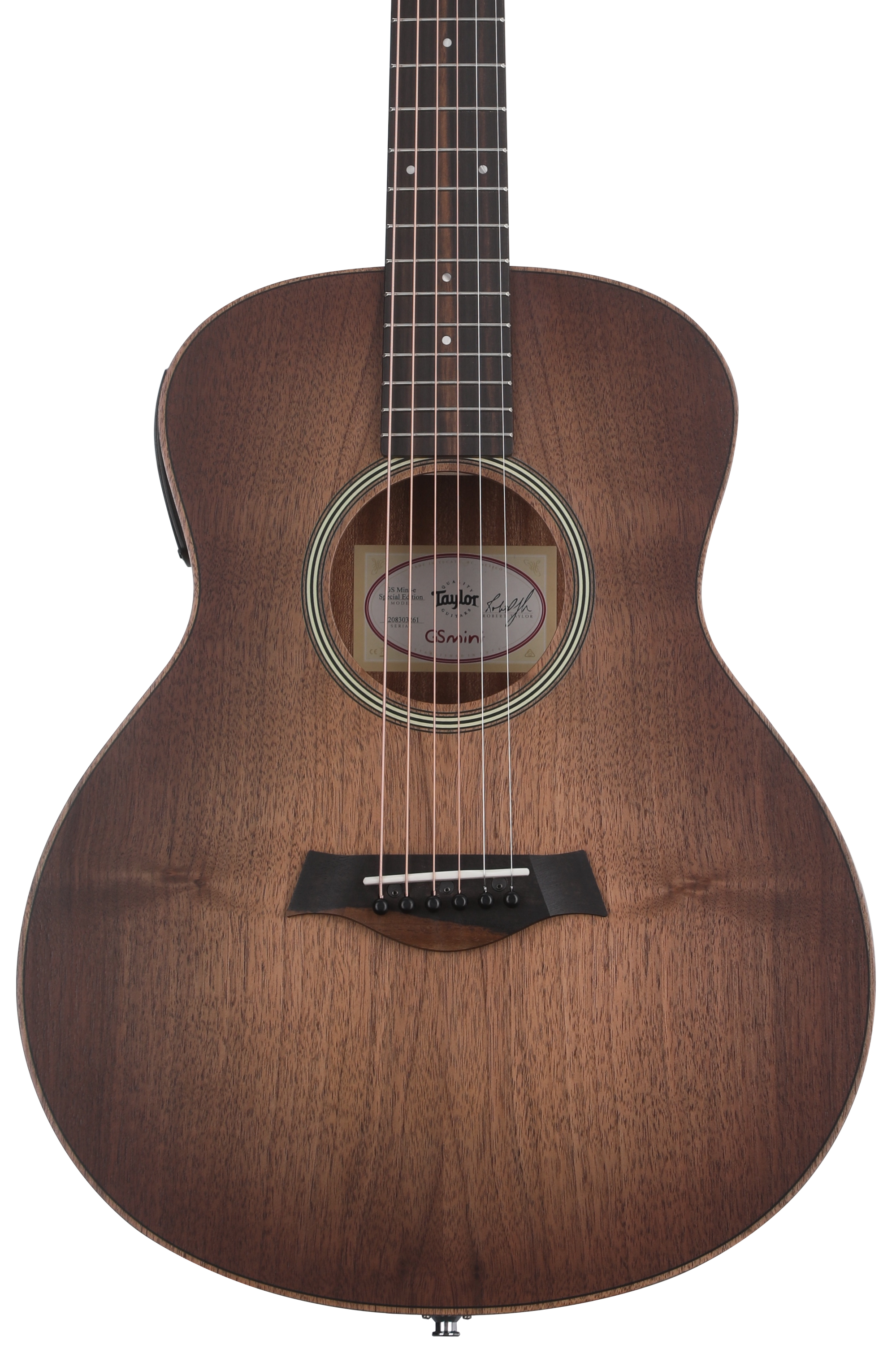
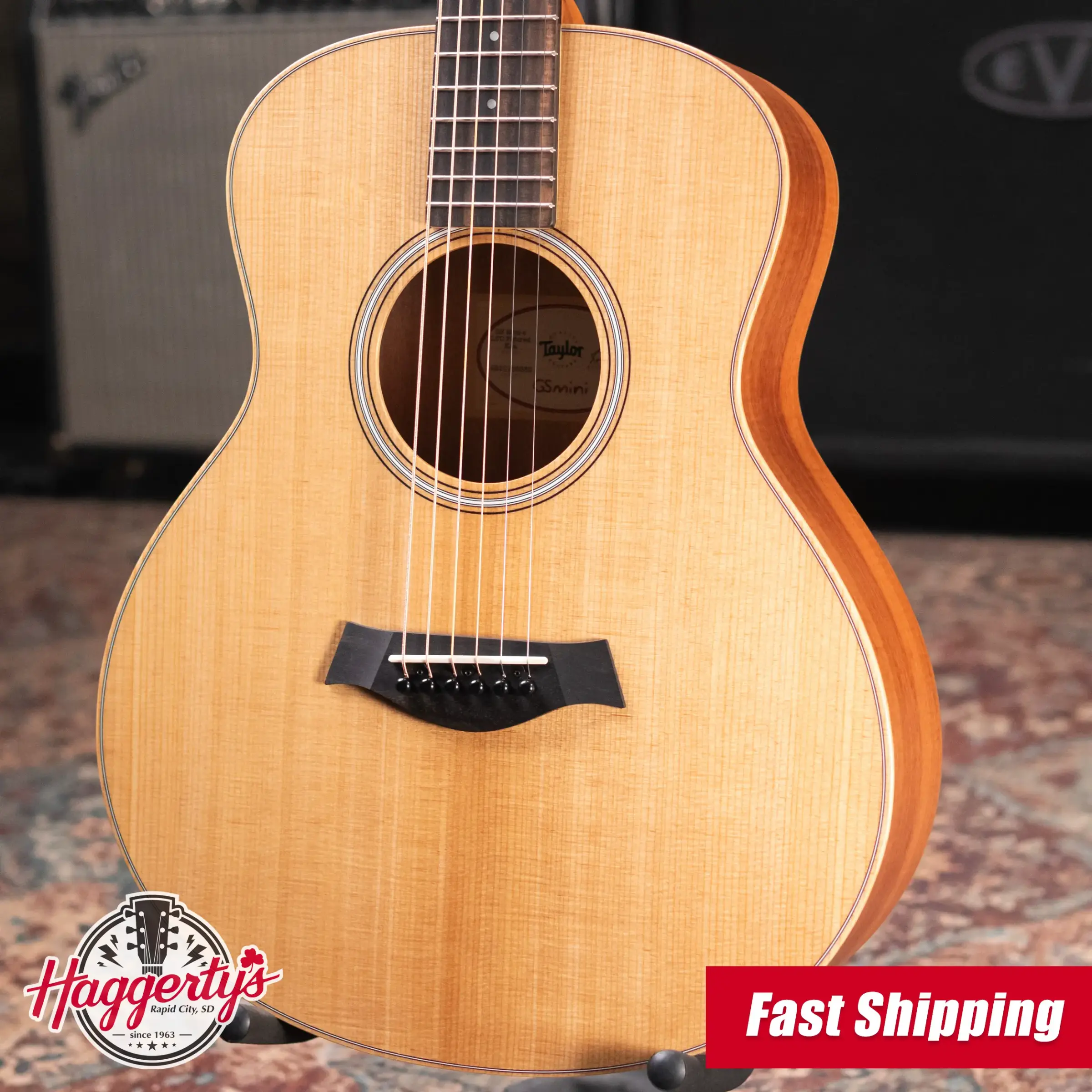
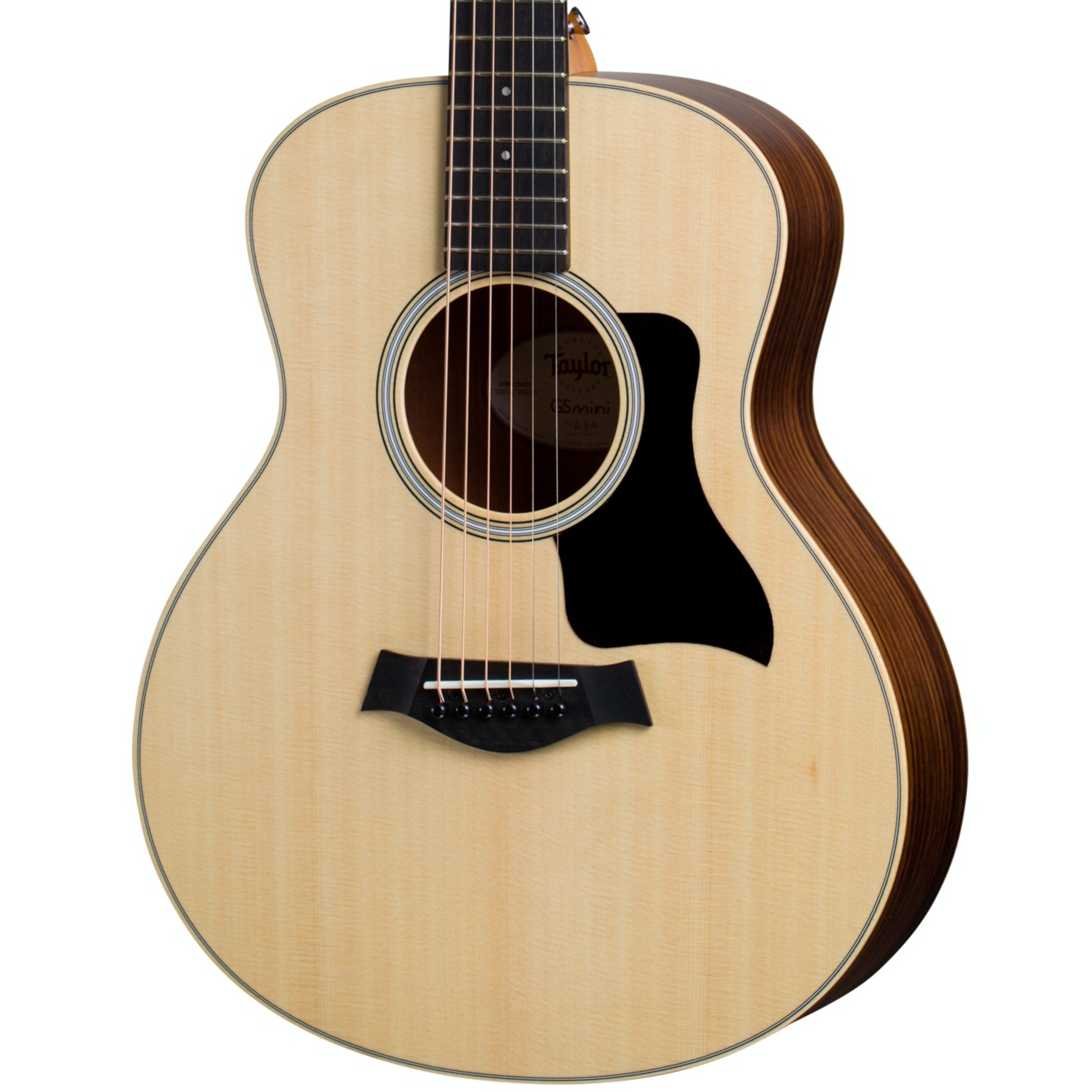
| Top Wood | Solid Sitka Spruce | Solid Tropical Mahogany | Solid Hawaiian Koa |
| Back & Sides | Layered Rosewood | Layered Sapele | Layered Hawaiian Koa |
| Scale Length | 23.5 inches (596.9 mm) | 23.5 inches (596.9 mm) | 23.5 inches (596.9 mm) |
| Nut Width | 1-11/16 inches (42.8 mm) | 1-11/16 inches (42.8 mm) | 1-11/16 inches (42.8 mm) |
| Neck Joint | Taylor NT (New Technology) Neck | Taylor NT Neck | Taylor NT Neck |
| Fingerboard & Bridge | Genuine West African Ebony | Genuine West African Ebony | Genuine West African Ebony |
| Electronics | Taylor ES-B (Behind-the-Saddle) | Taylor ES-B (Behind-the-Saddle) | Taylor ES-B / ES-2 (varies by edition) |
| Factory Strings | Coated Medium Gauge (.013–.056) | Coated Medium Gauge (.013–.056) | Coated Medium Gauge (.013–.056) |
| Included Case | Structured Hard Bag | Structured Hard Bag | Structured Hard Bag |
Build Quality, Ergonomics, and Playability
The 23.5-Inch Scale Length Dynamics
The defining playability metric of the GS Mini-E is its short 23.5-inch scale length. Compared to standard acoustic scale lengths—such as Martin’s 24.9-inch or Gibson’s 24.75-inch, and Taylor’s standard 25.5-inch—the shorter string length significantly reduces overall string tension when tuned to standard pitch (E A D G B E).
To compensate for reduced tension and prevent string buzz while maintaining optimal top drive, Taylor factory-equips the GS Mini-E with medium gauge strings (.013–.056). The combination of medium strings and a 23.5-inch scale yields a tactile feel similar to light gauge strings (.012–.053) on a standard long-scale guitar. Fretting chord voicings that require wide finger stretches becomes significantly easier, making the instrument approachable for players with smaller hands, while remaining comfortable for experienced players executing complex chord formations.
Neck Profile and Fretwork
The GS Mini-E utilizes Taylor's patented NT (New Technology) neck joint, which uses a continuous wood support pocket extending to the 19th fret. Because the neck pocket is precision-laser cut, the neck angle can be adjusted using micro-spacers during professional maintenance, guaranteeing optimal playability over the instrument's lifespan.
The neck features a shallow, comfortable "C" profile with a satin finish that prevents hand dragging during rapid position transitions. The nut width measures 1-11/16 inches (42.8 mm), which is narrower than Taylor's standard 1-3/4 inch nut width found on standard 300 series instruments and above. Strummers and flatpickers will find this width comfortable for thumb-over chordal styles, though complex fingerstyle guitarists with larger hands may initially feel slight finger crowding in the first three frets.
Acoustic Tone Profile and Tonewood Variations
Despite its small body volume, the GS Mini-E projects an unexpectedly robust voice. The acoustic performance relies heavily on Taylor’s specialized bracing pattern and the arched back construction, which forces acoustic waves through the soundhole without low-end cancellation.
Acoustic Resonance Flow:
- Solid Tonewood Top
- Vibrational Energy
- Internal Cavity Air
- Arched Unbraced Back
- Compressed Wave Reflection
- Forward Projection
Tonewood Performance Comparison
- Solid Sitka Spruce Top (Rosewood/Walnut Back & Sides): Offers the highest dynamic headroom and acoustic versatility. Spruce provides bright trebles, clear mid-range focus, and immediate transient response. When paired with layered rosewood back and sides, the guitar delivers strong acoustic clarity suited for flatpicking, heavy strumming, and vocal accompaniment.
- Solid Tropical Mahogany Top: Produces a warmer, naturally compressed tone with enhanced mid-range prominence. The solid mahogany soundboard softens aggressive pick attacks, resulting in a smooth, mellow response ideal for blues, fingerpicking, and roots music. It exhibits less immediate volume than spruce but offers greater fundamental note focus.
- Solid Hawaiian Koa Top: Provides a balance between spruce's brightness and mahogany's warmth. Fresh out of the box, Koa sounds clear, punchy, and articulate. As the solid Koa top breaks in over time, its lower mid-range opens up, offering a richer, highly textured acoustic timbre.
Electronics and Amplified Sound Performance
The "E" suffix in the GS Mini-E designation indicates factory installation of Taylor’s onboard preamp and pickup system. Modern production models are primarily equipped with the Taylor ES-B system, derived from Taylor's Expression System 2 (ES2) design architecture.
Pickup Mechanics: Behind-the-Saddle Piezo
Unlike traditional under-saddle piezo pickups (USTs) that compress synthetic elements under string pressure—often causing a harsh, metallic "piezo quack"—the ES-B uses three individually calibrated piezo-electric sensors positioned behind the bridge saddle.
Because the sensors contact the back side of the saddle rather than sitting beneath it, they register the organic mechanical vibration of the bridge wood and top soundboard alongside direct string movement. This orientation produces an amplified signal with natural acoustic warmth and dynamic fidelity.
Bridge Saddle Cross-Section:
- String
- Saddle
- Sensors Positioned Behind Saddle, Not Beneath
- Ebony Bridge Wood
ES-B Preamp Features and Control
The low-profile ES-B preamp module installed on the upper bout includes:
- Volume Control: Linear gain adjustment for output matching to acoustic amplifiers or PA systems.
- Tone Control: An active EQ contour knob that boosts bass while smoothing highs when rolled counter-clockwise, or enhances treble clarity when rolled clockwise.
- Built-in Digital Chromatic Tuner: Features an LED display screen that auto-mutes the audio output jack when activated, allowing silent tuning during live performances.
- Power Source: Powered by easy-to-replace CR2032 button cell batteries or a standard 9V battery (depending on the production revision year), providing up to 30 hours of active performance time.
When connected directly to an acoustic amplifier, direct box (DI), or audio interface, the ES-B system delivers an accurate representation of the guitar's acoustic character, requiring minimal external equalization.
Pros, Cons, and Structural Trade-Offs
Advantages
- High Projection-to-Size Ratio: Produces output levels rivaling traditional 000 and Concert acoustic body shapes.
- Structural Durability: Layered back and sides withstand temperature and humidity fluctuations better than all-solid wood instruments.
- Gig-Ready Electronics: Onboard ES-B preamp with integrated tuner simplifies setup for live shows and open-mic events.
- Included Hard Bag: Ships with a high-density foam, weather-resistant Taylor structured gig bag providing case-like protection at a fraction of the weight.
- Maintenance-Friendly Design: The adjustable NT neck joint permits easy future neck resets without structural geometry destruction.
Limitations
- Narrow Nut Width: The 1-11/16 inch nut width can feel restrictive for players with thick fingers or those accustomed to standard fingerstyle spacing (1-3/4 inch).
- Layered Wood Resonance Limits: While durable, layered back and sides do not age or resonate in the same manner as all-solid tone woods.
- Specific String Gauge Dependency: Using light-gauge strings (.012–.053) without adjusting the truss rod can lead to string rattle due to reduced tension on the short 23.5-inch scale.
Head-to-Head Competitor Comparison
To evaluate its value, the Taylor GS Mini-E must be measured against comparable short-scale and travel-oriented acoustic guitars in the market.
1. Taylor GS Mini-E vs. Martin Dreadnought Junior (DJr-10E)
The Martin Dreadnought Junior features an all-solid wood construction (solid Sitka spruce top with solid sapele back and sides) and a slightly wider 1-3/4 inch nut width. Its 24-inch scale length feels slightly closer to a full-sized guitar. However, the Taylor GS Mini-E offers superior acoustic projection and mid-range clarity due to its arched back design, and Taylor's ES-B system provides a more natural plug-and-play tone than Martin’s entry-level Fishman Sonitone UST pickup.
2. Taylor GS Mini-E vs. Yamaha CSF3M
Yamaha’s CSF3M is a parlor-sized acoustic featuring solid mahogany back and sides, a solid spruce top, and a 23.6-inch scale length. While the Yamaha offers solid wood construction at a competitive price point, the GS Mini-E delivers a punchier low-mid response, a stiffer structural build suited for travel, and a superior gig bag included out of the box.
Maintenance, String Choices, and Setup Guidance
To maintain peak playing condition and structural stability:
- String Selection: Use standard Medium Gauge (.013–.056) Phosphor Bronze strings. Coated strings (such as D'Addario XS or Elixir Nanoweb) extend string life and resist sweat and grime accumulated during travel. If tuning down (e.g., Drop D or Eb standard), medium gauge strings are mandatory to preserve correct string tension.
- Humidity Management: Keep the guitar within an ambient relative humidity (RH) range of 45% to 55%. Although the layered sides are resilient, the solid wood top can dry out, leading to top sinkage, fret sprout, or seam splitting. Utilize soundhole humidifiers inside the gig bag during dry winter months.
- Truss Rod Adjustments: The GS Mini-E utilizes a standard 1/4-inch nut accessible at the headstock under the truss rod cover. Adjust relief conservatively—turning clockwise tightens the rod to counteract forward bow, while counter-clockwise loosens it to relieve fret buzz near the nut.
Frequently Asked Questions
Is the Taylor GS Mini-E suitable for absolute beginners?
Yes. The 23.5-inch scale length reduces string tension, making fretting chords significantly easier on beginner fingers. Combined with factory-low action and a comfortable neck shape, it lowers the physical learning curve compared to standard full-scale acoustic guitars.
Can you play the Taylor GS Mini-E in standard tuning?
Yes. The Taylor GS Mini-E is designed to be tuned to standard pitch (E A D G B E) using medium-gauge strings (.013–.056). You do not need to use a capo or alternate pitch tunings to achieve standard tension.
What is the difference between the standard Taylor GS Mini and the GS Mini-E?
The standard Taylor GS Mini is a purely acoustic instrument with no internal electronics or controls. The GS Mini-E includes Taylor’s onboard ES-B pickup system, built-in digital tuner, output jack, and battery compartment for immediate plug-and-play amplification.
Does the GS Mini-E come with a case?
Yes. Every new Taylor GS Mini-E includes Taylor’s hard bag—a rigid, lightweight gig bag featuring high-density protective foam walls, double-stitched canvas fabric, neck support, and padded backpack straps.
Is the Taylor GS Mini-E dynamic enough for professional recording studio work?
Yes. Many audio engineers prefer recording short-scale, small-body acoustics like the GS Mini-E because they generate less muddy lower-frequency resonance. Its focused mid-range fits into dense studio song mixes without requiring aggressive high-pass EQ filtering.
Final Verdict and Buyer Recommendation
The Taylor GS Mini-E remains an industry standard in compact acoustic-electric design. By combining smart acoustic engineering—such as its parabolic arched back and solid wood top—with a shortened 23.5-inch scale length and reliable behind-the-saddle electronics, Taylor crafted an instrument that transcends the travel guitar label.
Who should buy the Taylor GS Mini-E:
- Performing & Touring Musicians: Ideal for songwriting on the road, backstage warm-ups, or acoustic stage sets.
- Home Producers & Studio Engineers: Excellent for tracking acoustic rhythms that need to sit neatly in a mix without overwhelming low-end boominess.
- Beginners & Players with Smaller Hands: The short scale length and narrow nut reduce physical stress on hands and wrist joints.
For players seeking maximum volume and traditional all-solid wood aging, a full-sized dreadnought or grand auditorium may be preferable. However, for those needing an acoustic-electric guitar that delivers build quality, playability, and amplified reliability in a compact package, the Taylor GS Mini-E is an outstanding choice.
Image Gallery