Understanding Greek and Latin Roots and Affixes in English Vocabulary
Greek and Latin roots and affixes form the structural foundation of the English language, providing the building blocks for thousands of academic, scientific, and technical terms. By mastering these linguistic components, readers can d...
Greek and Latin roots and affixes form the structural foundation of the English language, providing the building blocks for thousands of academic, scientific, and technical terms. By mastering these linguistic components, readers can decode unfamiliar vocabulary, improve reading comprehension, and communicate with greater precision by analyzing the etymological origins of modern words.
Contents
The Structural Anatomy of English Words
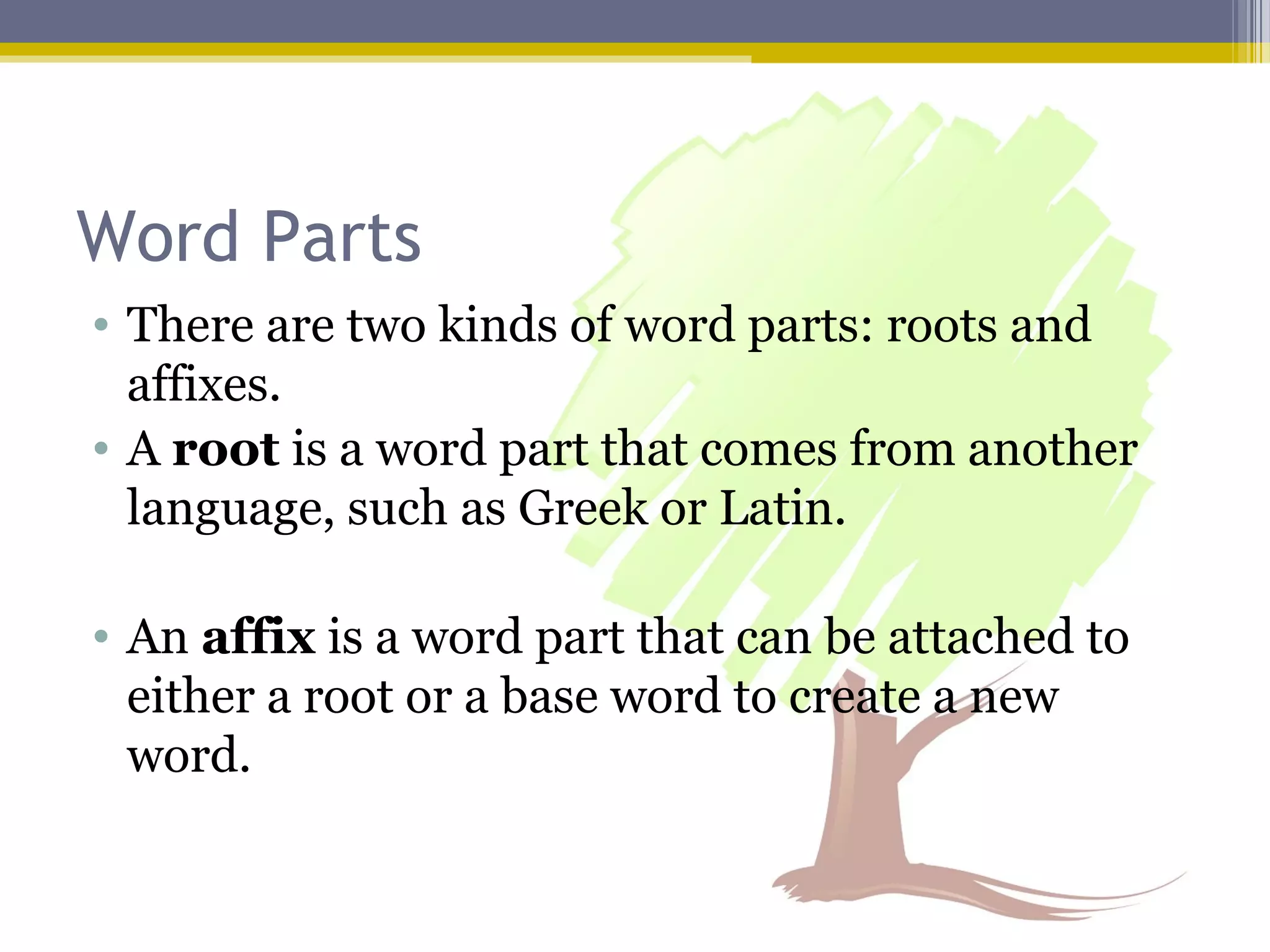
The English language is a composite structure, with over 60% of its vocabulary derived from Latin and Greek origins. Understanding how these words are constructed requires an appreciation for three primary elements: roots, prefixes, and suffixes. Together, these elements form the "affix" system, where an affix is a morpheme added to a base word or root to modify its meaning or grammatical function.
A root is the core meaning-bearing unit of a word. Often, a root cannot stand alone as a word but serves as the anchor to which other elements attach. For example, the Latin root dict- (meaning "to say") forms the base for terms like predict, contradict, and dictation.
Prefixes are affixes placed at the beginning of a word to alter its meaning, often by specifying location, time, or negation. In the word unpredictable, the prefix un- (meaning "not") provides the initial modification. Suffixes are placed at the end of a word, typically indicating the word's grammatical function—such as turning a verb into a noun or an adjective into an adverb—or subtly changing the root's meaning. In the same example, the suffix -able functions to convert the verb predict into an adjective.
The Distinction Between Greek and Latin Origins
While both languages contribute heavily to English, their roles often differ depending on the field of study. Recognizing these patterns helps users predict the etymology and usage of a specific term.
Latin Roots and Affixes
Latin roots are prevalent in general academic, legal, and formal English. Because Latin was the language of the Roman Empire and subsequently the language of European law and the Church, its influence is embedded in everyday vocabulary.
- Common Patterns: Latin roots often undergo internal changes depending on the grammatical context.
- Usage: They appear frequently in abstract concepts, governmental terminology, and formal writing. Examples include bene- (good) in benefit or mal- (bad) in malicious.
Greek Roots and Affixes
Greek roots are predominantly used in technical, scientific, and medical terminology. During the Renaissance and the Scientific Revolution, scholars frequently turned to Ancient Greek to name newly discovered phenomena, anatomical parts, and theoretical concepts.
- Common Patterns: Greek terms are often characterized by specific letter combinations like ph, ch, or y.
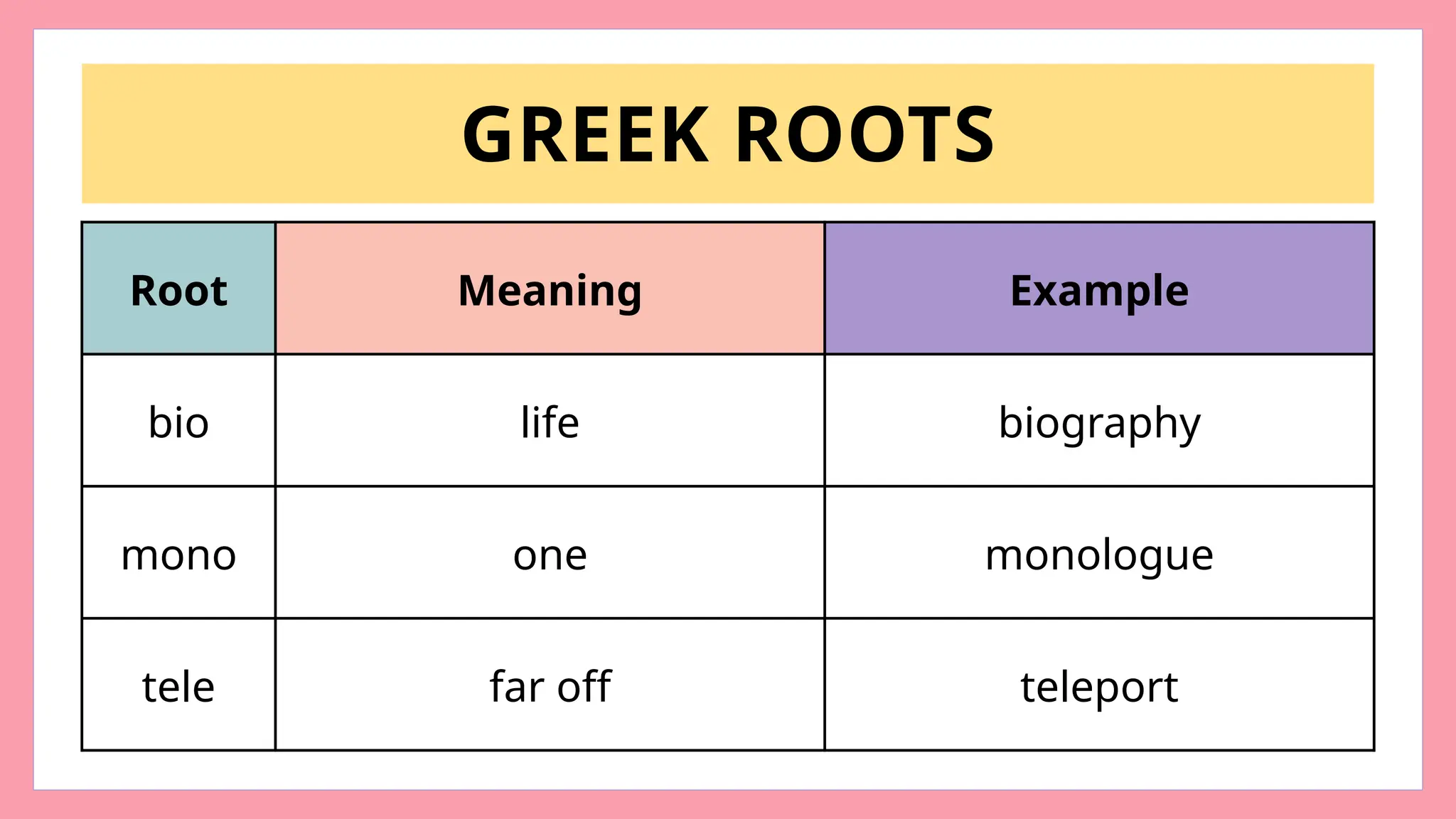
- Usage: They serve as the backbone for fields such as biology, physics, and medicine. Examples include bio- (life) in biology or therm- (heat) in thermostat.
Comparative Analysis of Linguistic Components
The following table categorizes common roots and affixes, illustrating how they combine to create specific meanings.
| Element | Type | Origin | Meaning | Example Word |
|---|---|---|---|---|
| Chron- | Root | Greek | Time | Chronology |
| Spec- | Root | Latin | Look | Spectator |
| Pre- | Prefix | Latin | Before | Premonition |
| Anti- | Prefix | Greek | Against | Antagonist |
| -ology | Suffix | Greek | Study of | Psychology |
| -tion | Suffix | Latin | Act of | Creation |
The Value of Morphological Analysis
Developing the skill of morphological analysis—the study of word formation—offers significant advantages in professional and educational settings. Rather than rote memorization of thousands of dictionary definitions, a learner who understands that tele- means "distance" and graph- means "to write" can immediately infer that telegraph involves writing over a distance.
This approach is particularly valuable in technical disciplines. In medicine, for example, a provider encountering the term gastroenteritis can break it down into gastro- (stomach), enter- (intestine), and -itis (inflammation). The meaning becomes clear without prior exposure to the specific term, reducing the cognitive load required to master complex terminology.
Common Pitfalls and Linguistic Nuance
While etymology is a powerful tool, it is essential to acknowledge common mistakes:
- Etymological Fallacy: Assuming a word's current meaning is strictly defined by its historical origin. Language evolves; while decimate historically meant to reduce by one-tenth, its modern usage frequently implies widespread destruction. Always verify current usage alongside etymological roots.
- Over-Generalization: Not every word that looks like it has a prefix actually possesses one. For instance, the word begin does not contain the prefix be- in the sense of "to be"; it is a historical compound where the segments have merged into a single, indivisible root.
- Orthographic Changes: During the process of word formation, spelling often shifts to accommodate pronunciation. The Latin prefix ad- (to) becomes ac- in acquire or af- in affix due to assimilation with the following consonant. Recognizing these sound-based changes is a prerequisite for identifying roots accurately.
Strategies for Expanding Vocabulary
To effectively leverage knowledge of Greek and Latin roots, consider the following systematic approach:
- Group by Category: Study lists of roots by their thematic relevance, such as "roots related to movement" or "prefixes related to negation."
- Contextualize: Practice breaking down words encountered in professional journals or news publications. Attempting to deconstruct a word before consulting a dictionary strengthens neural connections.
- Cross-Reference: Maintain a glossary of commonly encountered roots. As you encounter new terminology, map it back to these core elements.
- Consult Standard References: Utilize authoritative resources such as the Oxford English Dictionary for detailed etymological histories, as it provides the most precise lineage for English words.
Frequently Asked Questions
How does knowing Latin and Greek roots improve professional writing? Knowing these roots allows for more precise word choice. Instead of using generic verbs, a writer can select words that contain specific prefixes or roots to nuance their meaning, leading to more authoritative and concise communication.
Are there words that contain both Greek and Latin roots? Yes, these are known as "hybrid words." An example is television, which combines the Greek tele- (far) with the Latin visio (seeing). While purists historically looked down upon these, they are widely accepted in modern English.
Why do scientific terms rely so heavily on Greek? Greek roots are highly malleable and easily combined, which makes them ideal for creating new terms for complex scientific concepts. The ability to compound Greek roots allows for the precise description of specific processes or objects.
Can I rely on roots to understand every word? Roots are an essential tool, but they are not universal. English also contains a massive number of Germanic-origin words, loanwords from French, and modern technical neologisms that may not adhere to classical patterns. Use etymology as a guide, not a singular rulebook.
How long does it take to become proficient in decoding these words? Proficiency is cumulative. Learning the most frequent 50 roots and 20 prefixes will grant the ability to decipher roughly 70–80% of academic vocabulary. This can be achieved through consistent practice over several weeks.
Recommended Next Action
To begin applying this knowledge, identify five words in your daily professional or academic reading that you do not fully understand. Instead of using a simple definition search, locate the etymological breakdown of the word. Identify the prefix, root, and suffix, and note the original Greek or Latin meaning. By tracking these in a personal log for one month, you will significantly improve your ability to decode complex language intuitively.
Image Gallery