Best Practices for Conducting Inspections with Commissioning Checklists
To conduct effective commissioning inspections, professionals must implement a structured approach that prioritizes real-time data entry, aligns field observations with the Owner’s Project Requirements (OPR), and utilizes tiered checkl...
To conduct effective commissioning inspections, professionals must implement a structured approach that prioritizes real-time data entry, aligns field observations with the Owner’s Project Requirements (OPR), and utilizes tiered checklists—ranging from static pre-functional verification to dynamic functional performance testing—to ensure system integrated performance and long-term operational efficiency.
Contents
The commissioning (Cx) process is a quality-oriented strategy for achieving, verifying, and documenting that the performance of facilities, systems, and assemblies meets defined objectives and criteria. At the heart of this process lies the commissioning checklist. As we move through 2026, the complexity of high-performance buildings requires more than a simple "pass/fail" mentality. Effective inspections demand a synthesis of technical expertise, rigorous documentation, and collaborative communication among stakeholders, including owners, design professionals, and contractors.
The Strategic Importance of Commissioning Checklists
Commissioning checklists serve as the roadmap for quality assurance during the construction and occupancy phases. They are not merely administrative hurdles; they are technical instruments designed to reduce risk, minimize change orders, and ensure that complex MEP (Mechanical, Electrical, and Plumbing) systems operate as intended.
A well-constructed checklist bridges the gap between the design intent and the physical installation. By 2026 standards, these documents have evolved from simple paper lists into dynamic, cloud-based data sets that integrate with Building Information Modeling (BIM) and digital twins. The goal is to provide a "single source of truth" for the building’s functional readiness. When inspections are performed correctly, the checklist provides the evidentiary trail necessary for warranty claims, LEED or WELL certifications, and operational handovers.
Pre-Inspection Preparation: Developing Effective Checklists
The success of an inspection is often determined before the Commissioning Authority (CxA) even sets foot on the job site. Developing a checklist requires a deep dive into the Basis of Design (BoD) and the Owner’s Project Requirements (OPR).
1. Customization Over Generic Templates
While industry templates (such as those provided by ASHRAE or the Building Commissioning Association) offer a baseline, every project has unique parameters. Best practices dictate that checklists must be customized for the specific equipment models, sequences of operation, and environmental conditions of the project. A generic "Chiller Checklist" is insufficient for a variable-speed magnetic bearing chiller integrated with a district cooling plant.
2. Establishing Clear Acceptance Criteria
Vague checklist items like "Check unit installation" lead to inconsistent results. Effective checklists utilize specific, measurable criteria. For example, instead of "Check ductwork," a high-quality checklist will specify "Verify that duct leakage testing results are within 2% of the allowable CFM per SMACNA standards." Providing clear benchmarks ensures that different inspectors on the same project maintain consistency.
3. Verification of Prerequisites
Before field inspections begin, the CxA must verify that submittals have been approved and that the contractor has completed their own internal quality control checks. Conducting a commissioning inspection on equipment that hasn't been properly started by the manufacturer is a waste of resources and often masks deeper systemic issues.
Categories of Commissioning Checklists
To maintain order during a project, inspections are typically divided into distinct phases. Understanding the nuances of these phases prevents the premature testing of systems that are not yet stable.
Pre-Functional Checklists (PFCs)
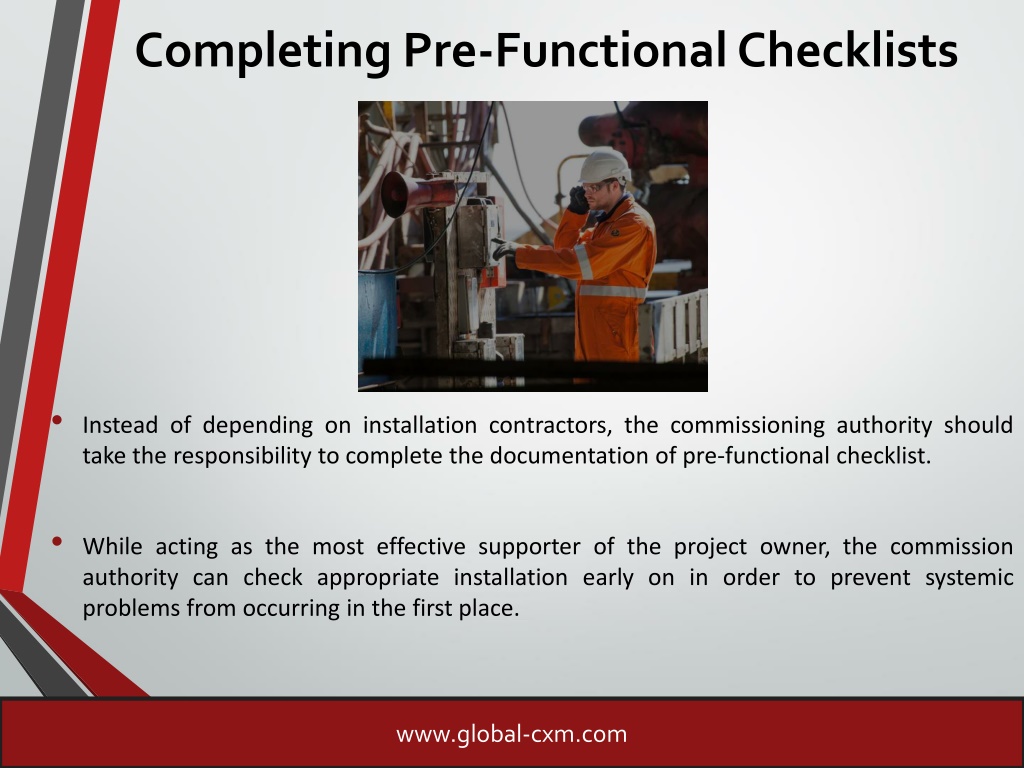
Often referred to as "Static Tests" or "Construction Checklists," PFCs focus on the physical installation of equipment. These inspections verify that the correct model was installed, it is located properly, and all peripheral components (valves, sensors, disconnects) are present. The primary goal of a PFC is to ensure the system is "ready to run."
- Key Focus Areas: Physical damage, labeling, accessibility for maintenance, electrical connections, and piping support.
- Best Practice: Require contractors to complete PFCs as equipment is installed, rather than waiting until the end of the project.
Functional Performance Tests (FPTs)
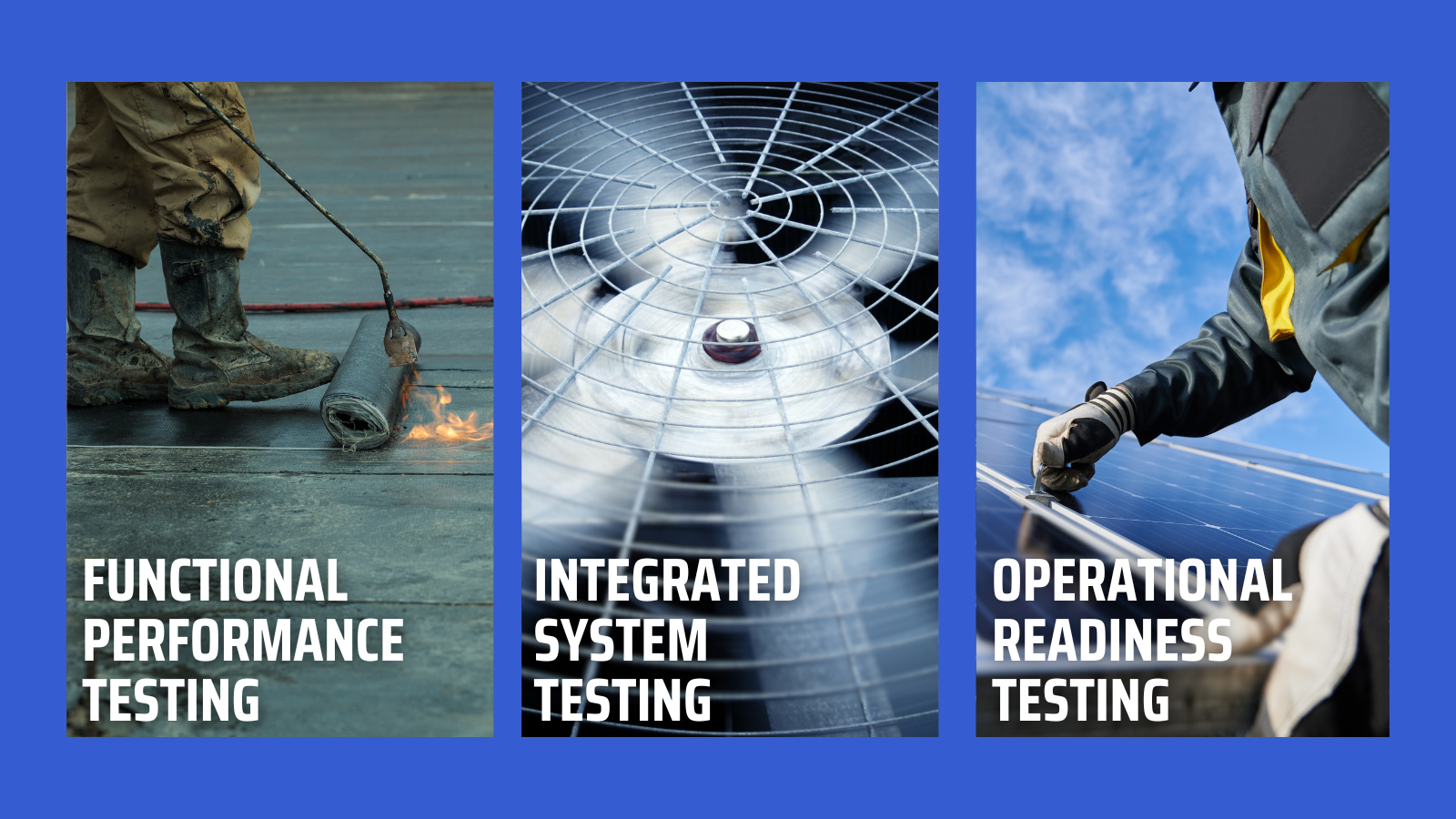
FPTs are "Dynamic Tests" that evaluate how systems operate under various loads and sequences. This is the core of the commissioning process. Inspections during this phase involve forcing the system into different states (e.g., full load, part load, emergency power, fire alarm override) to see if it responds according to the sequence of operations.
- Key Focus Areas: Sensor calibration, valve/damper modulation, PID loop stability, and failure mode responses.
- Best Practice: Witness at least 10% to 100% of these tests (depending on the criticality of the system) rather than relying solely on contractor reports.
Best Practices for Field Execution
When the time comes to perform the site walk, the methodology of the inspection matters as much as the technical knowledge of the inspector.
Real-Time Digital Documentation
In 2026, paper-based checklists are largely considered obsolete for professional-grade commissioning. Utilizing mobile platforms (such as Procore, BIM 360, or specialized Cx software like CxAlloy) allows inspectors to sync data immediately. This enables project managers to see "Issue Logs" in real-time, facilitating faster repairs and reducing the lag time between discovery and resolution.
Comprehensive Photographic Evidence
A checklist item marked "Pass" is subjective; a photograph showing the properly installed vibration isolation on a pump is objective. Best practices involve attaching photos to specific checklist line items. This provides a visual record for the facility management team, which is invaluable during future maintenance or troubleshooting.
The Power of the "Issue Log"
The checklist identifies the problem, but the Issue Log manages the solution. Every failed item on a checklist should automatically generate an entry in a centralized issue log. This entry must include:
- A clear description of the deficiency.
- The specific reference (e.g., "Non-compliant with Specification Section 230500").
- The party responsible for the fix.
- A priority level (Critical, Major, Minor).
Leveraging Technology in 2026
The integration of technology has transformed how inspections are conducted. The following table compares the traditional manual approach with the modernized digital approach currently dominant in the industry.
| Feature | Traditional Manual Approach | Modern Digital/BIM-Integrated (2026) |
|---|---|---|
| Data Entry | Pen and paper; manual upload to Excel. | Mobile app; real-time cloud synchronization. |
| Asset Tracking | Manual tagging and searching. | QR code/RFID scanning for instant asset history. |
| Visual Evidence | Separate camera; manual file renaming. | Integrated photos/video linked to checklist items. |
| BIM Integration | None; checklists are isolated documents. | Checklists linked to 3D model elements (COBie data). |
| Reporting | Time-consuming manual report generation. | One-click automated dashboard and PDF reports. |
| Issue Resolution | Email chains and verbal reminders. | Automated workflows with push notifications. |
Documentation and Final Verification
The final stage of conducting inspections is the "close-out." This is not simply about finishing the list but ensuring that the data is useful for the building's lifecycle.
Systems Manual Development
The completed checklists should be compiled into a Systems Manual. This manual is more than an O&M (Operations and Maintenance) folder; it includes the "why" behind the system settings. It provides future facility managers with the original test results, allowing them to perform "re-commissioning" or "ongoing commissioning" in the years to come to combat performance drift.
Seasonal Testing
Many systems cannot be fully tested in a single visit. A cooling system cannot be stressed in January, nor can a heating system be fully vetted in July. Best practices require that commissioning checklists include "deferred" or "seasonal" testing. The inspector must return during the opposite season to verify that the systems transition and perform correctly under peak design conditions.
Training Verification
The final "check" on many lists is the verification of operator training. A building is only as efficient as the people running it. Commissioning inspections should include a review of the training provided to the facility staff, ensuring they understand the sequences verified during the FPTs.
Common Pitfalls to Avoid
Even with a robust checklist, several common errors can undermine the commissioning process:
- Pencil-Whipping: This occurs when an inspector marks items as "Pass" without actually verifying them in the field. This is often caused by unrealistic schedules.
- Lack of Access: Inspections often fail because the inspector arrives and cannot access the equipment (e.g., no ladder, locked rooms, or safety hazards). Coordination meetings 48 hours prior to inspection are essential.
- Testing "Clean" Systems: Functional testing should only occur after the system is balanced (TAB) and the controls are fully programmed. Testing an unbalanced system leads to false negatives and repetitive site visits.
- Ignoring the Sensors: A system might appear to be working because the BAS (Building Automation System) screen says so. However, if the sensor is uncalibrated or improperly placed, the data is a lie. Physical verification of sensor readings with a handheld calibrated device is a non-negotiable best practice.
Frequently Asked Questions
What is the difference between a punch list and a commissioning checklist?
A punch list is typically a list of minor "cosmetic" or finishing items created at the end of a project by the architect or contractor (e.g., chipped paint, missing ceiling tiles). A commissioning checklist is a technical document used throughout the project to verify that complex systems meet specific engineering and operational performance standards.
How many items should be on a standard commissioning checklist?
There is no fixed number, but a checklist should be comprehensive enough to cover all critical components without being redundant. A typical AHU (Air Handling Unit) pre-functional checklist might have 30–50 items, while a functional performance test for the same unit could involve 20–30 specific sequence steps.
Who is responsible for completing the commissioning checklists?
Usually, the contractor completes the Pre-Functional Checklists (PFCs) to confirm they are ready for the Commissioning Authority (CxA). The CxA then reviews and verifies the PFCs and leads the execution of the Functional Performance Tests (FPTs), which are witnessed by the owner or their representative.
Can commissioning checklists be used for existing buildings?
Yes. This is known as Retro-Commissioning (RCx). The checklists are adapted to evaluate the current state of equipment and identify "low-cost/no-cost" operational improvements, such as adjusting setpoints or repairing dampers that have seized over time.
Why is 100% testing not always required?
For non-critical or repetitive equipment (like 500 identical VAV boxes), a "sampling rate" (e.g., 10% or 20%) is often used to manage costs. However, if a high failure rate is found in the sample, best practices dictate expanding the sample size—sometimes to 100%—to ensure systemic issues are corrected.
Final Recommendation
To achieve the highest ROI on commissioning, transition your workflow to a data-centric digital platform that supports BIM integration. Prioritize the development of custom, sequence-specific functional tests over generic installation lists. By treating the commissioning checklist as a living technical document rather than a static administrative requirement, you ensure that the facility is not just completed, but truly optimized for its entire operational lifespan.
Image Gallery