Understanding Wells Fargo Home Loan Rates in 2026: Mortgage Options, Pricing Factors, and Application Guide
In 2026, Wells Fargo home loan rates depend on broad macroeconomic conditions—including Federal Reserve monetary policy, inflation trends, and 10-year Treasury bond yields—as well as individual borrower creditworthiness. The bank offer...
In 2026, Wells Fargo home loan rates depend on broad macroeconomic conditions—including Federal Reserve monetary policy, inflation trends, and 10-year Treasury bond yields—as well as individual borrower creditworthiness. The bank offers conventional fixed-rate mortgages, adjustable-rate mortgages (ARMs), FHA, VA, and jumbo loans, with special rate discounts frequently available for existing relationship banking clients.
Contents
The 2026 Mortgage Rate Landscape and Wells Fargo's Market Position
Understanding how mortgage pricing works at major commercial institutions requires examining both macroeconomic benchmarks and bank-specific strategies. As one of the largest retail depository institutions in the United States, Wells Fargo structures its mortgage pricing based on national interest rate benchmarks while providing specialized incentives for retail banking clients.
Mortgage rates in 2026 are heavily anchored to the yield on 10-year U.S. Treasury notes. When Treasury yields rise due to strong economic growth or elevated inflation expectations, mortgage rates adjust upward. Conversely, when the Federal Reserve moves to ease monetary conditions or bond yields drop, mortgage borrowing costs typically decline. Mortgage lenders also factor in the "mortgage-backed security (MBS) spread"—the difference between 10-year Treasury yields and 30-year fixed mortgage rates—to account for prepayments, operational overhead, and credit risk.
- Macroeconomic Benchmarks (Fed Funds Rate & 10-Yr Treasuries)
- Mortgage-Backed Securities (MBS) Market
- Wells Fargo Base Mortgage Rates (Daily Standard Rate Sheet)
- Individual Borrower Rate (Adjusted for FICO, LTV, DTI & Relationship Discounts)
Wells Fargo focuses its mortgage operations on direct-to-consumer retail lending and relationship banking. Rather than relying heavily on third-party mortgage brokers, the bank incentivizes home buyers to consolidate their primary banking, savings, and investment accounts within Wells Fargo in exchange for interest rate reductions or closing cost credits.
Disclaimer: Mortgage rates fluctuate daily based on market volatility and individual borrower profiles. The following financial details are for informational and educational purposes. Borrowers should consult directly with a licensed mortgage loan originator to obtain an official Loan Estimate under the Real Estate Settlement Procedures Act (RESPA) and Truth in Lending Act (TILA).
Breakdown of Wells Fargo Home Loan Products
Wells Fargo provides several mortgage structures tailored to different financial profiles, property types, and long-term ownership plans. Selecting the right product impacts both the initial interest rate and the total cost of borrowing over the life of the loan.
1. 30-Year Fixed-Rate Mortgages
The 30-year fixed-rate mortgage remains the standard for American home buyers. This product locks in the principal and interest portion of your monthly payment for the full 360-month term, offering complete predictability regardless of future economic shifts.
- Best Suited For: Homebuyers planning to remain in their home for seven years or longer who prefer stable monthly payments.
- Rate Profile: Typically carries a higher initial interest rate than 15-year fixed or adjustable-rate loans to compensate the lender for long-term rate risk.
2. 15-Year Fixed-Rate Mortgages
A 15-year fixed-rate mortgage compresses the repayment schedule into 180 months. Because the repayment period is cut in half, the monthly principal and interest payment is substantially higher, but the overall interest paid over the life of the loan is drastically reduced.
- Best Suited For: Borrowers with strong cash flow looking to build equity quickly and pay off their home in half the traditional time.
- Rate Profile: Usually offers an interest rate 0.50% to 1.00% lower than a 30-year fixed mortgage.
3. Adjustable-Rate Mortgages (ARMs)
Wells Fargo offers adjustable-rate mortgages, typically structured as 5/6, 7/6, or 10/6 SOFR-indexed ARMs. Under these terms, the interest rate remains fixed for an initial period (5, 7, or 10 years) and subsequently adjusts every six months based on the Secured Overnight Financing Rate (SOFR) plus a predetermined margin.
- Best Suited For: Buyers who plan to relocate, refinance, or sell the property before the end of the initial fixed period.
- Rate Profile: Offers lower initial starting rates compared to 30-year fixed loans, though borrowers bear the risk of potential rate increases after the fixed window expires.
4. Government-Backed Loans (FHA and VA Loans)
For borrowers who need lower down payment requirements or have non-traditional credit histories, Wells Fargo participates in government-backed loan programs:
- FHA Loans: Insured by the Federal Housing Administration, allowing down payments as low as 3.5% with a credit score of 580 or higher. Note that FHA loans require an upfront Mortgage Insurance Premium (MIP) as well as an annual MIP paid monthly.
- VA Loans: Guaranteed by the U.S. Department of Veterans Affairs for eligible military service members, veterans, and surviving spouses. VA loans frequently offer 0% down payment options, competitive interest rates, and no ongoing private mortgage insurance (PMI).
5. Jumbo Loans
When a home purchase price exceeds the conforming loan limits set annually by the Federal Housing Finance Agency (FHFA), buyers must secure a non-conforming jumbo loan. Wells Fargo is a major lender in the premium residential sector, offering customized portfolio underwriting for higher-value properties.
- Best Suited For: High-net-worth individuals purchasing luxury homes or primary residences in high-cost real estate markets.
- Rate Profile: Highly competitive for borrowers with significant liquid assets, particularly when combined with relationship pricing discounts.
Comparing Wells Fargo Mortgage Options
The table below outlines key features, credit requirements, and structural characteristics across Wells Fargo's core mortgage products.
| Mortgage Product | Primary Purpose | Typical Min. Credit Score | Standard Down Payment | Rate Structure | Key Advantage |
|---|---|---|---|---|---|
| 30-Year Fixed | Long-term primary purchase | 620 | 3% - 20%+ | Fixed for 30 Years | Maximum payment stability over long horizons |
| 15-Year Fixed | Rapid equity build-up | 620 | 3% - 20%+ | Fixed for 15 Years | Lower interest rate, faster debt clearance |
| 7/6 SOFR ARM | Short-to-medium residency | 640 | 5% - 20%+ | Fixed 7 Yrs, Adjusts 6 Mos | Lower initial monthly payment |
| FHA Loan | Low down payment / lower credit | 580 | 3.5% | Fixed 15 or 30 Years | Flexible qualification criteria |
| VA Loan | Eligible veterans / military | 620 | 0% | Fixed 15 or 30 Years | Zero down payment, no monthly PMI |
| Jumbo Loan | Loan amounts above FHFA limit | 680 - 720 | 10% - 20%+ | Fixed or Adjustable | High loan limits for premium real estate |
Primary Factors Influencing Your Individual Rate
The advertised rate on a financial website represents a baseline for an ideal borrower profile. Your actual interest rate will vary depending on your personal borrower characteristics and risk profile.
- Credit Score (FICO): Lower Score = Risk Adjustment Fee
- Loan-to-Value (LTV): Lower Down Payment = Higher Rate / PMI
- Debt-to-Income (DTI): High DTI = Stricter Underwriting Terms
- Relationship Tier: Higher Deposits = Rate Discounts (up to 0.50%+)
1. Credit Score (FICO)
Your credit score is one of the most critical variables in mortgage pricing. Lenders use Risk-Based Pricing Adjustments (often called Loan-Level Price Adjustments or LLPAs). A applicant with a 760+ FICO score will secure a lower interest rate than an applicant with a 640 FICO score, holding all other variables constant. Improving your credit score by even 20 points before applying can translate to substantial interest savings over the lifetime of the mortgage.
2. Down Payment and Loan-to-Value Ratio (LTV)
The Loan-to-Value ratio measures the total mortgage loan amount against the appraised value of the property. Put simply: $$\text{LTV} = \left( \frac{\text{Loan Amount}}{\text{Appraised Property Value}} \right) \times 100$$
A down payment of 20% or more (resulting in an LTV of 80% or lower) eliminates the need for Private Mortgage Insurance (PMI) on conventional loans and signals lower risk to the bank, which translates to favorable loan pricing.
3. Debt-to-Income Ratio (DTI)
Your DTI is the percentage of your gross monthly income dedicated to paying recurring debts, including credit cards, student loans, auto financing, and your proposed mortgage payment. Wells Fargo prefers a front-end DTI (housing expenses only) below 28% and a back-end DTI (total debt obligations) below 36% to 43%, though higher thresholds may be permitted for applicants with strong compensating factors such as cash reserves.
4. Discount Points vs. Lender Credits
Borrowers can customize their interest rate through upfront financial trade-offs at closing:
- Discount Points: Paying 1 point (equal to 1% of the total loan amount) upfront at closing permanently lowers your mortgage rate (typically by 0.25%). This strategy is ideal if you intend to hold the mortgage long enough to reach the breakeven point.
- Lender Credits: The bank increases your interest rate slightly in exchange for providing cash credits to offset your upfront closing costs.
5. Wells Fargo Relationship Discounts
Wells Fargo provides tiered mortgage rate reductions for clients who maintain qualified balances across Wells Fargo deposit, investment, or brokerage accounts prior to closing. Depending on the eligible account balance (e.g., $250,000, $500,000, or $1,000,000+), qualifying relationship customers may receive interest rate discounts ranging from 0.125% to 0.50% off standard retail interest rates.
Steps to Secure and Lock a Mortgage Rate with Wells Fargo
Navigating the mortgage application process efficiently helps ensure you receive the most competitive interest rate while avoiding unexpected rate spikes before closing.
- Step 1: Pre-Qualification & Credit Review
- Step 2: Formal Pre-Approval & Document Submission
- Step 3: Property Selection & Loan Application
- Step 4: Executing a Rate Lock Agreement (30, 45, or 60 Days)
- Step 5: Underwriting, Appraisal, & Final Closing
Step 1: Pre-Qualification and Financial Assembly
Gather financial documents early, including tax returns (W-2s, 1099s, 1040s for the past two years), recent pay stubs, bank statements, and documentation for any external assets. Review your credit reports from Equifax, Experian, and TransUnion to correct any errors before applying.
Step 2: Obtain a Formal Loan Estimate
Submit your complete mortgage application to receive an official Loan Estimate (LE) within three business days. The LE is a standardized three-page document mandated by federal law that details the exact interest rate, projected monthly payment, closing costs, origination fees, and cash-to-close metrics.
Step 3: Understand Rate Lock Options
Because market rates fluctuate daily, obtaining a rate lock protects your quoted interest rate during the application process:
- Standard Rate Lock: Guarantees your interest rate for a specific period—typically 30, 45, or 60 days—while your loan moves through underwriting and appraisal.
- Float-Down Option: Allows you to lock in a capped maximum interest rate, while retaining the flexibility to lower your rate if market interest rates drop significantly prior to final loan approval.
- Extended Rate Locks: Designed primarily for new residential construction, extended locks preserve an interest rate for up to 12 months, often requiring an upfront fee or periodic rate step-ups.
Closing Costs, Fees, and Out-of-Pocket Expenses
The interest rate is only one component of the cost of a mortgage. Borrowers must budget for upfront closing costs, which generally range between 2% and 5% of the total purchase loan amount.
Key Closing Expenses Include:
- Origination Fees: Charged by the bank to cover processing, underwriting, and administrative costs associated with issuing the loan.
- Appraisal and Inspection Fees: Third-party fees paid to verify the fair market value and structural condition of the subject property.
- Title Insurance and Settlement Services: Policies protecting both the lender and the home buyer against past ownership liens, title defects, or boundary disputes.
- Prepaid Escrow Items: Initial deposits paid into an escrow account to cover real estate property taxes, homeowners insurance, and private mortgage insurance (PMI) reserves.
Refinancing Options with Wells Fargo
If you already hold a mortgage, refinancing may allow you to lower your monthly payment, adjust your loan term, or convert equity into cash.
Rate-and-Term Refinancing
This option replaces an existing mortgage with a new loan featuring a lower interest rate, a shorter term (such as converting from a 30-year to a 15-year loan), or a shift from an adjustable-rate mortgage to a fixed-rate loan. The principal balance remains essentially unchanged, aside from rolling allowable closing costs into the loan.
Cash-Out Refinancing
A cash-out refinance allows you to borrow more than your current mortgage balance, tapping into built-up home equity. The excess funds are paid out in cash at closing, which can be used for home renovations, debt consolidation, or other major financial needs. However, cash-out refinances carry higher interest rates and stricter Loan-to-Value limitations than standard rate-and-term refinancing.
Frequently Asked Questions
How do Wells Fargo mortgage rates compare to credit unions or online lenders?
Wells Fargo rates are generally competitive with national money-center banks. Online lenders and credit unions may offer slightly lower baseline rates or reduced origination fees, but Wells Fargo often offsets this gap for existing customers through targeted relationship discounts and integrated online management tools.
What credit score do I need for a Wells Fargo home loan?
Minimum credit requirements vary by product tier. Standard FHA loans generally require a FICO score of at least 580. Conventional home loans typically require a minimum score of 620, while jumbo loans usually demand a minimum score between 680 and 720, depending on the loan amount and reserve assets.
Does Wells Fargo charge a penalty for paying off a mortgage early?
No. Standard residential mortgages issued by Wells Fargo carry no prepayment penalties. Borrowers can make extra principal payments or pay off the balance in full at any point without incurring fee penalties.
What is the difference between an interest rate and an Annual Percentage Rate (APR)?
The interest rate is the base cost of borrowing the principal amount annually. The APR reflects the broader cost of the loan, incorporating the base interest rate plus upfront origination fees, discount points, mortgage insurance, and eligible processing costs. Comparing APRs across lenders provides a clearer picture of total long-term borrowing costs.
Can I lock my interest rate before finding a specific property?
Wells Fargo offers "Lock and Shop" programs in select market environments, allowing pre-approved home buyers to lock in an interest rate for a defined period (e.g., 60 to 90 days) while searching for a property. Terms and requirements vary, so check directly with a home mortgage consultant for current program availability.
Next Steps for Prospective Borrowers
- Calculate Your Target Budget: Use a mortgage calculator to estimate your total monthly housing cost—including principal, interest, property taxes, homeowners insurance, and HOA fees—to ensure it aligns with your long-term income dynamics.
- Review Credit Reports: Obtain free annual credit reports to address outstanding collections, lower high revolving credit balances, and fix errors prior to formal underwriting.
- Consolidate Banking Assets: If you intend to leverage relationship rate discounts, transfer qualified cash or investment assets into Wells Fargo accounts well ahead of applying.
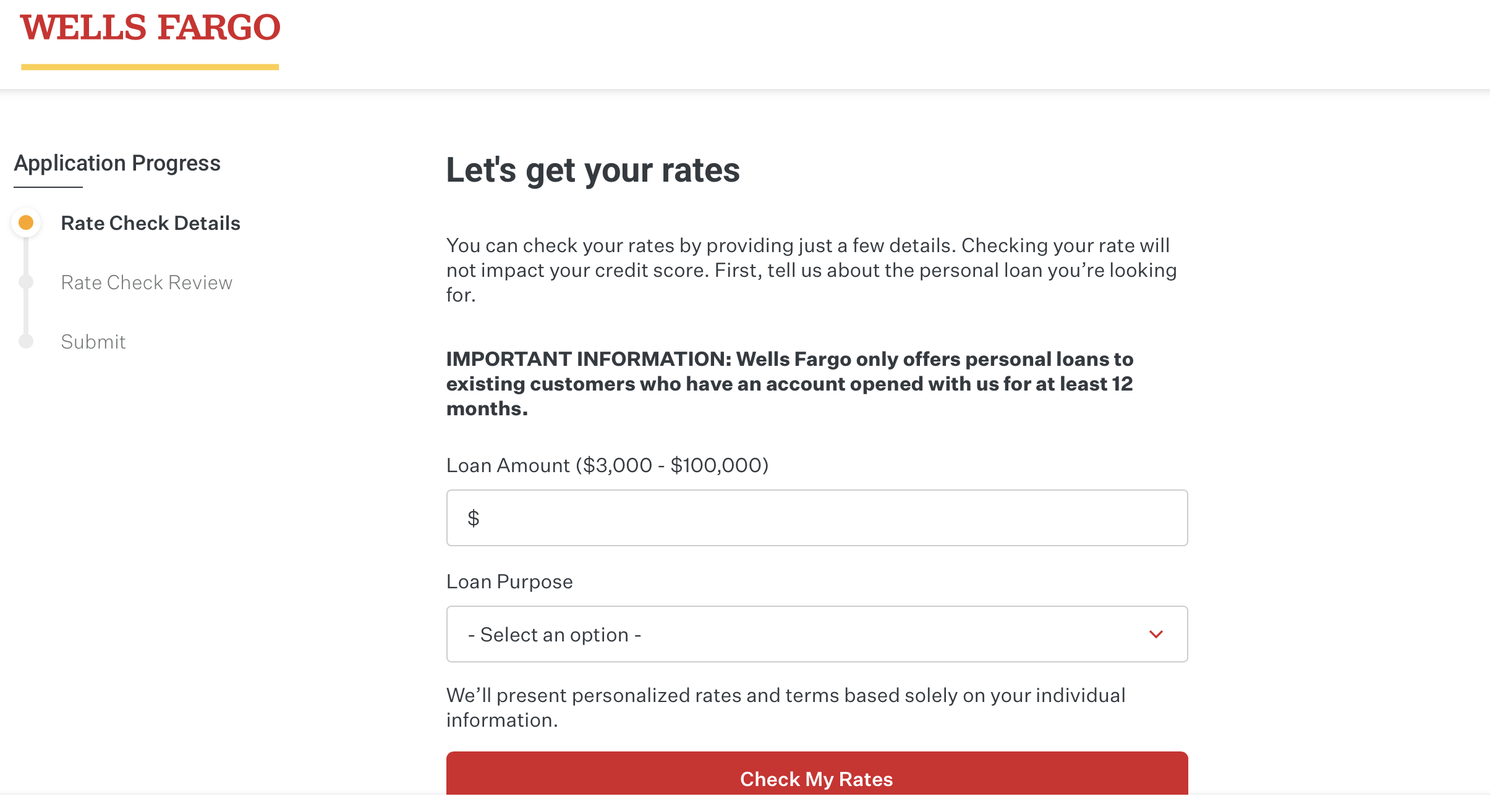
- Request an Official Loan Estimate: Contact a local Wells Fargo loan officer or complete an online application to generate an official Loan Estimate, allowing you to evaluate rates, terms, and closing costs against competing lenders.
Image Gallery