You Can Surf on the Great Lakes: The Complete Guide to Freshwater Surfing
You can surf on the Great Lakes. Powerful winds blowing across hundreds of miles of open water generate rideable waves on Lakes Michigan, Superior, Huron, Erie, and Ontario. While freshwater wave periods are shorter than ocean swells,...
You can surf on the Great Lakes. Powerful winds blowing across hundreds of miles of open water generate rideable waves on Lakes Michigan, Superior, Huron, Erie, and Ontario. While freshwater wave periods are shorter than ocean swells, autumn and winter atmospheric storms regularly produce clean, overhead surf for dedicated cold-water surfers across the Midwest and Canada.
Contents
Understanding Freshwater Wave Physics: Fetch, Swell, and Buoyancy
Surfing on the Great Lakes surprises many ocean veterans because the physical mechanics behind the waves differ significantly from oceanic coastlines. Ocean waves are primarily generated by distant deep-sea storms that travel thousands of miles across open oceans, arriving at beaches as long-period groundswells. In contrast, Great Lakes surf relies entirely on fetch—the continuous distance of open water over which wind blows in a constant direction.
- Low-Pressure Atmospheric Storm
- Wind Direction
- Fetch Area (100 - 300 Miles of Open Fresh Water)
- Short-Period Wind Waves (4–8s)
- Coastal Break / Pier / Point
When strong low-pressure systems move across North America, sustained winds pushing over 100 to 300 miles of lake surface construct organized wind swells. Understanding these meteorological dynamics is key to catching clean waves on inland seas.
Wind Swell vs. Ground Swell
The defining technical difference between ocean surfing and lake surfing is wave period—the time in seconds between consecutive wave crests.
- Ocean Groundswells: Typically feature periods of 10 to 20 seconds. This extended interval gives ocean waves immense power, interval spacing, and hydrodynamic momentum, allowing them to groom into clean lines before breaking.
- Great Lakes Wind Swells: Have much shorter wave periods, usually ranging between 4 and 8 seconds. Because the storm creating the waves is often directly over or near the lake, waves arrive in rapid succession.
For a surfer, a 5-second wave period means paddling back out through the impact zone requires speed and stamina, as there is little downtime between sets.
Water Density, Buoyancy, and Board Hydrodynamics
Freshwater is inherently less dense than ocean saltwater. Saltwater has an average density of approximately $1.025 \text{ g/cm}^3$, whereas freshwater sits at $1.000 \text{ g/cm}^3$. This 2.5% difference in water density directly affects hydrodynamic buoyancy:
- Board Sinkage: A surfboard sinks deeper into fresh water under identical surfer weight compared to salt water.
- Paddling Drag: Lower buoyancy increases surface drag while paddling, making it harder to match the speed of short-period waves.
- Volume Compensation: To compensate for lost buoyancy, Great Lakes surfers typically add 2 to 5 liters of additional volume to their board setups relative to what they would ride in the ocean.
Prime Surfing Locations Across the Great Lakes
Each of the five Great Lakes possesses distinct geographic features, bathymetry, and swell windows. Depending on wind direction and coastal orientation, high-quality surf breaks activate across several states and provinces.
- LAKE SUPERIOR (Duluth, Marquette)
- LAKE MICHIGAN (Sheboygan, Grand Haven)
- LAKE HURON (Kincardine, Tawas City)
- LAKE ONTARIO (Bluffer's Park, Stony Point)
- LAKE ERIE (Port Stanley, Presque Isle)
Lake Michigan
Lake Michigan offers the most developed surf culture in the region, driven by its long north-to-south orientation, which provides massive fetch during north or south gales.
- Sheboygan, Wisconsin: Often referred to as the "Malibu of the Midwest," Sheboygan juts into Lake Michigan, offering multiple break orientations along jetties and points.
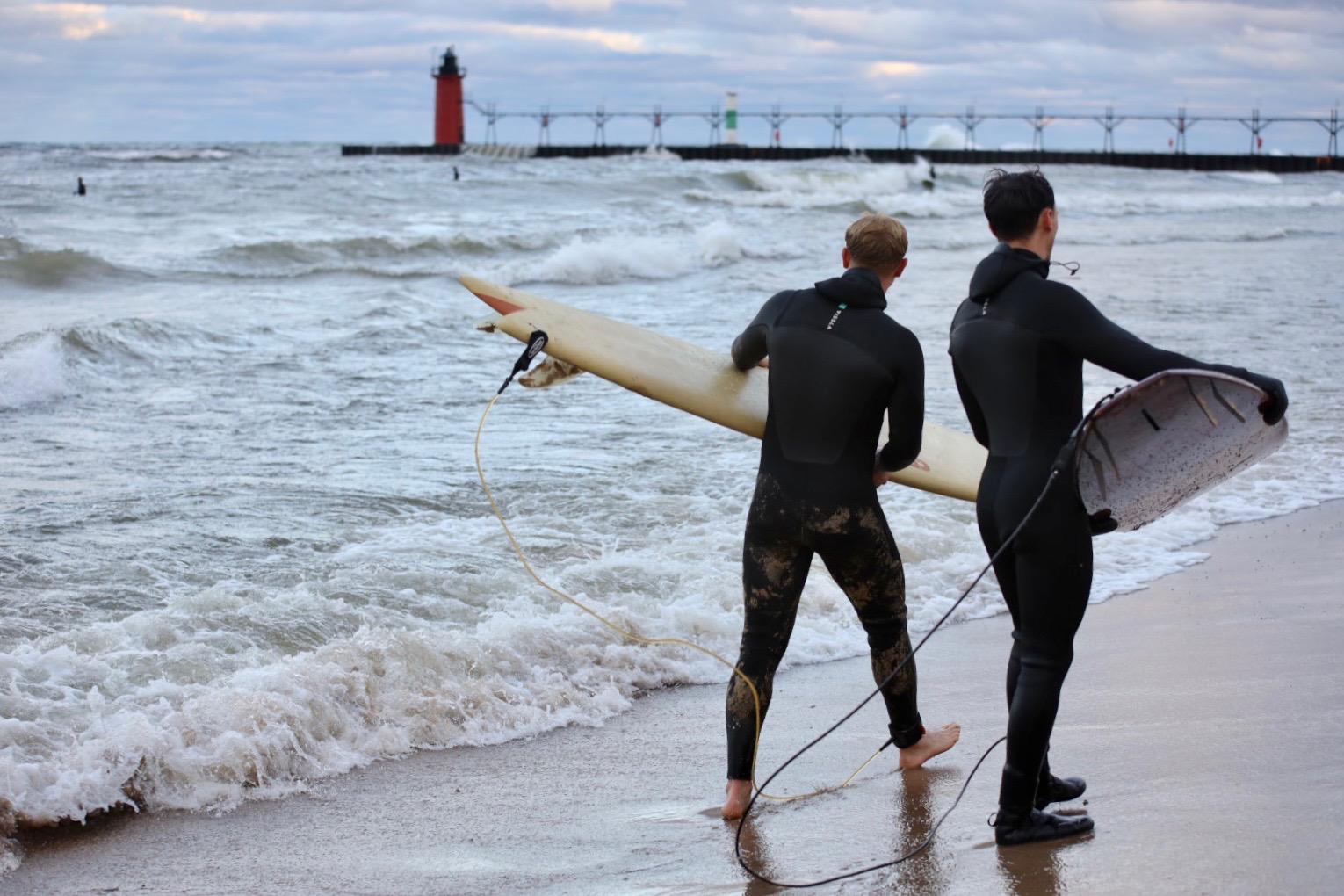
- Grand Haven & Grand Rapids Pier, Michigan: Pier structures trap sand to form reliable sandbars that shape incoming wind swell into clean, peeling lefts and rights.
- Whiting & Indiana Dunes, Indiana: Located at the southern tip of the lake, these spots catch powerful north winds sweeping down the full 300-mile length of Lake Michigan.
Lake Superior
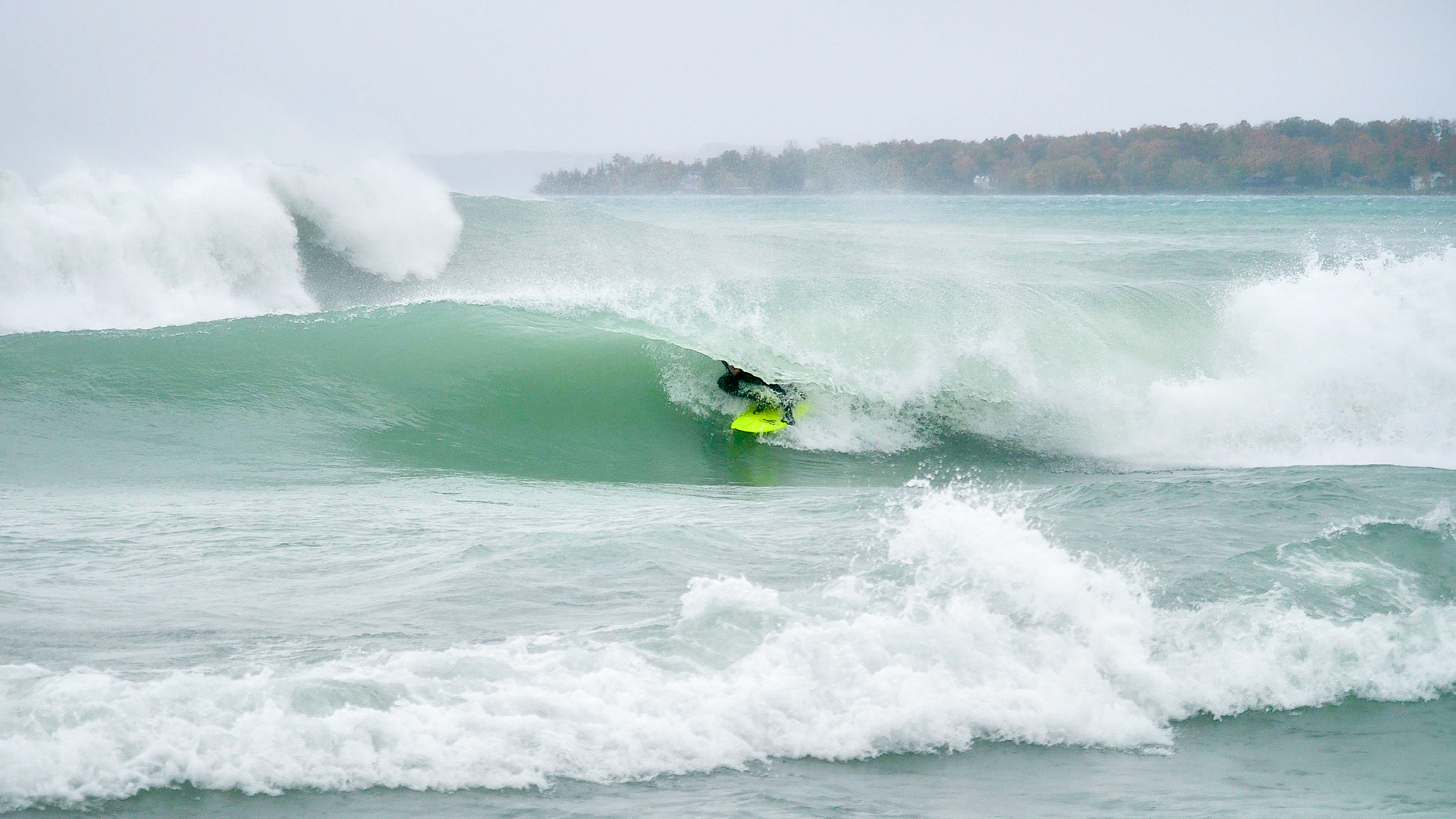
Lake Superior is the largest, coldest, and deepest of the lakes. It produces some of the heaviest waves in freshwater surfing during autumn low-pressure storms.
- Duluth, Minnesota (Park Point): Catches intense northeast winds blowing down the western arm of Superior, producing thick, heavy waves against long sandy stretches.
- Marquette, Michigan (Stony Point): A rocky point break capable of shaping long, organized waves during brutal northern gales.
Lake Huron
Lake Huron features clean beaches and piers that break up chop on both the American and Canadian sides.
- Kincardine, Ontario: Recognized as the surfing capital of Lake Huron on the Canadian side, where piers and river mouths shape localized banks.
- Tawas City, Michigan: Offers sheltered breaks along points during strong easterly winds.
Lake Erie
As the shallowest Great Lake, Erie builds waves very rapidly when high winds blow across its long east-to-west axis. However, because shallow water loses wave energy quickly, the surf window on Lake Erie can open and close within hours.
- Port Stanley, Ontario: A popular spot on the north shore that catches south and southwest wind swells.
- Presque Isle, Pennsylvania: A sand spit peninsula that provides diverse break angles depending on localized wind shifts.
Lake Ontario
Lake Ontario benefits from strong westerly and southwesterly winds blowing across its length toward New York and Eastern Ontario.
- Bluffer’s Park (Toronto, Ontario): High headlands shelter the lineup from severe crosswinds while allowing southwest swells to wrap into clean breaks.
- Stony Point, New York: Catches broad westerly swells moving across the full length of the lake.
Seasonality and Meteorological Drivers
Unlike tropical ocean breaks that offer year-round swell driven by trade winds and distant ocean storms, Great Lakes surfing is highly seasonal. The best conditions occur during late autumn, winter, and early spring.
- Fall: Sep – Nov: Peak Season: Strong Lows, Mild Water (45–60°F)
- Winter: Dec – Mar: Heavy Swells: Sub-Zero Air, Cold Water (32–40°F)
- Spring: Apr – May: Transitional: Declining Storms, Cold Water (38–50°F)
- Summer: Jun – Aug: Off-Season: Light Winds, Warm Water (60–72°F)
- Autumn (September to November): This is considered the prime season for Great Lakes surfing. Powerful atmospheric frontal systems—such as the famous "Gales of November"—pass over the region. Water temperatures remain relatively mild (45°F to 60°F), while air temperatures are manageable.
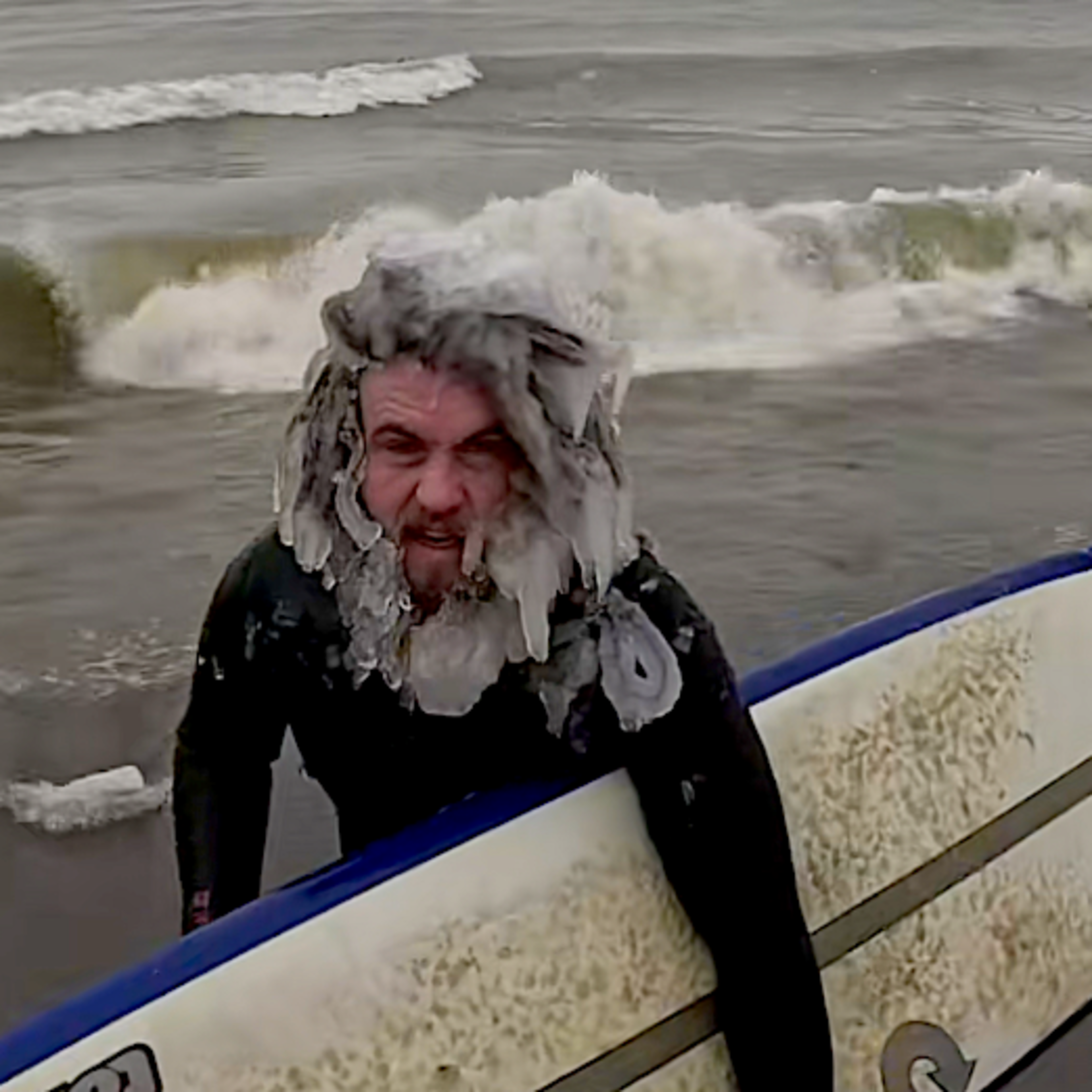
- Winter (December to March): Winter brings the biggest, most powerful waves of the year, driven by intense arctic atmospheric drops, Colorado Lows, and Alberta Clippers. However, challenges increase exponentially: water temperatures drop to near freezing (32°F to 36°F), air temperatures fall well below zero, and shorelines freeze into hazardous ice shelves.
- Spring (April to May): Transitional storm systems still bring rideable waves, but water temperatures remain extremely cold due to winter ice melt.
- Summer (June to August): Generally considered the off-season. Winds are light, and swells are infrequent, though warm water makes occasional flat-water paddleboarding or small longboard logging enjoyable.
Essential Gear for Cold-Water Freshwater Surfing
Surfing the Great Lakes safely requires specialized gear engineered for extreme cold water. Hypothermia is a constant danger during the peak autumn and winter seasons.
Cold-Water Wetsuit Setup:
- Integrated Hood (5-6mm)
- Chest-Zip Torso (5-6mm)
- Sealed/Taped Limbs (4-5mm)
- 5-Finger / Claw Mittens
- 7mm Round-Toe Boots
Surfboard Selection for Lake Waves
Because freshwater offers less lift and short-period waves lack long-range velocity, board design must prioritize paddle power and wave catching:
- High-Volume Longboards & Foamies: Ideal for beginners and soft summer waves.
- Mid-Lengths & Fishes: Flat rocker lines, wide outlines, and thick rails allow surfers to generate speed across short-period sections.
- Step-Up Shortboards: Used during heavy late-autumn and winter gales when wave heights exceed head-high, requiring extra foam under the chest to duck-dive rapidly coming sets.
Gear Specifications by Season
| Season | Water Temp Range | Avg Wave Height | Board Recommendation | Recommended Wetsuit System |
|---|---|---|---|---|
| Summer (Jun–Aug) | 60°F – 72°F (15°C – 22°C) | 1 – 3 ft | Longboard / Soft-top | 2mm Springsuit or 3/2mm Fullsuit |
| Autumn (Sep–Nov) | 45°F – 60°F (7°C – 15°C) | 3 – 8+ ft | Mid-length / High-vol Fish | 4/3mm or 5/4mm Fullsuit, 3mm Boots |
| Winter (Dec–Mar) | 32°F – 40°F (0°C – 4°C) | 4 – 10+ ft | High-vol Shortboard / Step-up | 5/4mm or 6/5mm Hooded Suit, 7mm Boots, 5mm Mittens |
| Spring (Apr–May) | 38°F – 52°F (3°C – 11°C) | 2 – 5 ft | Fish / Mid-length | 5/4mm Hooded Suit, 5mm Boots & Gloves |
Safety, Hazards, and Lineup Etiquette
Freshwater surfing presents distinct environmental hazards that differ from ocean environments. Respecting these conditions protects both you and other surfers in the lineup.
- HAZARD: Shelf Ice: Solid ice borders shoreline, blocking safe emergency exit points.
- HAZARD: Pier Currents: Water hits piers and creates fast, narrow channels along steel breakwaters.
- HAZARD: Cold Shock: Sub-40°F water induces involuntary gasping & rapid hypothermia.
Rip Currents and Structural Hazards
Many of the best Great Lakes surf breaks form alongside concrete piers, steel breakwaters, and jetties. While these man-made structures build clean sandbars, they also generate dangerous structural rip currents. Waves pounding against a pier create rapid seaward currents that can drag surfers into structural pilings or out into deep water. Always maintain a safe buffer zone from hard structures.
Shelf Ice and Freezing Conditions
In mid-winter, shoreline water freezes into treacherous shelf ice—thick floating or grounded ice formations along the beach.
- Entering or exiting the water over shelf ice is hazardous; slipping can trap a surfer beneath moving ice blocks.
- Ice buildup on board decks, suit zippers, and leashes can cause gear failure.
- Always identify clear, ice-free entry and exit points before entering cold water.
Hypothermia Prevention
Cold-water shock occurs instantly upon immersion in water below 60°F if unsuited, and below 40°F even with gear if water leaks inside. Always surf with a buddy during winter sessions, monitor your body for shivering or loss of dexterity, and limit sub-freezing sessions to 60–90 minutes.
How to Forecast Great Lakes Surf Conditions
Forecasting lake surf requires reading atmospheric weather models rather than oceanic swell charts. Because waves are generated locally, wind forecast accuracy is paramount.
Atmospheric Low Pressure
Sustained Wind Speed (20-35+ kts)
Fetch Direction (Onshore/Side-Shore)
Real-Time Buoy Check
Check Local Break Orientation for Off-Shore Winds
Monitor Marine Forecasts: Track marine updates through the NOAA National Weather Service Marine Forecasts for real-time gale warnings, wind directions, and fetch predictions.
Check Offshore Buoy Data: Review live wave height, wind speed, and wave period metrics from the NOAA National Data Buoy Center. Look for buoy readings showing wave periods expanding past 5 seconds.
Use Physical hydrodynamic Models: Consult the NOAA Great Lakes Environmental Research Laboratory (GLERL) and its Great Lakes Coastal Forecasting System (GLCFS) for high-resolution hydrodynamic forecasts mapping surface currents, wave heights, and surface water temperatures across all five lakes.
Identify the Wind Shift: The ideal lake surf scenario occurs when strong winds blow across the lake for several hours to build the swell, followed by a sudden localized wind shift (such as a passing front) that turns winds offshore at your local break, grooming the wind chop into clean, peeling lines.
Frequently Asked Questions
Is it harder to pop up on Great Lakes surf than ocean surf?
Yes, popping up on Great Lakes waves is generally more challenging for beginners. Because freshwater is less dense, surfboards sink lower in the water, decreasing paddle speed. Additionally, short wave periods (4–8 seconds) mean waves steepen and break rapidly, giving surfers less time to position themselves and complete their pop-up compared to long-period ocean groundswells.
Can I use my standard ocean surfboard on the Great Lakes?
You can use an ocean surfboard on the Great Lakes, but performance will suffer if the board lacks adequate volume. Standard ocean shortboards tuned for salt water often feel sluggish and drag in fresh water. For best results, select a board with 2 to 5 liters of additional volume, a flatter rocker line, and a wider chest area to maximize paddle efficiency in freshwater wind swell.
Are there sharks or dangerous marine life in the Great Lakes?
No, there are no sharks in the Great Lakes. The Great Lakes are cold freshwater systems that cannot support saltwater marine life such as sharks or jellyfish. The primary hazards in Great Lakes surfing stem from environmental factors, including freezing water temperatures, rip currents, ice shelves, and concrete pier structures.
What month offers the absolute best surf on the Great Lakes?
October and November generally offer the best combination of powerful wave-generating storms and manageable water temperatures. During late autumn, severe low-pressure systems regularly cross the region, while water temperatures remain between 45°F and 55°F, avoiding the extreme sub-freezing conditions and shelf ice typical of January and February.
Practical Recommendations for Your First Lake Session
If you are planning your first Great Lakes surf trip, follow these actionable steps to ensure a safe and successful session:
- Gear Up Correctly: Do not compromise on neoprene quality. If surfing between November and April, equip yourself with a high-end 5/4mm or 6/5mm hooded wetsuit, 7mm round-toe boots, and 5mm claw gloves or mittens.
- Select the Right Board: Leave high-performance, low-volume ocean shortboards at home. Opt for a high-volume fish, mid-length, or soft-top board that provides ample surface area and paddling speed.
- Study Weather Models: Use wind forecasting apps to watch for passing cold fronts or low-pressure systems. Look for sustained wind speeds over 20–30 knots across a long fetch area, followed by a shift to offshore winds at your target spot.
- Surf with Local Lineups: Connect with local Great Lakes surf shops and community groups in areas like Sheboygan, Grand Haven, or Toronto. Local surfers can provide crucial guidance regarding hidden hazards, sandbar locations, parking access, and safe entry points along winter shorelines.
Image Gallery