ICD-10 Code for Diastolic Heart Failure: Complete 2026 Coding Guide
The primary ICD-10-CM code for diastolic heart failure is found within the I50.3 category. To code accurately, you must identify the acuity of the condition: use I50.30 for unspecified, I50.31 for acute, I50.32 for chronic, and I50.33...
The primary ICD-10-CM code for diastolic heart failure is found within the I50.3 category. To code accurately, you must identify the acuity of the condition: use I50.30 for unspecified, I50.31 for acute, I50.32 for chronic, and I50.33 for acute on chronic diastolic heart failure.
Contents
Accurate coding for diastolic heart failure requires a deep understanding of both clinical documentation and the ICD-10-CM hierarchical structure. As of 2026, the medical community frequently uses the term Heart Failure with Preserved Ejection Fraction (HFpEF) interchangeably with diastolic heart failure. For coding purposes, these terms are synonymous and map to the same I50.3 series. Failure to assign the most specific code can result in claim denials, inaccurate risk adjustment scores, and a flawed clinical picture of the patient's health.
Understanding Diastolic Heart Failure (HFpEF) in a Coding Context
Diastolic heart failure occurs when the left ventricle of the heart becomes stiff and loses its ability to relax properly during the diastolic phase (the period when the heart fills with blood). Unlike systolic heart failure, where the heart's pumping strength is diminished, the pumping capacity—measured by the Ejection Fraction (EF)—often remains within a normal or near-normal range. This is why it is clinically referred to as HFpEF.
In the ICD-10-CM classification system, the code set is designed to capture the specific nature of the heart's dysfunction. While the "I50" category covers all forms of heart failure, the fourth character "3" specifically denotes the diastolic variety. This distinction is critical because the treatment modalities, prognosis, and resource utilization for diastolic heart failure differ significantly from systolic or right-sided heart failure.
The Specific ICD-10-CM Codes for Diastolic Heart Failure
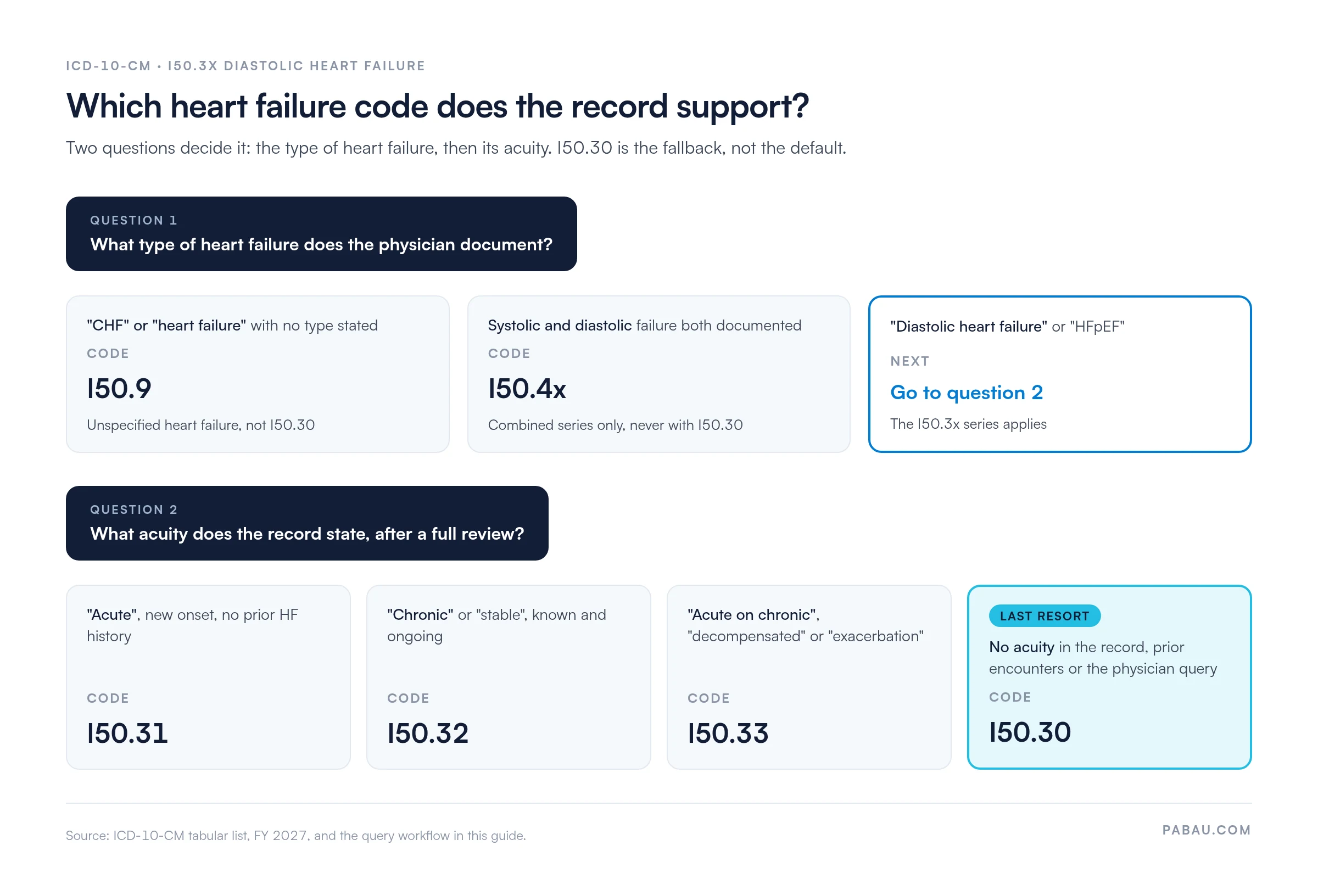
When selecting a code for diastolic heart failure, the medical coder must look for documentation regarding the "acuity" of the condition. Acuity describes whether the condition is new and sudden (acute), long-standing (chronic), or a sudden worsening of a long-standing issue (acute on chronic).
I50.30 - Diastolic Heart Failure, Unspecified
This code is used when the physician documents "diastolic heart failure" without specifying whether it is acute or chronic. In the 2026 coding environment, relying on unspecified codes is discouraged by the Centers for Medicare & Medicaid Services (CMS) and private payers, as it does not accurately reflect the patient's severity of illness.
I50.31 - Acute Diastolic Heart Failure
This code applies to a patient experiencing a new onset of diastolic heart failure or a sudden, severe episode that requires immediate medical intervention. Documentation for I50.31 often includes emergency department visits, new diagnoses of HFpEF during an inpatient stay, or sudden respiratory distress related to cardiac filling pressures.
I50.32 - Chronic Diastolic Heart Failure
This is the most common code for patients managed in an outpatient or primary care setting. It represents the ongoing, stable management of the condition. Documentation must support that the patient has a history of diastolic dysfunction and is receiving ongoing monitoring or therapy, such as diuretics or SGLT2 inhibitors.
I50.33 - Acute on Chronic Diastolic Heart Failure
This code is used when a patient with known chronic diastolic heart failure suffers an exacerbation. This is frequently seen in hospitalizations where a patient "decompensates." Clinical indicators often include increased peripheral edema, weight gain from fluid retention, and elevated B-type Natriuretic Peptide (BNP) levels that exceed the patient's baseline.
Clinical Documentation Requirements for 2026
To assign the I50.3 series correctly, the clinical record must be robust. In 2026, auditors and payers look for more than just a label. They look for "clinical validity," meaning the evidence in the chart must support the diagnosis.
- Ejection Fraction (EF) Evidence: Diastolic heart failure is typically associated with an EF of 50% or greater. If the EF is between 41% and 49%, it may be documented as "Heart Failure with Mid-Range Ejection Fraction" (HFmrEF), which currently still maps to diastolic codes in most instances unless systolic dysfunction is also present.
- Diagnostic Imaging: Results from an echocardiogram or cardiac MRI showing left ventricular hypertrophy, left atrial enlargement, or impaired relaxation (diastolic dysfunction) provide the necessary clinical backbone for the code.
- Symptom Correlation: The documentation should link symptoms—such as dyspnea on exertion, paroxysmal nocturnal dyspnea, and orthopnea—directly to the heart failure diagnosis.
- Treatment Plan: A clear link between the diagnosis and the prescribed treatment (e.g., "Adjusting Lasix for acute on chronic diastolic heart failure") strengthens the coding accuracy.
Coding Guidelines: Exclusions and Combinations
One of the most complex areas of cardiac coding involves the Excludes1 and Excludes2 notes in the ICD-10-CM manual.
If a patient is documented as having both systolic and diastolic heart failure, you cannot report I50.2x (systolic) and I50.3x (diastolic) together. Instead, the ICD-10-CM system provides a combined category: I50.4x (Combined systolic and diastolic heart failure).
- I50.40: Combined systolic and diastolic heart failure, unspecified.
- I50.41: Acute combined systolic and diastolic heart failure.
- I50.42: Chronic combined systolic and diastolic heart failure.
- I50.43: Acute on chronic combined systolic and diastolic heart failure.
Furthermore, there is a "Code First" requirement for heart failure. If the heart failure is due to certain underlying conditions, those conditions must be sequenced before the I50.3 code. Examples include:
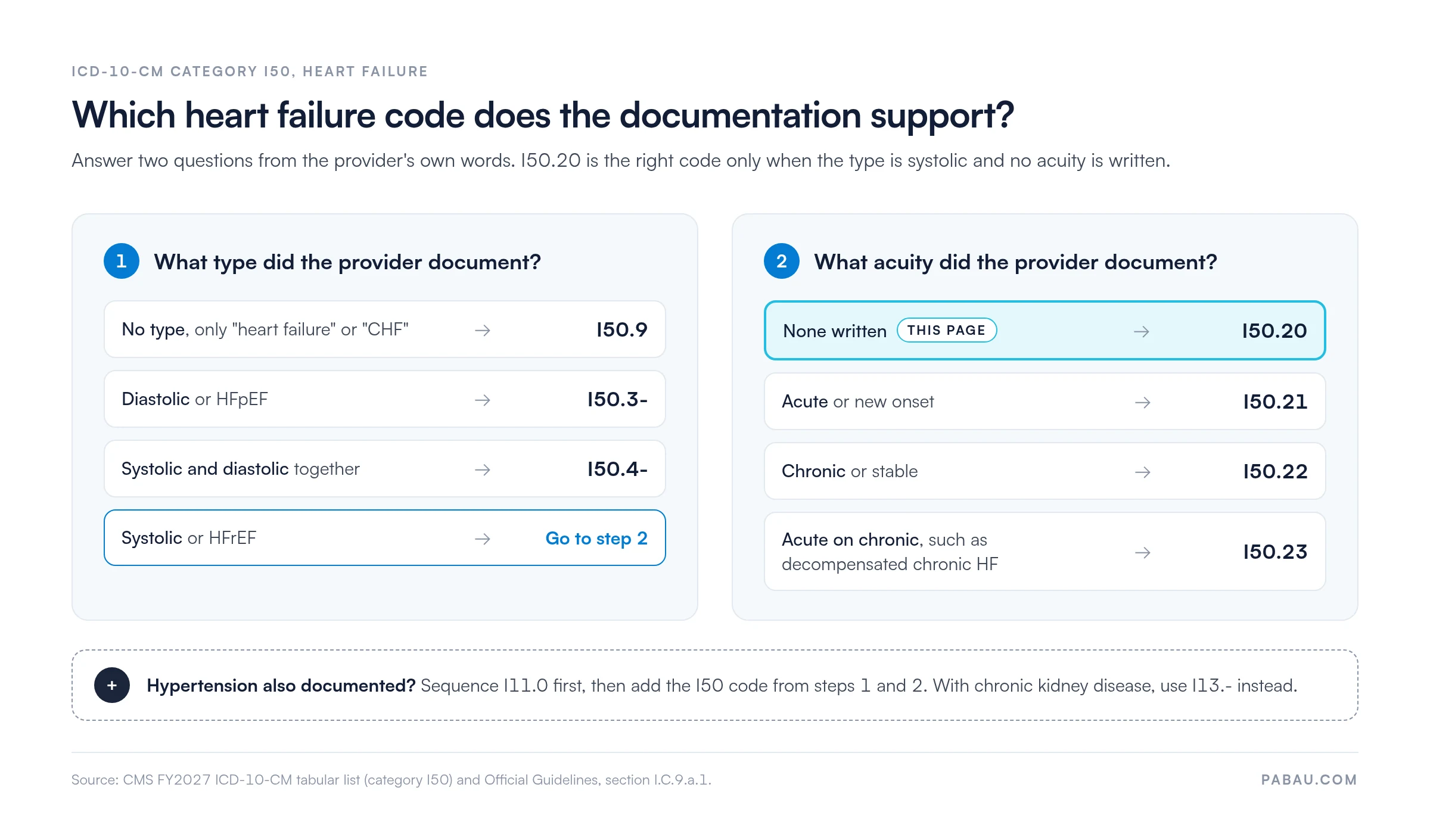
- Heart failure due to hypertension (I11.0)
- Heart failure due to rheumatic heart disease (I09.81)
- Heart failure following cardiac surgery (I97.13x)
Comparison of Diastolic Heart Failure Codes and Criteria
The following table summarizes the differences between the specific codes in the diastolic category to assist in rapid selection and verification.
| ICD-10 Code | Description | Acuity Level | Typical Clinical Presentation |
|---|---|---|---|
| I50.30 | Unspecified diastolic heart failure | Unknown/Not Stated | "Diastolic heart failure" noted without further detail. |
| I50.31 | Acute diastolic heart failure | High/Urgent | Sudden onset; often first-time diagnosis in ER. |
| I50.32 | Chronic diastolic heart failure | Stable/Ongoing | Managed via routine clinic visits; stable symptoms. |
| I50.33 | Acute on chronic diastolic heart failure | Decompensated | Known patient with sudden flare-up or "exacerbation." |
The Impact of Specificity on Risk Adjustment (HCC Coding)
In the current 2026 healthcare landscape, specificity in coding for heart failure is not just about billing—it is about Hierarchical Condition Categories (HCCs). Diastolic heart failure (I50.3x) is a significant "value" code in Medicare Advantage and other risk-sharing models.
When a patient is coded with I50.32 (Chronic Diastolic HF), it signals to the payer that the patient has a complex, chronic condition requiring higher resource allocation. This increases the patient's Risk Adjustment Factor (RAF) score. However, if the coder uses an "unspecified" code or fails to capture the chronic nature of the disease annually, the facility or provider group may lose the funding necessary to manage that patient's care appropriately.
According to the Official ICD-10-CM Guidelines, providers must document the most specific level of detail known at the time of the encounter. For diastolic heart failure, this means identifying the chronic or acute status in every relevant progress note.
Common Pitfalls and Troubleshooting
Medical coders often encounter ambiguous documentation that can lead to incorrect code assignment. Here are common scenarios and how to resolve them:
- "Diastolic Dysfunction" vs. "Diastolic Heart Failure": In many clinical settings, "diastolic dysfunction" is a finding on an echo report, while "diastolic heart failure" is a clinical diagnosis. You cannot code I50.3x based solely on an echo report mentioning dysfunction. The physician must explicitly state "heart failure." If only "dysfunction" is noted, query the provider for clarification.
- Overlapping Ejection Fractions: If a provider documents "Systolic heart failure with an EF of 55%," this is a clinical contradiction (as systolic failure usually implies a low EF). In this case, the coder should query the physician to see if they meant diastolic heart failure (HFpEF).
- Missing Acuity: If a patient is hospitalized for heart failure, but the doctor only writes "HFpEF," the coder should search the history and physical (H&P) or discharge summary for terms like "exacerbation," "flare," or "decompensated" to justify I50.33 instead of I50.30.
Frequently Asked Questions
Is I50.3 the same as HFpEF?
Yes. In the ICD-10-CM index, "Heart failure, preserved ejection fraction [HFpEF]" directs the coder to the I50.3 series. Clinicians in 2026 predominantly use the term HFpEF, but the coding remains anchored to the diastolic designation (I50.3).
Can I code diastolic heart failure if the patient also has hypertension?
Yes, but you must follow the instructional notes for Hypertensive Heart Disease. According to the American Heart Association, there is a strong causal relationship between high blood pressure and heart failure. In ICD-10, you would code I11.0 (Hypertensive heart disease with heart failure) first, followed by the specific I50.3 code to identify the type of heart failure.
What is the difference between I50.32 and I50.33?
I50.32 is for "Chronic" diastolic heart failure, used when the condition is stable. I50.33 is for "Acute on Chronic," used when a patient with an existing chronic condition has a sudden worsening (exacerbation) that requires intensified treatment, usually in an inpatient or observation setting.
How do I code heart failure with "mid-range" ejection fraction?
As of 2026, there is no separate ICD-10 code for "mid-range" ejection fraction (HFmrEF). Most clinical guidelines suggest treating and coding HFmrEF similarly to diastolic heart failure (I50.3x) unless there is documented systolic involvement.
Can I use I50.31 for a patient who was just started on diuretics?
If the physician documents that the patient is in an "acute" state of heart failure requiring the initiation of diuretics to manage fluid overload, I50.31 is appropriate. If the patient is being started on a low-dose diuretic for long-term maintenance of a stable condition, I50.32 is more accurate.
Final Recommendation for Accurate Coding
To ensure the highest level of accuracy and compliance when coding for diastolic heart failure in 2026, always prioritize specificity of acuity. Avoid the unspecified code I50.30 whenever possible by reviewing the entire medical record for mentions of "acute," "chronic," or "exacerbation." For healthcare providers, the best practice is to document "HFpEF" along with its current status (e.g., "Acute on chronic HFpEF") to provide the clearest path for the coding team and to ensure the patient's severity of illness is correctly captured.
Image Gallery