How to Appoint a Registered Agent: Step-by-Step Legal Guide
To appoint a registered agent, select an eligible individual or professional commercial service located within your entity's state of formation, secure their explicit consent to serve, and designate their legal name and physical street...
To appoint a registered agent, select an eligible individual or professional commercial service located within your entity's state of formation, secure their explicit consent to serve, and designate their legal name and physical street address on your official business filing—such as the Articles of Organization or Articles of Incorporation—submitted to the Secretary of State.
Contents
What Is a Registered Agent and Why Is One Required?
A registered agent—known in some jurisdictions as a statutory agent, resident agent, or agent for service of process—is an individual or entity legally designated to receive official government correspondence, legal notices, and service of process on behalf of a business entity.
Service of process refers to the delivery of legal notifications, such as subpoenas, summonses, complaints, and legal proceedings. When a legal action is brought against a business, process servers deliver these court documents directly to the registered agent. Beyond legal notices, the registered agent serves as the legal point of contact for official correspondence from state agencies, including state tax documentation, annual report reminders, and regulatory compliance notices.
- State Government (Secretary of State / Tax Department / State Courts)
- Delivers Legal Process, Tax Statements, & Notices
- Registered Agent (Receives documents at physical office during 9-5 hours)
- Forwards Official Mail & Subpoenas Promptly
- Business Entity (LLC, Corporation, Partnership, Non-Profit)
State statutes across all 50 U.S. states mandate that every formal business structure—including Limited Liability Companies (LLCs), C-Corporations, S-Corporations, Limited Partnerships (LPs), and Limited Liability Partnerships (LLPs)—must continuously maintain a registered agent. This requirement is anchored in statutory law, such as the Model Business Corporation Act and state-specific business entity codes. The purpose of this law is to ensure that the public, state regulators, and courts have a verifiable physical location to reach a representative of the company during business hours.
Failing to maintain an active registered agent can result in serious legal and administrative penalties, including financial fines, loss of good standing, administrative dissolution (where the state revokes the company's legal authorization to operate), and default judgments in civil lawsuits due to missed court summonses.
Disclaimer: This guide is provided for informational purposes only and does not constitute formal legal or financial advice. Business owners should consult a licensed business attorney or certified public accountant regarding specific state compliance laws.
Registered Agent Eligibility Requirements
Before appointing a registered agent, you must verify that the individual or commercial entity satisfies all statutory eligibility requirements imposed by state law. While exact wording varies slightly by state jurisdiction, three core requirements apply universally:
1. Physical Street Address (Registered Office)
The registered agent must maintain a physical street address within the state where the entity is formed or qualified to do business. This address is legally designated as the Registered Office.
- Permitted: Physical commercial office buildings, residential home addresses (if located in the state).
- Prohibited: P.O. Boxes, private mailbox services (such as The UPS Store or FedEx Office boxes), virtual office addresses that lack physical staff, and out-of-state addresses.
2. Physical Availability During Business Hours
The registered agent must be physically present at the registered office address during normal business hours—defined by state statutes as 9:00 AM to 5:00 PM local time, Monday through Friday. This requirement guarantees that legal process servers and state couriers can hand-deliver timesensitive legal documents without prior notification.
3. Legal Authorization and Capacity
- Individual Agents: If an individual is appointed, they must be at least 18 years old and a legal resident of the state in which the business entity operates. An owner, officer, employee, or attorney of the business can serve in this capacity, provided they reside in that state.
- Corporate or Commercial Agents: If an entity is appointed, it must be legally authorized by the Secretary of State to transact business in that state and must specifically hold authorization to offer registered agent services. A business entity cannot serve as its own registered agent (e.g., Acme LLC cannot list Acme LLC as its registered agent), though individual owners or managers of Acme LLC may be listed.
Step-by-Step Guide: How to Appoint a Registered Agent
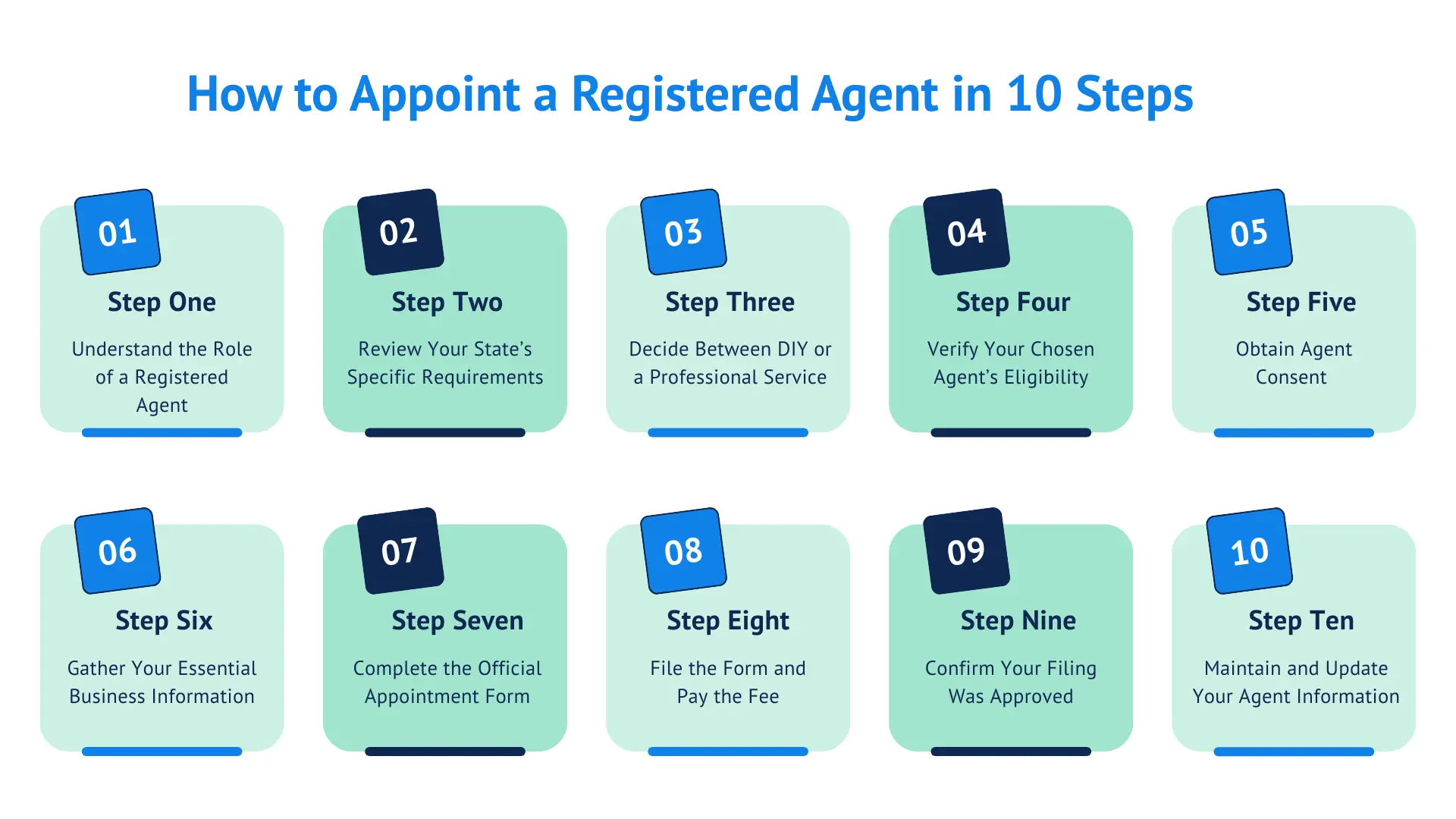
Appointing a registered agent is a structured administrative process executed during initial company formation or updated via formal post-formation filings. Follow these steps to complete the appointment accurately.
- Step 1: Choose Agent Type (Individual vs. Commercial Service)
- Step 2: Secure Explicit Consent from the Appointed Agent
- Step 3: Complete State Business Entity Formation Documents
- Step 4: File Documents & Pay State Filing Fees
- Step 5: Maintain Updated Records & Handle Annual Renewals
Step 1: Determine the Agent Type
Decide whether to appoint an individual (such as yourself, a co-founder, or an in-house corporate counsel) or a registered professional commercial service. Consider factors such as privacy preferences, physical presence during working hours, and whether your business will operate across multiple states.
Step 2: Secure Explicit Consent
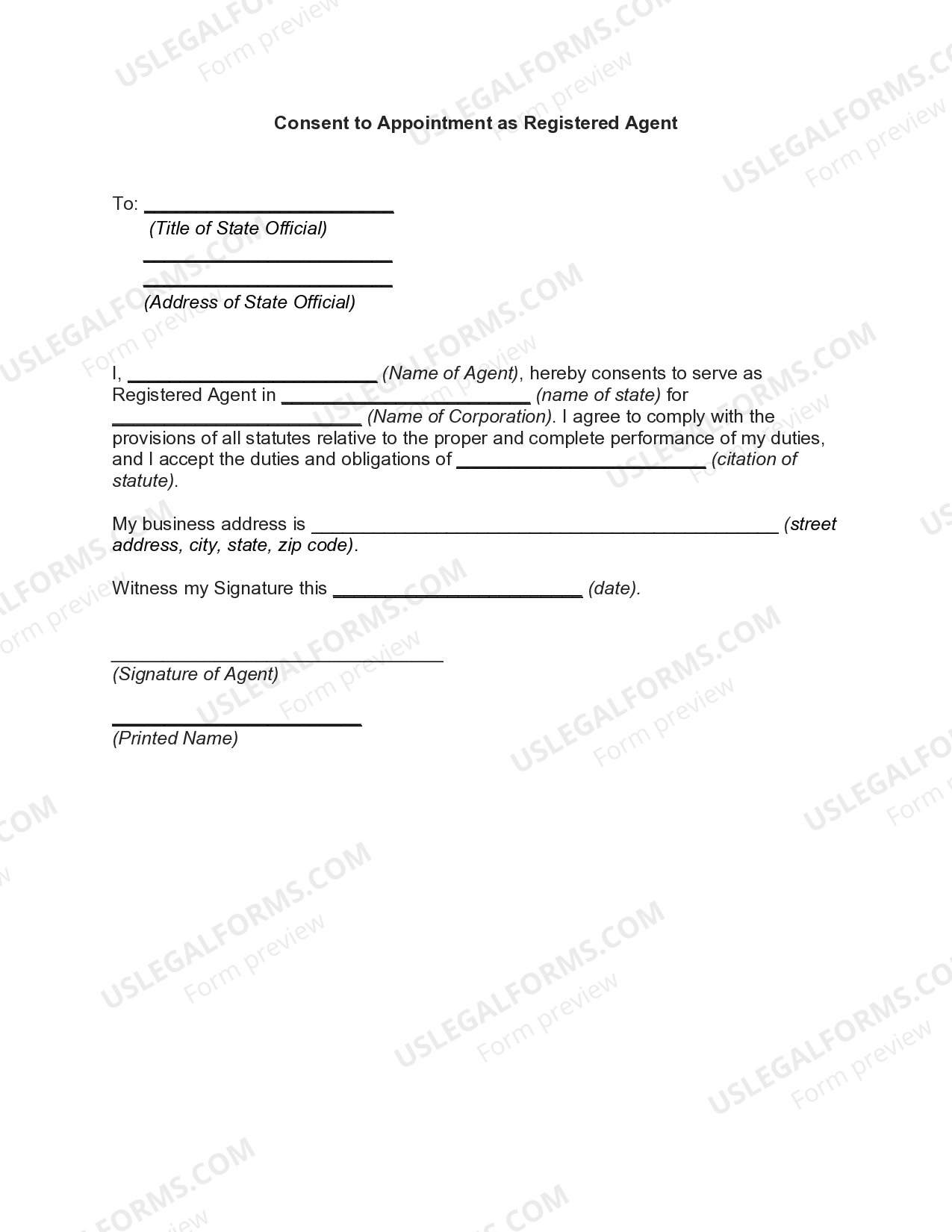
Under state law, you cannot legally appoint a person or service as your registered agent without their prior knowledge and authorization.
- Many states (such as Washington, Kentucky, and Nevada) require a signed Consent of Registered Agent form to be attached to the formation filing.
- Even in states where a signed consent document is not explicitly required at filing, submitting false agent information constitutes perjury or fraudulent filing, exposing the business to administrative invalidation.
Step 3: Complete Formation Filings
When completing your company's formation documents—such as the Articles of Organization for an LLC or the Articles of Incorporation for a Corporation—fill in the designated Registered Agent section. You will be required to provide:
- The full legal name of the registered agent (individual's full legal name or the full registered corporate name of the commercial provider).
- The physical street address of the registered office (including suite or unit numbers; standard P.O. Boxes will result in document rejection by state examiners).
- The mailing address (only if the state permits a separate mailing address for government correspondence alongside the physical address).
Step 4: Submit Filings and Pay Fees
Submit your completed formation documents to the state filing office (typically the Secretary of State, Department of State, or Division of Corporations) online or by mail, along with the state filing fee. The state agency will review the filing to ensure the registered agent's name and address comply with statutory formatting rules.
Step 5: Maintain Agent Information
Once the appointment is effective, your registered agent must remain active. If the agent's physical address changes or if an individual agent moves out of state, an official update form must be submitted immediately to prevent loss of good standing.
Individual Agent vs. Professional Commercial Agent
Choosing between appointing an individual (such as yourself) or hiring a commercial registered agent service is a critical operational decision. The table below outlines key differences across primary business criteria:
| Evaluation Factor | Self-Appointed / Individual Agent | Commercial Registered Agent Service |
|---|---|---|
| Public Record Privacy | Low. Your personal home or office address becomes a public government record searchable online. | High. The commercial service's address is listed on public databases, shielding your home address. |
| Availability Requirement | Must be at the registered address 9:00 AM – 5:00 PM every weekday without exception. | Fully guaranteed. Professional staff are present continuously during all statutory business hours. |
| Cost | Free ($0 in service fees; state filing fees still apply). | $100 to $300 per state per year. |
| Multi-State Operations | Difficult. Requires distinct local individuals in every state where you qualify to do business. | Simple. Single service providers cover all 50 states and U.S. territories. |
| Risk of Embarrassment | High. Lawsuits or court summonses can be served in front of clients, staff, or family. | Zero. Legal documents are served discretely at a commercial corporate facility. |
| Compliance Management | Manual. Business owner must track annual reports, tax filings, and legal deadlines independently. | Automated. Most professional services include digital tracking systems and statutory filing alerts. |
Privacy and Operational Flexibility Considerations
For many small business owners operating out of a home office, listing a personal home address on public Secretary of State records exposes them to unsolicited commercial mail, marketing databases, and unwanted visitors. Utilizing a commercial service keeps home addresses off permanent public records.
Furthermore, sole proprietors or individual agents who travel, meet clients offsite, or take vacations risk missing service of process. If a process server attempts to deliver legal notices and finds no one available, court proceedings may move forward without the business owner's knowledge. This can lead to a default judgment, in which a judge rules against the business due to failure to respond to a lawsuit.
Detailed guidelines on legal business structures and compliance requirements are maintained by the U.S. Small Business Administration (SBA).
Appointing a Registered Agent for Foreign Qualification
When an existing business expands operations beyond its home state (its "domestic" state) into another jurisdiction, it must apply for a Certificate of Authority or Foreign Qualification in the new state.
- Domestic State (Original State of Formation)
- LLC / Corp Formation Document Appoints Domestic Agent
- Domestic Registered Agent: Physical address in Home State
- Foreign State (Expansion State Jurisdiction)
- Application for Foreign Qualification / Authority
- Foreign Registered Agent: Physical address in Foreign State
Key Considerations for Foreign Registration:
- Local Presence Rule: A domestic registered agent in your home state cannot serve in a foreign state unless they also have a physical street address and authorization in that target foreign state.
- Consolidated Providers: Companies expanding into multiple states frequently utilize nationwide commercial registered agent services. A single provider can act as the registered agent across all jurisdictions, centralizing legal notices and compliance calendars onto a unified online dashboard.
- State Inconsistencies: State filing fees and rules for foreign qualification vary. For instance, states like Delaware require foreign entities to remain in active standing at home before issuing authorization to operate within their state jurisdiction. You can verify state-specific corporate guidelines via official repositories such as the Delaware Division of Corporations.
How to Change Your Registered Agent
If your current registered agent moves, resigns, stops offering services, or if you decide to switch from an individual to a professional service, you must file a formal legal amendment with the state.
- Step 1: Select and Secure Consent from the New Registered Agent
- Step 2: Obtain Official Change Form from the Secretary of State (e.g., "Statement of Change of Registered Agent")
- Step 3: Complete New Agent Details & Execute the Filing
- Step 4: Pay Required State Amendment Fee ($10 - $100 depending on state)
- Step 5: Verify System Processing & Notify the Outgoing Agent
The Change Process:
- Draft the Statement of Change: Obtain the official form—commonly titled Statement of Change of Registered Agent, Certificate of Change, or Notice of Change of Statutory Agent—from your Secretary of State’s business filings portal.
- Execute the Document: Fill out the entity name, state entity ID number, the outgoing agent’s details, and the new agent’s full legal name and physical address.
- Pay Filing Fees: State change fees range from $10 to $100 depending on the jurisdiction. Some states allow free updates during the submission of the company’s annual report filing.
- Prevent Service Gaps: Do not cancel your contract with an existing registered agent service until the state officially processes and approves the change filing. A gap in registered agent coverage leaves the company non-compliant and vulnerable to administrative dissolution.
Common Mistakes to Avoid
Appointing or managing a registered agent involves strict regulatory compliance. Avoid these common legal pitfalls:
- Using a P.O. Box or Mail Drop: State filing offices automatically reject filings that list P.O. Boxes, private mailbox dropboxes, or virtual addresses without physical personnel.
- Failing to Obtain Prior Consent: Appointing an individual or commercial agent without securing prior legal authorization can result in rejected filings, invalid service of process, and potential fraud penalties.
- Ignoring Address Updates: If an individual registered agent moves to a new residence or office, a formal change of address form must be filed with the Secretary of State immediately. Outdated addresses lead to missed legal notices and state compliance warnings.
- Failing to Track Agent Resignations: If a registered agent formally resigns with the state, the state will issue a formal notice granting the business a limited window (typically 30 to 60 days) to appoint a successor. Failing to appoint a replacement within this timeframe results in administrative termination of the business entity.
Frequently Asked Questions
Can I serve as my own registered agent?
Yes. If you are at least 18 years old and reside in the state where your business is formed or registered, you can legally serve as your own registered agent. However, doing so requires your personal address to be published on searchable public government databases and mandates your physical presence at that address during standard business hours (9:00 AM to 5:00 PM, Monday through Friday).
What is the difference between a commercial and non-commercial registered agent?
A commercial registered agent is a professional service provider or business entity that has filed formal notice with the Secretary of State to act as an agent for multiple businesses. A non-commercial agent is an individual (such as a business owner, attorney, or friend) or an unlisted company designated to serve as the agent for a specific entity.
What happens if my registered agent is served with a lawsuit?
When a registered agent receives a legal summons or subpoena, they log the delivery date and time, scan the documents, and transmit them immediately to the designated business point of contact via secure mail or electronic upload. Prompt delivery is essential, as legal responses to court summonses usually carry strict statutory deadlines (often 20 to 30 days).
How much does it cost to appoint a professional registered agent service?
Hiring a commercial registered agent service generally costs between $100 and $300 annually per state. State filing fees for changing an agent typically range between $0 and $100 depending on the state jurisdiction.
Can a registered agent resign from their position?
Yes. A registered agent has the legal right to resign by submitting a formal Statement of Resignation to the Secretary of State and delivering a copy to the business entity. Upon receipt, the state notifies the business that it must appoint a replacement registered agent within a specified statutory period to maintain active legal standing.
Next Steps for Business Owners
Appointing the right registered agent is an essential foundational step in establishing and protecting your business entity. Take the following legal and operational actions:
- Assess Operational Needs: Evaluate whether an individual or a commercial registered agent service aligns best with your privacy preferences, operational schedule, and multi-state expansion plans.
- Secure Written Consent: Prior to submitting formation or change documents, ensure the designated agent agrees to accept legal service of process on behalf of your entity.
- Verify Registered Office Details: Double-check that the provided street address is a physical location in the state of registration, not a P.O. Box or virtual box.
- Complete State Filings: Submit your Articles of Organization, Articles of Incorporation, or Statement of Change accurately through your state’s online business portal.
- Establish a Compliance Calendar: Maintain an internal system or leverage your commercial provider’s dashboard to track annual report deadlines, franchise tax submissions, and registered agent address updates.
Image Gallery