Darius Rucker Guitars: A Deep Dive into the Instruments of a Country Icon
Darius Rucker primarily uses Fender guitars, most notably his signature Fender Paramount Darius Rucker Signature acoustic-electric. Throughout his expansive career spanning 90s rock with Hootie & the Blowfish to his superstardom in cou...
Darius Rucker primarily uses Fender guitars, most notably his signature Fender Paramount Darius Rucker Signature acoustic-electric. Throughout his expansive career spanning 90s rock with Hootie & the Blowfish to his superstardom in country music, he has also relied heavily on Gibson J-45s, Guild acoustics, and Fender Telecasters to complement his distinct baritone voice.
Contents
Darius Rucker’s journey through the music industry is as much a story of sonic evolution as it is a career shift. From the jangly, acoustic-driven rock of the mid-1990s to the polished, twangy anthems of modern country, Rucker has maintained a consistent philosophy regarding his gear: functionality, reliability, and tonal warmth. As of 2026, Rucker remains a prominent Fender artist, but his collection reflects a deep appreciation for the "workhorse" instruments that have defined American music for decades.
The Fender Darius Rucker Signature Paramount
The most significant development in Rucker's gear arsenal in recent years is the release and continued use of his signature model within the Fender Paramount series. This instrument was designed to meet the specific demands of a touring country artist who needs a consistent sound across massive outdoor amphitheaters and intimate studio settings.
Design and Tonewoods
The Darius Rucker Signature Paramount is a dreadnought-style acoustic, a choice that aligns with Rucker’s role as a primary rhythm guitarist. The dreadnought shape is renowned for its bold volume and low-end projection, which provides a necessary foundation for Rucker’s deep vocal range.
The guitar features a solid Sitka spruce top paired with solid mahogany back and sides. This classic combination is the gold standard for singer-songwriters. The spruce provides the "snap" and clarity needed for the notes to cut through a dense mix of drums and bass, while the mahogany offers a warm, woody midrange that avoids the potentially "ice-picky" highs of rosewood. For a baritone singer like Rucker, mahogany is essential because it occupies a frequency space that supports the voice rather than competing with it.
Aesthetics and Electronics
Visually, the signature model reflects Rucker’s understated style. It often features a thin nitrocellulose finish that allows the wood to breathe and age naturally. The appointments are classic, including a tortoiseshell pickguard and a traditional bridge design.
For live performances in 2026, the guitar is equipped with high-end Fishman electronics. Specifically, it utilizes a Sonitone pickup system or the newer Presys variants, which allow for discrete control over volume and tone without requiring large, unsightly holes to be cut into the side of the guitar. This ensures that the acoustic resonance of the instrument is preserved while providing a reliable "plug-and-play" solution for his technical crew.
The Legacy of the Gibson J-45
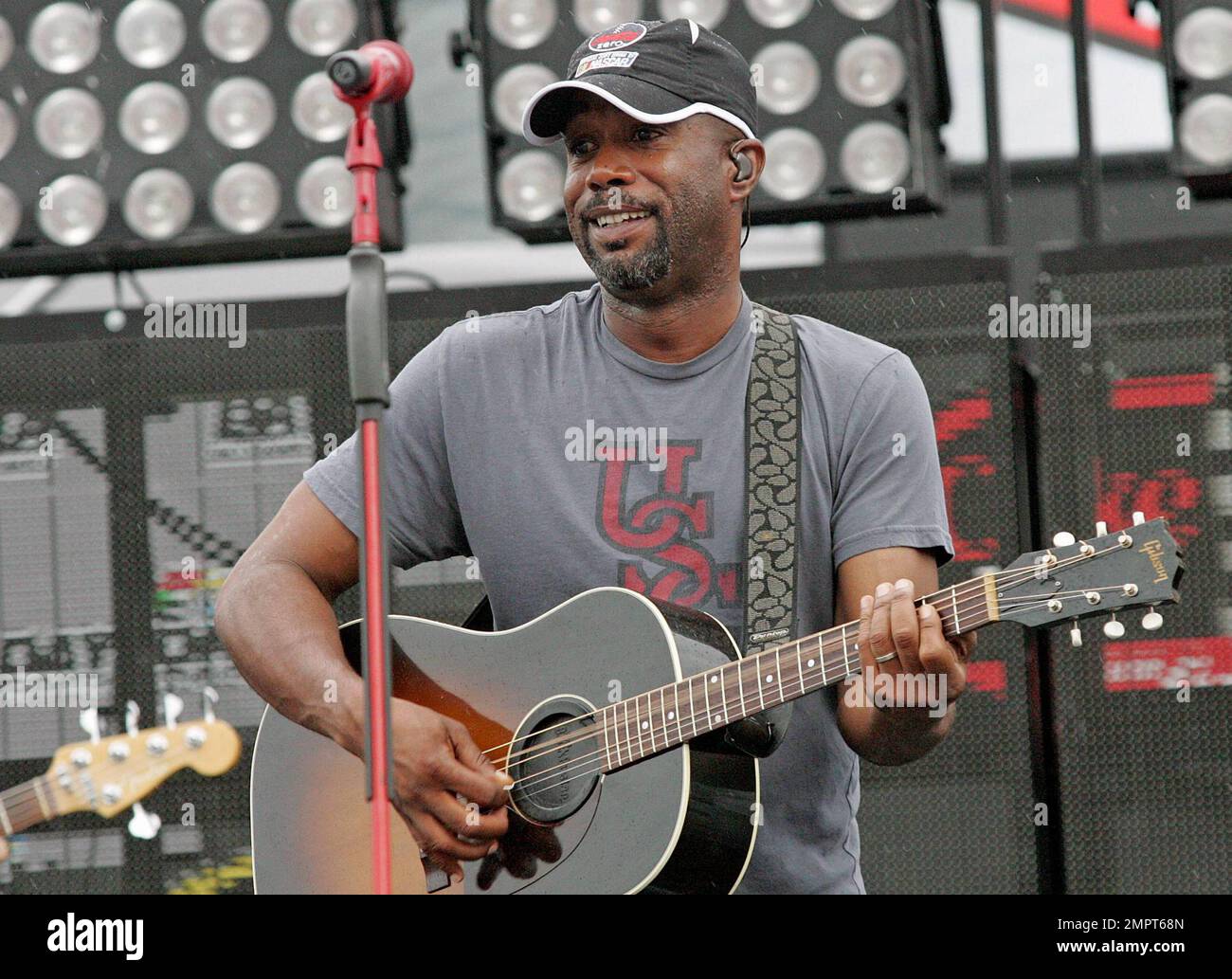
Before his official partnership with Fender, and continuing as a staple in his private collection, the Gibson J-45 played a pivotal role in shaping Rucker’s sound. Known as "The Workhorse," the J-45 has been a favorite of country and folk artists since its introduction in 1942.
Why the J-45 Suits Rucker
The J-45 is famous for its "round-shoulder" design, which creates a slightly more compressed and balanced sound compared to the square-shoulder dreadnoughts produced by Martin. For Rucker, this balance is critical. During his early country years, particularly around the Learn to Live (2008) era, the J-45 provided the percussive "thump" required for hits like "Don't Think I Don't Think About It."
Rucker’s J-45s are typically vintage or Custom Shop reissues, often finished in the iconic Vintage Sunburst. The shortened scale length of the J-45 (24.75 inches) also offers a slightly lower string tension, making it easier to play during long, high-energy sets where Rucker is both singing and leading the rhythm section.
Electric Evolution: The Fender Telecaster
While Rucker is most frequently seen with an acoustic guitar draped over his shoulder, his transition to country music necessitated a more frequent use of electric guitars for specific tracks and textures. In the country genre, there is no instrument more ubiquitous or essential than the Fender Telecaster.
The Country Workhorse
Rucker’s Telecasters are usually vintage-spec models, such as the '50s American Vintage II or Custom Shop "Nocaster" builds. He favors the bridge pickup’s "twang"—that sharp, biting treble that defines modern country leads—but he often uses the middle position (both pickups) to get a fuller, more chime-like rhythm tone.
The simplicity of the Telecaster matches Rucker's "no-frills" approach to gear. With just two pickups and a fixed bridge, there are fewer moving parts to fail during a tour. Furthermore, the ash or alder bodies of his Telecasters provide a solid, weighty feel that balances well on stage. In his 2026 touring rig, these electrics are often paired with Fender '65 Deluxe Reverb or Twin Reverb amplifiers, providing a clean, high-headroom canvas for his sound.
Looking Back: The Hootie & the Blowfish Era
To understand Rucker’s current gear preferences, one must look back at the instruments that powered the 90s rock revolution. During the height of Hootie & the Blowfish’s success, Rucker was often seen with Guild and Taylor acoustics.
- Guild D-55: This was a staple for Rucker in the mid-90s. Guild guitars are known for being incredibly sturdy—almost overbuilt—which made them perfect for the aggressive strumming style Rucker employed on tracks like "Only Wanna Be With You."
- Taylor 810 and 910: As the band’s production values increased, Rucker began using Taylor guitars. Taylor’s "modern" acoustic sound—characterized by a bright top-end and exceptional playability—helped the acoustic guitars sit perfectly in the radio-friendly mixes of the time.
The shift from Guild and Taylor toward Fender and Gibson in his later career represents a move from the "hi-fi" acoustic sound of 90s pop-rock toward the "earthier," more traditional tones of Nashville country.
Technical Specifications Comparison
The following table compares the primary instruments Rucker has utilized throughout the different phases of his career, illustrating the shift in tonewoods and body styles.
| Guitar Model | Primary Era | Body Wood (Back/Sides) | Top Wood | Key Tonal Characteristic |
|---|---|---|---|---|
| Fender Signature Paramount | 2022–2026 | Solid Mahogany | Solid Sitka Spruce | Warm, balanced, vocal-friendly |
| Gibson J-45 | 2008–Present | Solid Mahogany | Solid Sitka Spruce | Percussive "thump," vintage grit |
| Guild D-55 | 1994–2000 | Solid Rosewood | Solid Sitka Spruce | High volume, rich overtones |
| Fender Telecaster | 2008–Present | Ash or Alder | N/A (Solid Body) | Biting "twang" and clarity |
| Taylor 810 | 1996–2005 | Solid Rosewood | Solid Sitka Spruce | Modern, bright, "hi-fi" sparkle |
The Guitar as a Songwriting Tool
For Darius Rucker, the guitar is first and foremost a tool for composition. He has frequently stated in interviews that most of his hits begin with him sitting on a couch with a simple acoustic. This is why he favors "comfortable" guitars.
His preference for mahogany-backed instruments is not just a stage requirement but a songwriting one. Mahogany’s "dry" sound (meaning it has fewer complex overtones than rosewood) allows the songwriter to hear the melody and lyrics more clearly without the guitar "getting in the way." When writing his more recent material, Rucker often reaches for a Fender CP-100 Parlor guitar or a similar small-bodied instrument, which provides an intimate playing experience compared to the massive dreadnoughts used on stage.
Maintenance and Rig Configuration in 2026
Maintaining a fleet of high-end instruments on the road requires a dedicated tech team. Rucker’s guitars are typically strung with D'Addario Phosphor Bronze strings (usually 12-53 light gauge for acoustics) to provide a balance between longevity and tone.
His live signal chain is notably clean. For the acoustics, the signal often goes through a high-quality DI (Direct Input) box like the LR Baggs Para Acoustic DI or a Radial J48 before hitting the front-of-house console. This keeps the signal pure and minimizes the feedback issues that often plague acoustic guitars in loud, full-band country settings.
Frequently Asked Questions
What was the first guitar Darius Rucker ever owned?
While Rucker has played many high-end instruments, his first guitar was a budget acoustic gifted to him during his youth. He has often mentioned that he didn't become a "gear head" until Hootie & the Blowfish signed their first major record deal, at which point he invested in the Guild and Taylor models that defined his 90s sound.
Does Darius Rucker play his signature Fender model during every show?
Yes, in 2026, the Fender Paramount Signature is his "number one" acoustic for live performances. He typically keeps several on hand in different tunings (such as half-step down or Open G) to accommodate the various keys of his discography without needing to pause the show for retuning.
Why did Darius Rucker switch from Taylor to Fender?
The switch was largely driven by his transition to the country genre and an official partnership with Fender. While Taylor makes exceptional instruments, the aesthetic and tonal profile of Fender and Gibson better aligns with the traditionalist visual requirements of modern country music.
What kind of picks does Darius Rucker use?
Rucker typically uses heavy-gauge celluloid picks, often custom-printed with his logo or tour branding. A heavier pick allows him to drive the top of a dreadnought guitar more effectively, producing the volume and punch needed for his rhythmic playing style.
Does he use any specific pedals for his acoustic guitar?
Generally, Rucker avoids a complex pedalboard for his acoustic. He relies on the engineers to handle EQ and compression. However, he has been known to use a simple tuner pedal (like the Boss TU-3) and occasionally a light reverb or chorus for slower ballads to add a sense of space to the mix.
Final Recommendation for Achieving the Rucker Tone
If you are looking to emulate Darius Rucker’s signature sound, the most effective route is to prioritize a mahogany-bodied dreadnought. While his Fender signature model is the most direct path, any high-quality mahogany acoustic will get you into the ballpark. Focus on a strong, consistent down-stroke strumming pattern and use a heavy pick to bring out the low-end resonance of the instrument. For electric players, a Telecaster through a clean Fender-style amp with just a touch of spring reverb will replicate his country-era "plugged-in" vibe perfectly.
Image Gallery