Partnair Flight 394: The Counterfeit Parts Catastrophe and Its Enduring Safety Legacy in 2026
On September 8, 1989, Partnair Flight 394 plunged into the Skagerrak strait off the coast of Denmark, claiming the lives of all 55 passengers and crew members aboard. The disaster remains the deadliest aviation accident in Norwegian hi...
On September 8, 1989, Partnair Flight 394 plunged into the Skagerrak strait off the coast of Denmark, claiming the lives of all 55 passengers and crew members aboard. The disaster remains the deadliest aviation accident in Norwegian history. Beyond the immediate tragedy, the investigation into Flight 394 exposed a systemic, illicit industry operating within commercial aviation: the proliferation of substandard, counterfeit, and unapproved aircraft parts.
Contents
Over three decades later, the forensic discoveries made in the wreckage of that chartered Convair CV-580 continue to serve as the bedrock of global aerospace supply chain integrity. As the aviation sector in 2026 deploys advanced digital tracking and machine-learning metallurgical verification, the lessons of Partnair Flight 394 remain essential study for safety auditors, maintenance engineers, and aviation regulators worldwide.
Flight History and the Convair CV-580 Airframe
Partnair Flight 394 was an unscheduled passenger charter service originating from Oslo Airport, Fornebu, bound for Hamburg Airport, Germany. The charter was booked by the Norwegian shipping conglomerate Wilhelmsen Lines to transport 50 employees to the christening of a new vessel. The flight crew consisted of two highly experienced pilots: a 51-year-old captain with nearly 17,000 flight hours and a 59-year-old first officer with over 18,000 flight hours.
The aircraft assigned to the route was a twin-engine Convair CV-580, registration LN-PAA. Originally manufactured in 1953 as a piston-powered Convair CV-340, the airframe had been retrofitted with Allison 501-D13D turboprop engines. This popular turboprop conversion radically increased the airframe's power, operating ceiling, and service life, but it also altered the structural dynamics and vibrational loads transmitted through the empennage.
Prior to departing Oslo, the flight crew encountered an electrical issue: one of the two main engine-driven generators was defective. To comply with Minimum Equipment List (MEL) regulations for flight across open water, the crew opted to run the auxiliary power unit (APU)—located in the tail cone of the aircraft—throughout the duration of the flight. This operational decision inadvertently introduced a crucial vibrational catalyst into an already compromised structural assembly.
The Sequence of Catastrophic Structural Failure
Cruising at Flight Level 220 (approximately 22,000 feet) over the North Sea, the aircraft entered the cruising phase uneventfully. However, as the aircraft leveled off, passengers and flight instrumentation began experiencing severe, unusual low-frequency vibrations.
Within minutes, the structural integrity of the empennage deteriorated completely:
- Vibrational Coupling: The operating APU in the tail cone, mounted on a broken front support bracket that had been patched with an unauthorized repair, transmitted sustained harmonic vibrations directly through the rear fuselage.
- Resonant Oscillation: The frequency of the APU vibration aligned closely with the natural resonance frequency of the vertical stabilizer.
- Aeroelastic Flutter: Due to microscopic mechanical play in the vertical stabilizer's mounting assembly, aerodynamic loads amplified the oscillations into violent aeroelastic flutter.
- Structural Separation: The vertical stabilizer tore free from the fuselage attachment fittings.
- Loss of Control and In-Flight Breakup: Stripped of directional stability, the CV-580 pitched violently down and rolled uncontrollably. Dynamic aerodynamic loads far exceeded the ultimate design limits of the airframe, tearing the wings and empennage apart before the wreckage impacted the sea at high speed.
Forensic Metallurgical Investigation: Uncovering Bogus Parts
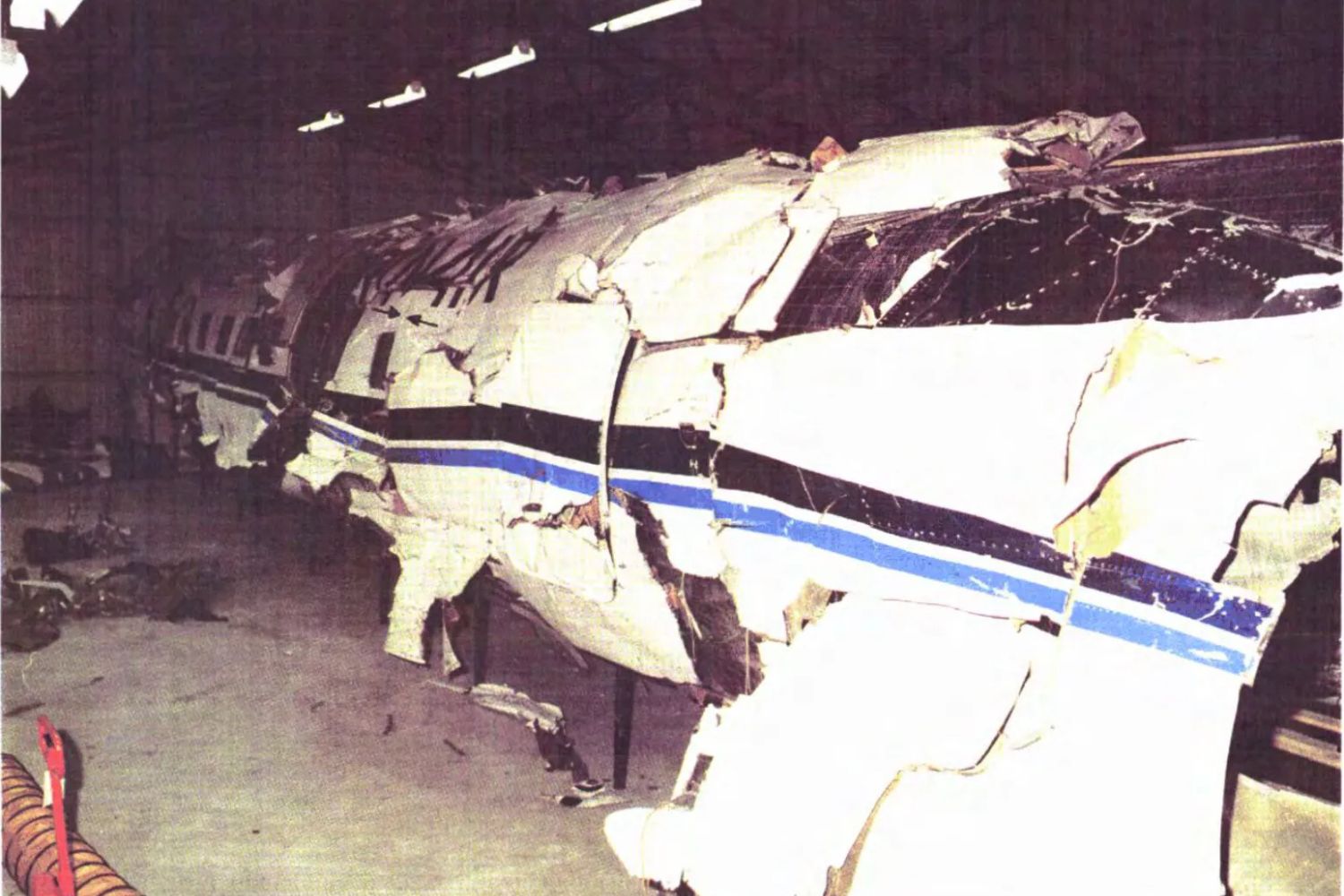
The Accident Investigation Board Norway (AIBN)—now the Norwegian Safety Investigation Authority—led an exhaustive salvage and reconstruction effort, recovering approximately 90% of the aircraft from the seabed. Initial theories pointed toward an external bomb or a mid-air collision with a military jet, as military exercises were active in the Skagerrak corridor at the time. Thorough forensic chemical analysis of the wreckage completely eliminated the possibility of explosives or physical contact with another aircraft.
Investigators shifted their focus to the vertical stabilizer attachment assembly. The CV-580 utilized four precision-engineered bolts to secure the base of the vertical fin to the structural bulkheads of the fuselage.
When metallurgical laboratories analyzed the recovered bolts, they made an alarming discovery:
- Three of the four bolts securing the vertical stabilizer were counterfeit, commercially fabricated fasteners that fell drastically short of aerospace specifications.
- The bolts were manufactured from standard, low-grade carbon steel rather than the required heat-treated aerospace-grade alloy steel (such as AISI 8740 or equivalent).
- The bogus fasteners had received only a thin, decorative plating to mimic the appearance of genuine parts, but they exhibited micro-voids, inconsistent thread pitches, and zero verifiable trace hardening.
- Laboratory destructive tensile testing revealed that the bogus bolts possessed only 60% of the ultimate shear and tensile strength mandated by the aircraft’s type certificate.
Because the counterfeit bolts lacked the required mechanical hardness and yield strength, normal aerodynamic loads caused them to stretch, wear prematurely, and deform under cyclic stress. This deformation created tiny clearances—fractions of a millimeter—between the bolt shanks and the mounting lugs. When the APU's mechanical vibrations resonated through the tail section, this microscopic slack allowed the vertical stabilizer to shake back and forth freely, triggering the catastrophic aeroelastic flutter that sheared the assemblies apart.
Technical Comparison: Certified vs. Counterfeit Aircraft Fasteners
The following table contrasts the metallurgical and regulatory parameters of certified aerospace-grade structural bolts against the counterfeit hardware recovered from Partnair Flight 394:
| Engineering Parameter | Certified Aerospace Structural Fastener (NAS/MS Standard) | Recovered Counterfeit Fasteners (Flight 394) | Operational Safety Impact |
|---|---|---|---|
| Material Composition | Certified high-grade alloy steel (e.g., AISI 4140, 4340, or 8740) | Unalloyed, low-carbon commercial steel | Inadequate yield strength; rapid structural elongation under standard operating load. |
| Heat Treatment | Uniformly quenched and tempered to strict Rockwell C hardness tolerances (36–40 HRC) | Non-uniform or completely absent thermal treatment | Catastrophic vulnerability to cyclic fatigue failure and early brittle fracture. |
| Tensile & Shear Capacity | Verified to minimum 125,000–160,000 PSI tensile strength | Measured at roughly 60% of minimum aerospace design threshold | Rapid fatigue failure under combined gust loads and engine/APU harmonic resonance. |
| Traceability & Documentation | FAA Form 8130-3 / EASA Form 1 with continuous chain-of-custody lot tracking | Forged paperwork, missing manufacturer trace tags, or shell-distributor certs | Inability to track manufacturing origin, lifecycle hours, or known supplier defects. |
| Microstructural Integrity | Flawless crystalline grain flow aligned along the bolt head and rolled threads | Porous grain boundaries, thread cut instead of rolled, causing sharp stress risers | Severe vulnerability to micro-cracking under low-amplitude vibration cycles. |
The Global Crackdown on Suspected Unapproved Parts (SUP)
The findings of the Partnair Flight 394 investigation exposed a dark corner of the international aviation supply chain: an active black market for unapproved, surplus, scrap, and counterfeit aircraft components. Driven by high profit margins and lax maintenance procurement oversight during the late 1980s, rogue brokers were buying discarded aircraft components from scrap yards, polishing them, forging airworthiness documentation, and reintroducing them into global inventory pools.
The disaster prompted sweeping changes across global aviation authorities, most notably the Federal Aviation Administration (FAA) and European regulatory predecessors to the European Union Aviation Safety Agency (EASA):
Core Regulatory Transformation Following Partnair 394:
The crash established the global Suspected Unapproved Parts (SUP) notification network. It mandated that any discovered counterfeit, undocumented, or substandard aircraft component must be reported immediately to civil aviation authorities and quarantined to prevent re-entry into the supply chain.
It dismantled self-certification loopholes for unapproved third-party distributors. It established severe criminal penalties for forging FAA Form 8130-3 or international equivalent airworthiness approval tags, making documentation fraud a federal crime.
These changes gave rise to comprehensive supplier auditing requirements, demanding continuous, cradle-to-grave traceability for life-limited and structural aircraft parts.
Modern Aerospace Supply Chain Integrity in 2026
The structural failure of Flight 394 remains central to modern Quality Assurance (QA) and Continuing Airworthiness Management (CAMO) architectures. In 2026, aviation maintenance organizations use advanced defensive layers to ensure counterfeit parts cannot breach certified supply chains:
- Digital Provenance and Distributed Ledgers: Parts distribution channels in 2026 rely on cryptographic chains of custody. Every maintenance event, overhaul, and component handover is logged into decentralized, tamper-proof tracking ledgers, permanently retiring components when they reach life-cycle limits.
- Non-Destructive Testing (NDT) at Receiving Inspection: Certified repair stations no longer rely solely on visual inspection or paper certificates. Critical fasteners and structural assemblies undergo automated X-ray fluorescence (XRF) spectrometry at the receiving dock to instantly verify alloy chemistry and heat-treatment signatures against original engineering specifications.
- Rigid Vendor Authorization Frameworks: Maintenance, Repair, and Overhaul (MRO) facilities are strictly forbidden from procuring safety-critical hardware from unverified brokers. Procurement must flow directly through Original Equipment Manufacturer (OEM) channels or fully certified tier-one distributors.
- Active Scrap Destruction Protocols: When structural parts, turbine blades, or airframe bolts reach life limits or fail inspection, maintenance personnel must physically cut, crush, or mutilate the item before disposal. This eliminates the risk that discarded hardware can be refurbished and illegally resold.
Frequently Asked Questions
What caused the crash of Partnair Flight 394?
Partnair Flight 394 crashed due to severe aeroelastic flutter that tore the vertical stabilizer from the aircraft in mid-flight. This aeroelastic flutter was triggered by harmonic vibrations from the tail-mounted auxiliary power unit (APU) acting on loose, counterfeit vertical stabilizer attachment bolts that lacked the structural strength of certified aircraft hardware.
How many people died on Partnair Flight 394?
All 55 people on board—50 passengers and 5 crew members—perished when the aircraft broke apart and struck the waters of the Skagerrak. The passengers were primarily employees of the Norwegian shipping company Wilhelmsen Lines en route to a corporate event in Hamburg.
What are "bogus parts" in aviation?
Bogus parts, formally classified as Suspected Unapproved Parts (SUP), are aircraft components that have not been manufactured, overhauled, or documented in accordance with approved aviation safety regulations. They include counterfeit items made from substandard materials, stolen parts, discarded parts salvaged from scrap yards and falsely repapered, and parts that have exceeded their allowable operational life limits.
How did counterfeit bolts get installed on an active airliner?
In the late 1980s, the aviation parts broker system had weak regulatory oversight, relying heavily on easily forged paper certificates without centralized digital validation. Partnair’s maintenance suppliers unwittingly purchased the bogus bolts from a broker who had acquired improperly certified hardware, assuming the low-cost components met original factory specifications.
What was the single biggest safety advancement resulting from the disaster?
The disaster established the modern FAA and international Suspected Unapproved Parts (SUP) reporting and enforcement programs. It made the distribution and installation of counterfeit aviation hardware a major regulatory and criminal offense while establishing rigorous chain-of-custody documentation requirements worldwide.
Upholding Safety Standards in Flight Operations
The legacy of Partnair Flight 394 serves as a permanent reminder that aviation safety relies as much on procurement integrity as it does on pilot competency and aerodynamic design. A single compromised fastener can cause an entire airframe to fail. Maintaining zero-tolerance quality assurance protocols, performing rigorous receiving inspections, and enforcing complete supply chain transparency remain non-negotiable requirements for every aviation professional and maintenance organization in 2026 and beyond.
Image Gallery