Understanding Liability-Driven Investment (LDI) Strategies: A Comprehensive Guide for 2026
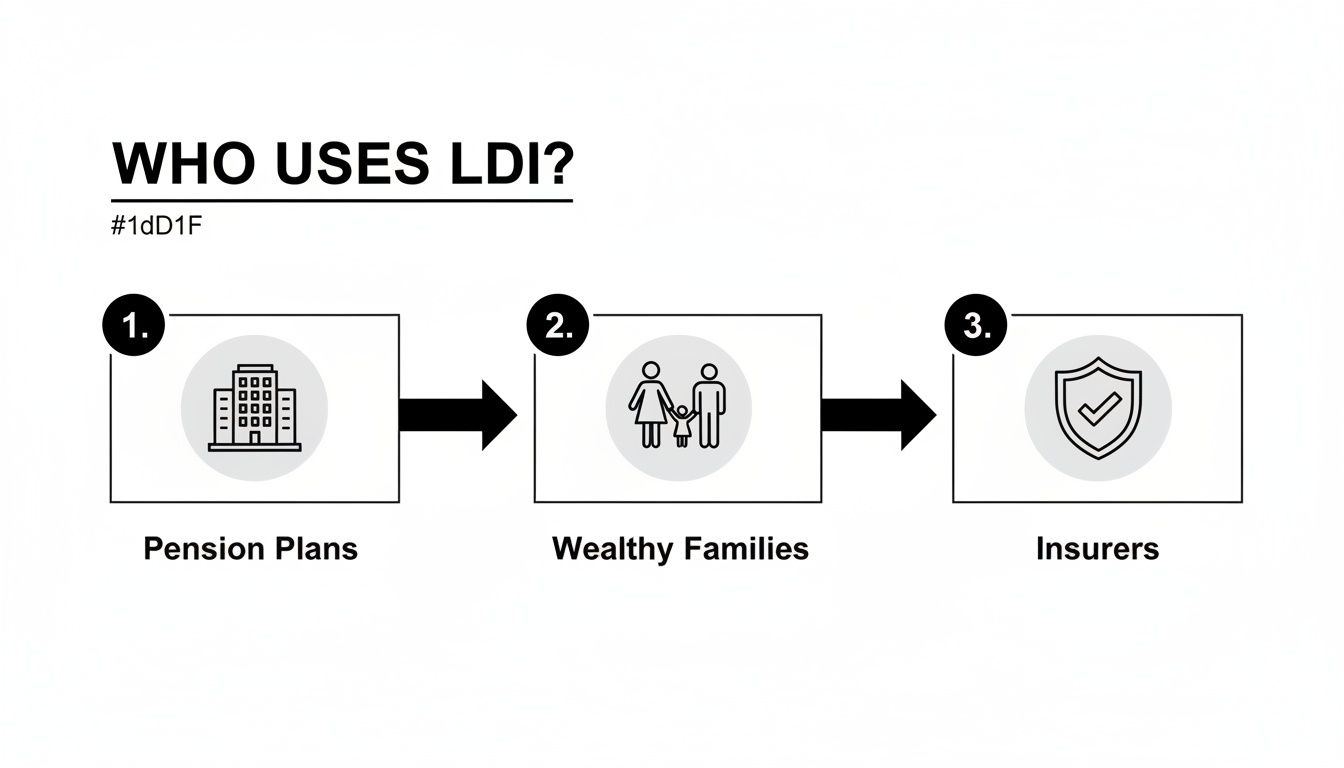
Liability-Driven Investment (LDI) is a sophisticated investment framework designed to match an institution's assets with its current and future liabilities. Primarily utilized by defined benefit pension plans, LDI prioritizes the stabi...
Liability-Driven Investment (LDI) is a sophisticated investment framework designed to match an institution's assets with its current and future liabilities. Primarily utilized by defined benefit pension plans, LDI prioritizes the stability of a fund's solvency ratio by hedging against interest rate and inflation risks through specialized bond portfolios and derivative instruments, rather than focusing solely on absolute market returns.
Contents
In the complex landscape of institutional finance, LDI has become the standard for managing long-term obligations. Whether you are a pension trustee, a corporate treasurer, or a finance professional, understanding how these strategies function is critical for maintaining fiscal health in an era of fluctuating interest rates. As of 2026, the evolution of LDI has reached a state of "Resilient LDI," characterized by higher liquidity buffers and more robust collateral management than seen in previous decades.
The Core Philosophy of LDI Strategies
Traditional investment strategies often focus on maximizing the "Alpha" or the total return of a portfolio relative to a benchmark like the S&P 500. While this is effective for individual wealth accumulation, it is often insufficient for institutions that owe specific amounts of money at specific dates in the future—such as a pension fund paying out retirees.
The fundamental shift in an LDI approach is moving the focus from asset-only returns to surplus volatility. In an LDI framework, the "benchmark" is not a market index; it is the present value of the liabilities. If the value of the liabilities increases because interest rates have fallen, the LDI strategy ensures the value of the assets increases by a corresponding amount, thereby protecting the funding ratio.
The Mathematics of Liabilities
To understand LDI, one must understand how liabilities are valued. Pension liabilities are essentially a series of future cash outflows. To determine how much money a fund needs today to meet those future payments, those cash flows must be "discounted" back to the present using a discount rate—usually based on high-quality corporate bond yields or government bond (gilt) yields.
There is an inverse relationship between discount rates and the present value of liabilities:
- When interest rates fall: The discount rate decreases, and the present value of future liabilities rises.
- When interest rates rise: The discount rate increases, and the present value of future liabilities falls.
LDI strategies use assets that have the same "duration" (sensitivity to interest rates) as the liabilities. This ensures that the assets and liabilities move in tandem, neutralizing the impact of interest rate swings.
How LDI Strategies Work: The Two-Silo Approach
Most modern LDI programs divide a portfolio into two distinct silos: the Hedging Portfolio and the Growth Portfolio. This bifurcated structure allows for risk mitigation while still pursuing the returns necessary to close any existing funding gaps.
1. The Hedging Portfolio (The Liability Matcher)
The hedging portfolio is the engine of the LDI strategy. Its sole purpose is to mimic the behavior of the liabilities. It typically consists of:
- Government Bonds (Gilts/Treasuries): These provide a secure match for long-term cash flows.
- Interest Rate Swaps: Contracts where the fund pays a floating rate and receives a fixed rate, effectively locking in a yield.
- Inflation Swaps: Used to hedge against the risk that the cost of living (and thus pension payouts) will rise faster than expected.
- Repurchase Agreements (Repos): Used to gain leveraged exposure to bonds without spending the full cash value.
2. The Growth Portfolio (The Return Generator)
Because many pension funds are "underfunded" (meaning they don't have enough assets to cover 100% of their liabilities), they cannot invest entirely in low-yielding bonds. The growth portfolio seeks higher returns to bridge the gap. It includes:
- Public Equities
- Private Equity and Venture Capital
- Real Estate and Infrastructure
- Diversified Growth Funds (DGFs)
The Role of Leverage and Derivatives in LDI
One of the most technical aspects of LDI is the use of leverage. In an LDI context, leverage is not necessarily used to "gamble" for higher returns, but rather to allow a fund to hedge 100% of its liabilities while only using a fraction of its cash.
For example, if a pension fund has $100 million in assets but $120 million in liabilities, it is underfunded. If it spends all $100 million on bonds to hedge the liabilities, it has no money left to invest in growth assets to close the $20 million gap. By using derivatives like swaps or leveraged gilt funds, the pension fund can achieve $120 million worth of interest rate protection while only putting down $30 million in collateral. This leaves $70 million available to invest in the Growth Portfolio.
Collateral Management and Liquidity
Leverage introduces the requirement for collateral. When interest rates rise, the value of the hedging instruments (like swaps) falls. The fund must then provide cash or high-quality bonds to their counterparties to cover this drop in value—a process known as a margin call. Following the market volatility observed in previous years, 2026 standards require significantly larger "liquidity ladders" to ensure funds can meet these collateral calls without being forced to sell their growth assets at a loss.
Comparing LDI with Traditional Investing
The following table illustrates the primary differences between a traditional "Total Return" approach and a "Liability-Driven" approach.
| Feature | Traditional Investing | Liability-Driven Investment (LDI) |
|---|---|---|
| Primary Goal | Maximize absolute return / Outperform index | Maintain or improve the funding ratio |
| Benchmark | Market Index (e.g., MSCI World, S&P 500) | The Present Value of Liabilities |
| Risk Measurement | Standard deviation of asset returns | Surplus volatility (Asset value vs. Liability value) |
| Role of Bonds | Income generation and diversification | Interest rate and inflation hedging |
| Use of Derivatives | Speculation or tactical hedging | Strategic duration matching and leverage |
| Success Metric | Percentage return (e.g., 8% per annum) | Funding Level (e.g., 102% funded) |
Implementation: Steps to Adopting an LDI Strategy
Transitioning to an LDI framework is a multi-stage process that requires coordination between actuaries, investment consultants, and asset managers.
Step 1: Liability Analysis
The fund’s actuary performs a "Liability Benchmark" study. This maps out the expected cash outflows for the next 30 to 50 years. This data is used to calculate the "duration" and "convexity" of the liabilities—essentially a map of how sensitive the debts are to interest rate changes at different points in time (the "yield curve").
Step 2: Defining the Hedge Ratio
The trustees must decide how much of the risk they want to cancel out. A "100% hedge ratio" means the fund is fully protected against interest rate movements. Some funds choose a lower ratio if they believe interest rates will rise in the future, which would naturally decrease the value of their liabilities.
Step 3: Selecting the Investment Vehicle
Funds can implement LDI through three main routes:
- Segregated Mandates: A bespoke portfolio managed specifically for one fund. This offers the most precision but is expensive.
- Pooled LDI Funds: Multiple pension funds pool their money into a fund that hedges specific durations (e.g., a "2045 Gilt Fund"). This is common for small to mid-sized schemes.
- Fiduciary Management: Delegating the entire investment process to a third party who manages both the growth and hedging silos dynamically.
Step 4: Ongoing Monitoring and Rebalancing
LDI is not a "set and forget" strategy. As interest rates move and as members join or leave the pension scheme, the liability profile changes. The manager must constantly rebalance the hedge to ensure it remains aligned with the evolving debt profile.
Risks and Limitations of LDI
While LDI is designed to reduce risk, it introduces specific challenges that must be managed:
- Operational Risk: The need to move collateral quickly during market stress requires high-quality operational infrastructure.
- Basis Risk: This occurs when the assets used to hedge (e.g., government bonds) do not move exactly in line with the liabilities (which might be valued based on corporate bond spreads).
- Inflation Risk: If an LDI strategy hedges nominal interest rates but not inflation, and inflation spikes, the real value of the pension obligations could outpace the assets.
- Counterparty Risk: When using derivatives, there is a theoretical risk that the bank on the other side of the trade could fail, though this is largely mitigated by daily collateral exchanges.
Frequently Asked Questions
Can individual investors use LDI strategies?
While LDI is a term used for institutional finance, individuals can apply "LDI-lite" principles. This is often called Liability Matching. For example, if you know you need $50,000 for a child’s college tuition in 10 years, buying a 10-year Zero-Coupon Bond that matures at $50,000 is a form of liability-driven investing. You are ignoring market volatility to ensure the specific cash need is met.
What happened to LDI in the 2022 Gilt Crisis?
In late 2022, a rapid spike in UK government bond yields caused the value of LDI hedging assets to plummet. This triggered massive collateral calls. Because many funds didn't have enough cash on hand, they were forced to sell the bonds themselves, creating a "doom loop" that drove yields even higher. This led to the modern 2026 regulations that mandate much higher liquidity buffers for any fund using leveraged LDI.
What is the difference between LDI and CDI?
LDI focuses on matching the sensitivity (duration) of liabilities to interest rates. Cashflow-Driven Investment (CDI) focuses on matching the actual cash payments. CDI usually involves buying bonds that pay out coupons and principal exactly when the pension payments are due, reducing the need to sell assets or use complex derivatives.
Does LDI eliminate all investment risk?
No. LDI primarily targets "unrewarded risks" like interest rate and inflation volatility. It does not eliminate the risk in the Growth Portfolio (equities, etc.), nor does it account for "longevity risk"—the risk that pension members live longer than the actuaries predicted.
Next Actions for Institutional Stakeholders
As we move through 2026, the complexity of the global fixed-income market continues to grow. For those managing or overseeing defined benefit schemes, the following steps are recommended:
- Audit Your Liquidity Buffer: Ensure your LDI manager has sufficient "Level 1" assets (cash and gilts) to withstand a 300-400 basis point move in interest rates without forced liquidations.
- Review the Hedge Ratio: With interest rates at different levels than in the early 2020s, reassess whether your current hedge ratio aligns with the fund’s long-term journey plan toward "buy-out" or "buy-in."
- Assess Counterparty Diversification: Avoid over-reliance on a single banking institution for swap contracts to mitigate systemic risk.
Image Gallery