New Hampshire: The Only State That Allows Driving Without Auto Insurance
New Hampshire is currently the only U.S. state that does not mandate most drivers to purchase auto insurance. While Virginia previously allowed drivers to bypass insurance by paying a $500 annual fee, legislative changes in 2024 made c...
New Hampshire is currently the only U.S. state that does not mandate most drivers to purchase auto insurance. While Virginia previously allowed drivers to bypass insurance by paying a $500 annual fee, legislative changes in 2024 made coverage compulsory there. In New Hampshire, drivers can legally operate a vehicle without a policy, provided they can demonstrate the financial ability to pay for damages in the event of an at-fault accident.
Contents
For decades, the American legal landscape regarding motor vehicles has been defined by compulsory liability insurance. Every state, with the exception of New Hampshire, requires motorists to carry a minimum amount of coverage to protect other road users from the financial fallout of collisions. Even in the "Live Free or Die" state, however, the lack of a mandate does not equate to a lack of responsibility. The legal framework governing New Hampshire's roads is built on the principle of "financial responsibility" rather than "compulsory coverage," a distinction that carries significant legal and personal financial weight.
The Shift in the National Landscape: Why Only One State Remains
As of 2026, New Hampshire stands alone in its approach to auto insurance. To understand why this is unique, it is necessary to look at the recent historical shift in Virginia. For years, Virginia was the second state often cited in discussions about uninsured driving. Under the old Virginia system, motorists could choose to pay a $500 Uninsured Motor Vehicle (UMV) fee to the Department of Motor Vehicles. This fee did not provide insurance; it simply allowed the individual to register and drive a vehicle without it.
However, the Virginia General Assembly passed legislation (Senate Bill 69 and House Bill 1087) that phased out this option. Effective July 1, 2024, the UMV fee was eliminated, and all Virginia drivers were required to provide proof of insurance meeting the state’s minimum liability limits. This policy change was driven by the rising costs of uninsured motorist claims and the realization that the $500 fee was insufficient to cover the social and economic costs of accidents involving uninsured drivers. Consequently, by 2026, New Hampshire is the final holdout, maintaining a system that prioritizes individual choice—and individual risk.
How New Hampshire's Financial Responsibility Law Functions
In New Hampshire, the law does not require you to buy insurance to register a vehicle or obtain a driver’s license. Instead, the state operates under the Financial Responsibility law (specifically RSA 264). This law stipulates that if a driver is involved in an accident and is found to be at fault, they must be able to prove they can pay for the resulting damages and injuries.
If an uninsured driver causes an accident, the New Hampshire Department of Safety may require them to post a "security" (cash or bond) to cover the estimated damages. If the driver cannot provide this proof of financial responsibility after an accident, their driving privileges and vehicle registration can be suspended indefinitely. Furthermore, the driver remains personally liable in civil court. This means that while there is no "upfront" cost for insurance, the "back-end" cost of an accident can result in the loss of one's home, savings, and future earnings.
The Standard of Proof
For those who do choose to purchase insurance in New Hampshire, the state requires minimum liability limits if a policy is issued. These limits are:
- $25,000 for bodily injury or death of one person.
- $50,000 for bodily injury or death of two or more people.
- $25,000 for property damage.
Additionally, New Hampshire law requires that any auto insurance policy sold in the state must include Medical Payments (MedPay) coverage, usually at a minimum of $1,000, and Uninsured Motorist (UM) coverage. This is a unique paradox: you aren't required to have insurance, but if you choose to buy it, the state dictates exactly what must be in that policy to ensure it provides a robust safety net.
When Insurance Becomes Mandatory in New Hampshire
Even in a state that prides itself on the lack of a general mandate, there are specific circumstances where New Hampshire law requires a driver to carry insurance. This is typically triggered by a driver’s history or the severity of past infractions. In these cases, the state mandates the filing of an SR-22 certificate, which is a form issued by an insurance company certifying that the individual has the required liability coverage.
The following scenarios generally trigger a mandatory insurance requirement in New Hampshire:
- DUI/DWI Convictions: Drivers convicted of driving under the influence of alcohol or drugs must carry insurance and file an SR-22 for a specified period, usually three years for a first offense.
- Habitual Offenders: Individuals designated as habitual offenders due to a high volume of moving violations or serious infractions are required to show proof of financial responsibility.
- At-Fault Accidents Without Insurance: If an uninsured driver causes an accident and cannot immediately pay the damages, they will likely be required to carry insurance as a condition of getting their license back.
- Certain Serious Traffic Violations: Convictions for reckless driving or leaving the scene of an accident often result in a mandate to carry insurance.
- Administrative Requirement: If a driver fails to pay a court-ordered judgment resulting from a motor vehicle accident, they will be required to carry insurance until that judgment is satisfied.
In these instances, the "Live Free" aspect of the state motto is curtailed by the state's interest in public safety and financial accountability. Once a driver is categorized as high-risk, the state removes the option of self-insuring.
Comparing New Hampshire to Compulsory Insurance States
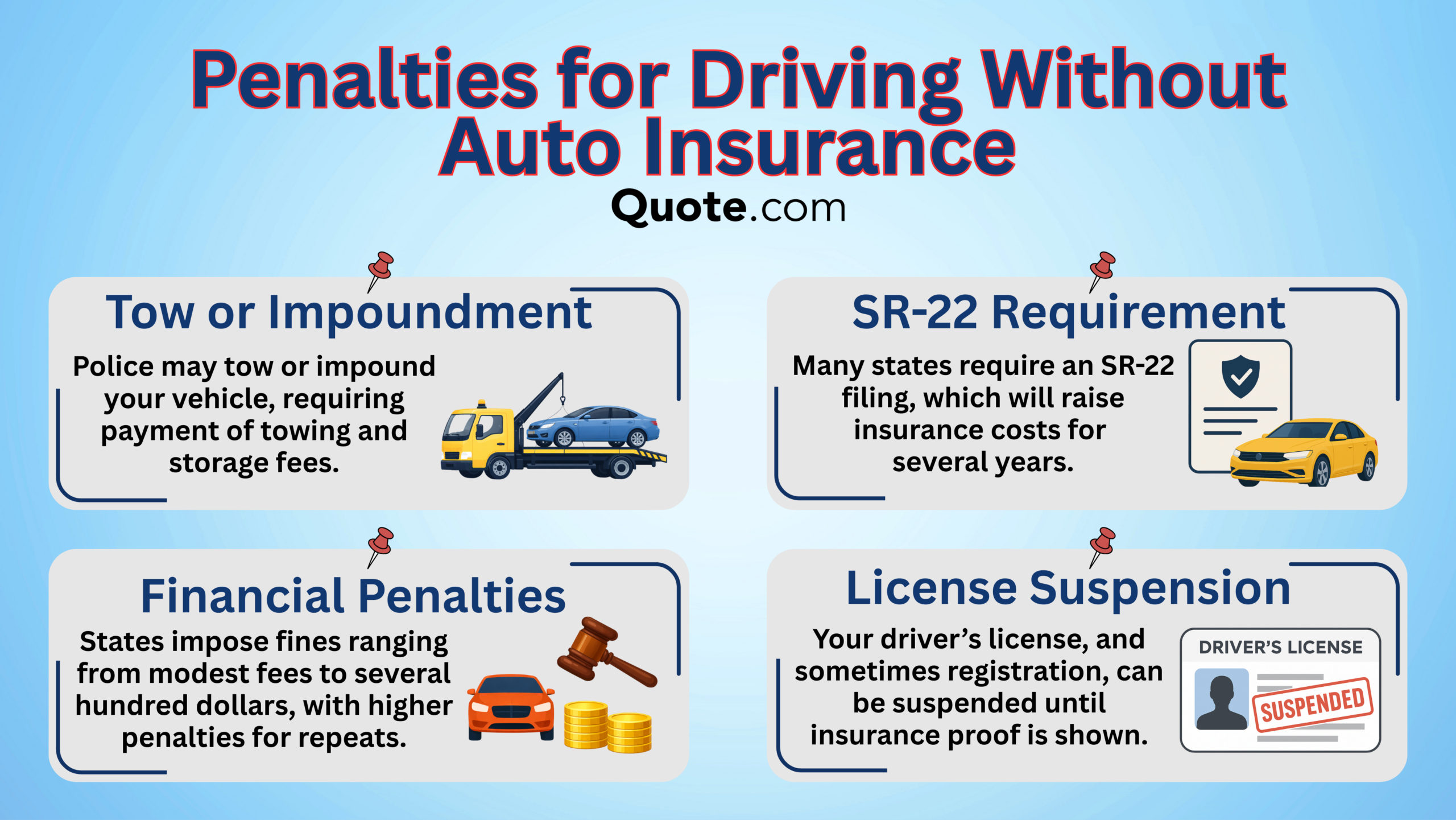
The vast majority of U.S. states follow a "Compulsory Liability" model. In these jurisdictions, proof of insurance is a prerequisite for vehicle registration and must be carried in the vehicle at all times. Failure to provide proof of insurance during a traffic stop or after an accident can result in immediate fines, vehicle impoundment, and license suspension.
| Feature | New Hampshire (The Exception) | Most Other States (The Rule) |
|---|---|---|
| Registration Requirement | No proof of insurance needed. | Proof of insurance is mandatory for registration. |
| Upfront Cost | $0 (if choosing to go uninsured). | Monthly or annual insurance premiums. |
| Legal Philosophy | Financial Responsibility (Post-accident proof). | Compulsory Liability (Pre-accident proof). |
| Standard Penalties | None for being uninsured, unless an accident occurs. | Fines, registration suspension, and impoundment. |
| Minimum Liability Limits | 25/50/25 (if policy is purchased). | Varies by state (often 25/50/20 or higher). |
| Uninsured Motorist Coverage | Mandatory if a policy is purchased. | Often mandatory; sometimes optional. |
The trade-off for New Hampshire drivers is the balance between immediate liquidity and long-term risk. In compulsory states, the collective risk is spread across the driving population, theoretically lowering the burden on the public when accidents occur. In New Hampshire, the risk is individualized.
The Hidden Risks of Driving Uninsured
While the ability to skip an insurance bill might seem like a financial win, the practical risks of driving uninsured in 2026 are higher than ever. Vehicle repair costs have surged due to advanced sensor technology, and medical costs continue to outpace general inflation.
Personal Asset Exposure
In an "at-fault" state like New Hampshire, the driver who causes the accident is responsible for all costs. If you are uninsured and cause a multi-vehicle pileup or an accident resulting in permanent disability for another person, the damages could easily exceed $500,000. Without an insurance company to defend you or pay the claim, your personal assets—including your home, bank accounts, and future wages—can be seized through legal judgments.
Lack of Legal Defense
A significant and often overlooked benefit of auto insurance is the duty to defend. When you have a policy, your insurance company provides an attorney and covers legal fees if you are sued following an accident. Uninsured drivers must pay for their own legal representation out of pocket, which can cost tens of thousands of dollars, regardless of whether they are eventually found at fault.
Out-of-State Travel
New Hampshire drivers must also consider what happens when they cross state lines. As soon as a New Hampshire vehicle enters Massachusetts, Vermont, Maine, or any other state, it is subject to the laws of that jurisdiction. While most states have reciprocity agreements that recognize New Hampshire's unique laws for residents visiting, being involved in an accident in a compulsory state while uninsured can lead to complex legal entanglements and may violate local statutes regarding "financial security" requirements for non-residents.
The Role of Uninsured Motorist Coverage for Others
Because New Hampshire allows drivers to be uninsured, it is arguably more important for insured New Hampshire drivers to carry high limits of Uninsured Motorist (UM) coverage. If an insured driver is hit by one of the many uninsured motorists in the state, their own UM coverage is what pays for their medical bills and property damage. In states with high rates of uninsured drivers, this coverage is the primary mechanism that protects responsible parties from the choices of the irresponsible.
FAQ
1. Is New Hampshire the only state where I don't need insurance?
Yes, as of 2026, New Hampshire is the only state that does not have a compulsory auto insurance law for the general driving population. Virginia was previously an option, but it repealed its uninsured motor vehicle fee system in 2024.
2. Can I get in trouble for not having insurance in New Hampshire?
You will not get a ticket simply for being uninsured. However, if you cause an accident and cannot pay for the damages, you face the suspension of your license and registration, legal lawsuits, and a future mandate to carry insurance (SR-22).
3. What is the minimum insurance I should have if I live in New Hampshire?
If you choose to buy insurance, the state minimum is 25/50/25 liability coverage. However, insurance experts generally recommend higher limits (such as 100/300/100) because the cost of medical care and modern vehicle repairs often exceeds the state minimums.
4. Does New Hampshire's law apply to out-of-state drivers?
No. If you are a resident of a state like Massachusetts or New York driving through New Hampshire, you must still comply with your home state’s insurance requirements. Similarly, New Hampshire drivers should ensure their choice to be uninsured doesn't create legal issues if they frequently commute into neighboring compulsory states.
5. Why did Virginia change its law to require insurance?
Virginia changed its law to reduce the number of uninsured motorists on the road. The previous $500 fee did not provide any protection to victims of accidents and led to higher premiums for insured drivers who had to pay more for "Uninsured Motorist" protection.
Final Recommendation
While New Hampshire remains the only state where you can legally drive without auto insurance, doing so is a high-stakes gamble. For the average driver, the "savings" of not paying a premium are dwarfed by the potential for lifelong financial ruin following a single mistake on the road. If you reside in New Hampshire, the most prudent action is to maintain at least the state-equivalent liability limits. If you choose to remain uninsured, you should maintain a highly liquid "emergency fund" or bond specifically for potential liability to ensure you do not lose your driving privileges—or your assets—after an accident.
Image Gallery